ENIG vs. ENEPIG: Choosing A Better PCB Plating for Your Project
The guide will compare ENIG with ENEPIG, helping you make an informed choice based on factors like cost, reliability and application demands, ensuring your next project achieves optimal performance.
Get Your PCB Quote!
Table of Contents
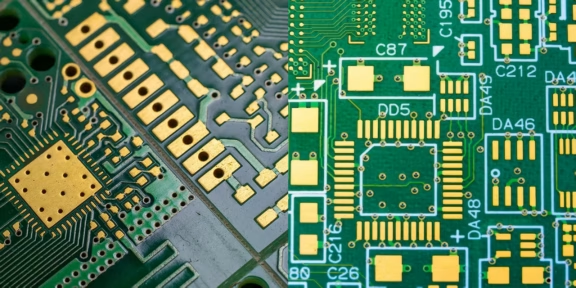
In the intricate world of Printed Circuit Board(PCB) manufacturing, every detail plays a crucial role in ensuring the final product’s reliability, performance, and longevity. Among these critical details, the choice of surface finish stands out. It’s the protective coating applied to copper traces, safeguarding them from environmental degradation and preparing them for soldering components. Two prominent players in this arena are Electroless Nickel Immersion Gold(ENIG) and Electroless Nickel Electroless Palladium Immersion Gold(ENEPIG).
The decision between ENIG and ENEPIG can significantly impact everything from signal integrity to long-term durability, especially for high-reliability applications found in rigid PCBs, flexible PCBs, and rigid-flex PCBs. While both finishes offer robust solutions superior to many alternatives like HASL or OSP, they each come with unique advantages, disadvantages, and ideal use cases. This comprehensive guide will delve deep into an ENIG ENEPIG comparison, helping you make an informed choice based on factors like cost, reliability, solderability, and specific application demands, ensuring your next project achieves optimal performance.
Key Takeaways
- ENIGprovides a flat, solderable surface suitable for fine pitch components, with good shelf life.
- The main concern with ENIG is the potential for “black pad”,which can lead to brittle solder joints.
- ENEPIGadds a palladium layer, virtually eliminating “black pad” risk and enhancing reliability.
- ENEPIG offers superior wire bonding capability and longer shelf life, making it ideal for high-end applications.
- Cost is a key differentiator: ENIG is moderate, while ENEPIG is higher due to palladium and process complexity.
- Choose based on your project’s reliability demands, budget, and specific application requirements like wire bonding or harsh environment operation.
1. What are PCB Surface Finishes and Why do They Matter?
A PCB surface finish is a protective metallic or organic coating applied to the exposed copper pads and traces on a circuit board. Its primary purpose is threefold: to prevent the underlying copper from oxidizing, to provide a solderable surface for component assembly, and to enhance the board’s overall performance and durability. Without a proper finish, copper exposed to air would quickly oxidize, making it impossible to form reliable solder joints.
The selection of the correct surface finish is a critical link in the electronics manufacturing process. It directly impacts solder joint reliability, long-term storage stability, resistance to environmental corrosion, and even signal transmission performance. Whether products are destined for demanding environments like aerospace and medical devices or for high-volume consumer electronics, the surface finish determines whether the PCB meets the required performance standards and extends its service life.
2. Understanding ENIG(Electroless Nickel Immersion Gold)
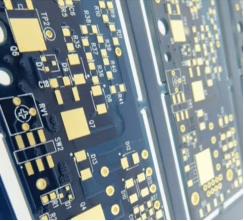
ENIG, or Electroless Nickel Immersion Gold, has been a popular and widely used surface finish in the PCB industry for decades. It’s a two-layer metallic coating that offers a good balance of cost and performance, making it a go-to choice for many applications.
2.1 The ENIG Process
The ENIG process involves two main steps:
1) Electroless Nickel Plating: A layer of nickel is deposited onto the copper pads through an autocatalytic chemical reaction. This nickel layer acts as a barrier, preventing copper diffusion and providing a robust base for soldering. Typical nickel thickness ranges from 3 to 6 micrometers(µm).
2) Immersion Gold Plating: A thin layer of immersion gold is then deposited over the nickel. This gold layer protects the underlying nickel from oxidation and ensures excellent electrical conductivity. The gold layer is very thin, usually between 0.05 to 0.15 µm. The immersion process means the gold displaces a small amount of nickel, creating a chemical bond.
2.2 Advantages of ENIG
- Excellent Solderability:The thin, flat gold layer provides an ideal surface for soldering , allowing for strong, reliable solder joints. This is particularly beneficial for fine pitch components and BGA(Ball Grid Array) packages.
- Good Shelf Life:ENIG-finished PCBs can be stored for an extended period(typically 6-12 months) without significant degradation, thanks to the protective gold layer.
- Flat Surface:The electroless plating process creates a very uniform and flat surface, which is crucial for mounting fine pitch components and ensuring consistent electrical performance. This contributes to better signal integrity.
- Moderate Cost:While more expensive than finishes like OSP or HASL, ENIG offers a cost-effective solution for many high-performance requirements.
- Good for Wire Bonding:While not as superior as ENEPIG, ENIG can be used for aluminum wire bonding in certain applications, though with limitations.
2.3 Disadvantages of ENIG
- “Black Pad” Risk:One of the most significant concerns with ENIG is the potential for “black pad”(also known as “black nickel”). This phenomenon occurs when excessive corrosion of the nickel layer happens during the immersion gold deposition, leading to a weak and brittle solder joint. This corrosion creates a rough, oxidized nickel surface that appears dark under magnification, hence the name.
- Higher Cost than Basic Finishes:Compared to more economical options, ENIG incurs a higher material and process cost.
- Magnetic Nickel:The nickel layer in ENIG is ferromagnetic, which can sometimes impact the performance of high-frequency or RF circuits.
- Process Complexity:While less complex than ENEPIG, ENIG requires careful control of chemical baths to prevent issues like black pad.
2.4 Typical ENIG Applications
ENIG is widely used across various sectors due to its balance of performance and cost. It’s particularly favored for:
- High-frequency and RF applications(with careful design considerations for the nickel layer).
- Fine pitch technology and BGA assembly.
- HighDensity Interconnect(HDI) PCBs.
- General-purpose consumer electronics, telecommunications, and automotive electronics where reliability is key but extreme environments are not typically encountered.
3. Understanding ENEPIG (Electroless Nickel Electroless Palladium Immersion Gold)
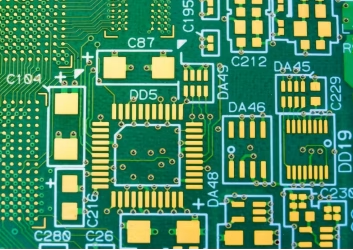
ENEPIG, or Electroless Nickel Electroless Palladium Immersion Gold, is often referred to as the “universal finish” due to its exceptional performance characteristics. It builds upon the ENIG structure by adding an intermediate palladium layer, significantly enhancing its capabilities.
3.1 The ENEPIG Process
The ENEPIG process is a three-layer metallic coating:
1) Electroless Nickel Plating: Similar to ENIG, a nickel layer is first deposited onto the copper traces, acting as a barrier and providing a solderable base.(Typical thickness: 3-6µm).
2) Electroless Palladium Plating: This is the key distinguishing layer. An electroless palladium layer is deposited over the nickel. Palladium acts as an excellent barrier against nickel corrosion and prevents the “black pad” phenomenon more effectively than ENIG. It also offers a stable surface for wire bonding.(Typical thickness: 0.1-0.2µm).
3) Immersion Gold Plating: A thin layer of immersion gold is applied over the palladium, protecting the palladium from oxidation and preserving its solderability and wire bondability.(Typical thickness: 0.05-0.15µm).
The presence of the palladium layer is crucial. It acts as a robust diffusion barrier between the nickel and the immersion gold, ensuring the integrity of the nickel surface.
3.2 Advantages of ENEPIG
- Superior “Black Pad” Prevention:The palladium layer effectively protects the nickel from corrosive attack during gold deposition, virtually eliminating the risk of black pad and ensuring robust solder joints. This dramatically increases reliability.
- Excellent Wire Bonding:ENEPIG provides an outstanding surface for both gold and aluminum wire bonding, making it ideal for bare die packaging and complex semiconductor integration.
- High Reliability:The multi-layer structure offers enhanced protection against corrosion and oxidation, leading to a very stable and long-lasting finish. This makes ENEPIG an excellent choice for applications requiring exceptional long-term reliability.
- Outstanding Solderability:Like ENIG, ENEPIG offers excellent solderability with a flat, uniform surface, crucial for high-density and fine pitch components.
- Long Shelf Life:ENEPIG boasts an even longer shelf life than ENIG, often exceeding 12 months, due to the superior barrier properties of the palladium layer.
- Good Signal Integrity:The thin, uniform layers contribute to excellent signal integrity, especially in high-frequency applications.
3.3 Disadvantages of ENEPIG
- Highest Cost:The primary drawback of ENE PIG is its higher cost compared to ENIG and other surface finishes, primarily due to the addition of palladium, which is a precious metal, and the more complex processing steps.
- Complex Process:The additional palladium plating step makes the ENEPIG process more intricate and requires tighter control over chemical parameters.
3.4 Typical ENEPIG Applications
Due to its unmatched performance and reliability, ENEPIG is the preferred choice for the most demanding and critical applications:
- Aerospace and Defense:Where failure is not an option and long-term reliability in harsh environments is paramount.
- Medical Devices:For critical medical electronics that require extreme durability and consistent performance.
- High-End Consumer Electronics:Devices that demand superior performance and longevity.
- Advanced Semiconductor Packaging:Ideal for bare die applications requiring extensive wire bonding.
- High-Frequency and RF Applications:The stable, uniform layers contribute to excellent signal integrity.
- Automotive Electronics:Especially for safety-critical systems.
4. ENIG vs. ENEPIG: A Side-by-Side Comparison
To summarize the key differences, here’s a detailed comparison table:
| Feature | ENIG(Electroless Nickel Immersion Gold) | ENEPIG(Electrol ess Nickel Electroless Palladium Immersion Gold) |
| Composition | Nickel(3-6µm) + Immersion Gold(0.05-0.15µm) | Nickel(3-6µm) + Electroless Palladium(0.1-0.2µm) + Immersion Gold(0.05-0.15µm ) |
| Cost | Moderate | High(due to palladium and more complex process) |
| Reliability | Good, but susceptible to “black pad” | Excellent, virtually eliminates “black pad” risk |
| Solderability | Excellent | Excellent |
| Shelf Life | Good (6-12 months) | Excellent(12+ months) |
| Wire Bonding | Fair to Good(Aluminum wire bonding possible, but challenging) | Excellent(Suitable for both Gold and Aluminum wire bonding) |
| “Black Pad” Risk | Moderate(significant concern in high-reliability applications) | Very Low(palladium acts as a robust barrier) |
| Signal Integrity | Good, but ferromagnetic nickel can be a factor for RF | Excellent(palladium’s properties enhance high-frequency performance) |
| Process Complexity | Moderate | High |
| Typical Applications | Consumer electronics, telecommunications, automotive(general), BGA, fine pitch | Aerospace, medical devices, defense, high-end automotive, advanced semiconductor packaging, RF, demanding environments |
5. Choosing the Right PCB Surface Finish: When to Use Which?
The decision between ENIG and ENEPIG ultimately boils down to balancing performance requirements, reliability demands, and budget constraints for your specific project. There isn’t a universally “better” finish; rather, there’s an optimal choice for each application.
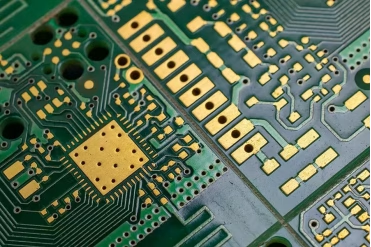
1) Choose ENIG when:
- You need good solderability and a flat surface for fine pitch or BGA components.
- Your budget is a significant concern, and you’re looking for a cost-effective solution that still offers high performance compared to basic finishes.
- The risk of “black pad” is deemed acceptable for your application, or design mitigations are in place.
- Wire bonding is not a primary requirement, or only limited aluminum wire bonding is needed.
- Your application does not involve extreme temperatures, vibrations, or other harsh environmental conditions that demand the highest levels of long-term reliability.
2) Choose ENEPIG when:
- Your application demands the highest levels of reliability and longevity, such as in aerospace, medical devices, or defense systems.
- Wire bonding(especially gold wire bonding) is a critical component of your assembly process, requiring superior bond strength and consistency.
- The absolute prevention of “black pad” is non-negotiable, ensuring robust solder joints for critical components.
- Your design incorporates fine pitch, high-density components, or bare die that require exceptionally flat and reliable surfaces.
- The PCB will operate in harsh environments or requires superior resistance to corrosion and oxidation over an extended period.
- You require excellent signal integrity for high-frequency or RF applications where palladium’s non-magnetic properties are beneficial.
- Cost is a secondary concern compared to achieving ultimate performance and durability.
The PCB industry is constantly evolving, with increasing demands for miniaturization, higher frequencies, and enhanced performance. This trend often pushes designers towards ENEPIG for its comprehensive advantages, especially as the cost difference becomes more manageable with advancements in plating technologies.
6. ENIG and ENEPIG FAQs
Question 1: What is “black pad” and why is it a concern with ENIG?
“Black pad” refers to the excessive corrosion of the electroless nickel layer during the immersion gold plating process in ENIG finishes. This corrosion leads to a brittle, non-solderable surface, resulting in weak and unreliable solder joints. It’s a significant concern because it’s difficult to detect visually before assembly and can cause catastrophic field failures, impacting the overall reliability and performance of electronic devices. ENEPIG largely mitigates this risk through its palladium layer.
Question 2: Which surface finish is better for wire bonding, ENIG or ENEPIG?
ENEPIG is significantly superior for wire bonding, especially gold wire bonding. The palladium layer in ENEPIG provides an excellent and stable surface for forming strong, reliable metallurgical bonds. While ENIG can sometimes be used for aluminum wire bonding, it presents more challenges and is not as robust or consistent as ENEPIG for demanding wire bonding applications.
Question 3: Is ENEPIG always the better choice, given its advantages?
Not necessarily. While ENEPIG offers superior reliability and performance, its higher cost and more complex processing can be prohibitive for projects where ENIG’s capabilities are sufficient. For many standard consumer electronics, telecommunications, or automotive applications where extreme reliability isn’t the absolute top priority, ENIG provides an excellent, cost-effective balance of performance and durability. The “better” choice always depends on the specific requirements, budget, and environmental conditions of your application.
7. Summary
The selection of a PCB surface finish is a critical decision that impacts the entire lifecycle of an electronic product. Both ENIG and ENEPIG stand as robust and reliable options, far surpassing many traditional finishes. ENIG offers a balance of excellent solderability, a flat surface for fine pitch components, and good shelf life at a moderate cost, making it suitable for a wide array of applications. However, it carries the inherent risk of “black pad”, which can compromise solder joint reliability.
ENEPIG, often called the “universal finish”, addresses ENIG’s primary drawback by incorporating an electroless palladium layer. This palladium acts as a robust barrier, virtually eliminating the “black pad” risk and offering unparalleled reliability, superior wire bonding capability, and extended shelf life. Its advantages make it the preferred choice for the most demanding applications in aerospace, medical devices , and advanced electronics where performance and longevity are paramount, despite its higher cost and process complexity. Ultimately, an informed decision requires a thorough understanding of your project’s specific needs, balancing performance requirements with budget constraints.
Table of Contents
Get Your PCB Quote!