
What is a High-Tg PCB
Glass transition temperature (Tg) is the temperature at which a substrate transitions from a glassy, rigid state to a rubbery state.High Tg boards are specifically designed to operate at high temperatures.A PCB is considered a high Tg board if its Tg is higher than 180 °C.
PCBAndAssembly manufactures high Tg PCBs using certified fabrication with high-temperature PCB materials such as IT180, S1000-2M, and Rogers 4350B. These materials have a Tg value exceeding 170°C and a decomposition temperature (Td) over 300°C, allowing them to withstand high temperatures during lead-free soldering and reflow processes.
Our substrate options include FR4, high Tg FR4, PTFE, aluminum, and ceramics for low CTE and high-temperature stability. We provide expert guidance on glass transition temperature management and design for high temperature durability, delivering precision-built high Tg PCBs ready for lead-free soldering and extreme thermal cycling.
Our process supports PCB fabrication with up to 64 layers, 1.8 mil / 1.8 mil minimum trace/space, and 0.1mm mechanical drill holes. Every printed circuit board undergoes IPC Class 2/3 compliant manufacturing with AOI, X-ray, and impedance testing to ensure dimensional accuracy, electrical continuity, and mechanical strength.
These PCBs maintain low thermal expansion (CTE-z ≤ 45 ppm/°C) and long T260/T288 delamination resistance, making them ideal for high-temperature applications in automotive, industrial, and aerospace systems.
PCBAndAssembly offers a wide selection of high-temperature PCB products manufacturing services either with FR-4 or other high-quality heat- and temperature-resistant Tg materials. We are able to perform high-temperature PCB fabrication for automotive, industry and high-temperature electronics applications. We can manufacture High-Tg PCBs with a Tg value of up to 180°C. Following table lists some of our commonly used materials for High-Tg PCBs production.
| Material | TG (DSC, °C) |
Td (Wt, °C) |
CTE-z (ppm/°C) |
Td260 (min) |
Td288 (min) |
| S1141 (FR4) | 175 | 300 | 55 | 8 | / |
| S1000-2M (FR4) | 180 | 345 | 45 | 60 | 20 |
| IT180 | 180 | 345 | 45 | 60 | 20 |
| Rogers 4350B | 280 | 390 | 50 | / | / |
Regardless of the scope or complexity of your PCB application, we have the technical expertise to develop customized PC boards that meets your specific demands. Check our capabilities in here:
| Feature | Capability |
| Quality Grade | Standard IPC 2 |
| Number of Layers | 2 – 40layers |
| Order Quantity | 1pc – 10000+pcs |
| Build Time | 2days – 5weeks |
| Material | S1141 (FR4), S1000-2M (FR4), IT180, Rogers 4350B |
| Board Size | Min 6mm x 6mm | Max 500mm x 900mm |
| Board Thickness | 0.4mm – 6.5mm |
| Copper Weight (Finished) | 0.5oz – 2.0oz |
| Min Tracing/Spacing | 3mil/3mil |
| Solder Mask Sides | As per the file |
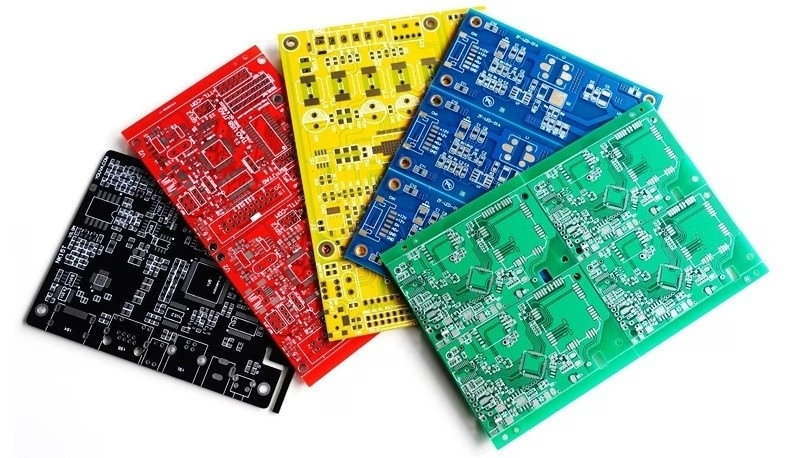
| Solder Mask Color | Green, White, Blue, Black, Red, Yellow |
| Silkscreen Sides | As per the file |
| Silkscreen Color | White, Black, Yellow |
| Surface Finish | HASL – Hot Air Solder Leveling Lead Free HASL – RoHS ENIG – Electroless Nickle/Immersion Gold – RoHS Immersion Silver – RoHS Immersion Tin – RoHS OSP – Organic Solderability Preservatives – RoHS |
| Min Annular Ring | 4mil |
| Min Drilling Hole Diameter | 6mil |
| Other Techniques | Gold fingers Blind/Buried Vias Countersink Holes |
What Materials Are Used in High Tg PCBs?
High temperature PCB materials include advanced FR-4 or specialized laminates with a Tg value above 170°C, a decomposition temperature (Td) greater than 300°C, and a low CTE-z to maintain structural and electrical integrity under high-temperature applications.
The features of high Tg PCBs stem from the thermal and mechanical behavior of their material systems under elevated temperatures. These properties directly influence the board’s performance during PCB fabrication, assembly, and prolonged field operation across demanding environments.
High Resistance to Thermal Stress
Because of their elevated Tg value and tightly controlled thermal expansion, high Tg PCBs resist warping, resin recession, and interlayer delamination under soldering or continuous load.
This makes them ideal for high-temperature applications involving frequent power cycling or sustained heat exposure, such as automotive electronics and industrial drives.
Thermal Shock and Heat Endurance
These boards are designed to survive rapid thermal transitions without layer separation or mechanical distortion.
Compared to standard PCBs, they offer higher thermal shock resistance, retaining integrity through soldering processes, HALT/HASS conditions, and high-power operation.
Excellent PTH Reliability
High Tg PCBs offer superior plated through hole (PTH) performance due to their low CTE-z (45–55 ppm/°C). Reduced thermal expansion prevents cracking in copper barrels during reflow and wave soldering.
The high-temperature PCB material resists softening, warping, or delamination around vias, making these boards suitable for complex, multilayer PCB assembly processes.
Improved Mechanical Strength
Built with high Tg materials, these boards exhibit higher rigidity and long-term dimensional stability.
Their glass transition temperature remains stable during repeated thermal cycling, which reduces fatigue and structural degradation.
This results in printed circuit boards that maintain alignment and bonding in environments where standard FR-4 would fail.
Low Thermal Expansion and Dimensional Stability
The base materials used in high Tg PCBs expand significantly more slowly than conventional FR4 material.
This minimizes misalignment in surface-mounted components, reduces strain on solder joints, and maintains registration across all layers. The result is tighter tolerance control and longer in-field lifespan.
Delamination Resistance and Long-Term Durability
With T260/T288 delamination thresholds of up to 60 minutes, high Tg printed circuit boards offer exceptional bonding performance under prolonged thermal load.
This makes them a strong choice for demanding environments where temperature resistance, mechanical shock, and humidity must all be managed simultaneously.
What Are The Technical Characteristics
of High Tg PCBs?
High Tg PCBs are engineered to perform reliably in environments where standard PCBs would fail due to thermal stress. Their enhanced material properties allow them to maintain structural and electrical integrity at elevated temperatures, making them ideal for high-temperature applications.
| Characteristic | Detail |
| Tg Value | >170°C (glass transition temperature). |
| Td (Decomposition Temp) | >300°C (temperature at 5% weight loss) |
| Material Type | High Tg FR-4, IT180, S1000-2M, Rogers 4350B. |
| Thermal Stability | Withstands reflow soldering and ambient temps >130°C. |
| Time to Delamination (T260/T288) | Up to 60 minutes under thermal load at 260°C or 288°C. |
| Mechanical Strength | High rigidity with reduced deformation under thermal stress. |
| Chemical Resistance | Improved resistance to moisture and corrosive environments. |
| CTE-z (Z-Axis Expansion) | 45 to 55 ppm/°C lower expansion rate minimizes via cracking and delamination. |
How Is Heat Dissipated in High Tg PCBs?
Heat in high Tg PCBs is dissipated through conduction, convection, and radiation, with each integrated into the board’s design based on the thermal profile of the application. These methods work together to protect the board during high-temperature applications, even when using high-quality heat- and temperature-resistant Tg materials.
When Do You Need a High-Temperature PCB?
Not all electronic assemblies require elevated thermal performance, but in designs where consistent exposure to heat is expected, the limitations of standard PCBs quickly become a risk factor.
