
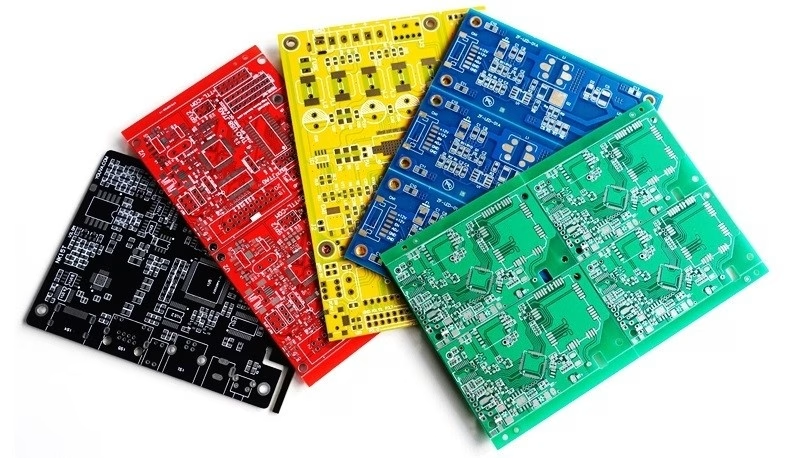
Ceramic PCB

Contact Us

Contact us for all your PCB, PCBA, and custom service needs!

pcb

Ceramic PCB China for High Thermal Applications

At PCBAndAssembly, we manufacture ceramic PCB China solutions for the USA and worldwide, serving high power electronics, thermal management and demanding applications across the aerospace, automotive, and medical industries.

Each ceramic PCB from our China facility is engineered with premium alumina and aluminum nitride materials, fabricated to IPC Class 3 standards, and supported with complete PCB assembly services for global customers.

Turnaround starts at 2 weeks for expedited ceramic PCB China prototypes, with standard production in 4 weeks and reliable shipping to the USA and international markets.

  • Alumina, AlN substrates with thermal conductivity up to 350 W/mK.
  • Certified to ISO 9001, IATF 16949, UL, REACH, and RoHS.
  • Ceramic PCB manufacturing using thick film and thin film processes.

What is a Ceramic PCB?

A ceramic PCB is a high-performance circuit board made from advanced ceramic materials like alumina or aluminum nitride. These materials provide excellent thermal conductivity, efficiently dissipating heat from hotspots and protecting sensitive electronic components from damage.
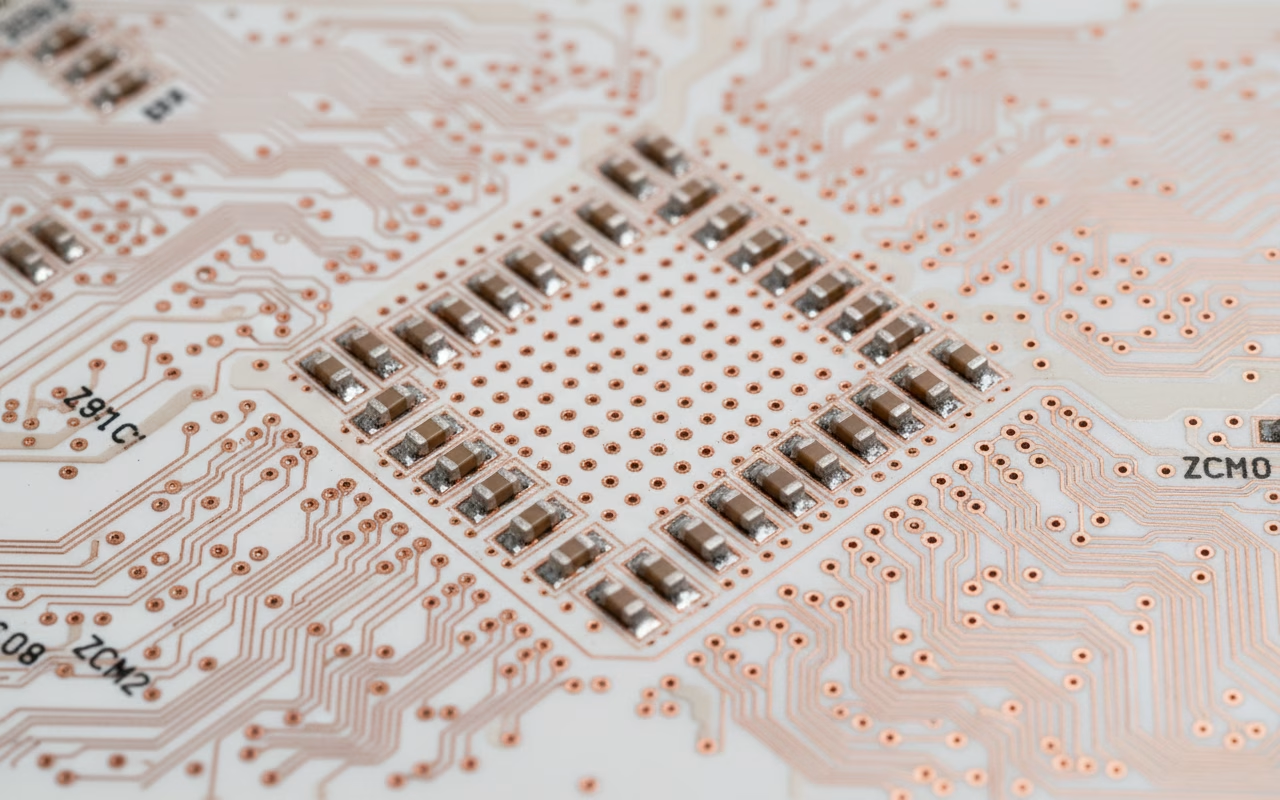
Ceramic PCB

Why is Ceramic PCB so Popular?

High Thermal Expansion

The first reason why ceramic boards are so popular in the electronics sector is their excellent thermal coefficient of expansion.

It is good to note that the ceramic base heat transmission almost matches silicon and can act as a connection material. Besides, you can use it as an isolator.

For applications requiring exceptional thermal performance, such as high-temperature PCBs, ceramic boards are indispensable due to their adaptability to adverse conditions.

Stability

The application of ceramic brings a stable dielectric capacity, and you can modify the balance into a partial radiofrequency loss to increase your device’s power.

Still, despite the surface roughness, ceramic materials come with an inherent resistance against chemical erosion. Ceramic’s chemical resistance can change to resistance against liquids and moisture.

Versatility

Integrated metal core boards with high thermal expansion can be used for several applications. Using the sintering technique, the metal core can still be turned into a reliable conductor. Therefore, ceramic PCBs’ high processing temperatures make them beneficial.

Durability

The ceramic board fabrication process creates durability through unique properties, such as toughness. That prevents your PCB from wear and tear.

You can be confident that you will not change your PCB soon because of its slow aging capacity. Also, the high thermal resistance of ceramic PCBs makes it assume a decelerated decomposition process.

Adaptability

Lastly, metal cores can serve as inflexible carriers that offer mechanical stiffness. This property makes it easier to use ceramic PCBs in any state of matter because of the high resistance to corrosion and normal wear and tear.

Our Ceramic PCB Manufacturing Capabilities

PCBAndAssembly supports single to 8-layer ceramic circuit board configurations with metallization, via drilling, surface finish application and complete PCB assembly services. Our fabrication capabilities include material selection, precision processing, comprehensive testing and volume production from prototype to 10,000+ units.

PCBAndAssembly manufactures ceramic PCBs using aluminum oxide (Al₂O₃) with thermal conductivity from 24 to 30 W/mK (14 to 17 BTU/hr·ft·°F), aluminum nitride (AlN) at 170 to 230 W/mK (98 to 133 BTU/hr·ft·°F), and silicon carbide substrates for extreme performance applications.

Our ceramic materials feature breakdown voltage specifications from 10 to 50 kV/mm, dielectric loss factors below 0.0002, and a low coefficient of thermal expansion ranging from 4 to 7 ppm/°C to minimize stress during temperature cycling.

Base material selection includes CTE matching calculations and cost performance analysis to optimize thermal properties for specific high power electronic device requirements.

Thick film metallization using screen printing techniques with conductor paste deposition achieving line widths down to 4 mil (0.1mm) for ceramic substrate circuit patterning and component attachment areas.

Thin film processing through sputtering and electroplating creates copper traces with thicknesses ranging from 0.5 to 5 oz/ft² (17 to 170 μm) on ceramic base materials, enabling fine-pitch routing for high-frequency applications.

Electroless plating and electroplating processes deposit copper, nickel, and gold layers with a thickness control to ±10% tolerance, ensuring reliable electrical connections and surface finish quality for ceramic PCB assembly operations.

Thermal via drilling using laser cut precision techniques with diameters from 0.1 to 0.3mm (4 to 12 mil) for efficient heat dissipation pathways in high-power ceramic PCBs.

Heat sink attachment processing includes mechanical mounting and thermal interface material application for electronic devices requiring enhanced thermal conductivity performance up to operating temperatures of 300°F (150°C).

Thermal pathway optimization through copper filling and plating ensures consistent thermal properties across ceramic substrate PCB areas, with thermal resistance validation testing conducted in accordance with ASTM standards for high power electronic applications.

We support single sided to 64-layer ceramic circuit configurations with sequential lamination and via structures, including laser cut microvias, blind and buried vias and via-in-pad designs.

Our fabrication process achieves a wall metallization thickness of ≥25 μm (1 mil), with aspect ratios of up to 8:1, for high-frequency and RF applications requiring controlled impedance.

All via structures in hybrid ceramic PCBs are thermally stress-tested per IPC-TM-650 standards to verify reliability under thermal expansion forces.

Surface finish treatments include thick film ceramic PCB gold metallization (2 to 5 μm), thin film ceramic PCB sputtered finishes, and solderable coatings matched to final assembly requirements.

The finish selection process considers reflow temperatures of up to 500°F (260°C), environmental exposure constraints, and electrical insulation requirements for high-power electronic applications.

Quality control protocols verify surface finish thickness, adhesion strength, and solderability following IPC standards for ceramic PCB supplier qualification.

Each ceramic PCB undergoes optical resolution verification (AOI, 5 μm resolution), X-ray cross sectioning of vias and internal layers, and thermal conductivity measurement for performance validation.

Advanced ceramic testing includes thermal cycling from -85 to 300°F (-65 to 150°C), dielectric breakdown testing, and dimensional stability verification following aerospace qualification standards.

Material selection validation covers CTE measurement, thermal properties characterization, and electrical insulation testing to ensure high quality ceramic PCBs meet application requirements.

Production supports rapid prototyping (as short as 2 weeks for standard ceramic substrate builds) and batch runs of up to 10,000 units, with full quality control and traceability.

Each ceramic PCB manufacturing job includes complete documentation (material lot tracking, process records, test logs) and is managed under ISO 9001:2015 standards.

Statistical process control (SPC) ensures consistency in thermal conductivity via registration and circuit accuracy across all ceramic PCBs production volumes.

What Types of Ceramic Substrate PCB Materials Are Available?

Substrates you’ll see often in ceramic PCBs include Al₂O₃, AlN, BeO, and SiC (aluminum oxide, aluminum nitride, beryllium oxide, and silicon carbide). These ceramic materials provide different thermal conductivity levels and electrical insulation properties for high power electronic devices requiring specialized thermal performance.

Material Properties Performance Uses
Aluminum Oxide (Al₂O₃) Dielectric constant: 9.4, excellent mechanical strength and chemical resistance. Thermal conductivity: 24 to 30 W/mK (14 to 17 BTU/hr·ft·°F), the most cost effective ceramic option. Industrial applications, automotive sensors, and LED lighting.
Aluminum Nitride (AlN) Low coefficient of thermal expansion matching silicon, superior electrical insulation. Thermal conductivity: 170 to 230 W/mK (98 to 133 BTU/hr·ft·°F), premium thermal performance. High-power LEDs, 5G infrastructure, and power modules.
Silicon Carbide (SiC) Diamond-like hardness, chemical inertness, and dielectric properties. Thermal conductivity: 120 to 200 W/mK (69 to 116 BTU/hr·ft·°F), high temperature stability to 400°F (200°C). Aerospace, industrial, high temperature applications.
Beryllium Oxide (BeO) Dielectric constant: 6.7, requires special handling protocols. Thermal conductivity: 220 to 350 W/mK (127 to 202 BTU/hr·ft·°F), the highest thermal performance available. Microwave devices, high frequency applications.

What Ceramic PCB Manufacturing Types Are Available?

Ceramic PCB manufacturers can make single layer, multilayer, thick film ceramic PCB, thin film ceramic PCB and hybrid ceramic PCB configurations.

These ceramic PCB manufacturing types accommodate different circuit complexity levels, from basic single-layer designs to complex 8-layer stackups for high frequency and high power applications.

Manufacturing Type Layer Count Process Description Real-World Applications
Single Layer Ceramic PCBs 1 layer Basic circuit designs with simple routing. Simple electronic devices, basic applications.
Multilayer Ceramic PCBs 2 to 8 layers Complex circuits with multiple routing layers. Advanced electronic devices, high power systems.
Thick Film Ceramic PCB Variable Screen-printed conductors, robust construction. Harsh environments, industrial applications.
Thin Film Ceramic PCB Variable Precision sputtered traces, fine-pitch capability. High frequency applications, RF devices
Hybrid Ceramic PCBs Variable Ceramic substrate areas with FR4 sections for cost optimization. Mixed-signal applications, cost sensitive designs.

When Should You Use Ceramic PCBs?

Find a ceramic PCB manufacturer when your operating temperatures exceed 300°F (150°C), power density surpasses 5 W/cm², or frequencies reach above 1 GHz. Ceramic substrates become necessary when standard FR4 materials cannot meet thermal, electrical, or mechanical requirements.

Operating Temperature Exceeds 300°F (150°C)

Ceramic PCBs can handle continuous operating temperatures from 660 to 840°F (350 to 450°C) depending on the ceramic material. Alumina substrates operate to 750°F (400°C), aluminum nitride handles up to 840°F (450°C), and silicon carbide ceramic substrates withstand temperatures above 1100°F (600°C) for extreme applications.

Our dielectric thickness uniformity tolerance is typically ±10% for standard ceramic substrates. Thin film ceramic PCB processing achieves ±5% tolerance, while thick film applications maintain ±15%. Contact us for specific tolerance requirements for your ceramic PCB application.

Our RCA process includes failure mode analysis, microsection examination, and electrical insulation testing to identify ceramic PCB defects. We use X-ray inspection, thermal cycling tests, and dimensional verification to determine failure causes. Quality control documentation tracks material selection, manufacturing process parameters, and test results to prevent recurring issues in ceramic substrate production.

We use thermal annealing processes and controlled cooling cycles during ceramic PCB manufacturing to minimize internal stress. Ceramic substrate processing includes controlled temperature ramping and cooling to reduce stress between ceramic layers and metallization. Material selection considers thermal conductivity and low coefficient of thermal expansion properties to minimize stress in complex circuit fabrication.

Contact Us

Contact us for all your PCB, PCBA, and custom service needs!

pcb
