Flex Cut PCB vs. Non-Flex Cut PCB: A Critical Comparison
Understanding the differences, benefits, and applications of Flex Cut PCB and Non-Flex Cut PCB is crucial for engineers and designers aiming to optimize the performance and reliability of the electronic devices.
Get Your PCB Quote!
Table of Contents
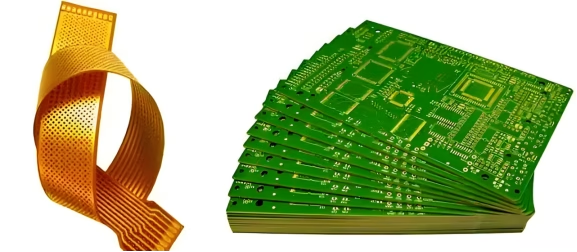
In the rapidly evolving world of electronics, Printed Circuit Boards (PCBs) are the unseen backbone of virtually every device, from smartphones to medical equipment. As technology advances, so too does the demand for more compact, versatile, and high-performance electronic solutions. This drive has led to the development and widespread adoption of various PCB types, notably the distinction between what we can broadly categorize as Flex Cut PCBs and Non-Flex Cut PCBs. While “Flex Cut” often specifically refers to flexible circuits or designs that integrate flexibility, this article will primarily use it interchangeably with “Flexible PCBs” for clarity, comparing them directly against traditional “Rigid PCBs”. Understanding the fundamental differences, benefits, and applications of these two distinct technologies is crucial for engineers and designers aiming to optimize their electronic products for performance, reliability, and form factor.
1. Understanding Flex Cut PCBs (Flexible Circuit Boards)
Flex Cut PCBs, commonly known as flexible printed circuit boards or FPCs, represent a significant advancement in electronic packaging. Unlike their rigid counterparts, these circuits are built on flexible substrates, typically thin sheets of polyimide(PI) or polyester(PET), allowing them to bend, twist, and conform to complex shapes. This inherent flexibility offers unparalleled design freedom and enables electronic components to be integrated into previously inaccessible or space-constrained areas.
1.1 Structure and Materials
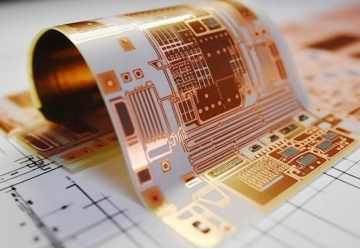
Flexible PCBs consist of conductive traces(usually copper) etched onto a dielectric film, protected by a coverlay or soldermask. The choice of substrate material is critical, with polyimide being the most common due to its excellent thermal stability, chemical resistance, and dielectric properties, making it suitable for demanding environments. Some designs also incorporate a “flex cut technology” where specific areas of a traditionally rigid board are thinned or designed to allow limited flexibility, often seen in rigid-flex PCB constructions where rigid sections are interconnected by flexible segments.
1.2 Benefits of Flex Cut PCBs
- Space and Weight Reduction:Their ability to bend and fold dramatically reduces the need for bulky connectors and cables, freeing up internal space and lowering the overall weight of a device. This is a significant advantage in compact and portable electronics.
- Enhanced Reliability:By replacing discrete wiring and connectors, flexible PCBs eliminate potential points of failure, improving the system’s reliability and durability, especially in applications subjected to vibration or movement.
- Dynamic Flexing Capability:Many flexible circuits are designed for continuous bending and flexing, making them ideal for applications requiring movement, such as robotic arms, camera gimbals, or wearable devices.
- Improved Heat Dissipation:The thin profile of some flexible PCBs can allow for more efficient heat transfer in certain designs, particularly when thermal management materials are integrated.
- Simplified Assembly:Flexible circuits can consolidate multiple rigid boards and their interconnects into a single, pre-tested flexible assembly, streamlining the manufacturing process and reducing manual labor.
- 3D Interconnection:They enable true three-dimensional electronic packaging, allowing circuits to wrap around objects or fit into irregular enclosures.
2. The Foundation: Non-Flex Cut PCBs (Rigid Circuit Boards)
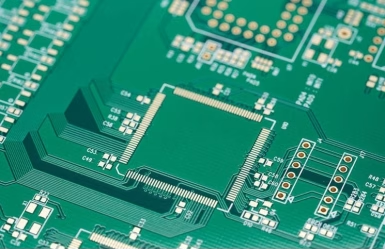
Non-Flex Cut PCBs, more commonly known as rigid printed circuit boards, are the traditional workhorses of the electronics industry. These boards are constructed from a solid, inflexible substrate material, most frequently FR-4(Flame Retardant level 4 fiberglass epoxy laminate). Their inherent rigidity provides a stable platform for mounting and interconnecting electronic components, ensuring structural integrity and robust performance.
2.1 Structure and Materials
Rigid PCBs typically feature copper traces laminated onto FR-4 material, with soldermask and silkscreen layers for protection and component identification. The multi-layer rigid PCB, with dozens of copper layers separated by dielectric materials, is common for high-density and high-performance applications. The FR-4 material offers excellent electrical insulation, mechanical strength, and thermal stability, making it a reliable choice for a vast array of electronic devices.
2.2 Benefits of Non-Flex Cut PCBs
- High Component Density:Rigid boards can accommodate a very high density of components on both sides, and their multi-layer capability allows for complex routing in a compact footprint.
- Cost-Effectiveness:For high-volume production, rigid PCBs are generally more economical to manufacture than flexible or rigid-flex solutions, especially for simpler designs.
- Durability and Robustness:The sturdy nature of rigid PCBs provides excellent mechanical support for components, making them resistant to physical stress and environmental factors.
- Thermal Stability:FR-4 material offers good thermal management properties, making rigid PCBs suitable for applications involving significant heat generation.
- Excellent Signal Integrity:The stable dielectric properties of FR-4 contribute to superior signal integrity, which is crucial for high-speed digital and RF applications.
- Ease of Assembly and Repair:Standardized manufacturing processes and established soldering techniques make rigid PCBs relatively straightforward to assemble, test, and repair.
3. Key Differences: Flex Cut PCBs vs. Non-Flex Cut PCBs
The choice between Flex Cut (Flexible) and Non-Flex Cut (Rigid) PCBs hinges on a critical understanding of their divergent characteristics. While both serve to electrically connect components, their physical properties and suitable applications vary dramatically. The table below highlights the primary distinctions:
| Feature | Flex Cut PCBs (Flexible PCBs) | Non-Flex Cut PCBs (Rigid PCBs) |
| Substrate Material | Poly imide (PI), Polyester (PET) | FR-4 (Fiberglass Epoxy Laminate) |
| Physical Form | Flexible, bendable, conformable | Rigid, inflexible |
| Space Utilization | Excellent; fits into irregular spaces, replaces cables | Good; components mounted on a flat surface |
| Weight | Lighter due to thin substrate and fewer connectors | Heavier due to thicker substrate and potential for more connectors |
| Reliability | High; fewer interconnects, resistant to vibration | High; robust mechanical support, good for stationary use |
| Cost (General) | Typically higher per unit (due to specialized manufacturing) | Generally lower per unit (standardized, high-volume manufacturing) |
| Assembly Complexity | Can simplify overall assembly by integrating multiple functions | Standard, well-established assembly processes |
| Component Density | Good, but often limited by bending radii and stress points | Excellent; ideal for high-density, multi-layer designs |
| Thermal Management | Can be challenging but specialized materials can improve it; thinness can aid dissipation | Good; FR-4 provides stable thermal properties |
| Applications | Wearables, medical implants, aerospace, automotive, robotics, cameras | Computers, consumer electronics, industrial controls, communication equipment |
4. Applications and Design Considerations
The choice between Flex Cut PCBs and Non-Flex Cut PCBs is not merely a matter of preference but a strategic decision driven by application requirements, environmental factors, and cost constraints. The unique properties of each PCB type make them indispensable for different market segments.
4.1 Applications of Flex Cut PCBs(Flexible PCB)
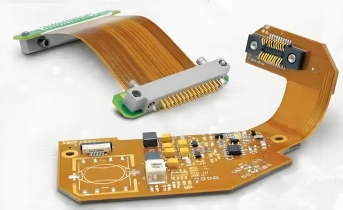
Flex Cut PCBs excel where space is at a premium, weight reduction is critical, or continuous movement is required. Their ability to conform to tight enclosures has revolutionized the design of:
- Wearable Technology:Smartwatches, fitness trackers, and body-worn sensors benefit from their low profile and ability to bend with the human body.
- Medical Devices:Implants, diagnostic equipment, and surgical tools leverage flexibility for minimal invasiveness and complex internal routing.
- Automotive Electronics:Advanced driver-assistance systems(ADAS), infotainment systems, and engine control units use flexible circuits for vibration resistance and tight packaging.
- Aerospace and Defense:Satellites, aircraft instrumentation, and missile guidance systems demand lightweight and reliable interconnections.
- Consumer Electronics:Smartphones, cameras, and laptops use flexible circuits to connect compact modules and hinge mechanisms.
4.2 Applications of Non-Flex Cut PCBs(Rigid PCB)
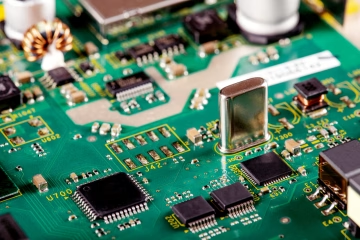
Non-Flex Cut PCBs remain the standard for applications demanding high component density, robust mechanical support, and cost-effectiveness in high volumes. They are the backbone of:
- Computers and Servers:Motherboards, graphics cards, and network interface cards rely on rigid boards for stability and high-speed signal integrity.
- Consumer Appliances:Televisions, refrigerators, and washing machines utilize rigid PCBs for control circuitry.
- Industrial Control Systems:PLCs, motor drives, and factory automation equipment require durable and stable platforms.
- Communication Infrastructure:Routers, switches, and base stations depend on rigid PCBs for high-performance data processing.
4.3 Choosing the Right PCB: Design Considerations
When deciding between these technologies, designers must weigh several factors:
- Required Flexibility:Is static bending(bend-to-fit) or dynamic flexing(continuous movement) needed? This dictates material choice and design rules.
- Space and Form Factor:How much internal space is available? Does the circuit need to fit into an irregular shape?
- Cost vs. Performance:While flexible PCBs often have a higher upfront cost, they can reduce overall system costs by simplifying assembly and improving reliability.
- Environmental Factors:Consider temperature ranges, humidity, and exposure to chemicals or vibration.
- Component Density:For very high component counts or complex routing, rigid PCBs or rigid-flex designs(which combine both) might be optimal.
- Manufacturing Volume:High-volume, standard applications often favor rigid PCBs for cost efficiency.
5. Flex Cut PCB and Non-Flex Cut PCB FAQs
Flex Cut PCBs(Flexible PCBs) can be designed for both. Some are meant for static bending(bend-to-fit once during assembly), while others are engineered for dynamic flexing, enduring millions of bend cycles in applications like camera gimbals or robotic arms.
Generally, yes. The specialized materials(like polyimide) and more complex manufacturing processes for flexible PCBs often result in a higher unit cost compared to standard rigid FR-4 PCBs, especially for simpler designs. However, they can reduce overall system costs by saving space, weight, and assembly time.
Yes, with proper design. Flexible PCBs can be engineered for high power applications by using thicker copper traces and specific thermal management strategies. For high-frequency signals, material selection and careful impedance control are crucial, similar to rigid PCBs.
Applications requiring a very stable, flat platform for numerous heavy components, or those demanding extremely high component density and excellent signal integrity over short distances, such as computer motherboards or high-performance graphics cards, often benefit most from rigid PCBs due to their mechanical robustness and established manufacturing processes.
A rigid-flex PCB is a hybrid board that combines both rigid and flexible circuit sections into a single, integrated unit. It offers the best of both worlds, providing the rigidity for components in specific areas and flexibility for interconnection, ideal for complex, space -constrained applications where dynamic flexing is needed in specific zones.
6. Summary
The distinction between Flex Cut(Flexible) PCBs and Non-Flex Cut(Rigid) PCBs is fundamental to modern electronic design. Rigid PCBs, primarily made of FR-4, offer unparalleled mechanical stability, high component density, and cost-effectiveness for a vast range of applications, forming the bedrock of most electronic devices. In contrast, Flex Cut PCBs, utilizing flexible substrates like polyimide, provide revolutionary design freedom through their ability to bend, twist, and conform. They excel in applications where space and weight are critical, reliability under movement is paramount, and complex three-dimensional interconnections are required. While flexible PCBs typically incur higher manufacturing costs, they often lead to overall system cost savings and enhanced product performance.
Key Takeaways
- Rigid PCBsare ideal for stable, high-density applications where mechanical robustness and cost-effectiveness are primary concerns.
- Flex Cut PCBs(Flexible PCBs)offer superior space efficiency, weight reduction, and enhanced reliability in dynamic or space-constrained environments due to their bendable nature.
- The choice between them depends heavily on the specific application’s requirements for flexibility, space, weight, cost, reliability, and thermal management.
- Flex Cut Technologyoften replaces traditional wiring and connectors, simplifying assembly and reducing points of failure.
- Understanding the uniquebenefits of Flex Cut PCBs and the foundational strengths of Non-Flex Cut PCBs enables designers to make informed decisions that optimize product performance and market fit.
Table of Contents
Get Your PCB Quote!