How PCBA Cleanliness Determines the Fate of Your Electronics
The guide delves into PCBA cleanliness, exploring why it's crucial, the types of contaminants encountered, effective cleaning methods, and the industry standards that govern this vital process.
Get Your PCB Quote!
Table of Contents
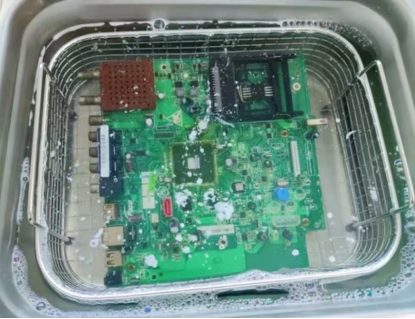
In the intricate world of electronics manufacturing, the reliability and longevity of Printed Circuit Board Assembly(PCBA) hinge on numerous factors, with cleanliness standing out as a critical, yet often underestimated, element. An assembled PCB, while appearing pristine to the naked eye, can harbor microscopic contaminants that severely compromise its performance and lifespan. This guide delves into the essential aspects of PCBA cleanliness, exploring why it’s crucial, the types of contaminants encountered, effective cleaning methods, and the industry standards that govern this vital process.
Modern electronic devices demand ever-increasing levels of performance and reliability in smaller, more complex packages. This miniaturization, coupled with higher operational frequencies and lower power consumption, makes PCBA cleanliness more critical than ever before. Even minute residues can lead to catastrophic failures, making a robust cleaning strategy indispensable for any reputable electronics manufacturer.
1. Why PCBA Cleanliness is Paramount?
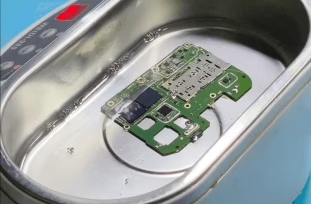
The state of printed circuit board assembly cleanliness directly impacts the functional integrity and durability of electronic devices. Neglecting proper cleaning can lead to a cascade of issues, from immediate operational failures to long-term reliability concerns. Understanding these risks underscores the importance of a rigorous cleaning protocol.
1.1 Risks Associated with Contamination
- Electrical Leakage and Short Circuits:Ionic residues, particularly from flux, can absorb moisture from the environment, creating conductive pathways. This can lead to parasitic currents, reducing insulation resistance, causing electrical leakage, and even resulting in short circuits between closely spaced traces and pads.
- Dendritic Growth:In the presence of moisture and an electrical field, ionic contaminants can facilitate the growth of metallic dendrites. These microscopic, tree-like structures can bridge conductors, leading to permanent short circuits and device failure.
- Corrosion:Residues, especially those containing halides, can react with metallic surfaces(like solder pads, component leads, and copper traces), initiating electrochemical corrosion. This degrades solder joints , component integrity, and overall board reliability.
- Reduced Adhesion for Conformal Coatings and Underfills:Any surface contaminant acts as a barrier, preventing proper adhesion of protective coatings(e.g., conformal coatings, potting compounds) or encapsulants(e.g., underfill for BGA packages). Poor adhesion compromises the protection against environmental factors like moisture, dust, and vibration.
- Signal Integrity Issues:Contamination can alter the dielectric properties of the board surface, potentially affecting signal transmission, especially in high-frequency applications, leading to signal attenuation or impedance mismatches.
- Premature Device Failure:Cumulatively, these issues contribute to reduced product lifespan, increased warranty claims, costly rework, and reputational damage for manufacturers.
1.2 Benefits of Achieving Optimal Cleanliness
- Enhanced Reliability and Lifespan:Clean boards are inherently more reliable, reducing the likelihood of field failures and extending the operational life of the electronic product.
- Improved Electrical Performance:Eliminating conductive residues ensures optimal electrical insulation, preventing leakage currents and maintaining signal integrity.
- Better Adhesion for Protective Layers:A clean surface is crucial for the effective application and adhesion of conformal coatings, underfills, and other protective materials, providing robust environmental protection.
- Compliance with Industry Standards:Meeting cleanliness standards like those set by IPC ensures product quality and often forms a prerequisite for critical applications(e.g., medical, aerospace, automotive).
- Reduced Rework and Warranty Costs:Proactive cleaning minimizes defects, leading to fewer reworks during production and a significant reduction in post-sale warranty claims.
2. Common Contaminants on Assembled PCBs
Contamination on an assembled PCB can originate from various stages of the manufacturing process or from the raw materials themselves. Identifying these sources is the first step toward effective cleaning and prevention.
2.1 Flux Residues
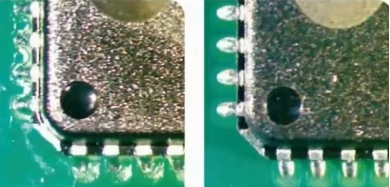
Flux is indispensable in soldering, facilitating wetting and preventing oxidation. However, its residues are the most common and problematic contaminants. Fluxes are categorized by their activation mechanisms and chemistries:
- Rosin-Based Fluxes:Traditionally used, these leave sticky, often visible residues. While rosin itself is non-conductive, it can encapsulate active ingredients that become conductive in the presence of moisture.
- No-Clean Fluxes:Designed to leave minimal, benign residues that supposedly do not require cleaning. However, for high-reliability applications, or when residues are excessive, even “no-clean” fluxes often necessitate cleaning to ensure optimal performance and adhesion of conformal coatings. Their residues can still be hygroscopic and problematic.
- Water-Soluble Fluxes:Highly active and effective, these leave residues that are typically very corrosive and conductive, making immediate and thorough water-based cleaning absolutely essential.
Both ionic(e.g., halides , activators) and non-ionic(e.g., rosins, resins, activators) components of flux residues can pose threats. Ionic residues are particularly problematic due to their propensity to absorb moisture and form conductive paths.
2.2 Solder Pastes and Adhesives
Uncured or partially cured solder paste and adhesive residues, often found underneath components or in tight spaces, can trap moisture and act as a source of ionic contamination.
2.3 Manufacturing Process Contaminants
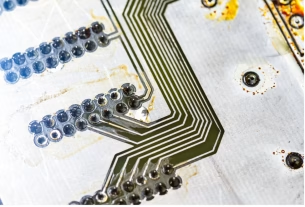
- Fingerprints:Human touch introduces oils, salts, and other organic residues that are often conductive and corrosive.
- Dust and Debris:Environmental dust, fiber particles from clothing or wipes, and metallic shavings from machinery can settle on boards, leading to short circuits or affecting electrical performance.
- Oils and Greases:Lubricants from machinery, handling equipment, or even cosmetic residues can create insulating layers or attract further contaminants.
- Mold Release Agents:Used in component molding, these can transfer to the PCB surface and interfere with adhesion processes.
- Environmental Factors:Airborne particles, humidity, and chemical vapors in the manufacturing environment can contribute to contamination.
3. Essential PCBA Cleaning Methods
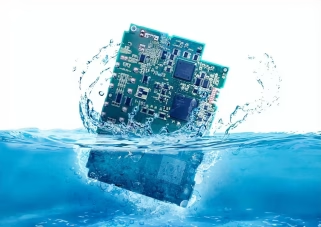
Choosing the appropriate PCBA cleaning method depends on the type of contaminants, board complexity, component sensitivity, and required cleanliness levels. A combination of methods may be employed for optimal results.
3.1 Aqueous Cleaning
This method uses deionized(DI) water, often with added saponifiers(alkaline detergents) or neutralizers. It is highly effective for removing water-soluble flux residues and some polar ionic contaminants. Aqueous cleaning is environmentally friendly and cost-effective, but requires thorough drying to prevent moisture entrapment.
3.2 Semi-Aqueous Cleaning
Semi-aqueous cleaning employs a solvent-based cleaning solution followed by a water rinse. The solvent effectively dissolves rosin-based and some “no-clean” flux residues, after which the water rinse removes both the solvent and dissolved contaminants. This method is powerful for a wide range of contaminants but requires careful management of both the solvent and rinse water streams.
3.3 Solvent Cleaning
Solvent cleaning utilizes specialized chemical solvents to dissolve and remove flux residues and other organic contaminants. Modern solvent cleaning solutions are often optimized for specific flux types and are designed to be environmentally friendlier than older ozone-depleting substances. This method can be very effective and often requires less rinsing and drying than aqueous methods, making it suitable for sensitive components.
3.4 Ultrasonic Cleaning
Ultrasonic cleaning involves immersing the PCBA in a cleaning solution(aqueous or solvent) and subjecting it to high-frequency sound waves. These waves create microscopic cavitation bubbles that implode, generating powerful scrubbing action that dislodges contaminants from intricate areas, including under components. While highly effective, care must be taken with sensitive components that could be damaged by the cavitation energy.
3.5 Spray Cleaning(Inline/Batch)
Industrial PCBA cleaning systems typically use spray technology, either in an inline conveyorized setup or a batch washer. High-pressure sprays of cleaning solutions(aqueous, semi-aqueous, or solvent) and rinse water effectively remove contaminants. Inline systems are ideal for high-volume production, while batch systems offer flexibility for varying board sizes and smaller runs.
3.6 Manual Cleaning
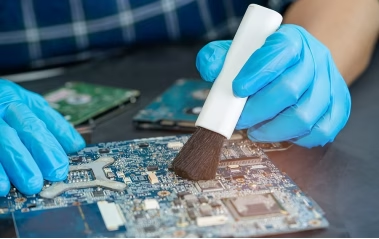
For localized cleaning, rework, or low-volume production, manual cleaning using brushes, swabs, and appropriate cleaning solvents is employed. While less consistent than automated methods, it allows for targeted contaminant removal. Proper technique and solvent selection are crucial to avoid damaging components or spreading contaminants.
4. PCBA Cleanliness Standards and Measurement
To ensure consistent quality and reliability, the electronics industry adheres to specific standards for PCBA cleanliness. Measuring cleanliness is crucial for process control and qualification.
4.1 IPC Standards for PCBA Cleanliness
The IPC(Association Connecting Electronics Industries) sets the widely accepted guidelines for electronic assembly quality:
- IPC-J-STD-001 (Requirements for Soldered Electrical and Electronic Assemblies):This cornerstone standard specifies the materials, methods, and verification criteria for producing high-quality soldered interconnections. It includes detailed requirements for cleanliness, often referencing specific test methods.
- IPC-CH-65 (Guidelines for Cleaning Electronic Assemblies): Provides comprehensive guidance on cleaning processes, materials, and equipment, helping manufacturers select and implement effective cleaning strategies.
4.2 PCBA Cleanliness Measurement Techniques
Various analytical methods are used to quantify and qualify PCBA cleanliness:
| Measurement Technique | Description | What it Measures | Benefits | Limitations |
| Resistivity of Solvent Extract(ROSE)/Ionic Contamination Test | A non-destructive test where a PCBA is rinsed with a solution(often alcohol/water), and the resistivity of the extract is measured. As ions are extracted, the conductivity increases(resistivity decreases). | Total ionic contamination(in µg NaCl eq./in²). | Quick, cost-effective, good for process control. | Does not identify specific ions; measures surface ions, not necessarily entrapped ones. |
| Ion Chromatography(IC) | A sophisticated laboratory technique that separates and quantifies individual ionic species(e.g., chlorides, bromides, sulfates, nitrates) present in an extract solution from the PCBA. | Specific ionic contaminants and their concentrations. | Highly precise, identifies problematic ions, crucial for failure analysis. | More complex, time-consuming, and expensive than ROSE. |
| Surface Insulation Resistance(SIR) | A reliability test where a voltage is applied across a test coupon or actual PCBA, and the resistance of the insulating material is measured over time, often under controlled temperature and humidity conditions. | Long-term electrical insulation performance, propensity for electrochemical migration and dendritic growth. | Predicts long-term reliability under environmental stress; evaluates interaction of residues, coating, and environment. | Destructive for test coupons; time-consuming(can take days or weeks). |
| Visual Inspection(Microscopic) | Magnified optical inspection of the board surface for visible residues, solder balls, foreign particles, or discoloration. | Gross contamination, visible defects. | Simple, immediate feedback. | Cannot detect invisible ionic contamination, subjective. |
| Fourier Transform Infrared Spectroscopy(FTIR) | Analy zes the chemical composition of residues by measuring their absorption of infrared light. | Identifies organic contaminants(e.g., specific flux types, oils, polymers). | Identifies chemical fingerprint of non-ionic residues. | Requires a relatively significant amount of residue for analysis, localized. |
5. Best Practices for Maintaining PCBA Cleanliness
Achieving and maintaining optimal PCBA cleanliness requires a holistic approach that integrates best practices throughout the manufacturing lifecycle.
- Design for Cleanliness:Consider component placement, spacing, and accessibility during the design phase to facilitate effective cleaning. Avoid areas where residues can easily become entrapped.
- Material Selection:Choose low-residue or no-clean fluxes appropriate for the application. If cleaning is mandatory, select fluxes and solder pastes that are easily removable by the chosen cleaning method.
- Process Control:Implement strict process controls for soldering(reflow profiles, wave soldering parameters) to minimize excessive flux spatter and incomplete reflow, which can lead to difficult-to-remove residues.
- Controlled Environment:Maintain a clean manufacturing environment to reduce airborne contaminants like dust and fibers. Use appropriate ESD-safe handling procedures, including gloves, to prevent fingerprints and body oils.
- Optimal Cleaning Process:Select the cleaning method, chemistry, and equipment best suited for the specific PCBAs and contamination types. Ensure proper agitation, temperature, contact time, and rinsing cycles.
- Thorough Drying:After wet cleaning, ensure complete and rapid drying of the boards to prevent moisture entrapment, which can reactivate ionic residues and lead to corrosion.
- Regular Testing and Monitoring:Implement routine cleanliness testing(e.g., ROSE, visual inspection) to monitor process effectiveness and ensure ongoing compliance with cleanliness standards.
- Proper Storage:Store clean PCBAs in sealed, humidity-controlled, and static-safe packaging until further assembly or shipment to prevent recontamination.
6. PCBA Cleanliness FAQs
Question1: Is “no-clean” flux truly no-clean?
While “no-clean” fluxes are designed to leave benign residues that don’t typically require cleaning for many applications, they can still leave residues that interfere with conformal coatings or affect long-term reliability in high-performance or harsh environments. For critical applications, cleaning “no-clean” flux residues is often recommended.
Question2: What is the most critical contaminant to remove from a PCBA?
Ionic contaminants, primarily from flux activators, are generally considered the most critical. They are highly conductive in the presence of moisture, leading to electrical leakage, short circuits, and corrosion.
Question3: How often should PCBA cleanliness be tested?
The frequency depends on production volume, criticality of the product, and process stability. For high-volume production, daily or even hourly ROSE testing is common for process control. More detailed tests like IC or SIR might be done periodically or for process qualification.
Question4: Can ultrasonic cleaning damage sensitive components?
Yes, ultrasonic cleaning, if not properly controlled, can damage delicate components(e.g., very fine wire bonds, MEMS devices) due to the intensity of cavitation. Parameters like frequency, power, and duration must be carefully selected and validated for each PCBA.
Question5: What is the primary purpose of a conformal coating after cleaning?
The primary purpose of a conformal coating is to provide an additional layer of protection against environmental factors like moisture, dust, chemicals, and extreme temperatures, further enhancing the PCBA’s reliability and extending its lifespan. A clean surface is essential for proper adhesion of the coating.
7. Summary
Maintaining exemplary PCBA cleanliness is not merely a best practice; it is a fundamental requirement for producing reliable, high-performance electronic devices. From preventing critical failures like short circuits and corrosion to ensuring optimal signal integrity and effective adhesion of protective coatings, the impact of a clean assembled PCB is far-reaching. By understanding the diverse sources of contamination, implementing appropriate cleaning methods, and adhering to rigorous industry standards and measurement techniques, manufacturers can significantly enhance product quality, reduce costly defects, and build trust in their electronic solutions. A proactive, integrated approach to cleanliness throughout the manufacturing process is the cornerstone of modern electronics production.
Key Takeaways
- PCBA cleanliness directly impacts product reliability, performance, and lifespan, preventing failures like short circuits, corrosion, and dendritic growth.
- Common contaminants include flux residues(rosin, no-clean, water-soluble), uncured solder pastes, fingerprints, dust, and manufacturing oils.
- Various cleaning methods exist, including aqueous, semi-aqueous, solvent, ultrasonic, and spray cleaning, each suited for different contaminants and board types.
- IPC standards(e.g., IPC-J-STD-001) define cleanliness requirements, while techniques like ROSE, Ion Chromatography(IC), and Surface Insulation Resistance(SIR) are used for measurement and validation.
- Best practices for maintaining cleanliness involve considering it from the design phase, meticulous material selection, strict process control, environmental management, and consistent testing.
Table of Contents
Get Your PCB Quote!