How to Build and use Breakaway Tabs PCB
Breakaway Tabs PCBs are array boards with a little row of holes perforated into them. They are two types: the Mouse bites and the V-groove method. PCBAndAssembly excels at providing customized solutions for PCB assembly, which is crucial for integrating detachable connectors into circuit board designs.
Get Your PCB Quote!
Table of Contents
1. What is Breakaway Tabs PCBs?
Producing individual printed circuit boards (PCBs) one by one is often impractical and expensive, especially for smaller boards or high-volume production. This is where the ingenious concept of PCB panelization comes into play, and within this technique, breakaway tabs PCBs stand out as a highly flexible and convenient solution.
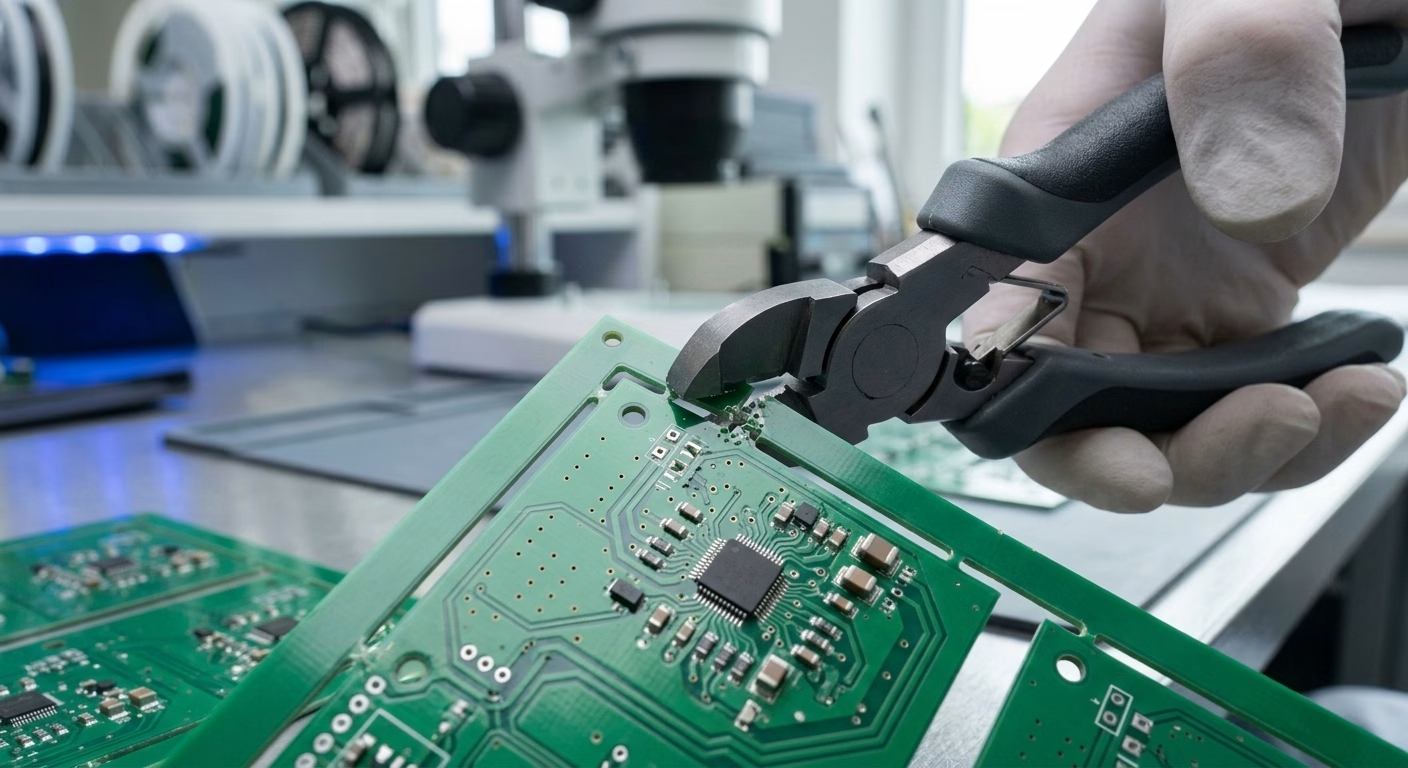
A breakaway tabs PCB, also known as a snap-off PCB or break-off PCB, features individual circuit boards connected together into a larger panel by small, easily separable tabs. These tabs are specifically designed to allow the individual boards to be cleanly “snapped apart” or “broken away” from the main panel after the assembly process. This method significantly streamlines production, offering a balance between manufacturing ease and the ability to obtain custom , standalone boards.
Whether you’re an electrical engineer optimizing production, a PCB designer prototyping new circuits, or an electronics hobbyist looking for adaptable solutions, understanding breakaway tabs is a valuable skill. This comprehensive guide will delve into everything you need to know about designing, manufacturing, and effectively utilizing breakaway tab PCBs to achieve cost-effective and flexible electronic projects.
2. Why Panelize with Breakaway Tabs?
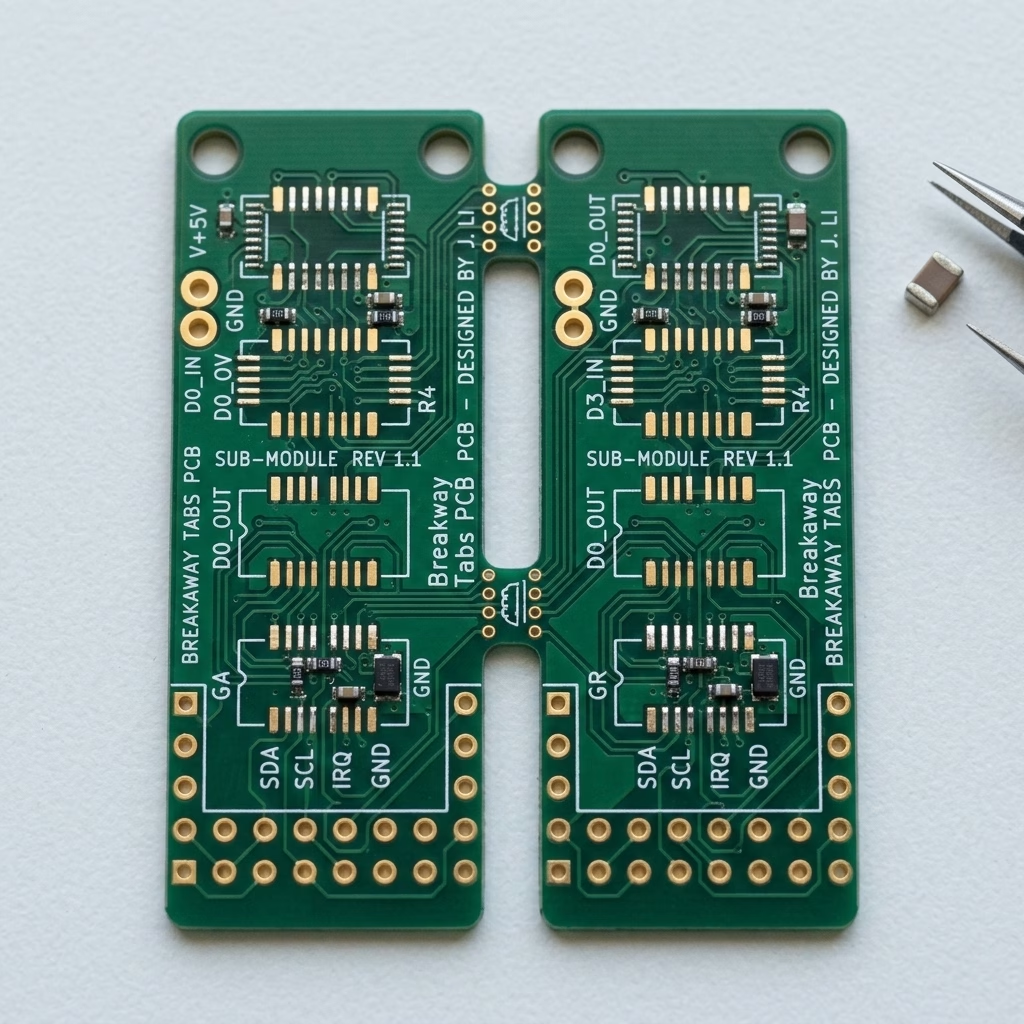
Panelization , the process of laying out multiple individual PCBs onto a larger, single manufacturing panel, is a fundamental practice in modern PCB fabrication. The primary driver behind panelization is to reduce manufacturing costs and increase efficiency. It’s generally more economical to produce a larger number of smaller PCBs on one big panel than to process each small board individually. Breakaway tabs enhance this process by providing a practical method for separating these panelized boards post-assembly.
The advantages of using breakaway tabs for panelization are numerous:
- Cost Reduction:Manufacturing multiple PCBs as a single unit significantly lowers per-board costs by optimizing material usage and reducing machine setup times for pick-and-place and reflow soldering processes.
- Increased Production Efficiency:Automation in PCB assembly thrives on uniformity. Handling a larger panel is easier for automated machinery, leading to faster throughput and reduced manual labor. This is a key benefit highlighted across multiple sources, emphasizing “increased flexibility in PCB assembly and dismantling.”
- Enhanced Flexibility and Customization:Breakaway tabs offer unparalleled flexibility. Designers can create various configurations, allowing different sections or modules of a single panel to serve distinct functions. This adaptability is particularly useful in prototyping, testing, and small-scale production where specific needs might change.
- Simplified Handling:Larger panels are easier to transport, handle, and feed into automated assembly lines than numerous tiny individual boards. This reduces the risk of damage during handling.
- Improved Quality Control:Testing and inspection can be performed on the entire panel before individual boards are separated, simplifying the quality assurance process.
- Streamlined Depaneling:While traditional routing or sawing can separate boards, breakaway tabs provide a quick, clean, and often tool-less method for separation, especially with perforated tabs.
In essence, breakaway tabs PCBs strike a balance, allowing manufacturers to leverage the economic benefits of panelization while providing users with the convenience of easily separating individual, customized modules.
3. Types of Breakaway Tabs PCBs: Mouse Bites vs . V-Groove
When designing a breakaway tabs PCB, you primarily have two methods for creating the separation points: mouse bites and V-grooves. Each method has its own characteristics, advantages, and ideal applications.
Mouse Bites (Perforated Breakaway Tabs)
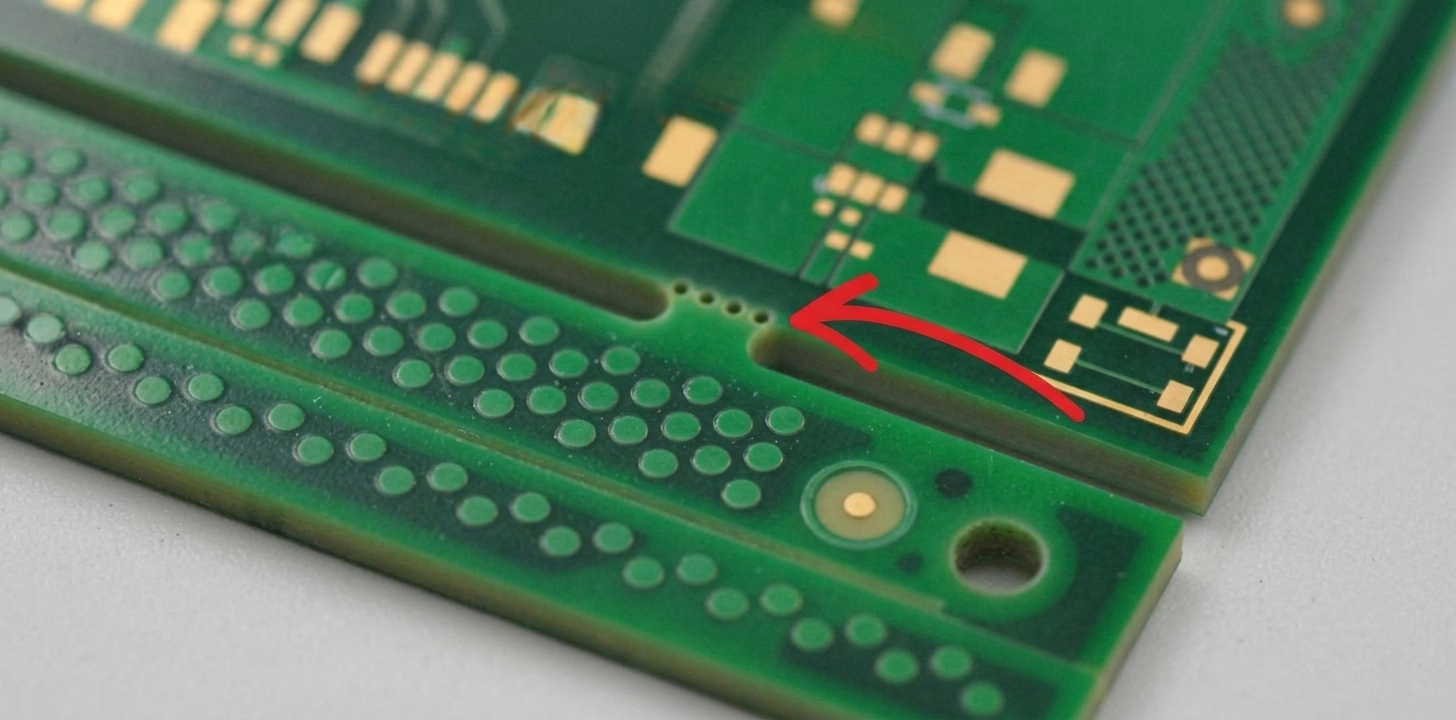
(Mouse Bites)
Mouse bites, also known as perforated breakaway tabs or break-routing, involve creating a series of small, closely spaced holes along the connection lines between individual boards on a panel. These holes make the material weaker, allowing the boards to be snapped apart by hand or with minimal force. After depanelization, the board outline has small, rough edges that resemble “postage stamp holes,” hence the name “mouse bites.”
- Characteristics:Rows of small, non-plated drill holes. The number and size of holes determine the strength of the tab and ease of breaking.
- Advantages:
- Allows for irregular board shapes and curved outlines.
- No special tools required for depaneling; can often be broken by hand.
- Offers greater flexibility in board layout, as traces can be routed closer to the tab without interference.
- Disadvantages:
- Leaves a rough edge that may require sanding or filing for a smooth finish.
- Can generate dust or small particles during separation, which might be an issue for sensitive components.
- Risk of stress on components near the tabs if not designed properly.
- Applications:Commonly used for FR4 panels and designs requiring unique board shapes or situations where a perfectly smooth edge is not critical.
V-Groove Breakaway Tabs
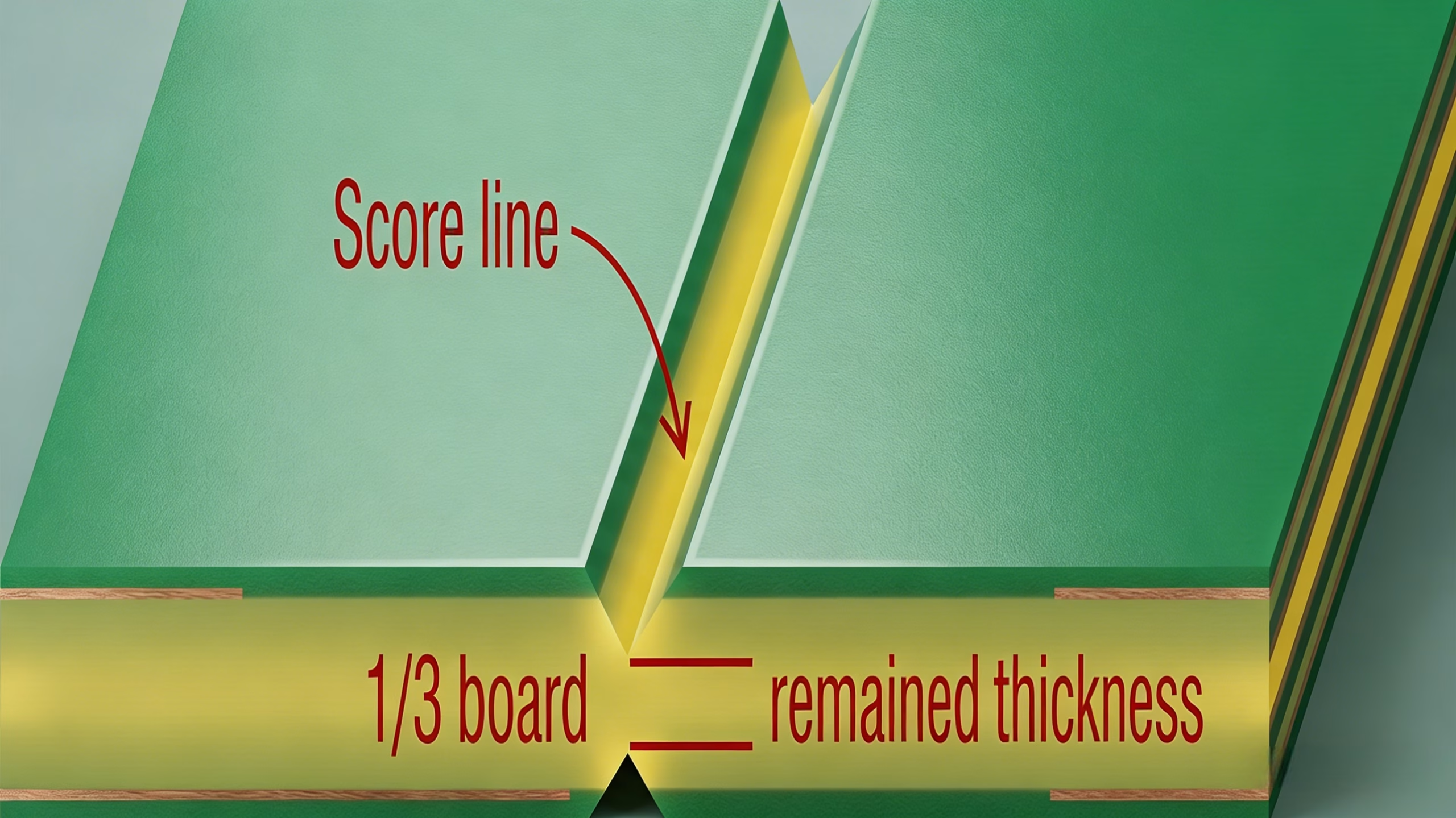
(V-Groove)
V-groove breakaway tabs involve cutting V-shaped scores into both the top and bottom surfaces of the PCB panel, along the lines where individual boards will be separated. These grooves reduce the board’s thickness, creating a weakened line that allows for a clean break. The cut typically leaves about one -third of the board’s original thickness at the bottom of the V-groove, ensuring structural integrity during assembly while facilitating easy separation.
- Characteristics:Straight, V-shaped cuts along the separation lines, typically 1/3 of the board’s thickness.
- Advantages:
- Produces a very clean and smooth edge after depaneling, often eliminating the need for further finishing.
- Faster depaneling for high-volume production using specialized V-groove cutting machines.
- Less dust and debris generated compared to mouse bites.
- Disadvantages:
- Limited to straight lines for separation; cannot accommodate curved or complex board outlines.
- Requires a specific V-groove cutting machine for efficient and clean depaneling.
- Traces and components must be kept further away from the V-groove line to prevent damage during cutting and breaking.
- The V-groove tool might limit the number of individual PCBs that can be processed on a single panel.
- Applications:Ideal for rectangular or square boards where clean edges are critical and high-volume, automated depaneling is desired.
Here’s a comparison of the two types :
| Feature | Mouse Bites (Perforated Tabs) | V-Groove Tabs |
| Separation Mechanism | Series of small drilled holes | V-shaped cuts from top and bottom |
| Edge Finish | Rough, “postage stamp” like | Clean, smooth |
| Board Shapes | Flexible, supports curves/complex shapes | Limited to straight lines |
| Depaneling Method | Hand, pliers, simple tools | V-groove cutter (depaneling machine) |
| Component/Trace Placement | Can be closer to the tab | Requires greater setback from groove |
| Debris | Can generate dust/particles | Minimal dust |
| Cost | Generally lower setup cost for simple cases | Requires specialized equipment, but efficient for high volume |
4. Designing Your Breakaway Tab PCB: Key Considerations
Effective design is crucial for successful breakaway tab PCBs . Proper planning ensures ease of manufacturing, clean depaneling, and the integrity of your individual boards. Here are key factors to consider:
Panelization Strategy
Before focusing on the tabs, define your overall panelization strategy. This involves arranging multiple instances of your PCB on a larger panel to maximize material usage and fit manufacturing equipment. Consider the panel dimensions used by your PCB fabricator and how many boards can fit efficiently.
Tab Placement and Dimensions
The placement and dimensions of your breakaway tabs are critical.
- Number of Tabs:Use enough tabs to secure the individual board to the panel during assembly, but not so many that depaneling becomes difficult. Typically, a few tabs (2-4) per side of a smaller board are sufficient.
- Tab Width:Generally, tabs are between 0.5mm to 2mm wide. Wider tabs provide more strength but are harder to break.
- Tab Length/Depth:This refers to how far the tab extends into the board outline. Ensure sufficient material is removed for easy breaking.
For mouse bites, specific dimensions for the drill holes are vital:
- Hole Diameter:Common hole diameters range from 0.5mm to 1.0mm.
- Hole Spacing:The distance between the centers of the holes, typically 0.5mm to 1.0mm. Closer spacing makes it easier to break but also weakens the tab.
- Tab Rout Width:The width of the routing channel between the holes and the board outline.
Component and Trace Keep-Out Zones
This is one of the most critical design rules.
- For Mouse Bites:Keep components, traces, and pads a minimum distance away from the mouse bite holes. This prevents damage to components during depaneling and ensures solder joints aren’t compromised by mechanical stress. A common recommendation is a 0.5mm to 1.0mm (20-40 mil) clearance.
- For V-Grooves:The keep-out zone is even more important due to the depth of the V-cut. Components and traces should be at least 1.5mm to 2.0mm (60-80 mil) away from the V-groove line to prevent the cutting tool from damaging them.
Board Outline Definition
Clearly define the final outline of your individual PCBs and the overall panel outline in your Gerber files. For mouse bites, ensure the routing path for the holes is precisely defined. For V-grooves, specify the exact lines for the V-cuts.
Material Considerations
The type of PCB material (e.g., FR4, alumina, flex PCB) can influence the effectiveness of breakaway tabs. Thicker or more rigid materials may require more robust tab designs or different breaking techniques. Flex PCBs, while inherently flexible, can also benefit from breakaway tabs for panelization during manufacturing.
Manufacturer Communication
Always communicate your breakaway tab requirements clearly to your PCB manufacturer. Provide detailed specifications in your design files (Gerbers, drill files) and accompanying fabrication notes. Ask about their preferred dimensions, minimum clearances, and any specific capabilities they have for mouse bites or V-grooves. This proactive approach helps avoid costly errors and ensures the final product meets your expectations.At PCBAndAssembly, we care about these details even more than you do. No matter how complex your board is, simply upload your requirements when placing your order, and our experienced engineers will perform a free DFM to ensure that every breakpoint is accurate.
5. Depaneling Your Breakaway Tabs PCBs
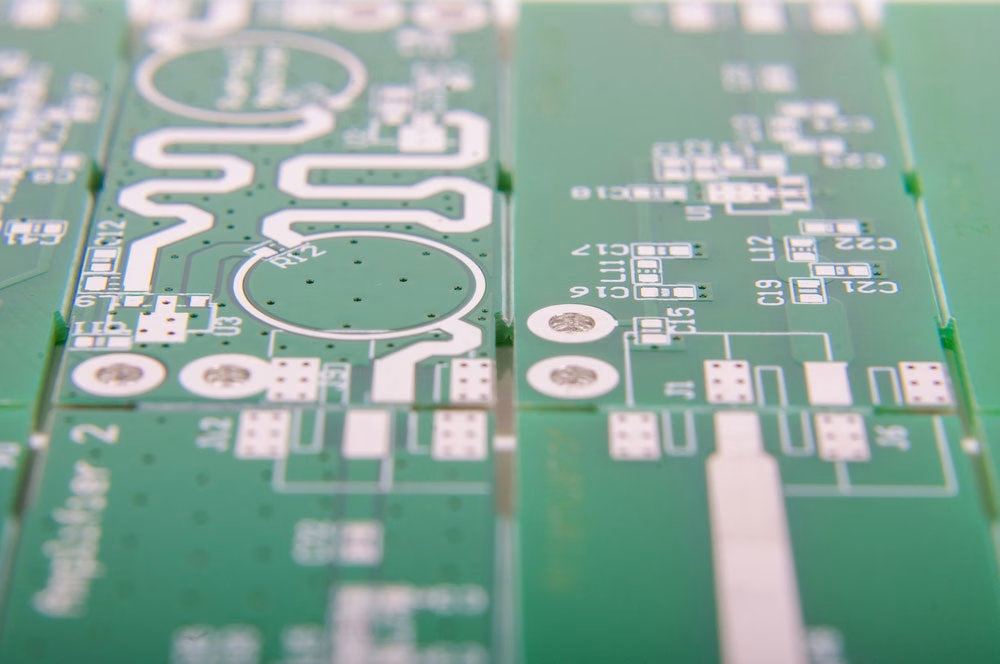
Once your PCB panel has been assembled, the next step is to separate the individual boards – a process known as depaneling. The method you use will largely depend on the type of breakaway tab (mouse bite or V-groove) and the volume of production.
Depaneling Mouse Bites (Perforated Tabs)
Mouse bites are designed for relatively easy separation, often without specialized tools:
- Manual Breaking:For low volumes or prototypes, boards can often be snapped apart by hand. Apply firm, even pressure along the tab line.
- Pliers or Depaneling Tools:Small, specialized depaneling pliers or scoring tools can provide leverage for a cleaner break, especially for slightly stronger tabs or thicker boards.
- Roller Depanelers:For moderate volumes, a roller depaneler allows users to roll the panel over a guide, breaking the tabs efficiently.
- Routing Machines:For very high volumes or if a perfectly smooth edge is critical (even with mouse bites), a CNC router can be used to precisely cut along the perforated lines, removing the tab remnants entirely.
When manually depaneling mouse bites, support the board evenly to prevent accidental damage to components, especially those near the tabs. The rough edges left by mouse bites may require light sanding or filing if a smooth finish is desired.
Depaneling V-Groove Tabs
V-groove tabs require a different approach to ensure a clean break:
- Manual V-Groove Depaneling:While possible, manually breaking V-groove panels can be inconsistent and may result in rougher edges or uneven breaks. It’s generally not recommended for precise applications.
- Roller Depanelers (V-Groove Specific): Similar to mouse bites, specialized roller depanelers are available for V-grooves. These machines apply controlled pressure along the V-cut line, resulting in a clean separation.
- V-Groove Depaneling Machines: For high-volume production, automated V-groove depaneling machines are used. These machines precisely separate boards along the V-grooves, ensuring consistent quality and speed.
The key advantage of V-gro oves is the clean edge they produce. When properly depanelled using the correct tools, the individual boards will have smooth, straight edges, often requiring no further finishing.
6. Best Practices for Breakaway Tab PCB Projects
To get the most out of your breakaway tabs PCB design and manufacturing process, adhere to these best practices:
- Early Communication with Fabricator:Share your design intentions and ask for their specific guidelines for breakaway tabs (hole sizes, spacing, V-groove depth, keep-out zones) early in the design process. This is the single most important step to avoid issues.
- Standardization (Where Possible):If you frequently use breakaway tabs, consider standardizing your tab dimensions and keep-out zones to streamline design and manufacturing.
- Testing Tab Strength:For new designs or critical applications, consider ordering a small prototype run to test the ease of depaneling and the integrity of the individual boards after separation.
- Consider Component Placement:Avoid placing sensitive or tall components directly adjacent to breakaway tabs, as mechanical stress during depaneling can cause damage.
- Clear Documentation:Ensure your fabrication notes clearly specify whether you are using mouse bites or V-grooves, along with all relevant dimensions and tolerances.
- Material Compatibility:Understand how your chosen PCB material will behave during depaneling. For example, some rigid materials might require more precise breaking tools.
- Environmental Factors:If dealing with dust-sensitive environments, prefer V-grooves over mouse bites or plan for adequate cleaning after depaneling mouse-bite boards.
- Automated Assembly Compatibility:Design your panel such that it fits standard assembly equipment. The overall panel size, including tabs, should be compatible with pick-and-place machines and reflow ovens.
7. Applications and Benefits
Breakaway tabs PCBs are employed across a wide spectrum of industries and applications, primarily due to their blend of manufacturing efficiency and design flexibility:
- Prototyping and Development :Ideal for creating multiple iterations of a circuit on a single panel, allowing for easy testing and modification of individual modules without wasting material.
- Small-Scale Production:For businesses or hobbyists producing limited quantities, breakaway tabs offer a cost-effective way to manufacture a batch of boards.
- Modular Electronics:Designs that require several identical or similar sub-modules can benefit from being produced on a single panel and then separated for integration into a larger system.
- Testing and Calibration:Multiple boards can be quickly tested while still in their panelized form, then separated for final product integration.
- Educational Kits:Breakaway tabs are common in electronic kits, allowing users to easily obtain individual components or boards for assembly.
- Complex Systems with Sub-Boards:When a main board requires smaller, specialized daughterboards, these can be panelized with breakaway tabs for efficient assembly .

8. Breakaway Tabs PCB FAQ
Mouse bites use a series of small drilled holes for separation and leave a rough edge, allowing for complex board shapes. V-grooves use V-shaped cuts and provide a clean, smooth edge, but are limited to straight separation lines.
Mouse bite PCBs can often be depanelled by hand, especially if designed with sufficient perforation. V-groove PCBs are best separated using specialized tools or machines for a clean break.
For mouse bites , maintain at least 0.5mm to 1.0mm (20-40 mil) clearance. For V-grooves, a larger clearance of 1.5mm to 2.0mm (60 -80 mil) is recommended to avoid damage during the V-cutting process. Always consult your fabricator for their specific recommendations.
Panel ization reduces manufacturing costs by optimizing material usage, increasing production efficiency, and streamlining automated assembly processes for multiple individual boards.
If properly designed and depan elled, breakaway tabs should not significantly weaken the individual PCB after separation. The mechanical stress is concentrated along the tab lines, not the main circuit area. However, improper design or forceful depaneling can cause stress or damage.
9 . Summary
Breakaway tabs PCBs are a cornerstone of modern, cost-effective, and flexible electronics manufacturing. By understanding the two primary types—mouse bites and V-grooves—and their respective design considerations, you can leverage their benefits for a wide array of applications. From reducing manufacturing costs and improving production efficiency through panelization to offering unparalleled customization for prototypes and small-scale runs, breakaway tabs empower designers and manufacturers.
Key to success is meticulous design, paying close attention to tab dimensions, component keep-out zones, and clear communication with your PCB fabricator. Whether you opt for the versatility of mouse bites or the clean finish of V-grooves, mastering breakaway tabs is a vital skill for anyone involved in printed circuit board development and production, ensuring your projects are built efficiently and effectively from concept to final product.
Key Takeaways
- Breakaway tabs PCBs enable cost-effective panelization , reducing manufacturing costs and boosting assembly efficiency.
- Choose between Mouse Bites (perforated holes for flexible shapes, rough edges) and V-Grooves (scored lines for clean edges, straight shapes only) based on project needs.
- Always maintain critical component and trace keep-out zones around tabs (e.g., 0.5-1.0mm for mouse bites, 1.5-2.0mm for V- grooves).
- Communicate detailed tab specifications and design intentions clearly with your PCB fabricator to avoid errors.
- Proper depaneling techniques (manual, pliers, roller, or automated machines) are crucial for clean separation without damaging boards.
- Breakaway tabs offer immense flexibility for prototyping, modular design, and various production scales.
Table of Contents
Get Your PCB Quote!