Mastering PCB Assembly Quality Control
Quality Control in PCB Assembly is not merely a final inspection step; it’s an integrated process spanning the entire manufacturing lifecycle, from design to final testing.
Get Your PCB Quote!
Table of Contents
- 1. The Criticality of PCBA Quality Control
- 2. Why Robust PCBA Quality Control is Indispensable?
- 3. Common Defects in PCB Assembly
- 4. Essential Stages and Techniques of PCBA Quality Control
- 5. Implementing Best Practices for Superior PCBA QC
- 6. Industry Standards and Certifications for PCBA
- 7. PCBA Quality Control FAQs
- 8. Summary
- Key Takeaways
1. The Criticality of PCBA Quality Control
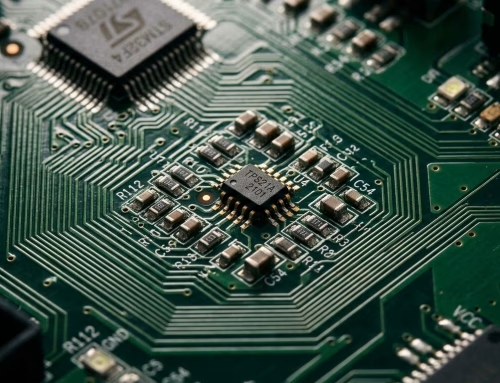
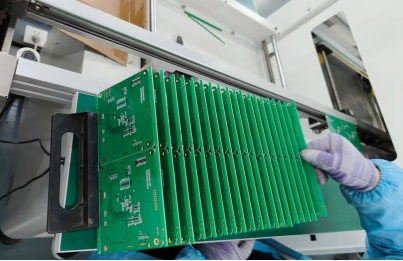
In the dynamic world of electronics, the reliability and performance of any device hinge significantly on the quality of its Printed Circuit Board Assembly(PCBA). A PCBA forms the very backbone of electronic products, from consumer gadgets to critical aerospace systems. As complexity escalates and component miniaturization continues, ensuring the flawless operation of these boards becomes paramount. This comprehensive guide delves into the essential principles and practices of PCBA Quality Control(QC), offering insights into how manufacturers can consistently deliver high-quality, dependable electronic assemblies.
Quality Control in PCB Assembly is not merely a final inspection step; it’s an integrated process spanning the entire manufacturing lifecycle, from design to final testing. It involves a systematic approach to detect and prevent defects, ensuring that each board meets stringent performance, reliability, and safety standards. Effective QC mitigates risks, reduces costly rework, and ultimately safeguards a company’s reputation and bottom line.
2. Why Robust PCBA Quality Control is Indispensable?
The importance of rigorous quality control in printed circuit board assembly cannot be overstated. The impact of a faulty PCBA can range from minor inconvenience to catastrophic failure, depending on the application. Here’s why robust QC is absolutely critical:
- Ensuring Product Reliability:High-quality PCBAs are synonymous with reliable products. Devices with well-controlled assemblies are less prone to premature failure, leading to longer lifespans and greater customer satisfaction.
- Preventing Costly Rework and Returns:Detecting defects early in the production cycle is far more economical than discovering them after the product has been shipped. Reworking or replacing faulty boards can incur significant costs in labor, materials, and logistics.
- Maintaining Brand Reputation:In today’s competitive market, a reputation for quality is invaluable. Consistent delivery of high-performing products builds trust and customer loyalty, while repeated failures can quickly erode a brand’s standing.
- Ensuring Safety and Compliance:In critical applications like medical devices, automotive systems, or aerospace technology, PCBA failures can pose serious safety risks. Stringent QC ensures compliance with industry regulations and safety standards, protecting users and manufacturers alike.
- Optimizing Manufacturing Efficiency:By identifying root causes of defects, QC processes enable continuous improvement in manufacturing processes, leading to higher yields, reduced waste, and improved overall operational efficiency.
3. Common Defects in PCB Assembly
Even with advanced manufacturing techniques, printed circuit board assembly can be susceptible to various defects. Understanding these common issues is the first step in implementing effective quality control measures:
1) Soldering Defects
- Solder Bridges:Unintended electrical connections between two or more pads/traces, often leading to short circuits.
- Opens:Incomplete solder joints resulting in no electrical connection.
- Cold Joints:Poor wetting, appearing dull and grainy, indicating insufficient heat during soldering, leading to unreliable connections.
- Insufficient Solder:Not enough solder to form a strong, reliable joint.
- Excess Solder:Too much solder, which can lead to bridging or structural weakness.
- Solder Voids/Bubbles:Cavities within the solder joint, reducing its strength and conductivity.
2) Component Placement Errors
- Misalignment:Components placed off-center, leading to poor connections.
- Incorrect Polarity:Polarized components(e.g., diodes, electrolytic capacitors) placed in the wrong orientation, causing malfunction or damage.
- Missing Components:Parts not placed on their designated pads.
- Wrong Components:An incorrect component type or value used in place of the specified one.
3) Board Damage
- Scratches and Delamination:Physical damage to the PCB substrate or traces.
- Warping/Twisting:Deformation of the board, which can affect component placement and overall integrity.
4) Contamination
- Residues from flux, solder paste, or other foreign materials that can lead to electrical leakage or corrosion over time.
4. Essential Stages and Techniques of PCBA Quality Control
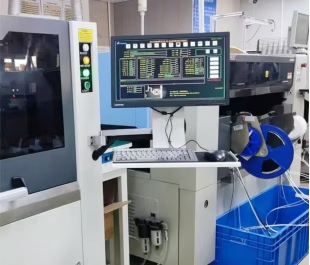
Effective PCBA Quality Control is a multi-faceted process, integrating various inspection and testing methods throughout the manufacturing flow. These stages are designed to catch defects at the earliest possible point, minimizing downstream costs and ensuring product integrity.
4.1 Design for Excellence(DFX)
Quality begins long before manufacturing. Implementing Design for Manufacturing(DFM), Design for Testability(DFT), and Design for Assembly(DFA) principles in the initial design phase is crucial. These practices optimize the layout for manufacturability, ease of testing, and assembly efficiency, significantly reducing potential defects.
4.2 Incoming Material Inspection(IQC)
The quality of the final PCBA is only as good as its raw materials. Incoming Quality Control involves verifying all received components and bare PCBs against specifications. This includes visual inspection, dimension checks, and sometimes electrical testing to ensure components meet required standards before entering production.
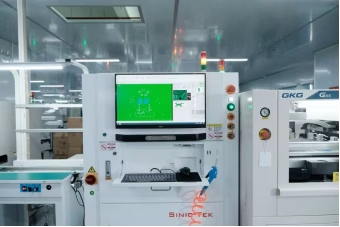
4.3 Solder Paste Inspection(SPI)
Solder paste application is a critical step in surface mount technology(SMT) assembly. SPI systems use 3D imaging to inspect the volume, shape, and alignment of solder paste deposits before component placement. Detecting issues like insufficient paste, excessive paste, or misalignment at this stage prevents numerous soldering defects later on.
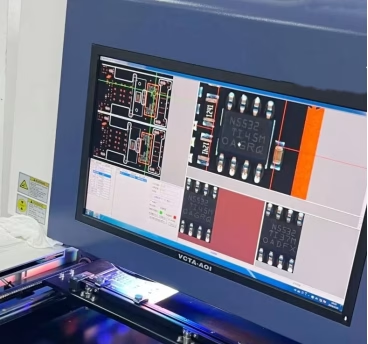
4.4 Automated Optical Inspection(AOI)
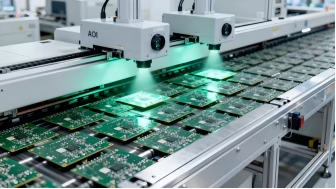
Automated Optical Inspection(AOI) is a non-contact, camera-based system widely used for rapid and accurate inspection of PCBAs. It uses advanced algorithms to compare images of the assembled board against a CAD reference or a “golden board”.
AOI can detect a wide range of defects, including:
- Missing components
- Misaligned components
- Incorrect polarity
- Incorrect component value(if visible markings are present)
- Solder joint defects(bridges, opens, insufficient/excessive solder)
- Scratches and etching defects
AOI is typically performed both pre-reflow(after paste application and component placement but before soldering) and post-reflow(after soldering) for maximum coverage.
4.5 X-ray Inspection(AXI)
For complex assemblies with hidden solder joints, such as those under Ball Grid Array(BGA), Quad Flat No-leads(QFN), or Chip Scale Package(CSP) components, Automated X-ray Inspection(AXI) is indispensable. AXI uses X-rays to penetrate components and reveal the internal structure of solder joints that are not visible to optical systems.
AXI is critical for detecting:
- Voids within solder joints
- Head-in-pillow defects
- Insufficient solder under BGAs
- Solder bridges under shielded components
- Misalignment of BGA spheres
4.6 In-Circuit Test(ICT)
In-Circuit Test(ICT) is an electrical test method that checks the functionality of individual components and verifies the integrity of their connections on the PCBA. It uses a “bed of nails” fixture to make contact with test points on the board . Each component is electrically isolated and tested independently.
ICT can identify:
- Shorts and opens
- Missing components
- Incorrect components(wrong value, wrong type)
- Reversed components(polarity)
- Faults in passive components(resistors, capacitors, inductors)
- Diode and transistor functionality
While effective, ICT requires significant upfront investment in fixture design and programming.
4.7 Functional Test(FCT)
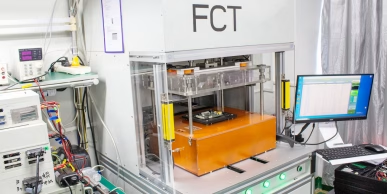
Functional Test(FCT) is the final and often most critical electrical test, designed to verify that the PCBA performs its intended functions according to design specifications. Unlike ICT, which tests individual components, FCT powers up the board and simulates its operational environment, checking the overall system functionality.
FCT can involve:
- Power-up sequence verification
- Input/output signal testing
- Communication interface verification(USB, Ethernet, UART, etc.)
- Software loading and firmware testing
- Stress testing under various environmental conditions
FCT is essential for ensuring that the assembled board will operate correctly in its end application.
4.8 Manual Visual Inspection
Despite the advancement of automated systems, manual visual inspection by trained technicians remains a crucial part of PCBA QC, especially for complex boards, prototypes, or when looking for subtle aesthetic defects that automated systems might miss. Inspectors typically use magnifiers or microscopes to check for:
- Surface blemishes and cleanliness
- Minor component alignment issues
- Solder quality on tricky joints
- Conformal coating integrity
4.9 First Article Inspection(FAI)
First Article Inspection(FAI) is a complete, independent, and documented physical and functional inspection of the first completed PCBA from a new production run or after significant changes in design, process, or materials. FAI ensures that all specifications are met before mass production begins, preventing widespread defects.
4.10 Summary of Key PCBA Quality Control Methods
| Method | Primary Purpose | Key Advantages | Limitations |
| Incoming Quality Control(IQC) | Verify raw materials and components | Prevents bad parts from entering production | Can be labor-intensive; not all defects detectable visually |
| Solder Paste Inspection(SPI) | Verify solder paste volume and placement | Catches solder paste defects early; high accuracy | Only inspects paste; typically for SMT lines |
| Automated Optical Inspection(AOI) | Detect visual surface defects(solder, components) | Fast, consistent, cost-effective for high volume | Cannot see under components(e.g., BGAs); false calls possible |
| Automated X-ray Inspection(AXI) | Inspect hidden solder joints(e.g., BGA, QFN) | Can see through components; detects voids and hidden shorts | More expensive; can be slower than AOI; limited to solder joint quality |
| In-Circuit Test(ICT) | Electrically test individual components and connections | High fault coverage; precise defect localization | Requires custom fixture; high setup cost; less effective for complex ICs |
| Functional Test(FCT) | Verify overall PCBA functionality in simulated environment | Confirms product performs as intended; close to end-user experience | Requires sophisticated test setups; does not pinpoint individual component faults |
| Manual Visual Inspection | Catch subtle visual defects, cleanliness, aesthetics | Flexible; good for small batches or complex areas | Subjective; slow; prone to human error; not for hidden defects |
5. Implementing Best Practices for Superior PCBA QC
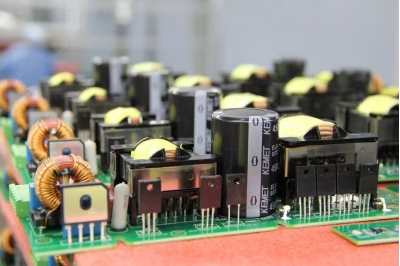
Beyond individual inspection methods, a holistic approach to PCBA QC involves integrating several best practices:
- Supplier Qualification:Partner with reputable suppliers who have demonstrated a commitment to quality and adherence to industry standards. Regularly audit your suppliers.
- Standard Operating Procedures(SOPs):Develop and strictly adhere to detailed SOPs for every step of the assembly and inspection process to ensure consistency and repeatability.
- Operator Training and Certification:Invest in continuous training for assembly technicians and QC personnel. IPC certifications(e.g., IPC-A-610 for Acceptability of Electronic Assemblies) are highly valuable.
- Statistical Process Control(SPC):Use statistical methods to monitor and control the manufacturing process. By tracking key metrics, manufacturers can identify trends and intervene before defects occur.
- Traceability: Implement robust traceability systems that can track components from their source through every stage of assembly, enabling quick identification and recall if issues arise.
- Continuous Improvement:Foster a culture of continuous improvement, regularly reviewing QC data, analyzing root causes of defects, and implementing corrective and preventive actions.
- Environmental Control:Maintain controlled environments(temperature, humidity, ESD protection) to prevent contamination and damage to sensitive components.
6. Industry Standards and Certifications for PCBA
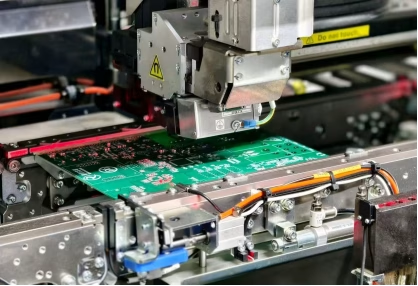
Adherence to industry standards and certifications is a testament to a manufacturer’s commitment to quality. Key standards include:
1) IPC Standards: The Association Connecting Electronics Industries(IPC) sets widely recognized standards for the design, manufacturing, and assembly of PCBs.
- IPC-A-610:“Acceptability of Electronic Assemblies”-The most widely used standard, providing criteria for acceptable quality of electronic assemblies.
- IPCJ-STD-001:“Requirements for Soldered Electrical and Electronic Assemblies”-Defines materials and methods for producing high-quality soldered interconnections.
- IPC-7711/7721:“Rework, Modification and Repair of Electronic Assemblies”-Guidelines for repairing and modifying electronic assemblies.
2) ISO9001: This international standard specifies requirements for a quality management system(QMS). Certification demonstrates a commitment to meeting customer and regulatory requirements and continuous improvement.
3) ISO13485: Specific to medical devices, this standard outlines quality management system requirements for regulatory purposes, critical for PCBAs used in healthcare.
4) AS9100: A widely adopted standard for quality management systems in the aviation, space, and defense industries.
7. PCBA Quality Control FAQs
While all steps are crucial, early detection methods like Solder Paste Inspection(SPI) and Automated Optical Inspection(AOI) are often considered most critical. Catching defects before reflow soldering can prevent significant rework costs and improve overall yield dramatically.
Absolutely. AI and ML are increasingly being integrated into AOI, AXI, and even FCT systems to enhance defect detection accuracy, reduce false calls, and optimize inspection parameters over time. They can learn from defect patterns, making QC more intelligent and predictive.
DFT involves incorporating features into the PCB design that make it easier and more efficient to test. This includes adding test points, boundary scan logic, and ensuring proper access for test probes, which directly improves the effectiveness and coverage of ICT and FCT.
AOI(Automated Optical Inspection) uses visible light cameras to inspect the surface of the PCBA, checking for defects like missing components, solder bridges, and polarity errors. AXI(Automated X-ray Inspection) uses X-rays to see inside components and solder joints, detecting hidden defects like voids under BGAs or hidden shorts. They are complementary technologies.
Calibration frequency depends on the equipment type, manufacturer recommendations, and usage. Generally, critical inspection equipment like AOI, AXI, and ICT should be calibrated regularly, typically annually, or after any significant maintenance, to ensure accuracy and reliability.
8. Summary
The pursuit of excellence in Printed Circuit Board Assembly Quality Control is a continuous journey, not a destination. From meticulous design considerations to comprehensive end-of-line functional testing, every stage of the manufacturing process offers an opportunity to build in quality and prevent defects. By understanding common failure modes, embracing advanced inspection technologies like AOI, ICT, and AXI, and adhering to robust best practices and industry standards, manufacturers can significantly enhance the reliability, performance, and longevity of their electronic products. Ultimately, a strong commitment to PCBA quality control safeguards investment, protects brand reputation, and delivers superior electronic devices to the market.
Key Takeaways
- PCBA Quality Control is vital for product reliability, cost reduction, brand reputation, and safety.
- Common defects include various soldering issues, component placement errors, and board damage.
- A multi-stage QC process, starting with DFX, IQC, SPI, and moving through AOI, AXI, ICT, and FCT, ensures comprehensive defect detection.
- Automated Optical Inspection(AOI) is crucial for surface defects, while Automated X-ray Inspection(AXI) is indispensable for hidden solder joints(e.g., BGAs).
- In-Circuit Test(ICT) verifies individual component integrity, and Functional Test(FCT) confirms overall board operation.
- Best practices include supplier qualification, strict SOPs, continuous training, SPC, and a commitment to continuous improvement.
- Adherence to IPC standards(like IPC-A-610) and certifications(like ISO9001)demonstrates a commitment to quality.
Table of Contents
- 1. The Criticality of PCBA Quality Control
- 2. Why Robust PCBA Quality Control is Indispensable?
- 3. Common Defects in PCB Assembly
- 4. Essential Stages and Techniques of PCBA Quality Control
- 5. Implementing Best Practices for Superior PCBA QC
- 6. Industry Standards and Certifications for PCBA
- 7. PCBA Quality Control FAQs
- 8. Summary
- Key Takeaways
Get Your PCB Quote!