
High TG PCB Assembly
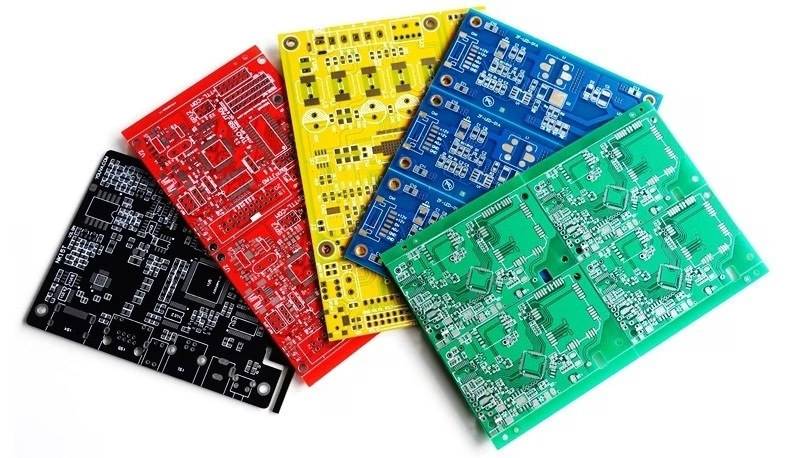
What is a High-Tg PCB?
High-Tg PCBs are circuit boards with a glass transition temperature (Tg) above 170°C, making them ideal for high-temperature environments. When a PCB exceeds its Tg, it softens, affecting performance. High-Tg materials offer better mechanical strength, chemical stability, and heat resistance, making them suitable for thermally intensive applications like CPU and GPU circuits.
Common high-Tg materials include Shengyi S1000-2, ISOLA 370HR, and ITEQ-IT 180L. For cost-effective solutions, FR4 TG130 balances thermal performance and affordability.
Features of High-Tg PCB
High-Tg PCBs are essential for high-performance electronics due to their superior thermal and mechanical properties. Their key features include:
| Material | CTE-z (ppm/℃) | Td (Wt, ℃) | Tg (DSC, ℃) | Td288 (min) | Td260 (min) |
| IT180 | 45 | 345 | 180 | 20 | 60 |
| S1141 (FR4) | 55 | 300 | 175 | / | 8 |
| Rogers 4350B | 50 | 390 | 280 | / | / |
| S1000-2M (FR4) | 45 | 345 | 180 | 20 | 60 |
Heat Dissipation Methods in High-Tg PCBs
High-Tg PCBs help protect electronics from excessive heat. There are three primary methods for dissipating heat in high-temperature PCBs:
- 1
Conduction
Transfers heat through direct contact with a heat sink, similar to electricity flowing through a system. Learn more about effective conduction techniques in conductive paint. - 2
Radiation
Uses electromagnetic waves to direct heat away from components. For further details, check out RF Amplifier, which explains how radiation aids in heat management. - 3
Convection
Convection dissipates heat by moving it through air or liquid, either naturally or with forced airflow from fans or pumps. This method enhances heat transfer efficiency, preventing overheating and ensuring the reliability of high-Tg PCBs.