

What is FR4?
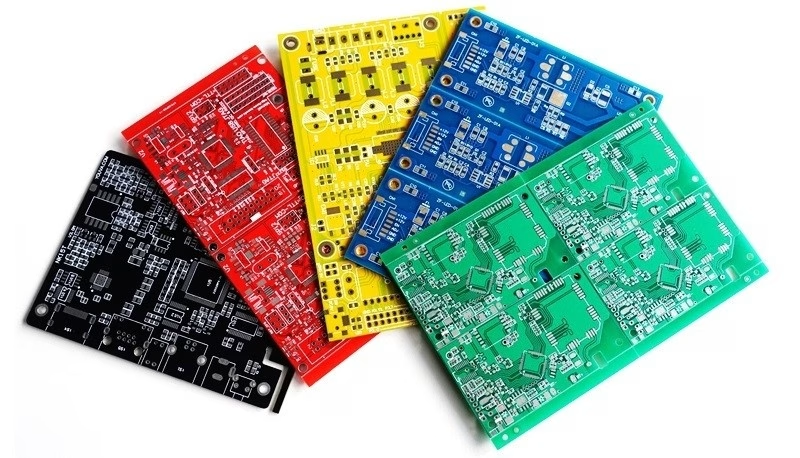
FR4 is a composite made up of woven glass fiber fabric bound together with an epoxy resin adhesive. It ranks among the most widely used substrate materials (i.e., base materials) for printed circuit boards (PCBs). Here, “FR” denotes “flame retardant,” while the “4” represents the material’s classification code for flame-resistant properties.
fr4 specifications are set by NEMA (National Electrical Manufacturers Association). Common fr4 PCB NEMA substrate grades are shown in the table below.
| Substrate Type | Grade | Material | Flame Retardant |
| Paper Substrate | XPC | Phenolic Resin Paper | No, UL94 HB |
| XXPC | Modified Phenolic Resin Paper | No, UL94 HB | |
| FR-1 | Flame Retardant Phenolic Resin Paper | Yes, UL94 V-1 | |
| FR-2 | Flame Retardant Phenolic Resin Paper | Yes, UL94 V-1 | |
| Glass Fabric Substrate | FR-4 | Epoxy Resin Glass Fabric | Yes, UL94 V-0 |
| FR-5 | Epoxy Resin Glass Fabric | Yes, UL94 V-0 | |
| Composite Substrate | CEM-1 | Epoxy Resin Paper and Glass Fabric | Yes, UL94 V-0 |
| CEM-3 | Epoxy Resin Glass Fabric and Glass Felt | Yes, UL94 V-0 |
What is the use of FR4 in the PCB Industry
1) Primary Insulating Materials
2) Copper Lamination
3) Multilayer PCBs
4) Surface Finishing
Key Benefits and Limitations of FR-4 in PCB Manufacturing
- Mechanical Strength:FR4 substrates stand out for their strong mechanical strength, a trait that preserves durability and resilience against physical stresses in both manufacturing and application processes.
- Electrical Insulation:FR4 delivers superior electrical insulation—a trait that helps ward off electrical shorts while ensuring reliable operation of circuits.
- Low Moisture Absorption: Its low moisture absorption allows FR4 to maintain stable electrical and mechanical properties even in humid environments.
- Thermal Resistance: FR4 excels at withstanding high temperatures, notably making it suitable for scenarios where heat dissipation is a key requirement.
- Flame Retardant: FR4 is characterized as a flame-retardant material—it minimizes the risk of fire, which in turn enhances the safety of electronic devices.
- Cost-Effectiveness: Compared to other high-performance PCB materials, FR4 is relatively cost-effective.
Disadvantages of FR-4
· Higher signal loss at high frequencies
· Lower thermal conductivity
For detailed information about FR4 PCBs, please refer to this article: 《FR4 PCB Material Guide: Properties, Types, and Applications》