RF Amplifiers: Powering Wireless Communication Guide
The guide delves into RF amplifiers, exploring their definition, historical evolution, principles, efficiency classes, design considerations and applications.
Get Your PCB Quote!
Table of Contents
- Kľúčové jedlá
- 1. Srdce bezdrôtovej komunikácie
- 2. Čo je to RF zosilňovač?
- 3. Stručná história a vývoj
- 4. Rozlišovanie typov zosilňovačov
- 5. Kľúčové parametre pri návrhu RF zosilňovača
- 6. Pochopenie tried účinnosti RF zosilňovačov
- 7. Pokročilé materiály vo RF zosilňovačoch
- 8. Rôzne aplikácie RF zosilňovačov
- 9. Návrhové úvahy pre optimálny výkon
- 10. VF zosilňovače Často kladené otázkys
- 11. zhrnutie
Key Takeaways
- RF amplifiers are critical for boosting weak radio frequency signals, enabling long-range wireless communication and overcoming signal loss.
- Efficiency classes(A-F) define an amplifier’s trade-off between linearity and power consumption, tailored for specific applications like high-fidelity or high-power transmission.
- Key design parameters include gain, bandwidth, linearity, efficiency, noise performance, and power handling, all crucial for optimal performance.
- Advanced materials like GaN and SiC are revolutionizing RF amplifier design, offering higher power density, efficiency, and thermal performance for modern systems.
- RF amplifiers are essential in diverse fields, including cellular networks, Wi-Fi, radar, satellite communication, broadcasting, and electronic warfare.
1. The Heart of Wireless Communication
In our increasingly connected world, seamless wireless communication is not just a convenience—it’s a necessity. From the smartphones in our pockets to sophisticated radar systems and vast satellite networks, the invisible waves of Radio Frequency(RF) signals carry the backbone of modern data exchange. At the very core of enabling these signals to travel far and wide, overcoming attenuation and interference, lies a critical component: the RF amplifier.
These electronic powerhouses are responsible for taking weak RF signals and boosting their amplitude, transforming them into robust outputs capable of reaching their intended destinations with clarity and reliability. Without RF amplifiers, wireless communication systems would be limited to incredibly short ranges, rendering much of our current technology impractical. This guide delves into the intricate world of RF amplifiers, exploring their definition, historical evolution, operational principles, efficiency classes, design considerations, and diverse applications that underscore their pivotal role in the digital age.
2. What is an RF Amplifier?
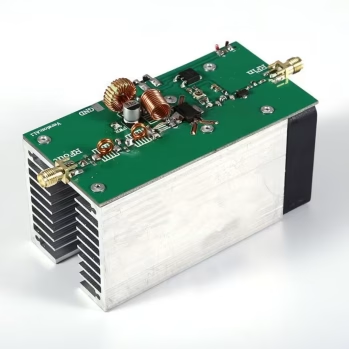
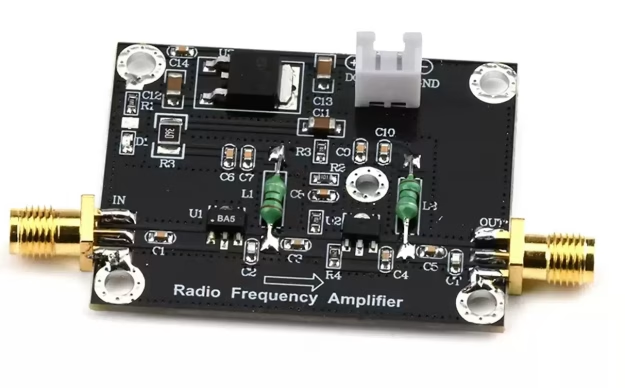
An RF(Radio Frequency) amplifier is an electronic device or circuit specifically designed to increase the power of a radio frequency signal. It serves as an essential component in a multitude of wireless communication systems, acting as the critical final stage in transmitter systems where it converts low-power RF signals into higher-power outputs suitable for antenna transmission.
The primary function of an RF amplifier is to boost the amplitude of an RF signal while meticulously maintaining its integrity and minimizing distortion. This amplification is crucial for several reasons: it enables signals to travel longer distances, compensates for signal losses experienced during transmission through various media, and ensures that the signal arrives at its destination with sufficient strength to be effectively processed and understood. Operating at high frequencies, typically ranging from megahertz(MHz) to gigahertz(GHz), RF amplifiers are engineered to handle the unique challenges presented by these higher frequencies, distinguishing them from other types of amplifiers.
3. A Brief History and Evolution
The journey of the RF amplifier is deeply intertwined with the history of radio technology itself. Its development dates back to the early 20th century, primarily beginning with the invention of the vacuum tube amplifier. These early amplifiers were bulky, consumed significant power, and generated a lot of heat, yet they laid the foundational principles for signal amplification.
Over the years, significant advancements in semiconductor technology revolutionized RF amplifier design. The transition from vacuum tubes to transistors, particularly bipolar junction transistors(BJTs) and later field-effect transistors(FETs), allowed for the creation of smaller, more efficient, and more reliable amplifiers. This evolution continued with the advent of Integrated Circuits(ICs), enabling complex amplifier designs to be miniaturized and mass-produced, making wireless communication ubiquitous. Modern RF amplifiers leverage advanced materials and sophisticated designs to achieve superior performance metrics, pushing the boundaries of what’s possible in wireless communication.
4. Differentiating Amplifier Types
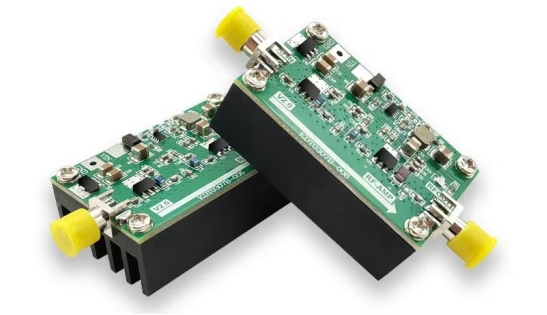
Within the broad realm of signal augmentation, amplifiers serve distinct functions tailored to specific signal characteristics. While all amplifiers increase signal power, their design and application vary significantly:
- Audio Amplifiers:These are crafted for the enhancement of audio signals within the audible frequency spectrum. They are crucial for applications ranging from music reproduction in home theater systems to public address systems, ensuring sound is clear and robust.
- RF(Radio Frequency) Amplifiers:As discussed, these specialized amplifiers undertake the task of fortifying high-frequency radio waves. They are indispensable in wireless communication networks, radar technology, and various domains entailing the propagation and capture of high-frequency transmissions.
- Digital Amplifiers(Class-D):Also recognized as switching amplifiers, digital amplifiers are tailored to elevate digital signals. They prominently feature in contemporary audio amplification systems, lauded for their efficiency and compact stature, often converting analog signals to a pulse-width modulated(PWM) digital signal before amplification.
The key distinction lies in the frequency range they operate within and the specific characteristics(like linearity vs. efficiency) they prioritize, which dictate their design and material choices.
5. Key Parameters in RF Amplifier Design
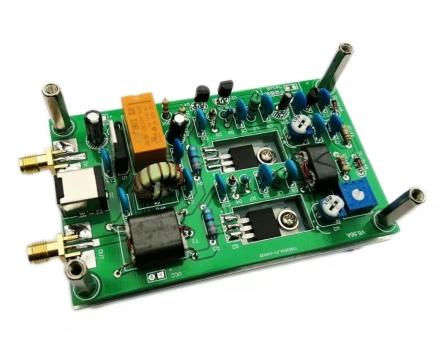
Designing an RF amplifier is a complex task that requires careful consideration of several critical parameters to ensure optimal performance for a given application. These parameters define an amplifier’s capabilities and limitations:
- Gain:This is a measure of how much an amplifier increases the power or amplitude of a signal. It’s typically expressed in decibels(dB) and is a fundamental specification, indicating the amplifier’s ability to boost weak signals.
- Bandwidth:Bandwidth refers to the range of frequencies over which the amplifier can operate effectively. A wide bandwidth allows an amplifier to handle a broader spectrum of signals simultaneously, which is crucial for multi-channel communication systems.
- Linearity:Linearity describes the amplifier’s ability to reproduce the input signal without introducing distortion. High linearity is vital for complex modulation schemes(like QAM), where signal integrity is paramount, ensuring that the amplified signal accurately represents the original information.
- Efficiency:Amplifier efficiency is the ratio of the output RF power to the DC input power. High efficiency is crucial, especially in battery-powered devices and high-power transmitters, as it reduces heat generation and power consumption, extending battery life and lowering operational costs.
- Noise Performance:Measured by the noise figure(NF), this parameter indicates how much noise the amplifier adds to the signal. A low noise figure is critical, especially in receiver applications, to ensure that weak signals can still be accurately detected amidst system noise.
- Power Handling:This refers to the maximum output power an amplifier can deliver without damage or significant performance degradation. It’s a key consideration for high-power applications like broadcast transmitters or radar systems.
6. Understanding RF Amplifier Efficiency Classes
RF amplifier efficiency classes categorize amplifiers based on their conduction angle, which dictates their trade-offs between linearity and power consumption. Each class is optimized for specific applications, balancing the need for signal fidelity with energy conservation.
| Class | Conduction Angle | Typical Efficiency | Key Characteristics | Ideal Applications |
| A | 360° | 20-50% (often 25%) | Highly linear, lowest distortion, always conducting. | Precision lab equipment, high-fidelity audio, low-power applications where linearity is critical. |
| B | 180° | 50-78.5% | Less linear than Class A, Push-pull configuration for full signal. | Public address systems, radio communication where some distortion is acceptable. |
| AB | 180-360° (slightly more than 180°) | 50-70% (better than A, less than B) | Compromise between Class A linearity and Class B efficiency, reduces crossover distortion. | High-fidelity audio, RF transmitters requiring good linearity and efficiency balance. |
| C | Less than 180° | 60-85% | High efficiency, highly non-linear, uses resonant circuit for output. | FM transmitters, radar systems, high-power RF applications where linearity isn’t paramount. |
| D | Switching operation | 80-90% | Operates devices as switches (on/off), high efficiency, requires output filter. | Digital audio (Class-D audio amplifiers), high-power switching applications, some RF. |
| E | Switching operation | 80-90% | Designed for very high efficiency with a single switch, reduces switching losses. | High-frequency RF power amplifiers, wireless power transfer. |
| F | Switching operation with harmonic tuning | 90% and above | Utilizes harmonic termination for higher efficiency by shaping voltage/current waveforms. | High-power RF transmitters, base stations, microwave applications . |
| G/H | Varying supply voltage | Variable (high) | Dynamically adjusts supply voltage to reduce power dissipation, improves average efficiency. | Audio amplifiers, some RF applications needing high efficiency with dynamic power. |
Class C amplifiers, for instance, are notable for delivering up to 85% efficiency, but they achieve this by sacrificing linearity, making them ideal for applications like FM transmitters and radar where the signal is either constant amplitude or specific harmonic content can be filtered. In contrast, Class A amplifiers offer the highest linearity but at significantly lower efficiency, often around 20-50%, making them suitable for precise laboratory equipment and high-fidelity audio where signal purity is paramount.
7. Advanced Materials in RF Amplifiers
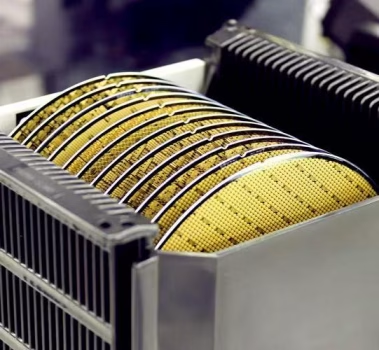
The pursuit of higher efficiency, increased power density, and improved thermal performance in RF amplifiers has led to the adoption of advanced semiconductor materials. Traditional silicon-based devices have their limitations, especially at higher frequencies and power levels. Modern RF amplifiers are increasingly leveraging Wide Band Gap(WBG) semiconductors:
- Gallium Nitride(GaN):GaN is a revolutionary material for RF applications due to its high electron mobility and breakdown voltage. GaN amplifiers can operate at higher temperatures and frequencies than silicon devices, providing superior power density and efficiency. This makes them ideal for 5G infrastructure, radar systems, and aerospace applications where size, weight, and power(SWaP) are critical considerations.
- Silicon Carbide(SiC):SiC also boasts excellent thermal conductivity and high breakdown voltage. While often used in power electronics for higher voltage applications, SiC is increasingly being explored for RF power devices, offering robustness and efficiency benefits, particularly in high-power, high-frequency environments.
These advanced materials allow for the development of RF amplifiers that are smaller, more efficient, and capable of handling greater power outputs, directly contributing to the advancements seen in modern wireless communication systems.
8. Diverse Applications of RF Amplifiers
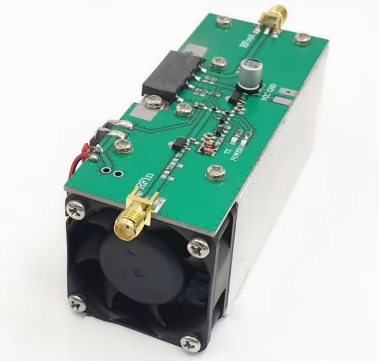
RF amplifiers are truly the unsung heroes behind much of our daily technology. Their ability to boost signals makes them indispensable across a vast array of industries and applications:
- Wireless Communication Systems:This is the most prevalent application. RF amplifiers are central to cellular networks(2G, 3G, 4G, 5G), Wi-Fi routers, Bluetooth devices, and satellite communications. They ensure that signals from your phone reach the nearest cell tower and that satellite dishes can transmit and receive data from orbiting spacecraft.
- Radar Systems:In military, aviation, and weather forecasting, radar systems rely on powerful RF amplifiers to transmit signals over long distances and receive faint echoes, enabling detection, ranging, and mapping.
- Broadcast Transmitters:Radio and television broadcasting stations use high-power RF amplifiers to send signals across wide geographical areas, reaching countless homes and devices.
- Electronic Warfare(EW):In defense applications, RF amplifiers are used in jamming systems, electronic countermeasures, and signal intelligence, playing a critical role in controlling the electromagnetic spectrum.
- Medical Devices:MRI machines and other diagnostic imaging equipment utilize RF amplifiers for generating and detecting high-frequency signals.
- Industrial Heating:Some industrial processes, such as plasma generation and RF welding, employ high-power RF amplifiers.
- Test and Measurement Equipment:Laboratories and manufacturing facilities use RF amplifiers in signal generators, spectrum analyzers, and network analyzers for testing and characterizing other RF components and systems.
The versatility and necessity of RF amplifiers highlight their foundational role in modern technology, continuously evolving to meet the demands of new communication paradigms.
9. Design Considerations for Optimal Performance
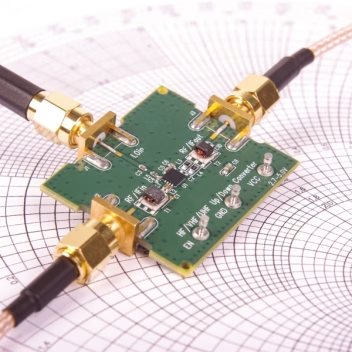
Designing an RF amplifier is a nuanced process that demands a holistic approach, considering the interplay of multiple factors to achieve optimal performance for a specific application. Beyond the key parameters discussed earlier(gain, bandwidth, linearity, efficiency, noise performance, power handling), several other critical considerations guide the design process:
- Matching Networks:Impedance matching is paramount in RF design. Input and output matching networks are crucial for maximizing power transfer between the amplifier and its preceding/succeeding stages(e.g., antenna, filter). Poor matching can lead to reflections, power loss, and instability.
- Stability:RF amplifiers can be prone to oscillation if not designed carefully. Stability analysis and the incorporation of stabilization techniques(e.g., resistive loading, feedback loops) are essential to prevent unwanted self-oscillation.
- Thermal Management:High-power RF amplifiers generate significant heat, especially those with lower efficiency classes. Effective thermal management, including heatsinks, fans, and appropriate PCB layouts, is critical to prevent device failure and ensure long-term reliability. Advanced materials like GaN and SiC help manage heat better, but cooling is still a key concern.
- Power Supply Design:A stable and clean power supply is vital for optimal amplifier performance. Noise and ripple on the power rails can degrade linearity and introduce unwanted spurs in the RF signal.
- Packaging:The physical packaging of the amplifier can significantly impact its performance, especially at higher frequencies. Parasitic inductances and capacitances introduced by the package must be minimized.
- Cost and Manufacturability:Practical design also involves balancing performance goals with cost constraints and ease of manufacturing. Component selection, PCB layout, and assembly processes all contribute to the final product’s cost and reliability.
Successful RF amplifier design requires a deep understanding of RF theory, careful component selection, advanced simulation tools, and rigorous testing to navigate these complex considerations and deliver a robust, high-performance solution.
10. RF Amplifier FAQs
The main purpose of an RF amplifier is to boost the power or amplitude of a weak radio frequency signal, enabling it to travel longer distances, overcome signal losses, and be reliably transmitted or received in wireless communication systems.
Different applications have varying requirements regarding linearity, efficiency, and power consumption. The various efficiency classes(A, B, C, D, E, F, etc.) represent different trade-offs between these factors, allowing engineers to select the most suitable amplifier type for specific needs, from high-fidelity audio to high-power radar.
Gallium Nitride(GaN) and Silicon Carbide(SiC) offer superior properties compared to traditional silicon, such as higher electron mobility, higher breakdown voltage, and better thermal conductivity. This allows RF amplifiers built with these materials to achieve higher power density, operate at higher frequencies and temperatures, and attain greater efficiency, leading to smaller, more powerful, and more robust devices.
11. Summary
RF amplifiers are indispensable electronic components that form the backbone of modern wireless communication and countless other advanced technologies. By boosting weak radio frequency signals, they enable long-distance transmission, counteract signal attenuation, and ensure reliable data exchange across diverse applications, from everyday cellular networks to sophisticated radar systems. Understanding their definition, historical evolution, and the critical design parameters such as gain, bandwidth, linearity, and efficiency is crucial for engineers and enthusiasts alike.
The variety of RF amplifier efficiency classes(A through F and beyond) highlights the necessary trade-offs between signal purity and power conservation, with specific classes optimized for distinct use cases. Furthermore, the advent of advanced materials like Gallium Nitride(GaN) and Silicon Carbide(SiC) continues to push the boundaries of performance, leading to more compact, powerful, and energy-efficient designs. As wireless technology continues its rapid advancement, the role of the RF amplifier remains as pivotal as ever, driving innovation in connectivity and communication.
Table of Contents
- Kľúčové jedlá
- 1. Srdce bezdrôtovej komunikácie
- 2. Čo je to RF zosilňovač?
- 3. Stručná história a vývoj
- 4. Rozlišovanie typov zosilňovačov
- 5. Kľúčové parametre pri návrhu RF zosilňovača
- 6. Pochopenie tried účinnosti RF zosilňovačov
- 7. Pokročilé materiály vo RF zosilňovačoch
- 8. Rôzne aplikácie RF zosilňovačov
- 9. Návrhové úvahy pre optimálny výkon
- 10. VF zosilňovače Často kladené otázkys
- 11. zhrnutie
Get Your PCB Quote!