SMA vs. BNC: 7 Key Differences You Need to Know
Discover the best RF connector for your project. From high-frequency SMA for GPS and Wi-Fi to quick-connect BNC for oscilloscopes and CCTV surveillance systems.
Get Your PCB Quote!
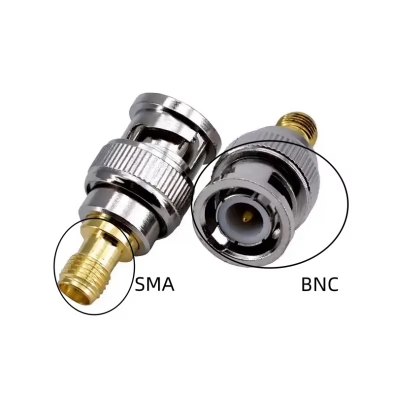
Table of Contents
- Points clés à retenir
- 1. Pourquoi les connecteurs RF sont importants?
- 2. Comprendre les connecteurs SMA
- 3. Exploration des connecteurs BNC
- 4. SMA vs. BNC : Principales différences en bref
- 5. Comparaison approfondie : 7 différences clés
- 6. Choisir le bon connecteur : un guide pratique
- 7. Applications concrètes : les points forts de chaque connecteur
- 7. FAQ sur les connecteurs SMA et BNC
- 8. Résumé
Table of Contents
- Points clés à retenir
- 1. Pourquoi les connecteurs RF sont importants?
- 2. Comprendre les connecteurs SMA
- 3. Exploration des connecteurs BNC
- 4. SMA vs. BNC : Principales différences en bref
- 5. Comparaison approfondie : 7 différences clés
- 6. Choisir le bon connecteur : un guide pratique
- 7. Applications concrètes : les points forts de chaque connecteur
- 7. FAQ sur les connecteurs SMA et BNC
- 8. Résumé
Key Takeaways
- SMAis ideal for high-frequency (up to 18 GHz+) applications needing stable, precise connections.
- BNCis perfect for lower-to-medium frequency (up to 2-4 GHz) uses requiring quick connect/disconnect and high durability.
- Always match the impedance (50 Ohm for RF, 75 Ohm for video ) to avoid signal degradation.
- The locking mechanism (threaded vs. bayonet) dictates ease of use and vibration resistance.
- Choosing the correct antenna connector is vital to avoid damage and ensure system compatibility.
- Size is a deciding factor for PCB design: SMA’s sub-miniature form factor fits high-density boards and portable devices; BNC’s larger footprint suits bench equipment and field setups where easy hand connection matters.
1. Why RF Connectors Matter?
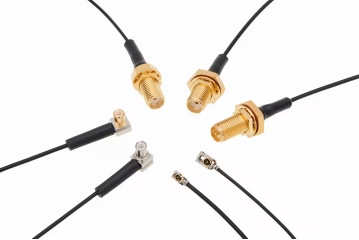
In the intricate world of radio frequency (RF) technology, seemingly small components can play an enormous role in system performance. Among these “unsung heroes” are RF connectors, the crucial links that ensure seamless signal transmission across a myriad of devices and systems. Whether you’re a seasoned engineer designing complex high-frequency boards or a hobbyist setting up your first radio, the choice of connector isn’t a minor detail—it’s paramount for preserving signal integrity and preventing hidden headaches. Choosing the wrong connector can lead to compatibility issues, degraded performance, or even damage to your equipment.
Among the vast array of coaxial connectors, the SMA (Sub-Miniature A) and BNC (Bayonet Neill-Concelman) types stand out as two of the most commonly encountered. While both perform the basic function of joining coaxial cables, their distinct characteristics make them suitable for vastly different applications. This comprehensive guide will delve into the fundamental differences between SMA and BNC connectors, helping you confidently pick the right gear and optimize your RF setup.
2. Understanding SMA Connectors
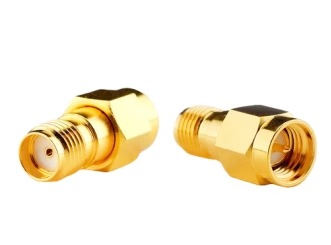
SMA connectors are compact, threaded RF connectors renowned for their high-frequency capabilities and precision. Developed in the 1960s, they are designed for frequencies typically up to 18 GHz, and sometimes even higher with specialized versions. The “Sub-Miniature” in their name highlights their small form factor, which is crucial for modern, compact electronic devices.
Key Characteristics of SMA Connectors:
- Threaded Coupling:SMA connectors utilize a screw-on threaded mechanism, which provides a secure, vibration-resistant connection. This firm coupling ensures excellent electrical contact and minimal signal loss, especially at higher frequencies.
- High Frequency Performance:Their design, which often includes a dielectric material like PTFE (polytetrafluoroethylene), minimizes reflections and maintains a constant impedance, making them ideal for high-frequency applications.
- Standard Impedance:SMA connectors are predominantly 50-ohm impedance, matching the requirements of most RF and microwave systems.
- Durability:While small, their robust threaded design offers good mechanical stability. However, they are not designed for frequent mating cycles due to the wear and tear on the threads.
Commonly found in wireless communication modules, Wi-Fi antennas, GPS receivers, microwave components, and various high-frequency test equipment, SMA connectors are the go-to choice when signal integrity at higher frequencies and a stable connection are paramount.
3. Exploring BNC Connectors
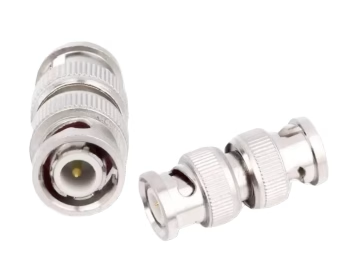
BNC connectors, short for “Bayonet Neill-Concelman” were invented in the late 1940s and quickly became a standard for low-to-medium frequency coaxial connections. Their most distinguishing feature is the bayonet-style coupling mechanism, which allows for quick and easy connect and disconnect cycles, making them incredibly popular in environments requiring frequent changes.
Key Characteristics of BNC Connectors:
- Bayonet Coupling:The signature quarter-turn bayonet lock enables rapid connection and disconnection without threading. This convenience makes them a favorite for test benches and field applications.
- Frequency Range:BNC connectors typically perform well up to 2-4 GHz, although specialized versions can extend this slightly. Beyond this range, their electrical characteristics, such as increased return loss, can degrade signal quality.
- Impedance Options:While 50-ohm versions are common for RF applications, 75-ohm BNC connectors are widely used in video transmission and broadcast environments.
- Robustness:The bayonet mechanism is robust and designed for a high number of mating cycles, making them excellent for dynamic environments.
BNC connectors are ubiquitous in video surveillance systems, broadcast equipment, laboratory test and measurement instruments, and older Ethernet networks (10BASE2). Their ease of use and reliability for lower frequency ranges have cemented their place in countless applications.
4. SMA vs. BNC: Key Differences at a Glance
To help visualize the primary distinctions, here’s a quick comparison table outlining the core differences between these two prevalent RF connectors:
| Feature | SMA Connector | BNC Connector |
| Locking Mechanism | Threaded (screw-on) | Bayonet (quarter-turn twist) |
| Frequency Range | Up to 18 GHz (some higher) | Typically up to 2-4 GHz |
| Impedance | Predominantly 50 Ohm | 50 Ohm and 75 Ohm (video) |
| Size | Sub-Miniature, compact | Larger than SMA |
| Signal Integrity | Excellent at high frequencies | Good at low-to-medium frequencies |
| Durability/Mating Cycles | Good mechanical stability, less for frequent mating | Very durable, high mating cycles |
| Common Applications | GPS, Wi-Fi, cellular, microwave, high-frequency test equipment | Test & measurement, video, broadcast, surveillance, older networking |
| Cost | Generally moderate to higher (for precision) | Generally lower |
5. In-Depth Comparison: 7 Key Differences
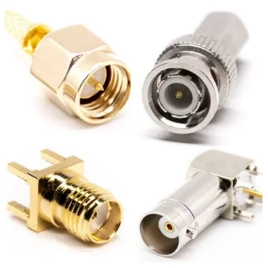
While the table provides a concise overview, let’s explore these differences in more detail to understand their practical implications.
5.1 Coupling Mechanism: Threaded vs. Bayonet
This is the most immediately visible difference and has the most direct impact on day-to-day usability.
SMA’s threaded coupling creates a mechanically tight joint that resists vibration, pull-out, and movement. Once tightened to the correct torque (typically 3–5 in-lb for standard SMA), the connection is extremely stable. The downside is time: threading takes longer than a bayonet lock, and repeated overtightening will damage the threads or the center pin of the mating connector.
BNC’s bayonet lock is engineered for speed. Push, rotate 90°, and the two spring-loaded pins engage. The entire operation takes under a second. This makes BNC the natural choice for oscilloscope probes, signal generator outputs, and any setup that changes frequently throughout the working day. The trade-off is that the bayonet provides less resistance to sustained vibration — in high-vibration environments like vehicles or industrial equipment, the BNC may work loose over time.
5.2 Frequency Range and Signal Integrity
This is the technically decisive difference between SMA and BNC.
SMA connectors are precision-engineered to maintain a consistent 50Ω impedance from DC up to 18 GHz. The small geometry of the connector, combined with PTFE dielectric and a tight threaded fit, minimizes parasitic inductance and capacitance that would otherwise degrade signal at high frequencies. Specialized versions (SMA-P, 3.5 mm compatible) extend the usable range beyond 26.5 GHz, covering the frequencies used in 5G mmWave, satellite downlinks, and advanced radar systems.
BNC connectors begin to show measurable performance degradation above 1–2 GHz due to impedance discontinuities in the larger bayonet geometry. While rated to 2–4 GHz depending on grade, real-world return loss and insertion loss start climbing well before that upper limit. For any application above 4 GHz — including modern 802.11ac/ax Wi-Fi, LTE, and all 5G bands — BNC is not a viable choice.
5.3 Impedance Matching
SMA connectors are manufactured almost exclusively to 50Ω. This makes component selection straightforward: every SMA cable, adapter, and connector in a standard RF bill of materials shares the same impedance. No accidental mismatch.
BNC connectors are available in both 50Ω and 75Ω variants. The 50Ω version is used for general RF work. The 75Ω version is the broadcast video standard — it matches the characteristic impedance of RG-59 and RG-6 coaxial cable used for analog video, HD-SDI, and 3G-SDI signals. Physically, 50Ω and 75Ω BNC connectors can mate with each other, but the impedance mismatch introduces reflections. In a video system, this causes signal artifacts; in an RF measurement setup, it corrupts the measurement. Always verify impedance before mixing BNC hardware.
5.4 Size and PCB Form Factor
SMA’s sub-miniature dimensions make it the standard RF connector interface for modern PCB-mounted wireless hardware. Edge-mount and end-launch SMA connectors add minimal height to a board and are compatible with automated PCB assembly processes. For IoT devices, drones, handheld instruments, and any battery-powered wireless product, SMA is the practical choice.
BNC’s larger body makes it impractical for most PCB mounting in portable devices, but it is well-suited for panel-mount applications on bench equipment. The larger connector body also accommodates larger-diameter coaxial cable, which is relevant for broadcast video installations where cable runs are long and cable quality matters for signal-to-noise ratio.
5.5 Ease of Use and Connection Speed
For a test engineer running hundreds of measurements per day, BNC’s quarter-turn connect/disconnect saves hours of time over a year. There is no contest here: if the application involves frequent manual connections in a lab environment, BNC’s ergonomics are superior.
For a field engineer installing a permanent antenna connection or commissioning a production wireless module, SMA’s threaded connection provides confidence that the joint will not loosen during transport, vibration, or temperature cycling. The extra time required to thread the connector is irrelevant when the connection is semi-permanent.
5.6 Durability and Mating Cycles
BNC connectors are rated for a high number of mating cycles. The spring-loaded bayonet mechanism distributes mechanical stress, and the relatively large contact surfaces maintain good electrical contact even after thousands of cycles. For test equipment that gets connected and disconnected daily, BNC is the more durable choice over its service lifetime.
SMA connectors are rated for approximately 500 mating cycles under standard conditions. For this reason, best practice in lab and test environments is to protect SMA ports on expensive instruments with BNC-to-SMA adapters or SMA barrel connectors that absorb the wear — extending the life of the underlying port significantly.
5.7 Cost and Availability
BNC connectors are manufactured in very high volumes and are available from a wide range of suppliers at low cost. Standard 50Ω BNC connectors and cables are commodity items.
SMA connectors require tighter manufacturing tolerances to maintain consistent 50Ω impedance at GHz frequencies. This precision manufacturing makes them more expensive, particularly for high-grade versions intended for measurements above 12 GHz. For production volumes, the cost difference is manageable; for hobbyist or low-volume work, BNC is the budget-friendly option when frequency requirements allow.
6. Choosing the Right Connector: A Practical Guide
Use these decision criteria when selecting between SMA and BNC for a new project:
- Operating frequency above 4 GHz?Use SMA. No exceptions — BNC cannot maintain adequate signal integrity above this threshold.
- Frequent manual connect/disconnect in a lab?Use BNC. The bayonet lock is faster and the connector is rated for more cycles.
- Mounting on a compact PCB or portable device?Use SMA. The sub-miniature form factor is designed for this.
- Video transmission (CCTV, broadcast, SDI)?Use 75Ω BNC. This is the industry standard and no other connector matches it in this application.
- High vibration environment (vehicle, industrial)?Use SMA. The threaded coupling is significantly more resistant to loosening under vibration than BNC’s bayonet.
- Budget-constrained project below 2 GHz?BNC connectors and cables are commodity items and significantly cheaper than comparable SMA components.
7. Real-World Applications: Where Each Connector Shines
Understanding the technical differences translates directly into practical application choices:
Where SMA Connectors Excel :
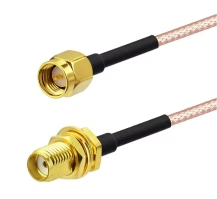
- Wireless Communication:Critical for cellular base stations, Wi-Fi routers (especially on the antenna side), GPS modules, and other high-frequency wireless devices where signal transmission quality is paramount.
- Microwave Components:Used extensively in filters, amplifiers, mixers, and oscillators operating in the GHz range.
- High-Frequency Test Equipment:Precision instruments like spectrum analyzers and network analyzers often use SMA to ensure accurate measurements.
- Compact Devices :Their small size makes them ideal for drones, portable radios, and embedded systems where space is a premium.
Where BNC Connectors Excel:
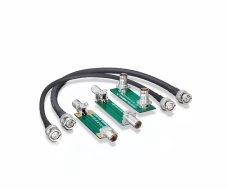
- Test and Measurement:Found on oscilloscopes, function generators, and other lab equipment where quick, repeatable connections are essential for prototyping and diagnostics.
- Video Surveillance and Broadcast:The 75-ohm BNC is the standard for connecting CCTV cameras, monitors, and professional video equipment.
- Amateur Radio & Field Communications:Their robust nature and ease of use make them popular for antennas and radios in mobile or field-deployable setups.
- Legacy Networking:Historically used in 10BASE2 Ethernet (thin net) networks.
Ultimately, the choice hinges on your specific requirements: is it raw frequency performance and a secure, vibration-resistant connection, or is it rapid connect/disconnect capability and robust durability for lower-frequency signals? Considering these factors will lead you to the most suitable RF connector for your project.

7. SMA & BNC Connector FAQs
Not directly. You would need an adapter (e.g., SMA male to BNC female) to connect them. However, using adapters can introduce some signal loss and potentially affect performance, especially at higher frequencies.
Yes, with an SMA-to-BNC adapter. These are widely available. However, the system will be limited by BNC’s frequency ceiling (2–4 GHz), and the adapter itself introduces a small amount of insertion loss and potential impedance discontinuity. For any application above 4 GHz, an adapter is not a viable solution — the hardware needs to be redesigned with SMA throughout.
Standard SMA and BNC connectors are not inherently waterproof or weatherproof. Specialized versions with seals and gaskets are available for outdoor or harsh environment applications, but always check the product specifications.
50 Ohm is the standard impedance for most RF and wireless communication systems, optimizing power transfer. 75 Ohm is typically used for video and broadcast applications, matching the impedance of video cables for optimal signal integrity in those specific contexts.
It depends on the hobby. For amateur radio or test bench setups involving frequent connections and lower frequencies, BNC is often more convenient. For DIY Wi-Fi antenna projects or compact SDRs, SMA is usually the standard. Always check your equipment’s specific connector type.
Impedance matching ensures that the impedance of the source, transmission line, and load are all equal (typically 50 or 75 ohms in RF systems). Mismatched impedance causes signal reflections, leading to power loss, standing waves, and signal distortion, which can severely degrade performance, especially at higher frequencies.
At frequencies below 100 MHz, impedance mismatch has minimal practical impact — the wavelength is long enough that reflections do not significantly affect signal quality. As frequency increases toward 1 GHz and above, even a small impedance discontinuity causes measurable return loss. At microwave frequencies, incorrect impedance is one of the primary causes of system performance problems. Always match impedance in RF work above 500 MHz.
Yes, 75-ohm BNC connectors are widely used for digital video signals, such as SDI (Serial Digital Interface) in broadcast and professional video applications. They are also used for digital audio (S/PDIF). However, their frequency limitations mean they are not suitable for very high-speed digital data like modern Ethernet.
8. Summary
The world of RF connectors, while seemingly minor, is critical to the performance and reliability of countless electronic systems. The SMA and BNC connectors, though both coaxial, serve distinct purposes driven by their unique mechanical and electrical characteristics. SMA connectors are the champions of high-frequency precision and compact design, ideal for demanding wireless and microwave applications where signal integrity is paramount. BNC connectors, on the other hand, excel in versatility, quick connectivity, and robust durability for lower-to-medium frequency environments, making them staples in test equipment and video systems. Understanding their core differences in frequency range, impedance, locking mechanism, and application ensures that you select the perfect connector, preventing compatibility nightmares and optimizing your system’s performance.
Get Quote Free