
What is Teflon PCB
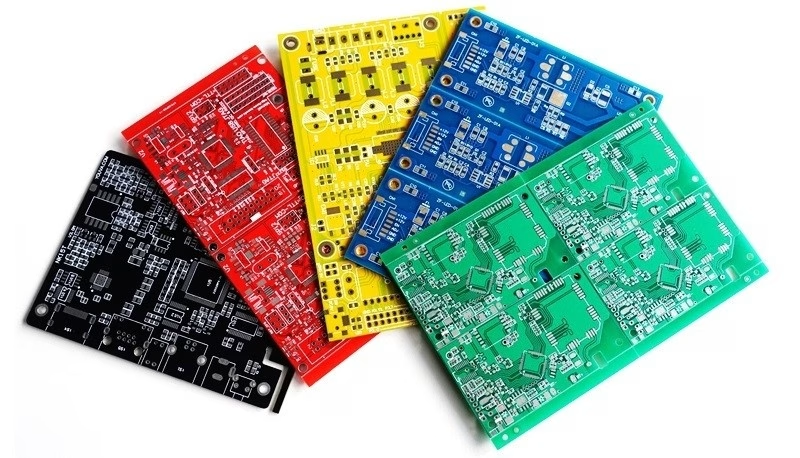
Teflon PCB, also known as Polytetrafluoroethylene (PTFE) PCB, is a specialized type of printed circuit board widely used in high-performance electronics. This material is characterized by its unique properties, such as resistance to acids and alkalis, resistance to various organic solvents, and its almost insolubility in all solvents, along with high-temperature resistance and low friction coefficient. These features make Teflon PCBs important in high-end electronic products. The manufacturing process of Teflon PCBs involves the use of high-performance materials that possess a range of excellent properties, including resistance to extreme temperatures, corrosion, weather, high insulation, high lubricity, non-adhesion, and non-toxicity.
PTFE was discovered by Roy Plunkett at DuPont in 1938. While famously known for non-stick coatings , its electrical properties—low dielectric constant (Dk) and ultra-low dissipation factor (Df)—make it the industry standard for RF and high-speed digital circuits. Unlike traditional boards, a Teflon PCB maintains its electrical characteristics across a massive frequency range, from 1 MHz to over 100 GHz.
Advantages and Disadvantages of Teflon PCBs
Advantages of Teflon PCBs:
- High-Temperature Resistance: Teflon PCBs can operate in a wide temperature range, with a maximum temperature of up to 260°C, allowing them to maintain good performance in high-temperature environments.
- Low-Temperature Resistance: Even at extremely low temperatures, Teflon PCBs retain some flexibility and mechanical toughness, making them less prone to brittleness.
- Corrosion Resistance: Teflon PCBs exhibit inertness to most chemicals and solvents, being able to withstand strong acids, strong alkalis, and various organic solvents, enabling stable operation in harsh environments.
- High Insulation: Teflon PCBs have excellent electrical insulation properties, effectively resisting high voltage and ensuring stable circuit board operation.
- Non-Adhesion: With extremely low surface tension, Teflon PCBs do not easily adhere to any substances, making cleaning and maintenance relatively easy.
- High Lubricity: Teflon has a relatively low friction coefficient among solid materials, helping to reduce friction and wear between various components on the circuit board.
Disadvantages of Teflon PCBs:
- Cold Flow: Teflon material exhibits a certain degree of cold flow, which may cause slight changes in the shape and size of the material in certain applications.
- Processing Difficulty: Due to the special properties of Teflon PCBs, such as high lubricity and non-adhesion, processing them can be relatively challenging. Issues like gas erosion or tearing may occur during PCB routing and drilling.
- Higher Cost: Compared to traditional FR-4 materials, Teflon PCBs have a significantly higher cost, primarily due to their special production processes and material costs.
In summary, Teflon PCBs offer significant advantages in terms of high temperature, low temperature, corrosion resistance, insulation, and lubricity. However, they also present challenges such as cold flow, processing difficulty, and higher costs.
Thermal and Chemical Resilience
Teflon PCBs offer mechanical and chemical stability that exceeds most organic substrates. This resilience is a requirement for aerospace and industrial applications where environmental exposure is common.
- Operating Temperature: PTFE maintains its properties from -200°C to +260°C. This wide window accommodates both cryogenic applications and high-heat power electronics.
- Glass Transition Temperature (Tg): With a Tg exceeding 280°C, PTFE outperforms standard High-Tg FR4 (170°C). This prevents delamination during rigorous soldering cycles and reflow.
- Chemical Inertness: PTFE resists acids , bases, and solvents. This is useful for medical devices requiring sterilization or industrial sensors exposed to corrosive fluids.
- Low Moisture Absorption: At less than 0.01%, PTFE is virtually impervious to humidity. In marine or high-altitude environments, moisture absorption in FR4 can cause Dk shifts; PTFE remains stable.
PTFE vs. FR4
The decision to move from FR4 to PTFE involves a trade-off between performance and cost. The following table highlights the technical disparities between the two materials.
| Property | Standard FR4 | PTFE (e.g., Rogers 5 880) | Impact on Design |
| Dielectric Constant (Dk ) | 4.3 – 4.8 | 2.1 – 2.2 | PTFE enables faster signal speed and smaller traces. |
| Diss ipation Factor (Df) | 0.015 – 0.025 | 0.0004 – 0.0009 | PTFE significantly reduces signal attenuation . |
| Moisture Absorption | 0.10% – 0.2 0% | <0.01% | PTFE provides higher stability in humid environments . |
| Coefficient of Thermal Expansion (Z-axis) | 5 0 – 70 ppm/°C | ~170 ppm/°C (Unfilled) | PTFE requires ceramic/glass filling to stabilize vias. |
| Surface Roughness | Moderate | Extremely Low | PTFE facilitates better high-frequency signal integrity. |
Specialized Material Variants and Fillers
Pure PTFE is physically soft and has a high coefficient of thermal expansion (CTE). To make it practical for PCB manufacturing, laminates are often reinforced with fillers.
Woven Glass Reinforced PTFE
Laminates like the Taconic TLY series use woven fiberglass to improve dimensional stability and mechanical strength. This reinforcement prevents the material from “cold flowing” or deforming under pressure. These are common in 77 GHz automotive radar systems where mechanical rigidity is necessary for mounting.
Ceramic-Filled PTFE
By adding ceramic particles, manufacturers can tailor the dielectric constant. Rogers RO3003, for example, achieves a Dk of 3.0 . Ceramic fillers also significantly lower the CTE, bringing it closer to the CTE of copper. This reduces stress on plated through-holes ( PTH) during thermal cycling, preventing via cracking.
Microfiber Glass Reinforced PTFE
Using randomly oriented microfibers instead of a woven structure (e.g., RT/duroid 5880 ) results in the lowest possible Dk and Df. This is the material of choice for military-grade radar and satellite communications where loss must be minimized at all costs.
| Material Grade | Common Product | Dk @ 10GHz | Primary Application |
| Microfiber PTFE | Rogers RT/duroid 5880 | 2.20 | Satellite Communications, Military Radar |
| Ceramic-Filled PTFE | Rogers RO3003 | 3.00 | 5G Infrastructure, Automotive Radar |
| Woven Glass PTFE | Tac onic TLY-5 | 2.20 | LNBs, Power Amplifiers |
Manufacturing Challenges and Surface Preparation
Fabricating a Teflon PCB is significantly more complex than standard FR4. Process engineers must account for the material’s unique physical properties to avoid yield loss.
The Adhesion Problem
PTFE’s “non-stick” nature is a liability in PCB manufacturing. Copper foil does not naturally bond well to PTFE. To ensure a reliable bond, manufacturers must use specialized surface treatments:
- Sodium Etching: A chemical process using sodium naphthalene to strip fluorine atoms from the PTFE surface, creating a bondable layer. This is highly effective but requires careful handling of aggressive chemicals.
- Plasma Treatment: An alternative involving gas plasma (often Helium/Oxygen) to modify the surface energy. This is cleaner and more controllable than sodium etching but requires expensive vacuum equipment.
Drilling and Smearing
PTFE is soft and prone to “smearing” during drilling. If the drill bit gets too hot, the resin melts and covers the inner copper layers, preventing electrical connection during plating. Fabrication shops must use high-speed spindles, specialized drill geometries, and optimized feed rates to maintain hole quality. Desmear processes for PTFE often involve plasma, as chemical desmear agents used for FR4 (like permanganate) are ineffective on PTFE.
Key Industry Applications
PTFE substrates are found where performance is non-negotiable and the high material cost (often 5-10x that of FR4) is justified.
5G and Telecommunications
The deployment of mmWave 5G (24 GHz to 39 GHz) necessitates PTFE. Massive MIMO antennas require extremely consistent phase performance across dozens of elements. Materials like Rogers RO3003 are the industry standard for these beamforming networks.
Aerospace and Defense
Electronic Warfare (EW) systems, Phased Array Radars, and satellite transponders rely on PTFE . Its ability to survive the vacuum of space (low outgassing) and extreme temperature swings makes it indispensable for orbital hardware.
Automotive Radar
Advanced Driver Assistance Systems (ADAS) use 77 GHz radar for collision avoidance and adaptive cruise control. At these frequencies, FR4 is essentially an insulator that absorbs the entire signal. PTFE allows for high-gain antenna arrays to be integrated directly onto the PCB surface.
FAQ
Question: Can I use PTFE in a hybrid stackup with FR4?
Answer: Yes. This is a common cost-saving measure. Engineers use PTFE for the top layers (where high-frequency signals reside ) and FR4 for the internal ground/power planes and low-speed control layers. This reduces cost while maintaining performance.
Question: Why is Teflon PCB fabrication more expensive?
Answer: The cost is driven by three factors: the high price of the raw PTFE laminate, the specialized surface treatments (sodium etching/plasma) required for adhesion, and the slower drilling/processing speeds needed to avoid material deformation.
Question: Is Teflon the only material for high-frequency?
Answer: No. Thermoset materials ( like Rogers 4000 series) offer a middle ground between FR4 and PTFE. They are easier to process than PTFE but have slightly higher loss. PTFE remains the gold standard for the lowest possible signal attenuation.
