
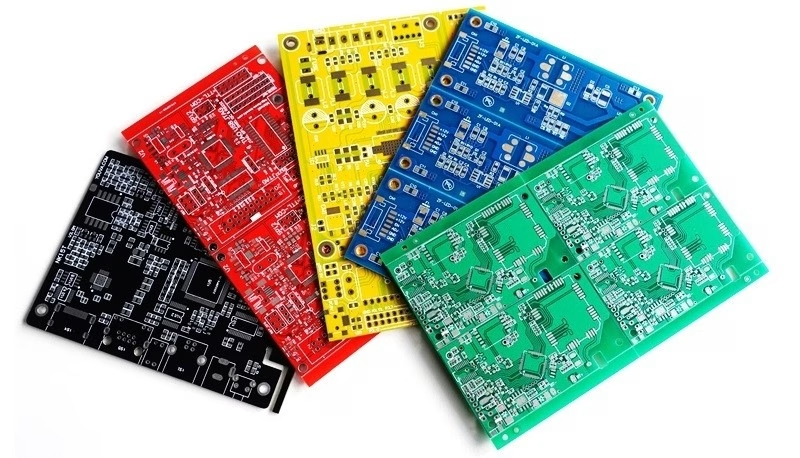
What is Solderability Testing
Solderability testing is a controlled evaluation process that determines whether electronic components and PCB surfaces can form reliable solder joints during assembly. The fundamental principle is simple: molten solder must wet the base metal surface, spreading evenly to create a continuous, adherent film that forms an intermetallic compound at the interface. This intermetallic layer is what gives a solder joint its mechanical strength and electrical conductivity.

The wetting process is governed by surface tension and adhesive forces between the solder and substrate. When adhesive forces dominate cohesive forces within the solder, the liquid metal spreads across the surface—this is good wetting. When cohesive forces win, the solder beads up and refuses to flow—this is non-wetting, and it’s a production killer. The wetting angle, which is the angle formed between the solder surface and the substrate at the point of contact, provides a direct measure of wetting quality. Angles below 90 degrees indicate acceptable wetting, while angles approaching 0 degrees represent ideal wetting behavior.
Solderability is not merely the adhesion of solder to a metal surface—it is a chemical reaction. For a secure electrical and mechanical joint to form, molten solder must wet the base metal substrate. This wetting process results in the dissolution of the base metal (typically copper, nickel, or silver) into the liquid solder, forming an intermetallic compound (IMC) layer at the interface.
The Intermetallic Compound (IMC) Layer
The IMC layer is the metallurgical bridge that secures the solder joint. In a typical copper-solder system using lead-free SAC305 (Tin-Silver-Copper) alloy, two distinct IMC phases form:
- η-phase (Cu₆Sn₅): Forms immediately at the interface of the copper substrate and liquid tin. It typically exhibits a scallop-like morphology and is the primary phase encountered during normal soldering.
- ε-phase (Cu₃Sn): Forms between the copper substrate and the Cu₆Sn₅ layer after prolonged thermal exposure or subsequent reflow cycles. This phase is more brittle than the η-phase.
A healthy IMC layer should be continuous, uniform, and thin—ideally between 0.5 μm and 1.5 μm. If the layer is too thin or discontinuous, mechanical joint strength is compromised. Conversely, an excessively thick IMC layer (exceeding 2.5 μm) renders the solder joint highly brittle and susceptible to cracking under mechanical vibration or thermal cycling.
Young’s Equation and Wetting Physics
The thermodynamic equilibrium of a liquid solder droplet on a solid metal substrate is described by Young’s Equation:
γSV = γSL + γLV · cosθ
Where: γSV = Solid-Vapor interfacial tension; γSL = Solid-Liquid interfacial tension; γLV = Liquid-Vapor (surface tension of molten solder); θ = contact (wetting) angle.
The contact angle θ indicates wetting quality:
- θ = 0°: Perfect wetting. The liquid solder spreads completely across the substrate in a flat, continuous film.
- 0° < θ ≤ 30°: Very good wetting. Typical of clean copper surfaces under active flux.
- 30° < θ ≤ 90°: Marginal/acceptable wetting. Indicates some surface resistance, often due to thin oxide layers.
- θ > 90°: Poor wetting (non-wetting). The solder beads up because adhesive forces between solder and substrate are insufficient.
To minimize θ, process engineers must lower the liquid-vapor surface tension (γLV) and maximize the solid-vapor interfacial energy (γSV). This is accomplished by using chemical fluxes that dissolve surface oxides, exposing high-energy, pristine base metals that actively attract the molten solder alloy. Through my work troubleshooting reflow defects, I have found that flux selection is often the fastest lever available when marginal wetting is observed on the line.
Solderability Standards: J-STD-002 vs. J-STD-003
Two primary standards govern solderability testing in the electronics industry. While closely related, they target entirely different parts of the assembly supply chain. I have worked with both in production environments and consider them complementary rather than interchangeable.
J-STD-002: Component Leads, Terminations, and Wires
J-STD-002, developed jointly by IPC, JEDEC, and the Electronic Industries Alliance (EIA), defines the test methods, defect classifications, and acceptance criteria for assessing the solderability of electronic component leads, discrete chip terminations, lugs, and terminals. This standard is utilized primarily by component manufacturers for quality assurance and by Electronic Manufacturing Services (EMS) companies during incoming component inspection.
J-STD-003: Printed Boards
J-STD-003, administered by the IPC, focuses exclusively on bare printed circuit boards prior to assembly. It evaluates the solderability of surface finishes, plated-through holes (PTHs), and surface mount pads. Because PCB surface finishes degrade under environmental exposure and thermal cycling—such as multiple reflow passes—J-STD-003 provides the testing framework to ensure bare PCBs remain solderable after storage.
| Parameter | J-STD-002 (Component Terminations) | J-STD-003 (Printed Boards) |
| Primary Target | Component leads, BGAs, chip capacitors/resistors, terminals, and wires. | Bare PCBs, SMT pads, through-holes, and surface finishes. |
| Solder Alloys | Sn63Pb37 (leaded) & SAC305/SnCu (lead-free). | Sn63Pb37 (leaded) & SAC305/SnCu (lead-free). |
| Standard Solder Temp. | 245°C ± 5°C (leaded); 255°C ± 5°C (lead-free). | 235°C ± 5°C (leaded); 255°C ± 5°C (lead-free). |
| Flux Type | Standard rosin (Type R) or mildly activated (Type RMA). | Standard rosin (Type R) or mildly activated (Type RMA). |
| Primary Test Methods | Dip-and-Look, Wetting Balance, SMT Simulation. | Edge Dip (Dip-and-Look), Wetting Balance, Solder Float. |
Table 1: Comparison of J-STD-002 and J-STD-003 Standard Parameters
Need PCB Manufacturing or Assembly?
Get a free quote within 24 hours. We specialize in prototype-to-production PCB/PCBA for hardware teams worldwide.
Preconditioning and Accelerated Aging
Freshly manufactured PCBs and components almost always pass solderability testing. However, real-world components must endure shipping, warehouse storage, and varying humidity levels before reaching the reflow oven. Therefore, standards mandate preconditioning (accelerated aging) to simulate a typical shelf life of 6 to 12 months before performing the actual solderability test.
Steam Aging
Steam aging is the most common preconditioning method for tin, tin-lead, and copper-protective coatings. Samples are suspended in a chamber containing saturated steam at 93°C ± 3°C with a relative humidity of 100%, which accelerates oxygen diffusion and intermetallic growth. The standard aging categories are:
- Category 1 (No Preconditioning): Used for components soldered immediately after fabrication.
- Category 2 (1-Hour Steam Exposure): Simulates short-term storage under controlled conditions.
- Category 3 (8-Hour Steam Exposure): Standard for evaluating components designed for longer shelf lives, simulating approximately 6 to 12 months of storage in uncontrolled warehouse environments.
Dry Heat Baking and Reflow Simulation
For surface finishes sensitive to moisture—such as Organic Solderability Preservative (OSP)—steam aging is inappropriate because hot moisture rapidly dissolves the organic protective layer, which does not represent typical dry-storage decay. Instead, engineers use dry heat baking (e.g., 4 hours at 155°C) or submit boards to one or two convection reflow passes (reflow simulation) prior to testing. This process replicates the thermal degradation that occurs on double-sided SMT boards when Side A is soldered and Side B must survive the heat before its own reflow pass. In practice, I recommend always confirming whether a board’s surface finish is OSP before selecting a preconditioning method, as an incorrect choice can invalidate the entire test.
Core Solderability Test Methods
Solderability testing is generally destructive, meaning tested components and boards cannot be returned to the production line. Three primary methods are used to evaluate solderability, each suited to different needs and resource levels.
The Dip-and-Look Test
This qualitative test is widely used for incoming inspection because of its simplicity and low capital equipment requirements. It simulates the thermal and fluid dynamics of a wave soldering process. Having used dip-and-look extensively for high-volume screening, I find it to be the most practical starting point for any new testing program.
Step-by-Step Procedure
- Preconditioning: Subject the PCB or component to steam aging or baking according to the required standard category.
- Flux Application: Dip the sample into a controlled, low-activity rosin flux (typically Type R) for 5 to 10 seconds. Drain excess flux.
- Immersion: Immerse the sample into a temperature-controlled solder bath (245°C for SnPb or 255°C for lead-free) at a precise mechanical rate (typically 25 mm/s).
- Dwell Time: Keep the sample in the solder bath for a specified period, usually 3 to 5 seconds.
- Withdrawal and Inspection: Withdraw the sample, allow the solder to solidify without vibration, clean off flux residue with isopropyl alcohol (IPA), and inspect under 10× to 40× magnification.
Acceptance Criteria: Per J-STD-002 and J-STD-003, a passing grade requires that at least 95% of the tested surface be covered with a continuous, smooth, and bright solder coating. No more than 5% of the area may exhibit pinholes, dewetting, or non-wetting.
Wetting Balance Analysis
The wetting balance test is a quantitative, highly precise engineering tool that provides real-time measurement of the wetting forces exerted by molten solder on a test specimen as a function of time. This test is essential for high-reliability applications—automotive, aerospace, and medical electronics—where subjective visual inspections are insufficient.
The Wetting Balance Curve
The test apparatus suspends the component or PCB sample from a sensitive load cell and lowers it into a molten solder bath. The instrument records the vertical force (buoyancy versus wetting tension) over time, producing a characteristic curve with the following stages:
- Point A – Initial Contact: The sample touches molten solder. The solder has not yet wetted the metal, so the liquid pushes back against the sample, producing a net negative (buoyancy) force.
- Point B – Zero Cross Time (T₀): The flux has stripped surface oxides and solder begins to wet the sample. The curve crosses the zero-force axis. A healthy joint should cross zero in under 1.0 second (ideally < 0.5 s). A sluggish T₀ > 2.0 s warns of poor solderability.
- Point C – Maximum Wetting Force (Fₘₐₓ): Solder continues to wet and climb the sample, reaching peak wetting force. This value indicates the ultimate mechanical strength of the wet interface.
- Point D – Withdrawal: The sample is pulled from the bath.
Surface Mount Simulation Test
The surface mount simulation test is specifically designed for SMT components that cannot be easily dipped, such as Ball Grid Array (BGA) packages, Quad Flat No-Lead (QFN) packages, or ultra-fine-pitch passives.
- A target solder paste (e.g., SAC305) is screen-printed onto a non-wettable ceramic plate using a standard stencil.
- The SMT component is placed onto the printed paste deposits.
- The assembly is processed through a convection reflow oven using a standard production thermal profile.
- Post-reflow, the quality team evaluates solder spread, coalescence, and the contact angle formed at the pad interface.
How Surface Finishes Affect Solderability
The choice of PCB surface finish fundamentally alters how the board behaves in solderability tests. Each finish has unique chemical properties, storage lifetimes, and common failure modes—a fact I have been reminded of on many troubleshooting investigations.
| Surface Finish | Metallurgical Action | Primary Risk | J-STD-003 Test Focus |
| HASL / Lead-Free HASL | Direct tin-to-tin bonding via molten solder coat. | Uneven thickness; excessive IMC growth during storage. | Check for non-wetting on thin knee areas of high-aspect pads. |
| ENIG | Gold dissolves into solder; bonds to underlying nickel. | Hyper-corrosion of nickel layer (“Black Pad”). | Inspect for dewetting and brittle interfacial fracturing. |
| ENEPIG | Gold and palladium dissolve; bonds to nickel layer. | Excessive palladium slowing nickel exposure. | Verify rapid wetting balance times (T₀ < 1.0 s). |
| Immersion Tin | Direct tin-to-tin bonding with base copper. | Rapid Cu-Sn IMC depleting the pure tin surface. | Evaluate after steam aging to verify tin thickness. |
| Immersion Silver | Silver dissolves; bonds to copper underneath. | Sulfur tarnishing (Ag₂S) halting wetting. | Test under mildly activated fluxes. |
| OSP | Organic film evaporates; solder bonds to pristine copper. | Thermal degradation during initial reflow passes. | Perform reflow simulation preconditioning before test. |
Table 2: PCB Surface Finishes and Wetting Behaviors
The “Black Pad” Phenomenon in ENIG Finishes
ENIG is highly favored for fine-pitch SMT components due to its flat surface. However, it is susceptible to “black pad,” a critical defect that can bypass basic visual inspections but is quickly exposed by solderability testing. Black pad occurs during the gold displacement process when the plating bath chemistry becomes aggressive, causing hyper-corrosion of the underlying electroless nickel layer. This corrosion forms a phosphorus-rich, dark nickel oxide layer that cannot form a proper IMC with tin.
During a wetting balance or solder float test, ENIG affected by black pad exhibits rapid dewetting, and the resulting joints can be sheared off with minimal force. Wetting balance testing is particularly effective at catching this defect early, before parts reach the assembly line.
Troubleshooting Wetting Failures
When a component or board fails a solderability test, identifying the metallurgical root cause is necessary before initiating corrective action. Two terms are frequently confused but represent entirely different chemical states.
Non-Wetting vs. Dewetting
- Non-Wetting: The molten solder never formed a metallurgical bond with the substrate. The base metal remains visible, or the solder rolls off entirely, leaving a bare, oxidized pad. This is typically caused by thick, stable oxide layers that the flux was too weak to dissolve, or the presence of organic contaminants such as silicone mold release agents.
- Dewetting: The solder initially wets the surface and forms an IMC, but then retracts, pooling into irregular droplets and leaving a thin, patchy film. This occurs when the solder encounters an unsolderable barrier beneath a thin, soluble plating layer. For example, if copper-tin IMC reaches the surface of an Immersion Tin board and oxidizes, the solder will initially wet the remaining pure tin, then pull back when it contacts the oxidized IMC.
Root Cause Analysis
When a batch of PCBs or components fails a solderability test, engineers should systematically investigate the following variables:
- Check Plating Thickness: If Immersion Tin is less than 0.8 μm thick, the underlying copper will quickly form IMCs, reaching the surface and oxidizing within weeks. Verify thickness using X-ray Fluorescence (XRF) spectroscopy.
- Assess Storage Conditions: Relative humidity above 60% or temperatures above 30°C accelerates oxidation. Ensure storage in Moisture Barrier Bags (MBBs) with active desiccant packs and Humidity Indicator Cards (HICs).
- Identify Surface Contamination: Fingerprint oils, solder mask residues, and airborne sulfur (frequently found in cardboard packaging) can inhibit wetting. Run Ion Chromatography or Fourier-Transform Infrared (FTIR) spectroscopy to identify organic and ionic contaminants.
- Review Solder Bath Purity: In dip-and-look testing, copper and gold can dissolve from test samples and contaminate the solder pot over time. If copper contamination in a SAC305 bath exceeds 1.0% by weight, the solder’s melting point rises, reducing fluidity and producing false-negative results. Regularly analyze solder pot samples using Inductively Coupled Plasma (ICP) emission spectroscopy.
Implementation Best Practices for EMS and OEMs
To establish an effective solderability testing program, manufacturers must integrate these procedures into their standard quality management systems. The following recommendations reflect lessons learned across both high-volume consumer electronics and low-volume, high-reliability production environments.
Incoming Inspection Sampling Plans
Testing every incoming component batch is cost-prohibitive because solderability testing is destructive. Instead, implement a risk-based sampling plan (e.g., ANSI/ASQ Z1.4). Focus testing efforts on:
- New component suppliers or unproven PCB fabricators.
- Components with a date code older than 12 months.
- Parts stored in damaged or compromised packaging.
- Critical surface finishes such as Immersion Tin or OSP.
Equipment and Process Calibration
To ensure repeatable and reproducible results across different manufacturing sites:
- Calibrate Wetting Balance Systems: Calibrate the load cell weekly using standard weights. Verify the mechanical immersion speed using laser displacement sensors.
- Standardize Flux Control: Rosin fluxes degrade upon air exposure due to solvent evaporation, which increases solids content and artificially improves wetting results. Measure and adjust flux specific gravity daily, or replace the flux pot every 24 hours of operation.
- Maintain Solder Temperature: Lead-free solder pots must maintain 255°C ± 5°C. Even minor temperature drops can significantly slow wetting times, leading to false-negative evaluations.
Frequently Asked Questions (FAQ)
Q: Is solderability testing destructive?
A: Yes. Components and PCBs subjected to steam aging, dry baking, fluxing, and solder dipping are altered thermally and chemically. They must never be used in final production assemblies. However, the cost of destroying a few samples is trivial compared to scrapping an entire production lot due to solderability-related defects.
Q: Why do lead-free alloys require higher testing temperatures than tin-lead alloys?
A: Tin-lead (Sn63Pb37) has a eutectic melting point of 183°C and is tested at 235°C to 245°C. Lead-free SAC305 has a higher melting range of 217°C to 220°C and poorer surface wetting characteristics. Consequently, lead-free testing requires 255°C to ensure equivalent liquid solder fluid dynamics and complete IMC formation during the short test window.
Q: How does steam aging compare to dry baking?
A: Steam aging introduces high humidity (100% RH) at 93°C to rapidly oxidize metal coatings like tin or copper, simulating long-term warehouse storage. Dry baking (typically 155°C in dry air) is used for moisture-sensitive finishes like OSP to simulate thermal degradation that occurs during SMT reflow. Selecting the wrong method can produce misleading results.
Q: What causes solder to bead up and roll off a pad during a dip test?
A: This is non-wetting. It indicates that the solid-vapor surface energy is low, usually because the pad carries a heavy oxide layer or is contaminated with organic residues such as silicones or mask material that the flux could not strip.
Q: How often should we test our solder pot purity?
A: For high-volume dip-and-look testing, analyze solder pot alloy purity monthly. For low-volume operations, quarterly analysis is sufficient. Contamination from copper (>1.0%), gold (>0.2%), or iron (>0.02%) will alter wetting kinetics and skew test results.
Summary
Solderability testing is an essential preventive quality control measure in electronics manufacturing. By understanding the metallurgy of the intermetallic compound (IMC) layer and utilizing standards like J-STD-002 and J-STD-003, engineers can identify wetting issues before parts reach the assembly line. Whether using the qualitative dip-and-look test for high-volume screening or wetting balance analysis for quantitative process verification, proper testing improves first-pass yields, reduces rework expenses, and ensures long-term product reliability.
From my perspective, the single most impactful change a manufacturing organization can make is to treat solderability testing not as an optional incoming inspection step, but as a non-negotiable gate in the supply chain qualification process. The investment in test equipment and procedures pays for itself the first time a bad lot is caught before it reaches the production floor.
