
Isola PCB
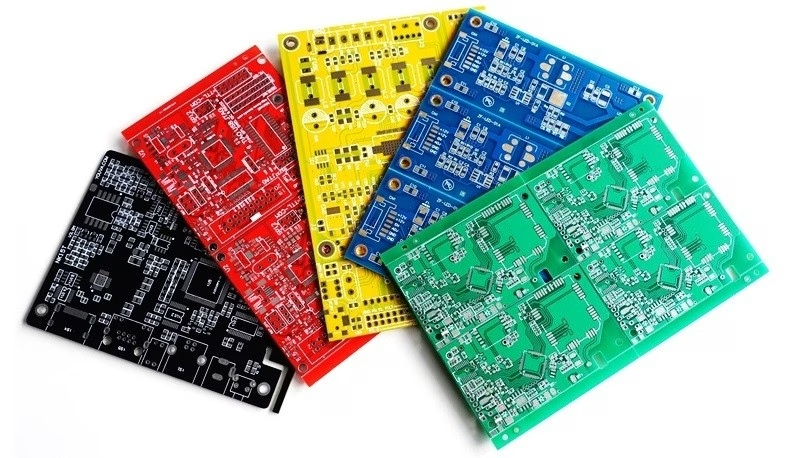
Isola PCB Manufacturing ( Get Isola PCB Price,Pls send mail to sales@pcbandassembly)
If you’re designing high-speed digital circuits, RF/microwave systems, or multilayer boards that demand consistent signal integrity, you’ve likely encountered the limitations of standard FR-4. Dielectric losses creep up, impedance control becomes unpredictable, and your carefully simulated design doesn’t match real-world performance. That’s exactly why Isola PCB materials exist.
Isola Group is one of the world’s leading manufacturers of high-performance copper-clad laminates and dielectric prepregs. Their materials bridge the gap between standard FR-4 and expensive PTFE-based microwave laminates, offering engineers a practical path to high-frequency performance without exotic fabrication requirements.
Key Takeaways
- Isola offers six major product families covering everything from high-Tg FR-4 replacements (IS410, FR408) to ultra-low-loss millimeter-wave materials (Astra MT77, Tachyon 100G)
- Isola materials are designed for standard FR-4 fabrication processes, reducing manufacturing complexity compared to PTFE-based alternatives
- I-Tera MT40 and Astra MT77 provide PTFE-like electrical performance with thermoset processing ease
- Tachyon 100G is specifically engineered for data rates exceeding 100 Gbps with extremely stable Dk across temperature
- Isola materials typically cost 30-50% less than equivalent-performance PTFE laminates while delivering comparable electrical results
What Is Isola PCB?
Isola PCB refers to printed circuit boards fabricated using laminate and prepreg materials manufactured by the Isola Group, a global leader in material sciences for the electronics industry. Founded in 1912 and headquartered in Chandler, Arizona, USA, Isola has spent over a century developing high-performance dielectric materials for demanding applications.

Unlike standard FR-4, which uses simple epoxy resin and woven glass reinforcement, Isola materials employ proprietary resin formulations and specialized reinforcement systems. These formulations deliver superior electrical, thermal, and mechanical properties while maintaining compatibility with standard PCB fabrication processes.
Why Engineers Choose Isola PCB Materials
The primary reasons for selecting Isola over standard FR-4 or other high-frequency materials come down to three factors: manufacturability, performance consistency, and cost.
| Factor | What It Means | Why It Matters |
| FR-4 Compatible Processing | Can be fabricated using standard FR-4 equipment and processes | No specialized tooling or handling required; lower fabrication costs |
| Tight Dk Tolerance | ±0.05 or better on dielectric constant | Predictable impedance control, higher first-pass design success |
| Broad Product Range | From high-Tg FR-4 replacements to millimeter-wave materials | One supplier for multiple performance tiers; simplified supply chain |
| Enhanced Thermal Performance | Tg up to >280°C, Td up to 390°C+ | Reliable through multiple lead-free reflow cycles |
| Oxidation Resistance | Proprietary formulations resist long-term oxidation | Stable electrical performance over product lifetime |
The combination of these factors makes Isola a popular choice for designers who need performance beyond FR-4 but want to avoid the cost and complexity of PTFE-based materials.
Isola PCB Product Portfolio
Isola organizes its products into several families, each targeting specific performance requirements and application domains.
Product Family Overview
| Product Series | Performance Tier | Primary Application | Dk Range | Df Range |
| IS410 | Standard High-Performance | High-layer-count multilayer boards, backplanes | 4.2-4.5 | 0.010-0.015 |
| FR408 / FR408HR | Mid-Loss | Complex multilayer, networking, router/switch designs | 3.7-3.9 | 0.006-0.009 |
| I-Tera MT40 | Ultra-Low Loss | RF/microwave, high-speed digital, mmWave | 3.45 | 0.0031 |
| Astra MT77 | Extremely Low Loss | Automotive radar, millimeter-wave antennas, satellite | 3.0 | 0.0017 |
| Tachyon 100G | Ultra-Low Loss | >100 Gbps data rate, cloud infrastructure, AI/ML | 3.02 | 0.002 |
| TerraGreen | Low Loss (Halogen-Free) | Environmentally conscious designs, high-speed/RF | 3.0 | 0.0018 |
IS410: High-Tg Multilayer Workhorse
IS410 is a lead-free, high-performance, high-Tg epoxy laminate designed for high-layer-count applications requiring multiple thermal excursions.
Key Specifications
| Property | Value | Test Method |
| Glass Transition Temperature (Tg) | 180°C | DSC |
| Dielectric Constant (Dk) | 4.2-4.5 | 1 GHz |
| Dissipation Factor (Df) | 0.010-0.015 | 1 GHz |
| Decomposition Temperature (Td) | >340°C | TGA |
| Z-Axis CTE | 60 ppm/°C | IPC-TM-650 |
| UL Rating | 94 V-0 | — |
IS410 is the go-to material when you need reliable performance in high-layer-count digital designs. It handles the thermal stress of lead-free assembly without issues and provides solid mechanical stability for boards up to 30+ layers.
Best For: Backplanes, server motherboards, industrial controllers, telecom infrastructure.
FR408 / FR408HR: High-Performance Multilayer
FR408 and FR408HR (High Reliability) represent Isola’s mid-loss performance tier, designed for broadband circuit designs requiring faster signal speeds and better loss performance than standard FR-4.
| Property | FR408 | FR408HR |
| Tg (DSC) | 180°C | 190-230°C |
| Dk @ 1 GHz | 3.9 | 3.7 |
| Df @ 1 GHz | 0.012 | 0.0092 |
| Td | >340°C | >360°C |
| CAF Resistance | Standard | Enhanced |
FR408HR is the more advanced option, with significantly lower dissipation factor and better thermal reliability. The improved CAF (Conductive Anodic Filament) resistance makes it suitable for high-reliability applications where moisture resistance and long-term stability are critical.
Best For: Complex multilayer designs, networking equipment, high-speed digital, military/aerospace.
I-Tera MT40: RF/Microwave and High-Speed Digital
I-Tera MT40 is Isola’s ultra-low-loss thermoset laminate designed for demanding RF, microwave, and high-speed digital applications. It delivers electrical performance approaching PTFE materials while maintaining FR-4-like processing characteristics.
Key Specifications
| Property | Value | Test Condition |
| Dielectric Constant (Dk) | 3.45 ± 0.05 | 10 GHz, 23°C |
| Dissipation Factor (Df) | 0.0031 | 10 GHz, 23°C |
| Tg | 200°C | DSC |
| Td | 360°C | TGA |
| Z-Axis CTE | 38 ppm/°C | — |
| Thermal Conductivity | 0.53 W/m·K | — |
The low and stable Dk of 3.45 combined with a Df of just 0.0031 makes I-Tera MT40 suitable for applications well into millimeter-wave frequencies. Rogers specifies performance up to 100 GHz.
What sets I-Tera MT40 apart is its processing ease. Unlike PTFE-based materials that require plasma treatment, sodium etching, and specialized drilling, I-Tera MT40 runs on standard FR-4 fabrication lines with minimal process modification.
Best For: 5G infrastructure, base station antennas, radar systems, high-speed backplanes, satellite communications.
Astra MT77: Automotive Radar and Millimeter-Wave
Astra MT77 is an ultra-low-loss laminate designed specifically for the demanding requirements of automotive radar and other millimeter-wave applications.
Key Specifications
| Property | Value | Test Condition |
| Dielectric Constant (Dk) | 3.0 | 10-77 GHz |
| Dissipation Factor (Df) | 0.0017 | 10-77 GHz |
| Tg | >280°C | DSC |
| Td | 390°C | TGA |
| Dk Stability (-40°C to +140°C) | <1% variation | — |
| Z-Axis CTE | 35 ppm/°C | — |
Astra MT77’s dielectric constant of 3.0 remains remarkably stable across both frequency and temperature. This is critical for automotive radar operating at 77 GHz and 79 GHz, where even minor Dk variations can shift antenna beam patterns.
The material’s processing advantage is significant. Traditional PTFE materials used in automotive radar require specialized fabrication steps that increase cost and limit production volume. Astra MT77 processes like a standard thermoset, enabling high-volume production at lower cost.
Best For: 77 GHz automotive radar, 79 GHz short-range radar, millimeter-wave antennas, point-to-point wireless backhaul.
Tachyon 100G: Ultra-High-Speed Digital
Tachyon 100G is Isola’s flagship material for the most demanding high-speed digital applications. As the name suggests, it’s engineered for data rates of 100 Gbps and beyond.
Key Specifications
| Property | Value | Test Condition |
| Dielectric Constant (Dk) | 3.02 | 10 GHz |
| Dissipation Factor (Df) | 0.002 | 10 GHz |
| Tg | >280°C | DSC |
| Td | 390°C | TGA |
| Dk Stability (-55°C to +125°C) | Extremely stable | — |
| CTE (Z-axis) | 30 ppm/°C | — |
Tachyon 100G’s exceptionally low Df of 0.002 ensures minimal signal loss over long trace lengths. The material also features extremely stable electrical properties across a wide temperature range, from -55°C to +125°C.
What makes Tachyon 100G unique is its ability to maintain signal integrity at the highest data rates. At 112 Gbps PAM4 signaling, every fraction of a dB of insertion loss matters, and Tachyon 100G delivers the lowest loss of any Isola material.
Best For: Hyperscale data center switches, AI/ML training infrastructure, 400G/800G optical transceivers, high-frequency trading systems.
TerraGreen: Halogen-Free, Environmentally Friendly
TerraGreen is Isola’s family of halogen-free, ultra-low-loss laminate and prepreg materials. It meets the growing demand for environmentally sustainable PCB materials without compromising electrical performance.
Key Specifications
| Property | Value | Test Condition |
| Dielectric Constant (Dk) | 3.0 | 10 GHz |
| Dissipation Factor (Df) | 0.0018 | 10 GHz |
| Tg | 200°C | DSC |
| Td | 380°C | TGA |
| Halogen Content | None | — |
| Lead-Free Compatible | Yes | 6x 260°C reflow |
TerraGreen achieves its performance without brominated or chlorinated flame retardants. The material also features low moisture absorption and excellent CAF resistance, making it suitable for applications where both environmental compliance and reliability matter.
Best For: Green electronics initiatives, telecom infrastructure, automotive (RoHS-compliant designs), consumer electronics with environmental mandates.
Need PCB Manufacturing or Assembly?
Get a free quote within 24 hours. We specialize in prototype-to-production PCB/PCBA for hardware teams worldwide.
Isola vs Rogers vs FR-4: How They Compare
Choosing between Isola, Rogers, and standard FR-4 depends on your specific performance requirements and budget constraints.
Performance Comparison
| Parameter | Standard FR-4 | Isola FR408HR | Isola I-Tera MT40 | Isola Astra MT77 | Rogers RO4350B | Rogers RT/5880 |
| Dk | 4.2-4.8 | 3.7 | 3.45 | 3.0 | 3.48 | 2.20 |
| Dk Tolerance | ±10% | ±0.05 | ±0.05 | ±0.05 | ±0.05 | ±0.02 |
| Df @ 10 GHz | 0.020-0.025 | 0.0092 | 0.0031 | 0.0017 | 0.0037 | 0.0009 |
| Tg (°C) | 130-180 | 190-230 | 200 | >280 | >280 | — (PTFE) |
| Processing | Standard | FR-4 Compatible | FR-4 Compatible | FR-4 Compatible | FR-4 Compatible | Specialized |
| Relative Cost | 1x | 2-3x | 4-6x | 5-8x | 5-7x | 8-12x |
When to Choose Isola
Isola materials sit in a sweet spot between cost and performance.
Choose Isola FR408HR when you need better loss performance than FR-4 for high-speed digital designs up to 10-25 Gbps, without paying the premium for ultra-low-loss materials. It’s the natural upgrade from standard FR-4 when your signal integrity analysis shows margin issues.
Choose Isola I-Tera MT40 when you need RF/microwave performance up to 100 GHz but want to avoid PTFE processing costs. If your design requires 50Ω impedance control at mmWave frequencies, I-Tera MT40 delivers at roughly half the material cost of equivalent PTFE laminates.
Choose Isola Astra MT77 when you’re designing automotive radar at 77 GHz or similar millimeter-wave applications. Its temperature-stable Dk and ultra-low loss make it the material of choice for the automotive industry.
Choose Isola Tachyon 100G when your design pushes beyond 100 Gbps and every fraction of a dB matters. This is the material for hyperscale data center infrastructure where signal integrity over long channels is the primary constraint.
When to Choose Rogers
Rogers remains the gold standard for certain applications.
Choose Rogers RT/duroid 5880 when absolute lowest loss is your priority. With a Df of 0.0009, it outperforms any Isola material in insertion loss. Satellite communications, high-end test equipment, and military EW systems often justify the premium.
Choose Rogers RO4350B when you need a well-established, broadly supported RF material with extensive characterization data. The RO4000 series has decades of industry adoption and is supported by nearly every PCB fabricator worldwide.
When FR-4 Is Enough
If your design operates below 1-2 GHz and signal integrity isn’t critical, standard FR-4 remains the most cost-effective choice. Don’t pay for performance you don’t need.
Isola PCB Applications by Industry
Isola materials serve demanding applications across multiple industries.
Telecommunications and 5G Infrastructure
The rollout of 5G networks created massive demand for materials that can handle higher frequencies and data rates.
| Application | Recommended Isola Material | Why |
| 5G base station antennas | I-Tera MT40 | Stable Dk at mmWave frequencies |
| Massive MIMO arrays | I-Tera MT40, Astra MT77 | Tight Dk tolerance for beamforming accuracy |
| Backhaul radios | Astra MT77 | Ultra-low loss at 28-80 GHz |
| Core routers | Tachyon 100G | 100 Gbps+ data rate support |
| Edge computing servers | FR408HR | Mid-loss performance at lower cost |
Automotive Electronics
Modern vehicles contain hundreds of electronic components, from engine control units to advanced driver assistance systems.
| Application | Recommended Isola Material | Why |
| 77 GHz radar | Astra MT77 | Temperature-stable Dk, ultra-low loss |
| 79 GHz short-range radar | Astra MT77 | Millimeter-wave performance |
| ADAS control units | FR408HR | High reliability, CAF resistance |
| Infotainment systems | IS410 | Cost-effective high-Tg performance |
| Battery management | IS410 | High-Tg for thermal management |
Aerospace and Defense
Military and aerospace applications require materials that maintain performance under extreme conditions.
| Application | Recommended Isola Material | Why |
| Phased array radar | I-Tera MT40 | Broadband RF performance |
| Electronic warfare systems | I-Tera MT40 | Consistent performance across frequency |
| Satellite communications | Astra MT77 | Low loss, temperature stability |
| Avionics | FR408HR | High reliability, CAF resistance |
| Missile guidance | I-Tera MT40 | Predictable Dk at RF frequencies |
Data Center and Cloud Computing
Hyperscale data centers push signal integrity to the limit with ever-increasing data rates.
| Application | Recommended Isola Material | Why |
| 400G/800G switches | Tachyon 100G | Lowest loss for 100 Gbps+ signaling |
| AI/ML servers | Tachyon 100G | Signal integrity over long channels |
| Storage networks | FR408HR | Reliable mid-loss performance |
| High-frequency trading | Tachyon 100G | Minimized latency through low loss |
| Cloud infrastructure | I-Tera MT40 | Balanced performance and cost |
Industrial and Medical
Beyond communications and automotive, Isola materials serve specialized industrial and medical applications.
| Application | Recommended Isola Material | Why |
| Medical imaging equipment | I-Tera MT40 | RF performance for MRI/CT systems |
| Industrial radar sensors | Astra MT77 | Millimeter-wave accuracy |
| Test and measurement | I-Tera MT40 | Predictable electrical properties |
| Power distribution | IS410 | High-Tg for thermal management |
Isola PCB Design Guidelines
Designing with Isola materials requires understanding their unique properties. Here are practical guidelines drawn from real-world experience.
Impedance Control Considerations
Isola materials offer tight Dk tolerance, but proper impedance control still requires attention to detail.
For I-Tera MT40 (Dk = 3.45): 50Ω microstrip on 5 mil core typically requires ~11 mil trace widths. This is wider than FR-4, which improves manufacturing yield but requires more board space.
For Astra MT77 (Dk = 3.0): The lower Dk produces even wider traces for a given impedance. Plan your layout accordingly and verify with your fabricator’s specific stackup.
For Tachyon 100G (Dk = 3.02): Similar trace widths to Astra MT77. The material’s extremely stable Dk across temperature is a significant advantage for time-domain applications.
Stackup Recommendations
For multilayer Isola PCB designs, stackup symmetry is critical to prevent warpage.
General rules:
- Maintain balanced copper distribution across layers
- Use compatible prepreg materials from the same product family
- Keep inner layer copper percentages within 20% between opposing layers
- Verify stackup with your fabricator before production
For hybrid stackups, Isola materials can be combined with standard FR-4 layers to optimize cost. Place Isola materials only on signal layers where loss matters, and use FR-4 for power and ground planes.
Via Design and Reliability
The Z-axis CTE of Isola materials varies by product family. Account for this when designing plated through-holes.
| Material | Z-Axis CTE | Aspect Ratio Recommendation |
| IS410 | 60 ppm/°C | ≤10:1 |
| FR408HR | 50 ppm/°C | ≤12:1 |
| I-Tera MT40 | 38 ppm/°C | ≤14:1 |
| Astra MT77 | 35 ppm/°C | ≤14:1 |
| Tachyon 100G | 30 ppm/°C | ≤15:1 |
The lower Z-axis CTE of advanced Isola materials improves via reliability during thermal cycling, especially in high-layer-count boards.
Copper Foil Selection
Copper foil type affects insertion loss, especially at higher frequencies.
Standard ED copper: Suitable for applications below 10 GHz. Cost-effective and widely available.
VLP (Very Low Profile) copper: Recommended for applications above 10 GHz. The smoother surface reduces conductor losses where skin effect concentrates current at the trace surface.
HVLP (Hyper Very Low Profile) copper: Required for millimeter-wave applications above 30 GHz. Provides the lowest conductor losses but comes at a cost premium.
Isola PCB Fabrication Guidelines
One of Isola’s key advantages is compatibility with standard FR-4 fabrication processes. However, each material family has specific requirements.
Drilling Parameters
| Material | Recommended Drill Speed | Typical Chip Load | Stack Height |
| IS410 | Standard FR-4 parameters | 0.001-0.003″ | 2-3 panels |
| FR408HR | Standard FR-4 parameters | 0.001-0.003″ | 2-3 panels |
| I-Tera MT40 | Standard FR-4 parameters | 0.001-0.002″ | 2-3 panels |
| Astra MT77 | Modified (tool wear expected) | 0.001-0.002″ | 1-2 panels |
| Tachyon 100G | Modified (tool wear expected) | 0.001-0.002″ | 1-2 panels |
Astra MT77 and Tachyon 100G contain ceramic filler that increases drill bit wear. Factor this into cost estimates and plan for more frequent tool changes.
Plating Considerations
All Isola materials accept electroless copper plating well. Key recommendations:
- Standard desmear processes work for most materials
- Plasma desmear provides best results for high-performance materials
- Monitor plating thickness in high aspect ratio vias
- For sequential lamination designs, verify material compatibility with multiple process cycles
Surface Finish Options
Isola materials support all standard PCB surface finishes:
| Surface Finish | Best For | Notes |
| ENIG | High-frequency designs | Flat surface, consistent skin effect |
| HASL (Lead-Free) | General purpose | Lower cost, adequate for most designs |
| Immersion Silver | Mixed-signal designs | Good solderability, flat surface |
| OSP | Short shelf-life designs | Lowest cost, 6-month shelf life |
| Immersion Tin | Fine-pitch applications | Flat surface, good for SMT |
For mmWave applications above 30 GHz, ENIG or immersion silver provides the best performance due to their smooth surface finish.
Lead-Free Assembly Compatibility
All Isola high-performance materials are fully compatible with lead-free soldering processes.
| Material | Tg | Td | Reflow Cycles (260°C) |
| IS410 | 180°C | >340°C | 3+ |
| FR408HR | 190-230°C | >360°C | 5+ |
| I-Tera MT40 | 200°C | 360°C | 5+ |
| Astra MT77 | >280°C | 390°C | 6+ |
| Tachyon 100G | >280°C | 390°C | 6+ |
| TerraGreen | 200°C | 380°C | 6+ |
The high Tg and Td values provide ample margin for multiple reflow cycles without material degradation.
Cost Considerations
Isola materials span a wide cost range depending on the product family.
| Material Family | Relative Cost vs FR-4 | Typical Cost per sq ft |
| IS410 | 1.5-2x | $4-8 |
| FR408HR | 2-3x | $6-12 |
| I-Tera MT40 | 4-6x | $12-20 |
| Astra MT77 | 5-8x | $15-30 |
| Tachyon 100G | 6-10x | $20-40 |
| TerraGreen | 3-5x | $10-18 |
Note: Prices vary significantly based on thickness, copper weight, panel size, and volume. These are approximate ranges for standard configurations.
Cost Optimization Strategies
Use hybrid stackups: Combine Isola high-performance layers with FR-4 for non-critical layers. This can reduce material costs by 30-50% compared to all-Isola construction.
Choose standard thicknesses: 3 mil and 4 mil cores are more readily available and less expensive than custom thickness options.
Optimize panel utilization: Design your board layout to maximize material usage on standard panel sizes (12×18″ or 18×24″).
Select the right material tier: Don’t specify Tachyon 100G for a design that only needs FR408HR. Match the material to your actual signal integrity requirements.
Isola PCB Frequently Asked Questions
What is Isola PCB material used for?
Isola PCB materials are used in high-performance electronic applications where standard FR-4 cannot meet performance requirements. Common applications include 5G infrastructure, automotive radar systems, high-speed data center equipment, aerospace and defense electronics, and industrial RF systems. Each Isola product family targets specific performance needs, from high-Tg multilayer boards (IS410) to millimeter-wave radar modules (Astra MT77).
How does Isola compare to Rogers for high-frequency applications?
Isola and Rogers both produce excellent high-frequency materials, but they approach the market differently. Rogers materials like the RO4000 and RT/duroid series have broader industry adoption and more extensive characterization data. Isola materials, particularly Astra MT77 and I-Tera MT40, offer comparable electrical performance with better FR-4 processing compatibility and typically lower cost. For most applications below 100 GHz, both suppliers deliver excellent results. The choice often comes down to fabricator familiarity, supply chain preferences, and specific material availability.
Can Isola materials be processed using standard FR-4 fabrication?
Yes, this is one of Isola’s key advantages. Materials like IS410, FR408HR, and I-Tera MT40 can be fabricated using standard FR-4 equipment with minimal process modification. Astra MT77 and Tachyon 100G contain ceramic filler that increases drill bit wear but remain compatible with standard FR-4 fabrication lines. This contrasts with PTFE-based materials that require specialized processes including plasma treatment and sodium etching.
What is the difference between Isola FR408 and FR408HR?
FR408HR (High Reliability) is an improved version of FR408 with lower dissipation factor (0.0092 vs 0.012), higher Tg (190-230°C vs 180°C), better CAF resistance, and enhanced thermal reliability. FR408HR is recommended for designs where long-term reliability under thermal stress is critical, such as military, aerospace, and high-reliability industrial applications.
Is Isola Astra MT77 suitable for automotive radar applications?
Absolutely. Astra MT77 was specifically designed for automotive radar applications at 77 GHz and 79 GHz. Its temperature-stable dielectric constant (minimal variation from -40°C to +140°C), ultra-low dissipation factor (0.0017), and compatibility with high-volume FR-4 fabrication make it an ideal choice for automotive radar modules. Major automotive radar manufacturers use Astra MT77 in production systems.
What prepreg materials should I use with Isola laminates?
Isola recommends using prepreg materials from the same product family as the laminate cores. For example, use Isola prepregs designed for the specific FR408HR or I-Tera MT40 system. These prepregs have matched Dk values, CTE characteristics, and thermal properties to ensure reliable lamination and consistent electrical performance across the multilayer stackup.
Can Isola and FR-4 materials be combined in the same board?
Yes, hybrid stackups combining Isola high-performance layers with standard FR-4 are common and cost-effective. Place Isola materials on signal layers where loss performance matters, and use FR-4 for power, ground, and non-critical layers. Ensure CTE compatibility between materials and use appropriate bonding prepregs to prevent delamination. Work with your fabricator to verify the hybrid stackup design.
What is the maximum layer count achievable with Isola materials?
High-layer-count boards using Isola materials are practical up to 30+ layers. IS410 and FR408HR are particularly well-suited for these applications due to their high Tg and stable mechanical properties. I-Tera MT40 can also be used in high-layer-count RF designs. The thin core options of materials like Astra MT77 and Tachyon 100G enable dense layer stacking while maintaining manageable total board thickness.
PCBAndAssembly: Your Partner for Isola PCB Manufacturing
Choosing the right material is only half the battle. You also need a manufacturer with the experience and capability to fabricate high-performance Isola PCBs correctly.
At PCBAndAssembly, we fabricate PCBs using the full range of Isola materials—from IS410 and FR408HR to I-Tera MT40, Astra MT77, and Tachyon 100G. With 14 years of experience and three manufacturing facilities in Shenzhen, China, we deliver IPC Class 2 and Class 3 quality at competitive prices.
Why work with us for your Isola PCB needs:
- Material expertise: Our engineers are trained on Isola material handling, drilling parameters, and lamination profiles
- ISO 9001 certified: Quality management systems ensure consistent results
- 1-54 layer capability: From simple 2-layer boards to complex 54-layer HDI designs
- Fast turnaround: Prototypes in as little as 24 hours, production in 5-7 days
- Competitive pricing: 30-50% lower than Western manufacturers without compromising quality
- Full turnkey assembly: PCB fabrication + component sourcing + PCBA assembly + testing
Whether you need a quick prototype in I-Tera MT40 or volume production with Astra MT77, we have the experience and capacity to deliver. Contact us for a quote on your next Isola PCB project.
Conclusion
Isola PCB materials offer a compelling solution for engineers who need performance beyond standard FR-4 without the complexity and cost of PTFE-based laminates. From the workhorse IS410 for high-layer-count digital designs to the millimeter-wave performance of Astra MT77 and Tachyon 100G, Isola’s product portfolio covers the full spectrum of high-frequency and high-speed applications.
The key is matching the material to your specific requirements. Don’t pay for Tachyon 100G performance if FR408HR meets your signal integrity budget. Don’t settle for IS410 if your 77 GHz radar needs Astra MT77’s temperature-stable Dk. With the right material selection and an experienced fabricator, Isola PCBs deliver reliable, predictable performance across the most demanding applications.
