How to Choose the Right EMS Partner for Industrial Automation
Selecting the right EMS partner for industrial automation is not the same exercise as picking a fab for a smartphone motherboard or a wearable prototype. The stakes are different. The certification requirements are different. The acceptable failure rates are different.
Get Your PCB Quote!
Table of Contents
- Warum sich die industrielle Automatisierungstechnik (EMS) von anderen unterscheidet
- Die 8 wichtigsten Kriterien
- Warnsignale, auf die Sie achten sollten
- Checkliste zur Bewertung von Rettungsdienstpartnern
- Wie Sie den passenden EMS-Partner für Ihr Industrieprogramm finden
- Nützliche Ressourcen für die Evaluierung von EMS-Partnern
- Häufig gestellte Fragen
- Fazit
Table of Contents
- Warum sich die industrielle Automatisierungstechnik (EMS) von anderen unterscheidet
- Die 8 wichtigsten Kriterien
- Warnsignale, auf die Sie achten sollten
- Checkliste zur Bewertung von Rettungsdienstpartnern
- Wie Sie den passenden EMS-Partner für Ihr Industrieprogramm finden
- Nützliche Ressourcen für die Evaluierung von EMS-Partnern
- Häufig gestellte Fragen
- Fazit
If you’ve ever had a production line shut down because a PLC control board failed three months into deployment, or watched a sensor module suffer intermittent failures from marginal solder joints in a high-vibration environment, you already know the problem. Industrial electronics live a harder life than consumer products. They operate on factory floors at 70°C, inside enclosures that trap heat and dust, on assembly lines where they vibrate 24/7 for years at a time. The wrong EMS (Electronic Manufacturing Services) partner will treat your board like a commodity consumer PCB — and you’ll pay for it in field failures, warranty returns, and missed delivery windows.
Why Industrial Automation EMS Is Different
Industrial automation electronics — PLCs, motor drives, robotic controllers, vision systems, IIoT gateways, and process instrumentation — share a set of requirements that separate them from most consumer and commercial electronics.
| Requirement | Consumer Electronics | Industrial Automation |
| Product lifecycle | 2–4 years | 10–15 years |
| Operating temperature | 0°C to 40°C | −20°C to 85°C (or wider) |
| Vibration tolerance | Minimal | Continuous, multi-axis |
| EMI environment | Controlled | High (motors, drives, switching) |
| Acceptable failure rate | <2% annually | <0.1% annually (often target 0 ppm) |
| Component obsolescence risk | Low (short life) | High (long life requires active management) |
| Testing requirements | AOI + basic functional | In-circuit test + burn-in + ESS + functional load |
| Certification baseline | ISO 9001 | ISO 9001 + IPC Class 3 + often IATF 16949 |
The EMS partner you choose must operate to a fundamentally different quality and process standard. A consumer electronics assembler producing 500,000 phone boards a month has an entirely different process profile than what’s needed for a run of 5,000 industrial controller boards that each need to run without failure for a decade.
The 8 Criteria That Matter Most
After evaluating EMS partners against the specific demands of industrial automation projects, eight criteria consistently separate capable suppliers from those that deliver problems.
1. Certifications That Actually Matter for Industrial Products
Certifications are the easiest filter to apply and the most frequently misunderstood. Not every certification applies equally.
ISO 9001:2015 is the absolute baseline. Do not consider a partner without it. But for industrial automation, ISO 9001 alone is not enough — it certifies that a quality management system exists, not that it is optimized for high-reliability production.
| Certification | Why It Matters for Industrial Automation |
| IPC-A-610 Class 3 | The highest acceptance standard for high-reliability electronics. Class 3 allows 50% fewer defects than Class 2. Required for industrial control systems, safety equipment, and mission-critical automation hardware. |
| J-STD-001 | Soldering standard that covers materials, methods, and verification criteria for high-reliability solder connections. Essential for products subject to thermal cycling and vibration. |
| IATF 16949 | Originally automotive, but increasingly required by industrial OEMs for its rigorous defect prevention and risk management framework. If your EMS partner has IATF 16949, their process discipline is at the highest tier. |
| ISO 13485 | Relevant if your automation product touches medical or pharmaceutical manufacturing lines. Not required for general industrial, but signals strong traceability and cleanliness discipline. |
| AS9100D | Relevant for aerospace-adjacent automation. Indicates the highest level of process rigor and counterfeit prevention. |
Verify each certification directly. Ask for the certificate number and check against the issuing body’s online registry. Expired certifications happen more often than you’d think.
2. Industrial Domain Experience
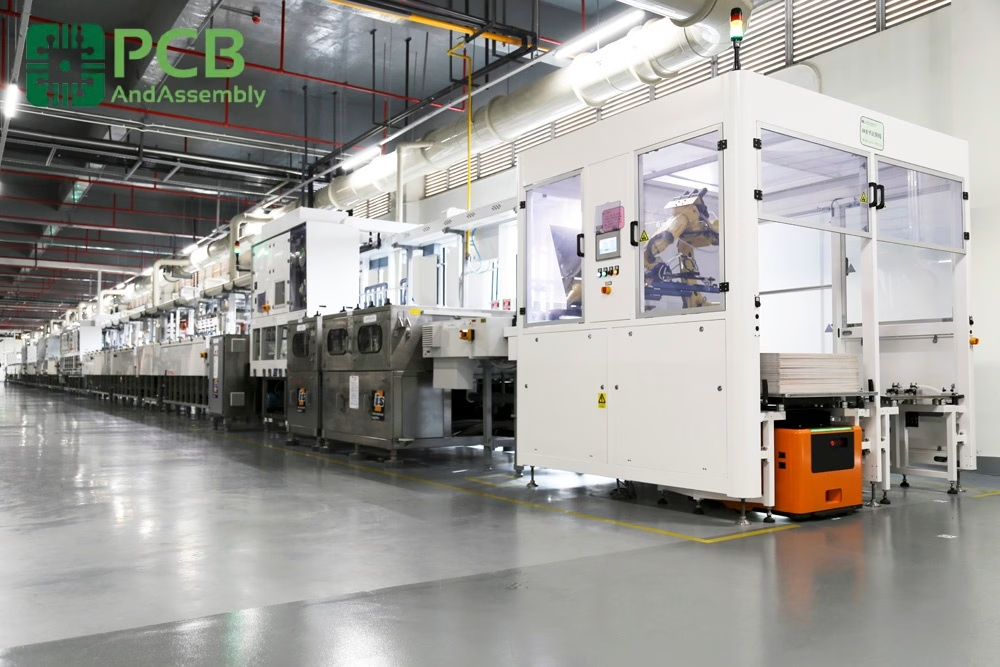
An EMS partner that builds 5G base station boards may have excellent SMT processes but zero understanding of what happens to a board inside a motor drive enclosure. Domain experience matters because it shapes every decision from component selection to testing strategy.
Look for an EMS partner that can show you:
- Specific industrial automation products they have manufactured (PLCs, drives, sensors, controllers)
- Understanding of conformal coating requirements for dusty/humid environments
- Experience with high-temperature FR-4, thick copper, and thermal management design
- Familiarity with industrial communication protocols (Profinet, EtherCAT, Modbus) on PCBA layouts
OrienwPCB, a Shenzhen-based EMS provider with 14 years of experience, qualifies here. Their customer base includes mining equipment controllers, industrial sensor systems, and power conversion modules — products that operate in conditions where consumer-grade electronics would fail within weeks. Their engineering team routinely performs DFM feedback that catches design gaps specific to harsh-environment deployment, and their testing includes functional load cycling and burn-in validation, not just basic AOI.
3. Design for Manufacturing (DFM) and Design for Test (DFT) Capability
Industrial PCBs are often more complex than consumer boards in ways that matter for manufacturability: thicker copper (2 oz+ for power stages), mixed-signal sections (high-voltage power alongside sensitive analog), larger board sizes, and non-standard form factors.
A capable EMS partner provides DFM feedback that goes beyond checking minimum trace widths and annular rings. They should flag:
- Thermal management issues where heavy copper planes concentrate heat
- Component placement that traps heat or creates soldering shadows
- Test point accessibility for ICT and functional test
- Stackup recommendations for controlled impedance with thick copper layers
On the DFT side, the partner should design test fixtures and programs in-house. If they outsource test development, you’re adding weeks to the NPI cycle and losing a layer of process integration.
4. Supply Chain Management and Obsolescence Handling
This is the single most overlooked criterion in EMS selection for industrial products, and it is often the most expensive to get wrong.
Industrial automation products have 10–15 year lifecycles. Semiconductor manufacturers discontinue components on 2–5 year cycles. If your EMS partner does not actively manage component obsolescence, your product will face a forced redesign every few years — or worse, you’ll discover at the 8-year mark that a critical MCU or ADC is no longer available with no qualified replacement.
What to look for in supply chain capability:
| Capability | Why It Matters |
| BOM risk analysis | Flags long-lead, single-source, and EOL components before production begins |
| Multi-sourcing strategy | Qualifies second sources for critical components during NPI, not after a shortage |
| Obsolescence monitoring | Active tracking of PCN (Product Change Notifications) from semiconductor vendors |
| Counterfeit detection | In-house verification (X-ray, decapsulation, electrical test) for high-risk components |
| Inventory management | Ability to hold customer-owned inventory for long-life product support |
5. Testing Infrastructure — Beyond AOI
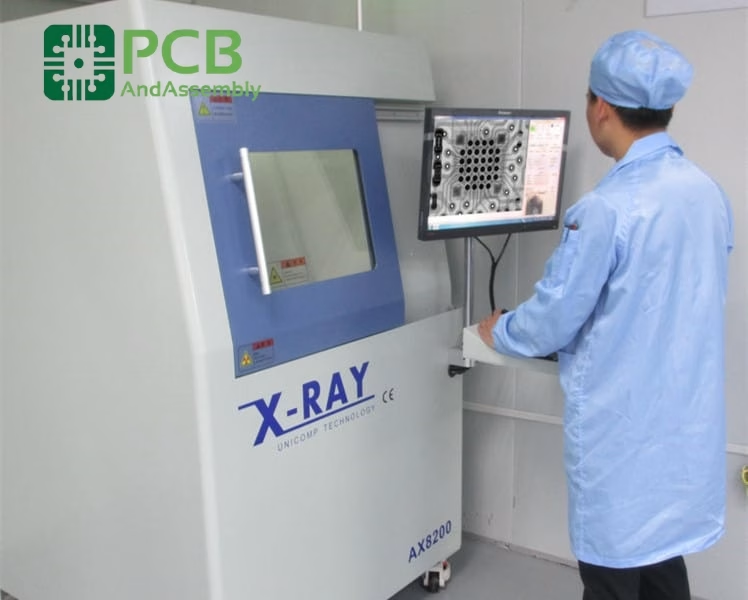
Automated Optical Inspection (AOI) is standard at any serious EMS partner. For industrial automation, you need more.
| Test Type | What It Catches | Required For |
| AOI (Automated Optical Inspection) | Solder paste defects, component shift, missing parts | Baseline — every board |
| X-Ray Inspection | Hidden solder joints (BGAs, QFNs), voiding, shorts | All BGA/QFN assemblies |
| In-Circuit Test (ICT) | Component values, opens, shorts, polarity | Every production board |
| Functional Test (FCT) | Behavior under load, signal integrity, timing | Every production board |
| Burn-In Test | Early-life failures, infant mortality | Mission-critical systems |
| Environmental Stress Screening | Failures from thermal cycling, vibration | Harsh environment products |
A critical question to ask: “Do you build your own test fixtures, or do you rely on your customer to provide them?” The best EMS partners have an in-house test engineering team that designs and builds ICT and functional test fixtures as part of their NPI process.
6. Production Flexibility for High-Mix, Low-Volume
Industrial automation products rarely run at the volumes of consumer electronics. A typical production profile might be 500–5,000 boards per build across 20–50 different variants per year. This is “high-mix, low-volume” (HMLV), and it requires a completely different factory organization than high-volume production.
An HMLV-capable EMS partner runs:
- Production lines optimized for quick changeovers (under 30 minutes between product types)
- Feeding systems that handle multiple part numbers simultaneously
- Scheduling systems that can accommodate engineering changes mid-production
- Separate prototype and production areas to avoid contamination of production lines
If an EMS partner’s website prominently features their “10 million boards per month” capability, they may be optimized for consumer volume rather than the flexibility your industrial program needs.
7. Quality Metrics and Transparency
Ask every potential EMS partner for their actual quality metrics over the past 12 months. The ones that share them willingly are the ones you want to work with. The ones that hesitate or offer generic statements have something to hide.
Baseline metrics for a competent industrial automation EMS partner:
| Metric | Target |
| First-pass yield (FPY) | ≥97% |
| Defect rate (DPPM) | ≤50 ppm |
| On-time delivery (OTD) | ≥95% |
| Customer return rate | ≤0.5% |
| AOI false call rate | ≤3% |
OrinewPCB reports 99% quality pass rate and 98.15% on-time delivery across their three production facilities, with a dedicated quality team performing multi-layer testing (AOI, X-ray, ICT, FCT, and burn-in) on every assembled board.
8. Communication and Engineering Support
Industrial automation programs involve ongoing engineering changes. Component substitutions happen. PCB layout optimizations get requested. Test procedures evolve as field data comes in. Your EMS partner’s engineering team needs to be accessible and responsive.
Key indicators of good communication:
- Dedicated program manager assigned to your account
- English-fluent engineering team (for Western customers) — or native-language support that matches your region
- Response time to DFM queries within 24 hours
- Regular production status updates without you needing to chase them
- Transparent root cause analysis when issues arise
The best EMS partners act as an extension of your engineering team, not as a black box that takes orders and ships boards.
Red Flags to Watch For
Experience with hundreds of OEM-EMS relationships reveals patterns that predict trouble. If you see any of these during evaluation, slow down or walk away.
Vague or hand-wavy certification claims. “We follow ISO standards” is not the same as “We hold ISO 9001:2015 certificate number [X], issued by [registrar], valid through [date].” Same for IPC. If they can’t produce a certificate, don’t assume they have one.
No in-house test engineering. An EMS partner that expects you to design, build, and deliver test fixtures is a box assembler, not a true manufacturing partner. Every revision cycle will be painful.
Zero mention of obsolescence management. If they can’t describe their approach to component lifecycle management, they don’t have one. Your product will face a forced redesign within 3–5 years.
Promises that sound too good to be true. A 3-day turnaround on a complex industrial mixed-signal board with full ICT and functional test? That either means they’re skipping steps or they have zero engineering depth to handle your NPI. Realistic lead times for multilayer industrial PCBA with full testing: 10–18 working days for prototypes, 15–25 days for production.
High-volume factory optimized for consumer goods. If their entire operation is set up to run 100,000 identical phones a month, they will struggle with your 5,000-unit run of 40 different board variants. Your product will be the disruption on their line, not the focus.
The EMS Partner Evaluation Checklist
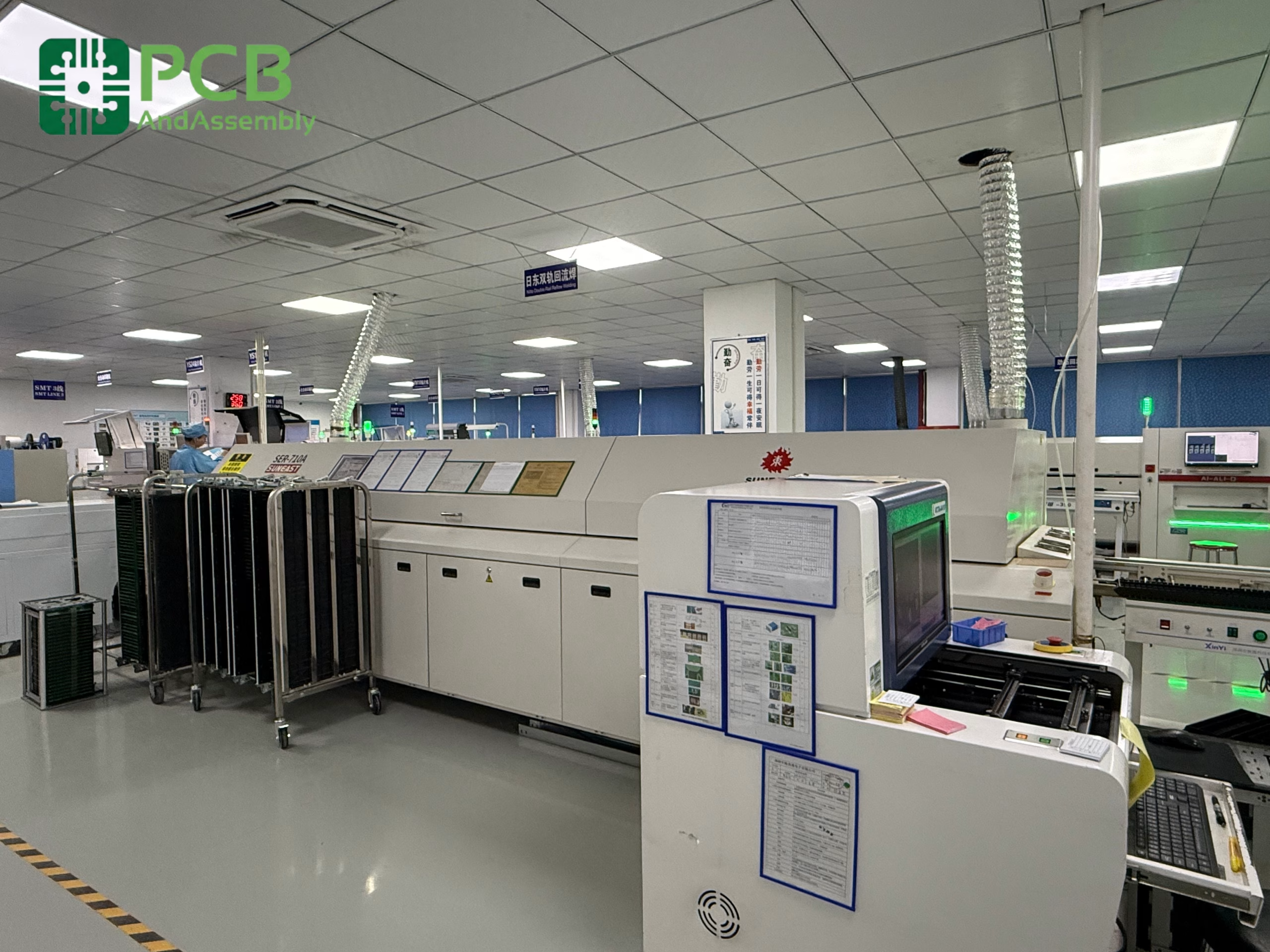
Use this checklist when evaluating potential EMS partners for industrial automation programs.
Certifications & Compliance
- ISO 9001:2015 (current, verified)
- IPC-A-610 Class 3 accepted
- J-STD-001 soldering capability
- IATF 16949 or AS9100D (if required by your industry)
- UL marking capability
- RoHS/REACH compliance
Engineering & NPI
- In-house DFM/DFT engineering team
- Dedicated NPI process with defined milestones
- 24-hour DFM feedback on new designs
- In-house test fixture design and build
- Experience with your specific product type (drives, controllers, sensors, etc.)
Manufacturing Capabilities
- SMT lines optimized for high-mix, low-volume
- Quick changeover capability (<30 minutes)
- Conformal coating and potting in-house
- Box build and system integration capability
- Cable/wire harness assembly capability
Testing
- AOI and X-ray inspection on every board
- In-circuit test (ICT) capability
- Functional test (FCT) fixture design
- Burn-in and ESS capability
- Comprehensive function testing (programming IC, then test)
Supply Chain
- Component obsolescence monitoring system
- Multi-sourcing strategy for critical parts
- Counterfeit detection process
- Full BOM procurement (turnkey capability)
- 100% original and new parts guarantee
Quality & Performance
- First-pass yield data (≥97% target)
- Defect rate data (≤50 DPPM target)
- On-time delivery data (≥95% target)
- Transparent quality reporting
- Lot-level component traceability
Communication
- Dedicated account/program manager
- Engineering support in your language/time zone
- 24-hour response time for technical queries
- Regular production status updates
- Free DFM check before production
Need PCB Manufacturing or Assembly?
Get a free quote within 24 hours. We specialize in prototype-to-production PCB/PCBA for hardware teams worldwide.
How to Match an EMS Partner to Your Industrial Program
The right partner depends on your program’s volume, complexity, and sensitivity.
For ITAR-controlled defense automation or US-government industrial programs: US-domestic EMS partners with AS9100D and ITAR registration are non-negotiable. Federal Electronics, Sanmina, and similar US fabs are the realistic shortlist. Expect 4–8 week lead times and pricing that reflects domestic compliance costs.
For high-volume industrial products (5000+ units per build) with established designs: Global Tier-1 EMS providers like Jabil and Sanmina offer the scale, supply chain depth, and multi-site redundancy that volume programs require. The trade-off is less engineering flexibility during the NPI phase — your design needs to be mature before it enters their production system.
For mid-volume industrial programs (500–5000 units per build) requiring engineering collaboration: Specialized EMS partners with high-mix, low-volume infrastructure deliver the best balance of engineering support, production flexibility, and cost. OrienwPCB (Shenzhen) and Kimball Electronics (US) are strong options in this category. OrinewPCB’s turnkey model — PCB manufacturing, component sourcing, SMT/thru-hole assembly, IC programming, and functional testing under one roof — is well-suited for industrial controller and sensor boards where traceability and quality validation are critical.
For prototypes and pilot runs (1–200 units): Look for an EMS partner with a dedicated NPI line that can handle quick-turn prototypes without contaminating production lines. OrinewPCB accepts orders from single prototypes through 50,000-unit production runs, with DFM feedback within 24 hours and the same inspection and testing standards applied at every volume level.
Useful Resources for EMS Partner Evaluation
These resources provide additional depth on specific aspects of EMS selection for industrial automation.
Design & Engineering:
- IPC-A-610 Acceptability of Electronic Assemblies— The definitive standard for electronics assembly quality. IPC Class 3 is the correct specification for industrial automation products. Available from ipc.org.
- J-STD-001 Requirements for Soldered Electrical and Electronic Assemblies— Covers materials, methods, and verification criteria for high-reliability solder connections. Available from ipc.org.
EMS Evaluation Guides:
- Federal Electronics Whitepaper: “7 Things You Must Know Before Selecting an EMS Partner” — Practical selection framework with a downloadable evaluation checklist.
- TT Electronics EMS Guide: Comprehensive overview of electronics manufacturing services from contractual models to application-specific considerations.
Certification Verification:
- IAF CertSearch(certsearch.iaf.nu) — Global online registry for verifying ISO certifications. Always check your potential EMS partner’s certificate here.
- IPC QML/QPL(ipc.org) — Qualified Manufacturers List for IPC-certified suppliers.
Industry References:
- Kimball Electronics Capabilities: Detailed overview of EMS capabilities specific to industrial and automotive sectors, including high-mix, low-volume production approaches.
- Foxtronics EMS Blog: Regular articles on industrial electronics manufacturing, testing strategies, and quality control for harsh-environment products.
Frequently Asked Questions
What certifications should an EMS partner for industrial automation have?
At minimum, ISO 9001:2015 and IPC-A-610 Class 3 acceptance. For higher-reliability programs, add IATF 16949 (process discipline) or AS9100D (aerospace-grade), J-STD-001 (soldering), and UL marking for safety compliance. Verify each certificate online before engaging.
What’s the difference between IPC Class 2 and Class 3 for industrial products?
IPC Class 2 allows cosmetic defects and minor deviations that don’t affect function — acceptable for consumer products. Class 3 tolerates almost no cosmetic deviations and has significantly tighter criteria for solder joints, component alignment, and contamination. For industrial products that operate in demanding environments, Class 3 is the correct specification. The cost premium is roughly 10–20% for the tighter acceptance criteria.
How do I know if an EMS partner can handle long-lifecycle product support?
Ask three questions: (1) What is your component obsolescence monitoring system? (2) Can you provide a BOM risk analysis before production? (3) How do you handle EOL (end-of-life) component transitions? A capable partner will have documented processes for all three. The answer “we source whatever is available when you need it” is not a process.
What testing should I require for industrial control boards?
Minimum: AOI on every board, X-ray for all BGA/QFN assemblies, and in-circuit test (ICT) for component-level validation. For mission-critical or harsh-environment products, add functional test under load, burn-in (48–168 hours), and environmental stress screening (thermal cycling). An EMS partner with in-house test fixture design capability is strongly preferred.
How long does it take to manufacture an industrial PCBA with full testing?
Prototype runs with full DFM, ICT, and functional test: 10–18 working days from finalized BOM and Gerber files. Production runs (100–5000 units): 15–25 working days. Expedited runs are possible if the EMS partner has component inventory and open capacity, but rushing the NPI process on an industrial product is a false economy — issues caught in the first build save weeks of field failure investigation later.
Can one EMS partner handle the full PCB, assembly, and box build?
Yes, and for industrial automation products, working with a single turnkey provider is usually the better approach. It eliminates handoff issues between separate PCB fab, assembly, and enclosure suppliers, simplifies quality responsibility, and shortens the overall lead time. OrienwPCB operates this way: PCB fabrication (1–54 layers), component sourcing, SMT+THT assembly, IC programming, functional testing, custom wire harness, and custom electronics enclosure — all managed through a single program manager.
What is the most common reason industrial automation OEMs change EMS partners?
Component quality issues and obsolescence failures are the top reasons. OEMs discover 3–5 years into production that a critical component is no longer available, and their EMS partner has no replacement strategy. The second most common reason is inadequate testing — boards that pass AOI but fail in the field because functional test under load was never performed. Both are avoidable with proper vetting during the selection process.
Is it better to use a global Tier-1 EMS or a specialized mid-size partner for industrial automation?
It depends on volume and program maturity. For high-volume, mature designs (10,000+ units), Tier-1 providers offer scale advantages. For mid-volume (500–5000 units), NPI-phase programs, or products with ongoing engineering changes, a specialized high-mix EMS partner provides more responsive engineering support, faster DFM turnaround, and greater production flexibility. Most industrial automation OEMs benefit from a specialized partner during the first 2–3 years of production.
Conclusion
Selecting the right EMS partner for industrial automation is one of the highest-leverage decisions you’ll make for your product’s long-term success. The wrong partner introduces risk that manifests not in the first build but in the third year of field deployment — intermittent failures, unavailable components, and quality variation that engineering cannot compensate for.
Start with certifications, verify them directly. Prioritize IPC-A-610 Class 3 and IATF 16949 if your product needs to survive in demanding environments. Evaluate DFM depth — a partner that catches design issues before production is worth more than one that simply builds what you send them. Demand testing beyond AOI: ICT, functional test under load, and burn-in should be standard for any industrial control board. And verify their supply chain management approach, because your product will likely outlive the components it’s built with.
Send the same detailed RFQ to three potential partners — one global Tier-1, one specialized mid-size provider, and one regional specialist. The variance in their DFM feedback, lead time estimates, and component sourcing recommendations will tell you more about each partner than any marketing page.
Get Quote Free