What Is Turnkey PCB Assembly
Turnkey PCB assembly refers to the service that provides the entire printed circuit board assembly solution from PCB design to product shipping. These include printed circuit board design, material procurement, PCB assembly, testing, etc. Turnkey PCB assembly services can simplify the production process. It reduces the time and resources for the printed circuit board assembly process.
Get Your PCB Quote!
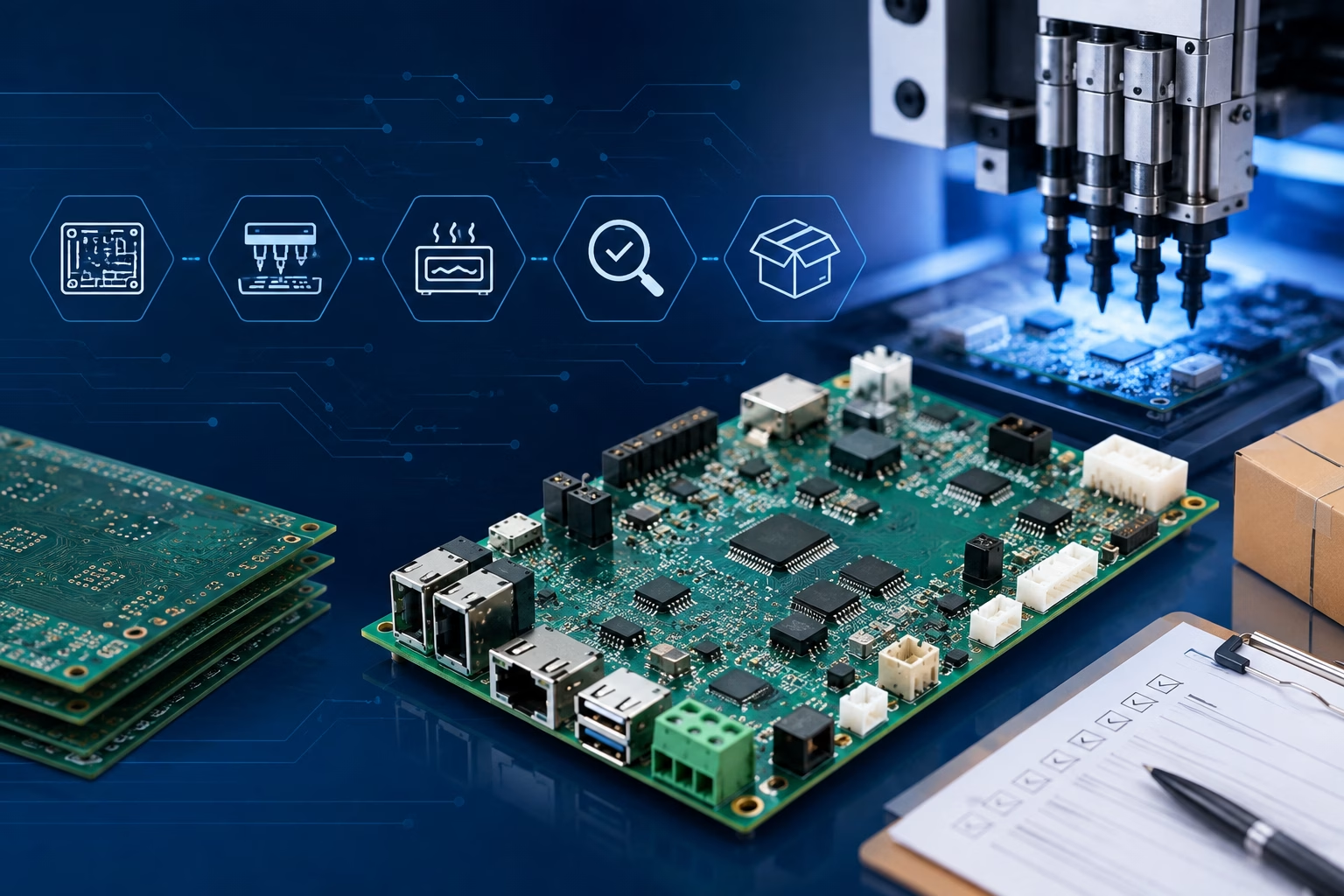
Table of Contents
- Ki sa ki asanblaj PCB kle an men?
- Kle an men konplè vs kle an men pasyèl vs konsinyasyon: ki kote liy lan ye vre
- Sa yon pwogram konplè kle an men gen ladan l, etap pa etap
- Lè asanblaj kle an men fè sans—epi lè konsinyasyon an genyen
- Risk pèsonn pa mansyone anvan ou siyen
- Konbyen asanblaj kle an men koute reyèlman
- Kesyon moun poze souvan
- Poukisa nou ekri sa
Table of Contents
- Ki sa ki asanblaj PCB kle an men?
- Kle an men konplè vs kle an men pasyèl vs konsinyasyon: ki kote liy lan ye vre
- Sa yon pwogram konplè kle an men gen ladan l, etap pa etap
- Lè asanblaj kle an men fè sans—epi lè konsinyasyon an genyen
- Risk pèsonn pa mansyone anvan ou siyen
- Konbyen asanblaj kle an men koute reyèlman
- Kesyon moun poze souvan
- Poukisa nou ekri sa
Quick Specs
| Scope | Component sourcing, PCB fabrication, assembly, testing, programming, coating, box build, shipping |
| Business models | Full turnkey, partial turnkey, consignment (kitted) |
| Component share of cost | 70–80% of total PCBA cost (directional industry figure) |
| Assembly standards | J-STD-001J and IPC-A-610J (both J-revisions released March 2024) |
| Turnkey component markup | 8–15% on BOM (vendor-reported) |
| Typical lead times | 1–3 weeks prototype, 4–8 weeks production (directional) |
Turnkey PCB assembly is a service model in which one contract manufacturer takes responsibility for everything between your design files and your finished, tested boards—component sourcing, PCB fabrication, assembly, testing, and usually programming, conformal coating, and shipping. You hand over your Gerber files and BOM, and the manufacturer hands back ready-to-ship products.
The real decision buried in that sentence is risk transfer. Under a full turnkey program, the manufacturer—not you—owns component availability, procurement quality, and schedule execution. That is what makes turnkey attractive, and it is also where most buyers get burned, because the quality of that risk transfer depends entirely on questions most articles never tell you to ask. This guide explains what turnkey assembly includes, how it differs from partial turnkey and consignment, when each model is genuinely the right call, and what to verify before you sign.
Key Takeaways
- Turnkey is a spectrum, not a single option—full turnkey, partial turnkey, and consignment differ in who owns component procurement and schedule risk.
- Components make up 70–80% of total PCBA cost, so turnkey pricing is really a component-management question, not a soldering question.
- Consignment can look cheaper on paper, but line stops from late or missing customer-furnished parts quietly erase the savings.
- The most dangerous turnkey risk is silent component substitution—ask for a written substitution policy and an authorized-distributor list before you sign.
- ERAI logged 1,055 suspect counterfeit parts in 2024, up 25% year over year—sourcing discipline is what turnkey actually buys you.
What is turnkey PCB assembly?
A turnkey PCB assembly program is one in which the contract manufacturer (CM) manages the full production chain from approved design files to finished assemblies. In practice that covers: BOM review and component sourcing, bare-board fabrication, solder paste and SMT placement, through-hole assembly, testing (AOI, X-ray, ICT, functional), and optional value-added work such as firmware programming, conformal coating, and box build.
The term borrows from the construction industry: a “turnkey” house is delivered with the keys in the lock, ready to move in. A turnkey PCBA is delivered the same way—tested, finished, and ready to go into your enclosure, not a pile of parts and boards you must assemble yourself.
What the customer still provides is the design package: Gerber files, a complete BOM, and where required, test specifications or programming files. What the customer does not provide is purchasing capacity, component inventory, or a supply chain—which is precisely the point. Most buyers evaluating turnkey are doing so because they have neither the volume to buy components at favorable pricing nor the team hours to chase lead times across twenty suppliers.
Full turnkey vs partial turnkey vs consignment: where the line actually sits
Most guides present turnkey and consignment as two clean options. In practice, the responsibility line is drawn per component, not per project, and most real programs sit somewhere in between.
Where the responsibility line sits—the three common models differ mainly in who owns component procurement and inventory risk.
| Full turnkey | Partial turnkey | Consignment (kitted) | |
| Who sources components | CM sources everything | Customer supplies some parts (long-lead or approved-vendor items); CM sources the rest | Customer supplies all parts |
| Who holds inventory | CM | Split | Customer |
| Who absorbs end-of-life (EOL) risk | CM | Shared | Customer |
| Component buying power | CM buys at volume across programs | Mixed | Customer buys at own volume |
| Best fit | Teams without purchasing capacity, fast time-to-market | Customer has an approved vendor list or secured long-lead parts | Existing inventory, legacy suppliers, specialized component contracts |
A common hybrid that does not show up in either column: the customer secures the one 28-week-lead MCU and consigns only that part, while the CM runs full turnkey on everything else. That is legitimate and often the right structure. The mistake is signing a “consignment” program without thinking through which parts belong on which side of the line—and without an agreement on what happens when a customer-supplied part arrives late or fails incoming inspection.
📐 Engineering Note
On a recent low-volume medical program at PCBAndAssembly, a customer’s “cost-saving” consignment plan stopped the line twice in a single month on late connector shipments before we moved the commodity portion to turnkey and the schedule stabilized. The parts themselves were not expensive—the cost was idle SMT lines, rescheduled slots, and a slipping delivery date to the customer’s own customer. Line-stop cost, not part cost, is what consignment buyers should model.
What a full turnkey program includes, step by step
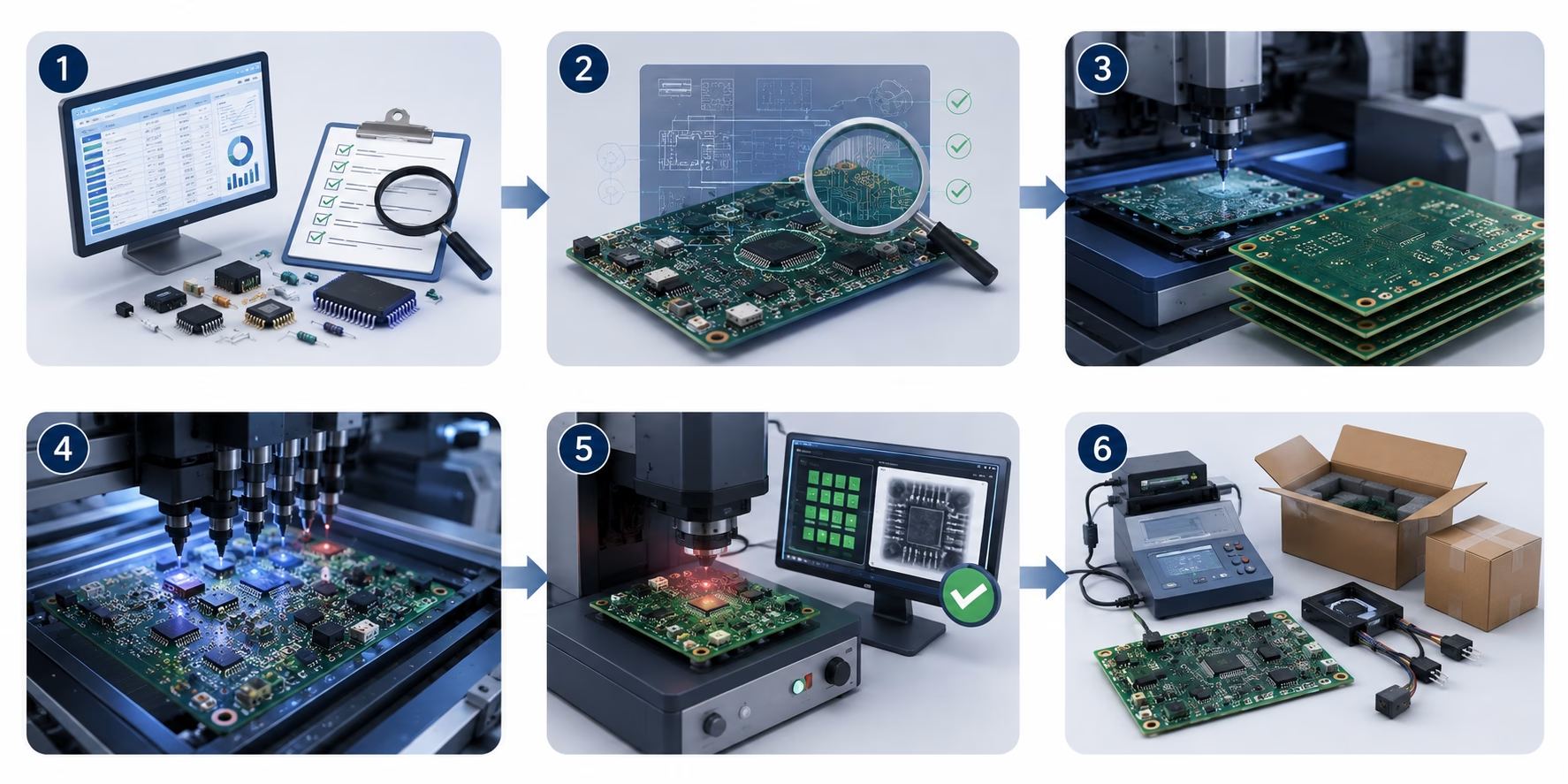
A full turnkey quote is not a price for soldering. It is a price for a supply chain. The steps below are what the fee actually covers.
- BOM review and sourcing.The CM analyzes your BOM for availability, lead time, counterfeit risk, and EOL status before any purchase order is placed. This is where a competent CM flags that your 0603 resistor is fine but your chosen microcontroller has a 26-week lead—before you are committed to a schedule built around it.
- DFM and DFA review.Design-for-manufacturability feedback on the bare board (spacing, annular ring, via aspect ratio) and design-for-assembly feedback on the population side (component clearances, fiducials, solder mask openings). On a recent prototype-to-production transition at PCBAndAssembly, our DFM review flagged that a customer’s BOM specified a 28-week-lead MCU while the rest of the design could have shipped in three—the program would have stalled waiting for a single component. We proposed a pin-compatible authorized alternative, the customer approved the substitution in writing, and the first production batch shipped six weeks earlier than the original plan. That review is not a line item on the quote; it is the cheapest insurance in the entire program.
- PCB fabrication.Bare boards are manufactured—copper print, etch, lamination, drilling, plating, solder mask, surface finish—against the bare-board acceptance criteria in IPC-6012 (Rev F).
- SMT and through-hole assembly.Solder paste printing, component placement, and reflow, followed by through-hole soldering where the design calls for it.
- Testing.Automated Optical Inspection (AOI) on every board, X-ray for hidden joints such as BGAs and QFNs, and In-Circuit Test (ICT) or functional test where the program specifies them. Testing is where “finished” stops meaning “assembled” and starts meaning “known-good.”
- Value-added services.Firmware programming, conformal coating, cable assembly, final box build, and packaging. This is what turns a board into a product ready for distribution—and it is the part of the program where a single accountable partner pays off most.
About OrinewPCB
Time is money in your projects – and OrinewPCB gets it. OrinewPCB is a PCB assembly company that delivers fast, flawless results every time. Our comprehensive PCB assembly services include expert engineering support at every step, ensuring top quality in every board. As a leading PCB assembly manufacturer, we provide a one-stop solution that streamlines your supply chain. Partner with our advanced PCB prototype factory for quick turnarounds and superior results you can trust.
When turnkey assembly makes sense—and when consignment wins
Here is the honest version of the “advantages of turnkey” section most articles write. Turnkey is not always the right answer, and pretending otherwise is how buyers end up paying a markup for a supply chain they did not need.
Choose full turnkey when:
- You have no purchasing department and no team hours for supplier management.
- Your schedule is driven by a launch date, not by component availability.
- Your BOM contains long-lead or single-source parts you cannot buy at favorable pricing on your own volume.
- You want one point of accountability for quality, cost, and delivery.
Choose consignment or partial turnkey when:
- You already hold component inventory, or you are transitioning an existing in-house program.
- Your company policy requires buying from a specific approved vendor list (AVL) that the CM cannot source from.
- You have secured long-lead parts yourself and only need assembly.
- Your component pricing through your own contracts beats what the CM can get (a situation that is rarer than most buyers assume).
If you are a startup or low-volume buyer, the tie-breaker is component management, not assembly cost. A hardware startup with ten BOM line items and no supplier relationships will almost always be better served by turnkey—the CM’s purchasing volume and sourcing discipline are worth more than the markup.
The data on component availability explains why: Sourceability’s market intelligence counts 328,000 end-of-life notices issued by component manufacturers in a single baseline year (2023), with instant-obsolescence events up 35%, and lead times on constrained categories stretching from a routine 8–16 weeks to 26–55+ weeks. Component risk is now a permanent feature of the landscape, not an exception—and turnkey is the model that hands that risk to someone whose full-time job is managing it.
The risks nobody mentions before you sign
The advantages of turnkey are easy to find. The failure modes are not—which is exactly why they deserve their own section.
⚠️ Silent component substitution
The most dangerous turnkey failure is not a counterfeit part. It is the authorized-but-wrong part. When a component goes EOL or short-supply, a CM under schedule pressure may quietly swap in a “pin-compatible” substitute that is not electrically equivalent—a voltage reference with inverted enable polarity, a capacitor with different ESR, a regulator with a different dropout. The board works on the bench and fails in the field, and by the time you trace it, the parts are in hundreds of units. Before signing a turnkey contract, ask for the substitution policy in writing: does every substitution require your written approval, or does the CM swap at its own discretion? That single clause is the difference between a risk you own and a risk you do not.
Gray market sourcing
Counterfeit and nonconforming parts remain a measurable threat. A turnkey CM should be able to show you the authorized distributors it buys from—Arrow, Avnet, DigiKey, Mouser, and equivalents—and should never source an unverifiable part because the price is low. Ask, and verify.
Obsolescence and EOL management
Every year, component manufacturers retire parts—328,000 EOL notices in 2023 per Sourceability’s market intelligence—and the average lifespan of advanced semiconductors has dropped by roughly two-thirds, from legacy norms of about 30 years down to roughly 10, with cutting-edge nodes running just 2–5 year availability windows. In a turnkey program, ask who monitors your BOM for EOL notices and what the notification process is. A CM that runs obsolescence alerts against your BOM before your part vanishes is managing a risk you would otherwise discover after your last build.
The data package as the contract
In turnkey, the CM holds your Gerbers, your BOM, and often your test programs. Before signing, confirm in writing who owns the files, what happens if you leave, and whether the CM will release your data package on request. The relationship works because both sides behave like partners; the contract should protect you even when they do not.
What turnkey assembly actually costs
Turnkey manufacturing is not a niche offering: Fortune Business Insights values the global EMS market at $650.77 billion in 2025, growing at a 6.7% CAGR through 2034, with Asia-Pacific holding a 54.73% share. Programs at that scale run on component management, which is why the pricing discussion below starts with parts, not labor.
The most common pricing misconception is that turnkey is more expensive because the CM “marks up” the parts. The truth is more useful: components are 70–80% of total PCBA cost, so assembly labor is a small slice of what you are paying for. Turnkey pricing is component pricing.
Vendor-reported ranges put the turnkey markup at roughly 8–15% on the BOM, while consignment buyers may save 10–25% on parts by using their own supplier contracts—both figures come from assembler commentary and are directional, not audited industry data. The question is whether that consignment discount survives contact with reality: inventory carrying cost, incoming inspection of customer-furnished parts, rework for parts that fail inspection, and the line-stop risk described earlier.
📐 Engineering Note
Take a $100,000 BOM. At a 10% turnkey markup, the component premium is $10,000. Now model the consignment alternative: one line stop of a day on a mid-size SMT line costs roughly $2,000–$5,000 in idle labor and rescheduling (directional, varies by line size and utilization), and consignment programs routinely absorb several such stops across a production cycle. Two or three stops erase most of the 10–25% parts savings. The markup is a known, capped cost; line stops are unknown and compounding.
Frequently Asked Questions
Q: What is turnkey PCB assembly?
Turnkey PCB assembly is a service model where one contract manufacturer manages the entire production chain from your design files to finished, tested boards—component sourcing, PCB fabrication, assembly, testing, and optional value-added services like programming, coating, and box build—so you hand over Gerber files and a BOM and receive ready-to-ship products.
Q: What is the difference between turnkey and consignment PCB assembly?
In turnkey assembly the manufacturer sources all components and owns procurement, inventory, and schedule risk. In consignment assembly the customer supplies all components (or a defined subset, in partial turnkey) and the manufacturer only assembles them. The trade-off is a component markup of roughly 8–15% on turnkey versus the hidden costs of consignment: carrying inventory, inspecting customer-furnished parts, and line stops when parts arrive late.
Q: Does turnkey PCB assembly cost more?
On components, yes—vendor-reported figures put the turnkey markup at 8–15% of the BOM. On total program cost, often no: components are 70–80% of PCBA cost, and the CM’s purchasing volume, sourcing discipline, and schedule accountability frequently save more than the markup costs. Model the line-stop risk, not just the part price.
Q: What do I need to provide for turnkey assembly?
A complete design package: Gerber files, a complete and accurate BOM (manufacturer part numbers, not just descriptions), and where required, test specifications and programming files. The more accurate the BOM, the fewer sourcing surprises.
Q: How long does turnkey PCB assembly take?
Directionally, 1–3 weeks for prototypes and 4–8 weeks for production runs after BOM approval and component availability are confirmed—but component lead times dominate the schedule, and constrained parts can run 26–55+ weeks. The CM’s purchasing position is what compresses that window.
Q: Do I still own my design files with turnkey?
Yes, if you negotiate it. Confirm in writing before signing that you own the Gerbers, BOM, and test programs and that the CM will release them on request. Ownership of the data package should never be the price of a turnkey relationship.
Why we write this
Most articles about turnkey PCB assembly stop at “it saves you time and hassle.” We wrote this guide because buyers who make procurement decisions deserve the version that includes the failure modes: silent substitution, gray-market sourcing, obsolescence, and the consignment trap where a “cheaper” parts deal costs more than the markup it avoids. We manufacture full turnkey PCBAs at PCBAndAssembly—including full turnkey PCB assembly services with component sourcing from authorized distributors and IPC Class 2/Class 3 assembly—so the recommendations here come from running real programs, not from a marketing brief.
Get Quote Free