PCB Assembly Automation: How Automation Streamlines the PCBA Production Process
This guide covers everything you need to know about how automation streamlines the PCBA production process: the key technologies, the workflow from paste printing to packaging, the quality control systems that catch defects at every stage, and what Industry 4.0 means for the future of PCB assembly.
Get Your PCB Quote!
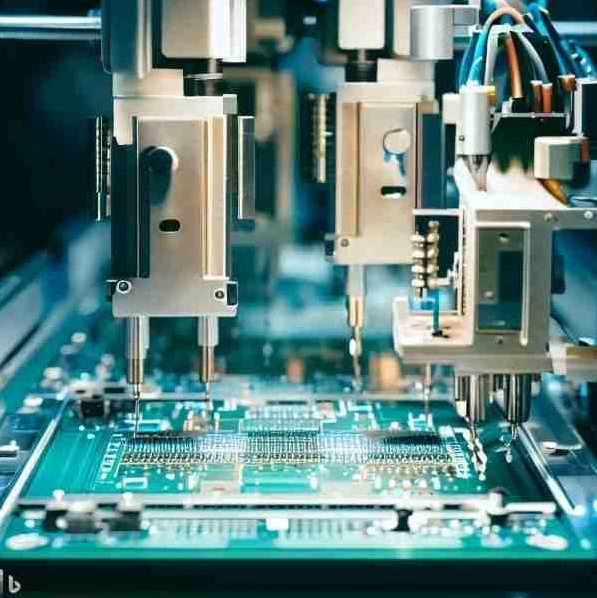
Table of Contents
- Apa Itu Otomatisasi Perakitan PCB?
- Manfaat Otomatisasi Perakitan PCB Secara Sekilas
- Bagaimana Otomatisasi Memperlancar Setiap Tahap Produksi PCBA
- Otomatisasi Perakitan Lubang Tembus: Penyolderan Selektif dan Penyolderan Gelombang
- Industri 4.0 dan Pabrik PCBA Pintar
- Cara Memilih Tingkat Otomatisasi yang Tepat
- PCBAndAssembly: Layanan PCBA Ahli dengan Otomatisasi Penuh
- Pertanyaan yang Sering Diajukan
- Kesimpulan
Table of Contents
- Apa Itu Otomatisasi Perakitan PCB?
- Manfaat Otomatisasi Perakitan PCB Secara Sekilas
- Bagaimana Otomatisasi Memperlancar Setiap Tahap Produksi PCBA
- Otomatisasi Perakitan Lubang Tembus: Penyolderan Selektif dan Penyolderan Gelombang
- Industri 4.0 dan Pabrik PCBA Pintar
- Cara Memilih Tingkat Otomatisasi yang Tepat
- PCBAndAssembly: Layanan PCBA Ahli dengan Otomatisasi Penuh
- Pertanyaan yang Sering Diajukan
- Kesimpulan
As electronic products continue to shrink in size while growing in complexity, PCB assembly has evolved far beyond manual operations. Today’s smartphones, 5G infrastructure, automotive radar modules, and IoT devices all rely on boards with component densities that are physically impossible to assemble by hand. The answer lies in PCB assembly automation — a tightly integrated system of advanced machinery, robotics, and software that performs the entire PCBA process with speed, precision, and repeatability that manual labor simply cannot match.
Key Takeaways
- PCB assembly automation replaces manual labor with high-speed pick-and-place machines, automated reflow ovens, and multi-stage inspection systems (SPI, AOI, AXI), achieving placement rates of 30,000+ components per hour.
- The automated PCBA line follows a precise sequence: solder paste printing → pick-and-place → reflow soldering → automated inspection → testing → packaging.
- Solder paste defects account for up to 80% of PCBA failures — SPI (Solder Paste Inspection) at the earliest stage prevents these defects from propagating downstream.
- Automation reduces labor costs by 60-80% in high-volume production while improving yield rates from 95% (manual) to 99.5%+ (automated), with defect rates below 50 PPM.
- Industry 4.0 technologies — IoT-connected machines, AI-powered inspection, digital twins, and real-time MES — are transforming automated lines into self-optimizing smart factories.
What Is PCB Assembly Automation?
PCB assembly automation refers to the use of computer-controlled machinery, robotic systems, and integrated software to perform the entire process of mounting and soldering electronic components onto printed circuit boards. Unlike manual assembly, where operators place components by hand and solder them individually, an automated line performs these tasks without human intervention from start to finish.
A fully automated PCBA production line typically consists of these core stations:
| Station | Equipment | Function |
| Solder Paste Printing | Automatic stencil printer | Deposits precise amount of solder paste on PCB pads |
| Component Placement | Pick-and-place machine | Retrieves components from reels/trays and places them on board |
| Reflow Soldering | Reflow oven | Melts solder paste to form permanent electrical connections |
| Automated Inspection | SPI / AOI / AXI | Inspects paste quality, component placement, and solder joints |
| Through-Hole Soldering | Wave soldering / Selective soldering | Solders through-hole components on mixed-technology boards |
| Testing | ICT / Flying probe / Functional test | Verifies electrical connectivity and board functionality |
| Packaging | Automated packaging system | Seals and packages finished boards for shipment |
The line is connected by conveyor belts and controlled by a Manufacturing Execution System (MES) that tracks every board, monitors machine status, and collects production data in real time.
The Benefits of PCB Assembly Automation at a Glance
Why do manufacturers invest heavily in automated assembly lines? The answer comes down to five measurable advantages.
Table: Automated vs Manual PCB Assembly Comparison
| Metric | Manual Assembly | Automated Assembly | Improvement |
| Placement Speed | 50-200 components/hour | 15,000-50,000+ components/hour | 100x+ |
| Placement Accuracy | ±0.5mm (variable) | ±25-50 µm (consistent) | 10-20x better |
| Defect Rate | 500-5,000 PPM | 20-50 PPM | 90-99% reduction |
| Labor Requirement | 5-15 operators per line | 1-2 operators per line | 80-90% reduction |
| Yield Rate (first pass) | 85-95% | 98-99.8% | 3-14% improvement |
| Repeatability | Varies by operator skill | Identical board to board | 100% consistent |
Faster Production: High-speed pick-and-place machines from ASM, Fuji, and Panasonic can place over 100,000 components per hour on a single line. What takes a team of 10 operators a full day can be completed by one automated line in under an hour.
Higher Quality: Automated systems eliminate the randomness of human error. Every board receives the same amount of solder paste, components are placed at the same coordinates with micron-level precision, and the same thermal profile is applied to every board passing through the reflow oven.
Lower Cost Per Board: While the initial capital investment is significant (2+ million for a full SMT line), the per-board cost drops dramatically at volume. Labor costs decrease by 60-80%, rework rates fall, and material waste is minimized through precise process control.
Consistent Quality: Once programmed and validated, an automated line produces identical boards for the entire production run. This consistency is essential for automotive, medical, and aerospace applications where every board must meet strict quality standards.
Handling Miniaturization: Components as small as 01005 (0.4mm x 0.2mm) and 008004 (0.2mm x 0.1mm) cannot be handled by human hands. Automated placement machines with advanced vision systems are the only practical way to assemble modern high-density boards.
How Automation Streamlines Each Stage of PCBA Production
Let’s walk through the production process and see exactly how automation drives efficiency at every step.
1. Solder Paste Printing — The Foundation of Quality
The first step in any SMT assembly line is applying solder paste to the PCB pads. An automated stencil printer uses a metal stencil with laser-cut apertures that match the pad pattern on the board. The machine aligns the stencil to the board, applies solder paste, and uses a squeegee blade to force paste through the apertures onto the pads.
Up to 80% of all PCBA defects trace back to solder paste issues — insufficient volume, misalignment, bridging, or paste slump. This is why Solder Paste Inspection (SPI) is critical at this stage. An SPI machine uses 3D laser profilometry to measure the volume, height, area, and position of every paste deposit on the board. If a deposit falls outside tolerance, the system alerts the printer to adjust its parameters automatically.
How automation helps: Closed-loop feedback between SPI and the stencil printer means the line self-corrects. If SPI detects consistently low paste volume on certain pads, the printer adjusts its squeegee pressure or speed — without operator intervention.
2. Pick-and-Place — Speed Meets Precision
The pick-and-place machine is the heart of the SMT line. These machines use high-speed gantry or rotary-head systems to retrieve components from feeders (reels, tubes, or trays) and place them on the board at programmed coordinates.
Capabilities of modern placement machines (2025-2026):
| Feature | Entry-Level | Mid-Range | High-End |
| Placement Speed | 8,000-15,000 CPH | 20,000-45,000 CPH | 50,000-100,000+ CPH |
| Placement Accuracy | ±50 µm | ±35 µm | ±20-25 µm |
| Component Range | 0402 to 30mm | 0201 to 50mm | 01005 to 55mm, odd-form |
| Feeder Capacity | 40-80 slots | 80-160 slots | 160-320+ slots |
| Head Configuration | Single-gantry | Dual-gantry / multi-head | Turret / multi-beam |
How automation helps: Modern placement machines use automatic nozzle changers, real-time component centering (laser or vision), and dynamic feeder verification to ensure the right component goes on the right pad every time. No operator judgment is needed — the machine validates every pick.
3. Reflow Soldering — Controlled Thermal Processing
After placement, the board enters a reflow oven — a multi-zone convection or infrared heating system that brings the board through a precise thermal profile: preheat, soak, reflow (above the solder melting point, typically 217°C for SAC305 lead-free solder), and cool-down.
A typical reflow oven has 8-12 independently controlled heating zones plus 2-4 cooling zones. The temperature profile is critical: ramp too fast and components crack, soak too long and flux evaporates, peak too hot and the board delaminates.
How automation helps: Real-time temperature profiling systems monitor the oven’s performance continuously. If a zone drifts, the system alerts maintenance or adjusts the conveyor speed to compensate. Modern ovens also offer nitrogen atmosphere capability for reduced oxidation on high-reliability boards.
4. Automated Inspection — Catching Defects Before They Escape
Quality control in an automated PCBA line is not a final checkpoint — it’s a multi-layer system that inspects at every stage:
SPI (Solder Paste Inspection): After paste printing. Checks volume, height, area, alignment. Catches insufficient paste, solder bridges, and paste slump.
Pre-Reflow AOI (Automated Optical Inspection): After placement but before reflow. Checks for missing, misaligned, tombstoned, or incorrectly oriented components. Allows rework before solder is set.
Post-Reflow AOI: After reflow. Inspects solder joint quality, component presence, polarity, and solder bridges. High-resolution cameras capture images from multiple angles.
AXI (Automated X-Ray Inspection): Required for hidden solder joints under BGAs, QFNs, CSPs, and other area-array packages. X-rays reveal voids, shorts, insufficient solder, and head-in-pillow defects.
How automation helps: AI-powered inspection systems have replaced traditional rule-based algorithms in many high-end lines. Machine learning models trained on thousands of defect images reduce false call rates by 60-80%, meaning operators spend less time verifying false positives and more time on actual issues.
5. Electrical Testing — Verifying Functionality
After assembly and optical inspection, boards undergo electrical testing to verify that every connection is intact and the board functions as designed.
| Test Type | Best For | Coverage | Setup Time |
| ICT (In-Circuit Test) | High-volume production | Opens, shorts, passive values, diode orientation | Days (fixture required) |
| Flying Probe Test | Prototype / Low-volume | Opens, shorts, passive values | Minutes (no fixture) |
| Functional Test | All volumes | Full board functionality | Hours to days (test system design) |
| Boundary Scan (JTAG) | BGA-heavy designs | Digital pin connectivity | Hours (software-driven) |
How automation helps: Test systems are fully automated. Boards feed into the test fixture via conveyor, the test program runs automatically, results are logged to the MES, and boards are sorted into pass/fail bins — all without operator action.
6. Packaging — The Final Automated Step
The finished boards are cleaned (if required), conformally coated (for harsh environments), and packaged. Automated packaging systems use conveyor-fed wrapping, sealing, and labeling equipment to prepare boards for shipment.
How automation helps: Barcode labeling and serial number tracking ensure full traceability from bare PCB through assembly, test, and shipping. Every board’s production history is recorded in the MES database.
Automation Through-Hole Assembly: Selective Soldering and Wave Soldering
Even in an age of surface-mount technology, through-hole components remain essential for high-power connectors, transformers, large electrolytic capacitors, and mechanical mounting points. Automation handles these too.
Wave Soldering: The board passes over a fountain of molten solder that wicks up into the plated through-holes. Used for boards with predominantly through-hole components.
Selective Soldering: A robotic nozzle applies solder only to specific through-hole joints, protecting nearby SMT components from thermal stress. Ideal for mixed-technology boards where SMT and through-hole components coexist.
Modern selective soldering machines use laser or inductive heating with flux-dot dispensing, achieving repeatable joint quality with minimal thermal impact on the surrounding board.
Industry 4.0 and the Smart PCBA Factory
The latest evolution in PCB assembly automation goes beyond individual machines — it connects everything into a unified, data-driven ecosystem. Here are the key trends transforming automated PCBA lines in 2025-2026:
Real-Time MES Integration: Manufacturing Execution Systems now integrate machines from different vendors through open protocols, providing full serial-level traceability. Every board’s journey through the line — which machine placed it, which reflow profile it saw, which inspector checked it — is logged and accessible.
AI-Powered Predictive Maintenance: Sensors on placement machine spindles, reflow oven heaters, and conveyor motors monitor vibration, temperature, and current draw. Machine learning models predict failures before they happen, reducing unplanned downtime by 30-50%.
Digital Twins: A virtual replica of the production line runs in parallel with the physical line. Operators can simulate schedule changes, new product introductions, or bottleneck resolutions on the digital twin before implementing them on the actual line.
Collaborative Robots (Cobots): Unlike traditional industrial robots that require safety caging, cobots work alongside human operators. They handle material replenishment, screw driving, final assembly, and packaging tasks, allowing human workers to focus on higher-value activities.
Automated Material Handling: Autonomous Mobile Robots (AMRs) and Automated Guided Vehicles (AGVs) deliver components, PCBs, and finished goods between storage and production lines — eliminating material handling labor and reducing WIP inventory.
Need PCB Manufacturing or Assembly?
Get a free quote within 24 hours. We specialize in prototype-to-production PCB/PCBA for hardware teams worldwide.
How to Choose the Right Level of Automation
Not every manufacturer needs a fully automated line. The right level depends on production volume, product complexity, and budget.
| Production Volume | Recommended Automation Level | Typical Investment | Labor Requirement |
| Prototype (< 100 boards/month) | Semi-automated: Manual paste, semi-auto pick-and-place, bench-top reflow | 80,000 | 2-3 operators |
| Low Volume (100-1,000 boards/month) | Basic SMT line: Automatic printer, mid-range P&P, reflow oven, AOI | 400,000 | 3-5 operators |
| Mid Volume (1,000-10,000 boards/month) | Full SMT line: High-speed P&P, SPI, AOI, AXI, selective soldering | 1.5M | 5-8 operators |
| High Volume (10,000+ boards/month) | Fully automated line: Multi-head P&P, inline testing, AMR material handling, MES | 5M+ | 8-15 operators per shift |
PCBAndAssembly: Expert PCBA Services with Full Automation
At PCBAndAssembly, we operate fully automated SMT and through-hole assembly lines with advanced inspection and testing capabilities. Our 3 factories span over 15,000m² with 400+ skilled employees, producing 15,000m² of PCB per month and supporting assembly volumes from prototype to mass production.
Our automated PCBA capabilities include:
| Service | Capability |
| SMT Assembly | High-speed placement, 01005 to BGA/CSP/QFN |
| Through-Hole Assembly | Wave soldering, selective soldering |
| Mixed-Technology Assembly | SMT + THT on the same board |
| Automated Inspection | SPI, pre-/post-reflow AOI, AXI for BGA inspection |
| Electrical Testing | ICT, flying probe, functional test |
| Conformal Coating | Robotic selective coating |
| Turnkey Services | Component sourcing, PCB fabrication, programming, functional testing |
| Certifications | ISO 9001, ISO 13485, IATF 16949, UL, RoHS, IPC Class 3 |
We serve clients worldwide, including Europe and North America, with competitive pricing (30-50% below European EMS rates) and strict quality control. Turnaround times range from 24 hours for quick-turn prototype assembly to standard 2-4 weeks for production volumes.
Frequently Asked Questions
What is the difference between SMT and through-hole assembly automation?
SMT assembly uses solder paste printing, pick-and-place machines, and reflow ovens — it’s fully automated and handles tiny surface-mount components at high speed. Through-hole assembly automation uses wave soldering or selective soldering systems that are better suited for larger, mechanically robust components. Most modern PCBA lines use both (mixed-technology assembly), applying SMT for most components and selective soldering for the few through-hole parts.
How much does an automated PCBA line cost?
A basic semi-automated SMT line suitable for low-volume production starts around 400,000. A fully automated high-speed line with SPI, AOI, AXI, ICT, and MES integration costs 5 million or more. Many manufacturers start with contract assembly services (like PCBAndAssembly) rather than investing in their own line until volumes justify the capital expenditure.
What defect rate can I expect from automated PCBA?
A well-maintained automated SMT line typically achieves defect rates below 50 PPM (parts per million) for mature designs, with world-class fabs running under 20 PPM. This compares to manual assembly, which typically sees 500-5,000+ PPM. The automated line’s edge comes from process control: consistent paste deposition, precise placement, controlled thermal profiles, and multi-stage inspection.
Can automation handle prototypes and low-volume production?
Yes. Modern flexible SMT lines can handle high-mix, low-volume (HMLV) production efficiently. Flying probe testers eliminate the need for custom test fixtures at low volumes. Many contract manufacturers offer quick-turn prototype assembly with the same automated equipment used for production — just with more manual setup and verification steps.
What is SPI in PCB assembly?
SPI stands for Solder Paste Inspection. It’s an automated 3D inspection system placed right after the solder paste printer. SPI measures the volume, height, area, and alignment of every paste deposit on the board. Since 80% of PCBA defects trace back to solder paste issues, catching problems at this stage prevents costly rework downstream. The best SPI systems provide closed-loop feedback to adjust printer parameters automatically.
How does AI improve PCB assembly automation?
AI improves PCBA automation in several ways: AI-powered AOI reduces false call rates by 60-80% (fewer false defect flags that waste operator time); predictive maintenance models reduce unplanned downtime; AI-driven path optimization on placement machines improves throughput; and machine learning on test data identifies subtle process shifts before they cause quality issues.
What certificates should an automated PCBA manufacturer hold?
For standard commercial applications, ISO 9001 is the baseline. For regulated industries: ISO 13485 (medical), IATF 16949 (automotive), AS9100D (aerospace/defense), and IPC-A-610 Class 3 (high-reliability electronics). UL certification for PCB fabrication is also important for safety compliance. These certifications ensure the manufacturer’s automated processes are audited and controlled to industry standards.
Is automated PCBA more expensive than manual assembly?
Per board, automated assembly is significantly cheaper at any reasonable volume. While manual assembly has lower upfront costs (no machine investment), the per-board cost is much higher due to labor, slower throughput, and higher defect/rework rates. The break-even point varies, but for any production run above 50-100 boards, automated assembly delivers lower total cost when including yield, speed, and quality factors.
Conclusion
PCB assembly automation has transformed electronics manufacturing from a labor-intensive craft into a high-speed, precision-driven industrial process. Automated lines place tens of thousands of components per hour with micron-level accuracy, inspect every solder joint at multiple stages, track every board through production, and deliver consistent quality that manual assembly cannot match.
As we move further into the era of 5G, IoT, electric vehicles, and AI-powered devices, the demand for automated PCBA will only grow. The manufacturers who invest in automation — or partner with automated assembly providers — will be the ones who can deliver the quality, speed, and cost efficiency that the market demands.
Whether you need a 50-board prototype run or a 50,000-unit production order, automated assembly is the right choice for modern electronics manufacturing.
Get Quote Free