Qualities of a Suitable PCBA Manufacturer:How to Choose a PCBA Manufacturer
Not all PCBA manufacturers are equal — and the wrong choice costs far more than the initial quote. This guide covers the certifications, testing protocols, and sourcing practices that separate reliable assembly partners from costly ones.
Get Your PCB Quote!
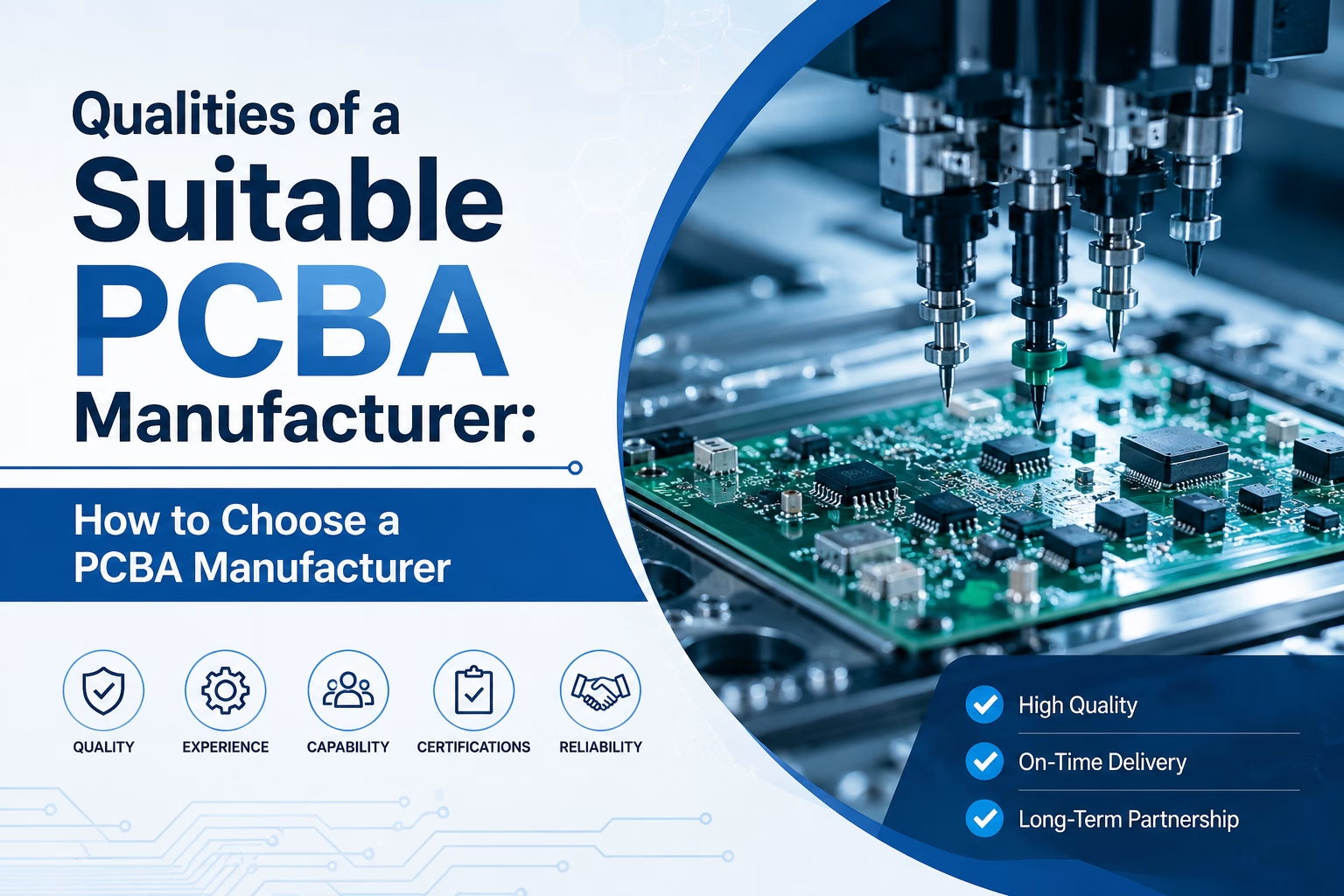
Table of Contents
- 1. Ievads
- 2. Sliktas piegādātāju izvēles izmaksas
- 3. Montāžas tehnoloģiju salīdzinājums
- 4. Būtiskākie kvalitātes vadības sertifikāti
- 5. Paplašinātās testēšanas un pārbaudes protokoli
- 6. Komponentu iegāde un piegādes ķēdes noturība
- 7. Ražojamības projektēšanas (DFM) atbalsts
- 8. Operacionāla mēroga un gatavi pakalpojumi
- 9. Izmaksu pārredzamība un cenu noteikšanas modeļi
- Biežāk uzdotie jautājumi
- Secinājumi
Table of Contents
- 1. Ievads
- 2. Sliktas piegādātāju izvēles izmaksas
- 3. Montāžas tehnoloģiju salīdzinājums
- 4. Būtiskākie kvalitātes vadības sertifikāti
- 5. Paplašinātās testēšanas un pārbaudes protokoli
- 6. Komponentu iegāde un piegādes ķēdes noturība
- 7. Ražojamības projektēšanas (DFM) atbalsts
- 8. Operacionāla mēroga un gatavi pakalpojumi
- 9. Izmaksu pārredzamība un cenu noteikšanas modeļi
- Biežāk uzdotie jautājumi
- Secinājumi
1. Introduction
Electronics manufacturing leaves no room for error. A single defective solder joint can cause complete system failure — making your choice of assembly partner the most consequential decision in your project.
A reliable PCBA manufacturer must demonstrate strength across three pillars:
- Technical capacity and process capability
- Certified quality management systems
- Full supply chain transparency
I’ve seen a minor 0.1mm offset in stencil alignment ruin an entire production batch of medical-grade boards during my decade auditing assembly lines. You must evaluate their technical capacity, quality management systems, and sourcing transparency to protect your intellectual property and project timelines.
Need PCB Manufacturing or Assembly?
Get a free quote within 24 hours. We specialize in prototype-to-production PCB/PCBA for hardware teams worldwide.
2. The Cost of Poor Supplier Selection
A cheap quote rarely stays cheap. Low-budget shops cut corners through grey-market components and skipped inspection steps — costs that surface later as field failures, warranty returns, and brand damage.
The true financial risk includes:
- Direct recall costs that dwarf any initial savings
- Unpredictable production schedules from inconsistent yields
- Expensive engineering rework on assemblies that passed a lenient supplier
Partnering with a proven manufacturer protects your capital investment and keeps production timelines intact.
3. Comparing Assembly Technologies
The right assembly method depends on your board’s component density and load requirements. A capable supplier masters all three:
| Assembly Type | Primary Advantages | Typical Applications |
| Surface Mount Technology (SMT) | High density; rapid automated throughput | Smartphones, IoT devices, high-speed processors |
| Through-Hole Technology (THT) | Strong mechanical bonds for heavy components | Power supplies, industrial connectors, automotive relays |
| Mixed Assembly | Combines thermal durability with dense signal routing | Industrial control systems, medical monitors |
Reflow Soldering
Each zone in the reflow profile serves a precise function. Poor calibration causes specific, predictable defects:
- Inadequate preheat: solvent outgassing leads to solder splattering and joint voiding
- Excessive liquidus heat: damages sensitive packaging or degrades laminate bonding
- Incorrect cooling rate: induces thermal stress fractures in solder joints
Wave Soldering
Through-hole assemblies require equal precision. Solder temperature, wave height, and conveyor angle must match the board’s thermal mass. Insufficient dwell time prevents capillary action from drawing solder to the top-side pad, leaving weak connections.
4. Essential Quality Management Certifications
Certifications are verifiable proof of process control. Certified manufacturers document every workflow, maintain trace logs, and follow rigorous calibration schedules.
ISO 9001 — Global Quality Management
The baseline standard for continuous improvement and document control.
- Mandates regular internal audits and corrective action workflows
- Requires standardized training records for all production operators
- Ensures consistent raw material inspection protocols
Best for: Standard consumer and industrial electronics
Watch out for: Uneven implementation depth across different plants
ISO 13485 — Medical Device Quality
Healthcare certification with strict risk management and documentation requirements to protect patient safety.
- Enforces full lot traceability back to raw material batch
- Requires verified cleanroom environments for assembly
- Demands extensive process validation before mass production
Best for: Medical devices and life-support electronics
Watch out for: Higher documentation overhead increases initial setup time
IATF 16949 — Automotive Production Standards
Automotive-grade standard focused on defect prevention and supply chain variation reduction.
- Utilizes Failure Mode and Effects Analysis (FMEA) to mitigate manufacturing risks
- Requires strict statistical process control on critical assembly lines
- Mandates structured product part approval processes (PPAP)
Best for: Automotive control systems and high-stress industrial machinery
Watch out for: Low flexibility for rapid, unvalidated design changes
5. Advanced Testing and Inspection Protocols
Modern PCB designs feature microscopic tolerances and hidden solder joints that human inspection cannot verify. A reliable supplier layers multiple methods to catch both surface and internal defects.
Automated Optical Inspection (AOI)
High-speed camera system that scans boards immediately after reflow soldering.
- Detects missing, rotated, or misaligned surface-mount parts
- Identifies bridging, solder insufficiency, and polarity errors
- Processes boards without slowing the production line
Best for: Catching surface assembly errors post-reflow
Watch out for: Cannot inspect solder joints beneath BGA components
Automated X-Ray Inspection (AXI)
Penetrative scanner that examines internal solder structures and hidden connections.
- Reveals solder voids and bridges beneath BGA and QFN packages
- Measures barrel fill inside through-hole solder joints
- Detects internal cracks in multi-layer board structures
Best for: Dense boards with bottom-terminated components
Watch out for: Higher equipment costs can elevate testing fees
In-Circuit Testing (ICT)
Physical test using a dedicated fixture or flying probe to validate individual component values.
- Measures resistance, capacitance, and inductance values on-board
- Detects open and short circuits within copper traces
- Provides diagnostic-level isolation of defective components
Best for: High-volume production with stabilized board designs
Watch out for: Custom test fixture development carries upfront cost
6. Component Sourcing and Supply Chain Resilience
Component procurement is the most significant vulnerability in electronics manufacturing. A reliable supplier maintains deep relationships with authorized global distributors to secure authentic parts.
Real-world risk: Counterfeit microcontrollers from grey-market brokers can bypass basic visual inspection and cause critical field failures.
BOM Scrubbing
Before procurement begins, a reliable manufacturer cross-references your component list against live component databases. This process flags:
- Obsolete parts with no available stock
- End-of-Life (EOL) components approaching discontinuation
- Not Recommended for New Designs (NRND) parts
Discovering an unavailable IC during production setup can halt an assembly line for weeks. Proactive scrubbing qualifies drop-in alternates with matching packages, pinouts, and electrical parameters before work begins.
Anti-Counterfeiting Protocols
When sourcing outside direct franchises, verified inspection procedures are essential. These include:
- Visual inspection of packaging markings and date codes
- Solderability testing of component leads
- X-ray analysis of internal lead frames to detect mismatched dies
- Decapsulation testing to verify silicon die against manufacturer specifications (high-reliability applications)
7. Design for Manufacturability (DFM) Support
Fixing a layout error on screen costs minutes. Fixing it after a completed production run can cost tens of thousands of dollars.
DFM reviews analyze trace widths, pad dimensions, and component spacing against production tolerances before a single board is fabricated.
Key DFM Checks
- Thermal relief pads: prevents tombstoning during reflow
- Component spacing: eliminates optical shadowing during inspection
- Copper balance across layers: uneven distribution causes board warping in reflow ovens, leading to misaligned joints and cracked traces
- Solder mask dam dimensions: dams that are too narrow cause mask peeling, solder bridging, and electrical shorts beneath dense packages
| DFM Error | Production Consequence | Engineering Solution |
| Acid Traps | Etching chemicals pool and erode traces | Route traces at 90° angles or greater |
| Insufficient Solder Mask Dams | Solder bridges adjacent pads during reflow | Maintain minimum 4-mil mask dam between fine-pitch pads |
| Uncapped Via-in-Pad | Solder wicks into via, starving the surface joint | Fill and cap vias with epoxy |
8. Operational Scale and Turnkey Services
Turnkey vs. Consigned Assembly
Managing multiple vendors for fabrication, sourcing, and assembly introduces unnecessary logistical risk. Turnkey services consolidate responsibility under a single point of contact.
| Workflow | Financial Profile | Inventory Risk |
| Consigned Sourcing | High upfront capital cost; lower unit manufacturing fee | Client bears full cost of scrap and overage buffers |
| Turnkey Assembly | Predictable single-invoice pricing; lower admin costs | Supplier absorbs sourcing errors and delay costs |
Choose turnkey for most projects. Consigned sourcing is appropriate only when you have exclusive access to proprietary components.
Scalability
Your supplier must handle the full production lifecycle without friction:
- Low-volume, high-mix runs during prototyping — without restrictive MOQs
- Rapid scale-up when demand spikes, backed by automated infrastructure
- Consistent quality standards across both pilot and mass production volumes
About PCBAndAssembly
Time is money in your projects – and PCBAndAssembly gets it. PCBAndAssembly is a PCB assembly company that delivers fast, flawless results every time. Our comprehensive PCB assembly services include expert engineering support at every step, ensuring top quality in every board. As a leading PCB assembly manufacturer, we provide a one-stop solution that streamlines your supply chain. Partner with our advanced PCB prototype factory for quick turnarounds and superior results you can trust.
9. Cost Transparency and Pricing Models
Professional manufacturers provide itemized quotes. Vague proposals that bundle materials, labor, and tooling often hide unexpected upcharges.
Insist on a line-item breakdown covering:
- Component costs (by part number)
- PCB fabrication fees
- Assembly labor
- Stencil and fixture setup
- Test setup and per-unit test charges
The cheapest unit price rarely means the lowest total cost. A supplier with robust testing protocols may charge a slightly higher unit rate — but lower defect rates reduce rework, returns, and warranty exposure.
Frequently Asked Questions
Q1: What is the difference between SMT and Through-Hole assembly?
SMT places components directly onto the board surface, maximizing density and enabling high-speed automated assembly. THT inserts component leads into drilled holes, providing stronger mechanical bonds for heavy or high-stress parts.
Q2: Why are ISO certifications important when selecting a PCBA supplier?
Certifications prove the manufacturer follows standardized quality systems, ensuring consistent assembly quality and documented material traceability. They are essential for projects requiring regulatory approval.
Q3: How does DFM affect production costs?
DFM reviews identify layout issues before fabrication begins. Catching errors at the design stage eliminates expensive production delays, material waste, and manual rework on the assembly line.
Q4: What testing methods should a reliable supplier offer?
A capable manufacturer should provide AOI, AXI, and In-Circuit Testing as a minimum. Together, these methods catch surface defects, hidden solder faults, and electrical failures before boards ship.
Q5: Should I choose turnkey assembly over consigned sourcing?
Turnkey assembly simplifies logistics by placing sourcing, fabrication, and assembly under one vendor. Opt for consigned sourcing only if you have exclusive access to proprietary or customer-furnished components.
Conclusion
The right PCBA partner is more than a contract manufacturer — they are an engineering collaborator. Evaluate each candidate against three criteria:
- Verified quality certifications aligned to your target market
- Comprehensive inspection and testing capabilities
- Transparent sourcing with documented anti-counterfeiting protocols
Prioritizing these factors protects your development budget, keeps production predictable, and ensures reliable field performance from first article to mass production.
Get Quote Free