0.5 oz PCB: Complete Guide to Half-Ounce Copper for Fine-Line & HDI Designs
Complete guide to 0.5 oz PCB copper weight. Learn about thickness (17.5 µm), trace width capabilities, impedance control, applications, and design guidelines for half-ounce copper PCBs.
Get Your PCB Quote!
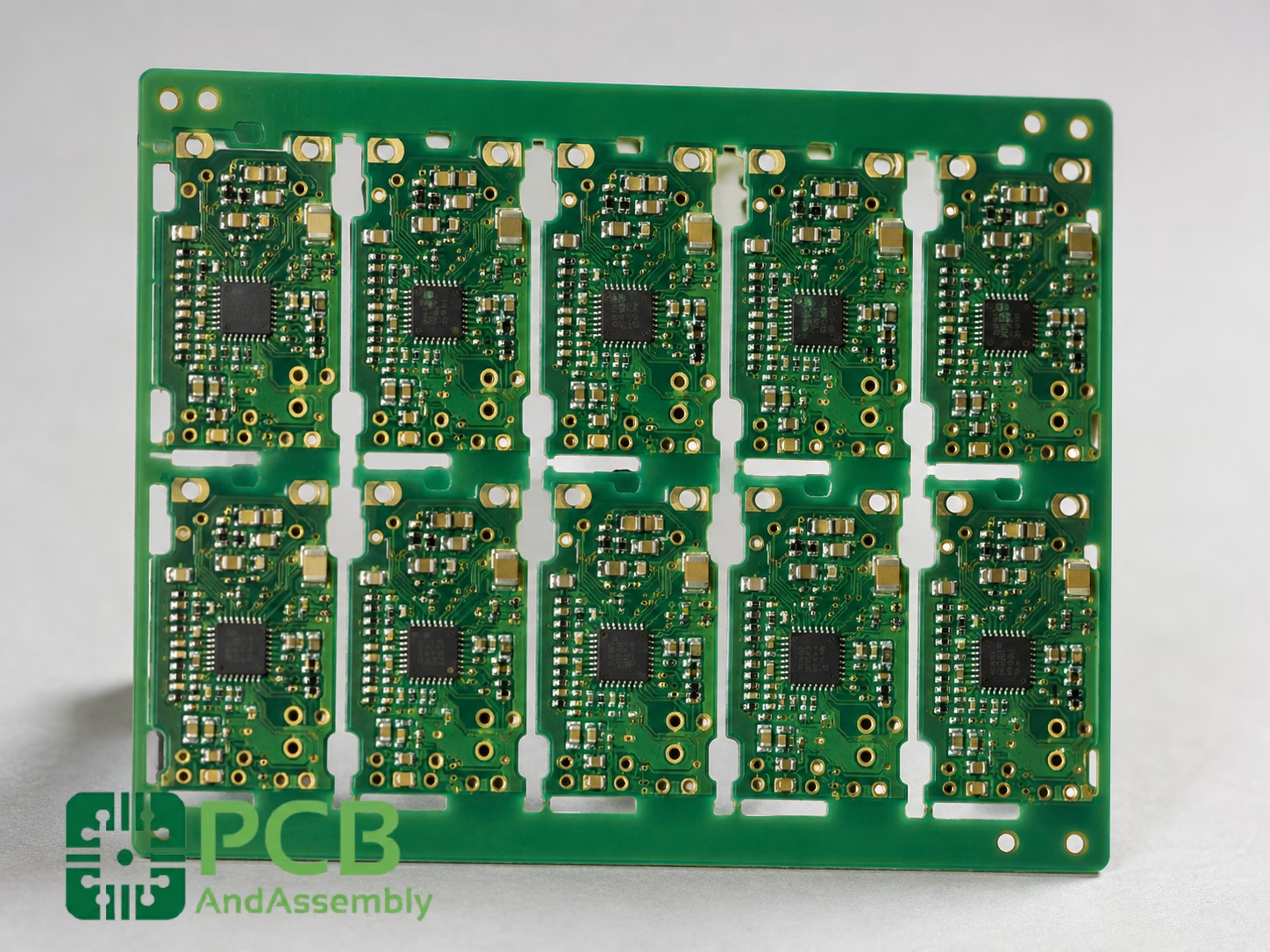
Table of Contents
- What is 0.5 oz PCB?
- 0.5 oz PCB Electrical Properties
- Advantages and Disadvantages of 0.5 oz PCB
- Applications for 0.5 oz PCB
- 0.5 oz vs 1 oz vs 2 oz: How to Choose the Right Copper Weight
- 0.5 oz PCB Design Guidelines
- Manufacturing Considerations for 0.5 oz PCB
- Cost Analysis: 0.5 oz vs Standard Weights
- 0.5 oz Copper Foil Types
- Frequently Asked Questions About 0.5 oz PCB
- PCBAndAssembly: Your Partner for Precision 0.5 oz PCB Fabrication
- Conclusion
Table of Contents
- What is 0.5 oz PCB?
- 0.5 oz PCB Electrical Properties
- Advantages and Disadvantages of 0.5 oz PCB
- Applications for 0.5 oz PCB
- 0.5 oz vs 1 oz vs 2 oz: How to Choose the Right Copper Weight
- 0.5 oz PCB Design Guidelines
- Manufacturing Considerations for 0.5 oz PCB
- Cost Analysis: 0.5 oz vs Standard Weights
- 0.5 oz Copper Foil Types
- Frequently Asked Questions About 0.5 oz PCB
- PCBAndAssembly: Your Partner for Precision 0.5 oz PCB Fabrication
- Conclusion
Standard 1 oz copper has been the default choice for PCB fabrication for decades. But as electronics shrink and signal frequencies climb, that default no longer works for every design. When you’re routing 3 mil traces on an 8-layer HDI smartphone board or controlling impedance at 28 GHz, 0.5 oz copper isn’t a special request — it’s a requirement.
The 0.5 oz PCB (half-ounce copper, ~17.5 µm thick) enables finer trace geometries, tighter impedance control, and thinner overall board construction. It’s the go-to copper weight for modern high-density interconnect (HDI) designs, RF/microwave circuits, and any application where board real estate is at a premium.
This guide covers everything you need to know about 0.5 oz copper: the technical specifications, design considerations, manufacturing processes, and when to choose it over standard copper weights.
Key Takeaways
0.5 oz copper measures ~17.5 µm (0.7 mils, 0.0175 mm) — half the thickness of standard 1 oz copper
Enables trace widths as fine as 2-3 mils, making it essential for HDI and high-density designs
Provides better impedance control for high-frequency circuits above 1 GHz
Lower current capacity than 1 oz — design accordingly with wider traces for power paths
Compatible with standard PCB processes but requires careful etching control to prevent over-etching
What is 0.5 oz PCB?
A 0.5 oz PCB uses copper foil weighing half an ounce per square foot on its conductive layers. In the PCB industry, copper weight is specified by the weight of copper distributed over one square foot of board area — a convention dating back to the early days of PCB manufacturing.
| Copper Weight | Thickness (µm) | Thickness (mils) | Thickness (mm) |
| 0.5 oz | 17.5 | 0.7 | 0.0175 |
| 1 oz (standard) | 35 | 1.37 | 0.035 |
| 2 oz | 70 | 2.74 | 0.070 |
| 3 oz | 105 | 4.11 | 0.105 |
The 17.5 µm thickness of 0.5 oz copper is roughly the width of a human hair (50-70 µm) or about three sheets of standard printer paper. This thinness is what makes it valuable — and what introduces unique design and manufacturing considerations.
Where 0.5 oz Fits in the Copper Weight Spectrum
Copper weights in PCB fabrication range from ultra-thin (0.25 oz, ~9 µm) to heavy copper (10 oz, ~350 µm). The 0.5 oz PCB sits at the lower end of this spectrum:
| Weight Class | Copper Weight | Typical Applications |
| Ultra-thin | 0.25 oz | Flex circuits, specialized HDI |
| Fine-line | 0.5 oz | HDI, RF/microwave, consumer electronics |
| Standard | 1 oz | General-purpose PCBs, most designs |
| Medium copper | 2-3 oz | Power supplies, automotive |
| Heavy copper | 4-10 oz | High-current industrial, EV |
0.5 oz copper occupies the “fine-line” category — it’s optimized for density and signal integrity rather than current-carrying capacity.
0.5 oz PCB Electrical Properties
The reduced copper thickness of 0.5 oz boards has several direct effects on electrical performance.
Current Carrying Capacity
The most significant trade-off with 0.5 oz copper is reduced current handling. Because current capacity scales with cross-sectional area, a 0.5 oz trace carries approximately half the current of a 1 oz trace at the same width and temperature rise.
Current Capacity Table (External Layer, 10°C Rise):
| Trace Width | 0.5 oz | 1 oz | 2 oz |
| 5 mil | ~0.6A | ~1.0A | ~1.8A |
| 10 mil | ~1.2A | ~2.3A | ~4.5A |
| 20 mil | ~2.5A | ~5.0A | ~9.5A |
| 50 mil | ~5.5A | ~11.0A | ~21.0A |
Note: Values are estimates based on IPC-2152. Always verify with your specific design conditions.
For power traces, you need to compensate by widening the copper or using multiple parallel traces. For signal traces carrying negligible current (< 10 mA), the current limitation isn’t a concern.
Impedance Control Benefits
Where 0.5 oz copper truly shines is controlled-impedance design. Thinner copper reduces the trace cross-section, which affects the characteristic impedance calculation. For a given target impedance (e.g., 50 Ω), a 0.5 oz trace can be slightly narrower than a 1 oz trace, or the dielectric thickness can be reduced — both benefits for high-density designs.
At frequencies above 1 GHz, skin effect becomes significant. Signal current concentrates near the trace surface (skin depth at 1 GHz is ~2 µm for copper). Since 0.5 oz copper is 17.5 µm thick, the skin depth occupies a larger percentage of the trace cross-section, which can increase effective resistance slightly at very high frequencies. However, this effect is minimal for most practical designs below 30 GHz.
DC Resistance per Unit Length
| Trace Width | 0.5 oz Resistance (mΩ/inch) | 1 oz Resistance (mΩ/inch) |
| 5 mil | ~95 | ~48 |
| 10 mil | ~48 | ~24 |
| 20 mil | ~24 | ~12 |
DC resistance is roughly double that of 1 oz copper at the same trace width — another reason to use appropriate trace widths for power distribution.
Advantages and Disadvantages of 0.5 oz PCB
Advantages
Finer Trace Geometries: 0.5 oz copper enables trace widths down to 2-3 mils (0.05-0.075 mm) with standard etching processes. This is essential for HDI boards where routing density is critical. The thinner copper requires less etching time, which means less lateral undercutting and better trace definition.
Better Impedance Control: For high-speed designs, 0.5 oz copper provides tighter impedance tolerances because the reduced copper height minimizes the impact of etching variations on the trace cross-section. This is especially valuable for differential pairs and RF transmission lines.
Thinner Overall Board Construction: Using 0.5 oz inner layers allows thinner prepreg and core materials, resulting in a thinner finished board. A 6-layer design using 0.5 oz inner layers can be 10-15% thinner than an equivalent design using 1 oz on all layers.
Reduced Material Cost: Copper is a significant raw material cost in PCB fabrication. Using 0.5 oz instead of 1 oz reduces copper consumption by 50% per layer. For high-volume production, this translates to measurable cost savings.
Improved Etching Precision: The shorter etching time required for 0.5 oz copper means less undercut and better dimensional accuracy. Trace width tolerances are typically ±10% of the nominal width, compared to ±15% for 1 oz.
Disadvantages
Limited Current Capacity: As discussed above, 0.5 oz copper carries roughly half the current of 1 oz at the same trace width. Power distribution requires careful planning, wider traces, or copper pours.
Mechanical Fragility: Thin copper traces are more susceptible to mechanical damage during handling, assembly, and field operation. Delicate traces can lift from the substrate if subjected to mechanical stress.
Thermal Dissipation: Copper acts as a heat spreader in PCB designs. The reduced copper mass in 0.5 oz boards provides less thermal spreading capability, which can be a concern for designs with heat-generating components.
Inner Layer Plating Considerations: In multilayer boards, 0.5 oz inner layers have thinner copper in plated through-hole barrels. This can affect via reliability in high-reliability applications requiring specific minimum copper plating thickness.
| Parameter | 0.5 oz | 1 oz | Best For |
| Min trace width | 2-3 mils | 4-5 mils | 0.5 oz |
| Current capacity | Lower | Standard | 1 oz |
| Impedance control | Excellent | Good | 0.5 oz |
| Mechanical strength | Lower | Good | 1 oz |
| Thermal spreading | Limited | Good | 1 oz |
| Etching precision | Excellent | Good | 0.5 oz |
| Material cost | Lower | Standard | 0.5 oz |
| HDI compatibility | Excellent | Moderate | 0.5 oz |
Applications for 0.5 oz PCB
The unique properties of 0.5 oz copper make it the preferred choice for several demanding application areas.
High-Density Interconnect (HDI) Boards
HDI designs push the limits of PCB fabrication with microvias, fine-pitch BGAs, and dense routing. 0.5 oz copper is the standard choice for HDI inner layers because it supports the 2-3 mil trace widths needed to route signals between tightly spaced BGA pads.
Common HDI applications include:
-
Smartphone and tablet main boards
-
Wearable device PCBs
-
Medical imaging equipment
-
Aerospace avionics modules
-
Compact IoT gateway boards
RF and Microwave Circuits
For designs operating above 1 GHz, 0.5 oz copper provides better impedance control and reduced parasitic capacitance compared to thicker copper. The thinner traces also reduce the discontinuity at impedance transitions.
RF applications that benefit from 0.5 oz copper:
-
5G small cell antennas and beamforming arrays
-
Wi-Fi 6/7 RF front-end modules
-
Satellite communication transceivers
-
Radar sensor modules (automotive 77 GHz)
-
RF filter networks and matching circuits
Consumer Electronics
The consumer electronics industry is the largest consumer of 0.5 oz PCBs. The combination of fine-line capability, cost-effectiveness, and compatibility with HDI processes makes it ideal for high-volume production.
-
Laptop and notebook motherboards
-
Gaming console PCBs
-
Digital camera and drone electronics
-
Smart home device controllers
-
Set-top boxes and streaming devices
Thin Form-Factor Devices
Any product where board thickness matters benefits from 0.5 oz inner layers:
-
Smart cards and SIM cards
-
Thin medical patches
-
Portable diagnostic devices
-
Compact sensor modules
-
Miniature data loggers
0.5 oz vs 1 oz vs 2 oz: How to Choose the Right Copper Weight
Selecting the appropriate copper weight depends on your design’s electrical, mechanical, and manufacturing requirements.
Decision Framework
| Design Requirement | Recommended Weight | Reason |
| Fine-pitch BGA routing (< 0.5mm pitch) | 0.5 oz inner, 1 oz outer | Enables trace escape routing |
| High-frequency RF (> 5 GHz) | 0.5 oz | Better impedance control |
| High current (> 2A per trace) | 1 oz or heavier | Adequate current capacity |
| Minimum board thickness | 0.5 oz inner layers | Thinner stackup possible |
| High reliability / harsh environment | 1 oz minimum | Better mechanical robustness |
| Cost-sensitive high-volume | 0.5 oz where possible | Lower material cost |
| Standard digital (under 1 GHz) | 1 oz | Industry default, proven |
Practical Hybrid Approaches
Most production designs use a mix of copper weights. A typical stackup might use 0.5 oz on inner signal layers for routing density and 1 oz on outer layers for component reliability and thermal performance.
Example 6-Layer Hybrid Stackup:
| Layer | Function | Copper Weight | Reason |
| L1 (Top) | Signal + components | 1 oz | Component pad reliability |
| L2 | Ground plane | 0.5 oz | Minimizes stackup thickness |
| L3 | Signal | 0.5 oz | Fine-line routing |
| L4 | Signal | 0.5 oz | Fine-line routing |
| L5 | Power plane | 1 oz | Current distribution |
| L6 (Bottom) | Signal + components | 1 oz | Component pad reliability |
This approach gives you the routing density of 0.5 oz where you need it, with the mechanical strength and current capacity of 1 oz on outer layers.
0.5 oz PCB Design Guidelines
Designing with 0.5 oz copper requires adjusting your design rules and expectations compared to standard 1 oz designs.
Trace Width and Spacing
For 0.5 oz copper, most fabricators specify minimum trace widths and spacing of:
| Feature | Standard Capability | Advanced Capability |
| Min trace width | 3 mil (0.075 mm) | 2 mil (0.05 mm) |
| Min spacing | 3 mil (0.075 mm) | 2 mil (0.05 mm) |
| Min trace width (impedance controlled) | 3.5 mil (0.09 mm) | 2.5 mil (0.065 mm) |
These capabilities depend on the specific fabricator’s etching equipment and process control. Always verify minimum capabilities with your manufacturer before finalizing a design.
Impedance Control with 0.5 oz
For controlled-impedance traces on 0.5 oz copper, the reduced copper height changes the trace width required for a given target impedance.
Approximate 50 Ω Microstrip Widths (0.5 oz):
| Dielectric Thickness | Dielectric Material | Trace Width (0.5 oz) | Trace Width (1 oz) |
| 4 mil (0.1 mm) | FR-4 (Dk ~4.2) | ~6.5 mil | ~7.0 mil |
| 8 mil (0.2 mm) | FR-4 | ~14 mil | ~15 mil |
| 12 mil (0.3 mm) | FR-4 | ~22 mil | ~23 mil |
The difference between 0.5 oz and 1 oz trace widths is around 5-8% for 50 Ω microstrip. For differential pairs (100 Ω), the difference is similar. Use impedance calculators with the correct copper weight to dial in your target impedance.
Power Distribution
For power traces on 0.5 oz copper:
-
Use copper pours or planes instead of narrow traces for power distribution
-
Calculate required trace width using IPC-2152 or a reliable calculator
-
Consider using 1 oz on power layers and 0.5 oz on signal layers
-
Use multiple vias to distribute current between layers
-
Keep high-current paths short and wide
Via Design
Via reliability with 0.5 oz copper is generally good, but consider these points:
-
Minimum via pad size should be at least 8 mil (0.2 mm) larger than the hole diameter
-
Use teardrops on vias connected to narrow traces to improve mechanical strength
-
For high-reliability applications, specify minimum copper plating in via barrels (typically 1 mil / 25 µm)
-
Microvias in HDI designs typically work well with 0.5 oz target copper on inner layers
Manufacturing Considerations for 0.5 oz PCB
Fabricating 0.5 oz PCBs requires process control that differs from standard 1 oz production.
Etching Process
The thinner copper of 0.5 oz actually makes etching easier — less time in the etcher means less lateral undercut. This is why 0.5 oz can achieve finer trace geometries than 1 oz.
However, there’s a risk of over-etching if the process isn’t carefully controlled. Over-etching can “nick” traces, reducing their effective width and creating reliability risks. Reputable fabricators use automated optical inspection (AOI) to catch these defects.
Etch Factor Comparison:
| Copper Weight | Typical Etch Factor | Undercut per Side (mils) |
| 0.5 oz | 3:1 – 4:1 | 0.2 – 0.3 |
| 1 oz | 2.5:1 – 3:1 | 0.4 – 0.6 |
| 2 oz | 2:1 – 2.5:1 | 0.7 – 1.0 |
Surface Finishes
All standard surface finishes are compatible with 0.5 oz copper:
| Surface Finish | Compatibility | Notes |
| HASL / Lead-Free HASL | Good | Thermal shock may stress thin traces |
| ENIG | Excellent | Best for fine-pitch components |
| OSP | Excellent | Low cost, good for fine traces |
| Immersion Silver | Excellent | Good for RF applications |
| Immersion Tin | Good | Planar surface, good for fine pitch |
| Hard Gold (ENEPIG) | Excellent | Best for high-reliability and wire bonding |
ENIG and OSP are typically preferred for 0.5 oz HDI boards because they provide good solderability without the thermal stress of HASL.
Panel Handling
The thin copper on 0.5 oz boards can be more susceptible to damage during panel handling. Fabricators use:
-
Tighter controls on conveyor and handling equipment
-
Reduced brush scrubbing pressure during cleaning
-
Gentle handling through solder mask and final finish processes
-
Protective cover sheets where needed
Cost Analysis: 0.5 oz vs Standard Weights
The material cost of 0.5 oz copper is lower than 1 oz, but the total board cost depends on several factors.
| Cost Factor | 0.5 oz Impact | Why |
| Raw material | Lower (-10-20%) | Less copper used per layer |
| Etching | Slightly lower | Faster etch time |
| Yield | Slightly lower risk | Less undercut, better trace definition |
| Inspection | Standard | AOI required regardless |
| Testing | Standard | Impedance testing same |
Bottom line: Expect 0.5 oz boards to cost slightly less than equivalent 1 oz boards for the same layer count and size. However, 0.5 oz is often used in HDI designs that have higher layer counts and more advanced features — which drive total cost.
0.5 oz Copper Foil Types
The type of copper foil used matters for performance and reliability.
| Foil Type | Description | Best For |
| ED (Electro-Deposited) | Standard copper foil, cost-effective | Most rigid PCB applications |
| RA (Rolled Annealed) | Smoother, more ductile | Flex and rigid-flex circuits |
| HTE (High-Temperature Elongation) | Improved ductility at temperature | Multilayer boards, automotive |
| VLP (Very Low Profile) | Ultra-smooth surface | High-frequency RF (reduced conductor loss) |
For most HDI and consumer designs, standard ED copper is sufficient. For RF designs above 10 GHz, consider VLP or RA foil to reduce conductor losses.
Frequently Asked Questions About 0.5 oz PCB
What is 0.5 oz copper thickness in mm?
0.5 oz copper has a nominal thickness of 0.0175 mm (17.5 µm, or 0.7 mils). This is the thickness before processing — finished thickness after etching and surface preparation will be slightly less, typically around 12-15 µm on inner layers per IPC-6012 requirements.
Can 0.5 oz PCB handle high-current designs?
Not directly. A 0.5 oz trace carries roughly half the current of an equivalent 1 oz trace. For high-current designs using 0.5 oz copper, you need to use wider traces, copper pours, or multiple parallel traces. For designs exceeding 3-5A per trace, consider using 1 oz or heavier copper on power layers.
What’s the minimum trace width for 0.5 oz copper?
Most PCB manufacturers can produce 3 mil (0.075 mm) traces with 3 mil spacing on 0.5 oz copper as a standard capability. Advanced fabs can achieve 2 mil (0.05 mm) traces and spacing. These fine geometries make 0.5 oz copper essential for HDI designs with fine-pitch BGAs.
Is 0.5 oz copper good for RF and microwave designs?
Yes. 0.5 oz copper is often preferred for RF designs above 1 GHz because the thinner copper provides better impedance control and reduced parasitic capacitance. The difference is most noticeable in designs above 5 GHz, where impedance tolerances become critical.
How does 0.5 oz compare to 1 oz for impedance control?
For a given target impedance, 0.5 oz traces are approximately 5-8% narrower than 1 oz traces. The thinner copper also reduces the impact of etching variations on impedance tolerance, making 0.5 oz a better choice for tight (±5%) impedance requirements.
Can 0.5 oz and 1 oz copper be mixed in the same board?
Yes — this is common practice. Most HDI designs use 0.5 oz on inner signal layers for routing density and 1 oz on outer layers for component reliability. The fabricator handles the different copper weights during the lamination process without issues.
What surface finish works best with 0.5 oz copper?
ENIG (Electroless Nickel Immersion Gold) is the most popular choice for 0.5 oz HDI boards because it provides a flat, solderable surface without the thermal shock of HASL. OSP is also commonly used for cost-sensitive designs. For RF applications, immersion silver offers good performance.
Does 0.5 oz copper affect PCB cost?
The copper material cost is lower for 0.5 oz than 1 oz, but the actual board cost depends on the overall design complexity. 0.5 oz boards often use HDI features (microvias, fine traces) that add cost. The net effect is usually cost-neutral to slightly lower for equivalent designs.
PCBAndAssembly: Your Partner for Precision 0.5 oz PCB Fabrication
At PCBAndAssembly, we manufacture 0.5 oz PCBs with the process control required for fine-line HDI and RF designs. With 14 years of experience and ISO 9001, UL, and IPC Class 3 certifications, our facilities in Shenzhen handle complex 0.5 oz designs daily.
Our 0.5 oz PCB Capabilities:
| Capability | Specification |
| Minimum trace/space | 2.5 mil / 2.5 mil (0.065 mm) |
| Minimum microvia diameter | 4 mil (0.1 mm) |
| Layer count | 1-54 layers (0.5 oz inner layers available) |
| Impedance tolerance | ±5% standard, ±3% with TDR reports |
| Surface finishes | ENIG, OSP, immersion silver, immersion tin, HASL, ENEPIG |
| Copper foil options | ED, RA, HTE, VLP |
| Lead time | 3-5 days for prototypes, 7-10 days for production |
| Certifications | ISO 9001, UL, RoHS, REACH, IPC-A-610, IPC Class 3 |
Whether you need a quick-turn 0.5 oz HDI prototype or high-volume production with tight impedance control, our engineering team reviews every order for DFM issues before production begins. Contact us for a quote within 24 hours.
Conclusion
The 0.5 oz PCB has earned its place as a critical option in the PCB designer’s toolkit. It enables the fine-line geometries that make modern HDI designs possible, provides the impedance control that high-frequency circuits demand, and supports the thin form factors that consumers expect.
The key to success with 0.5 oz copper is understanding where its strengths align with your design requirements — and where its limitations (particularly current capacity) need to be addressed through thoughtful design. For signal integrity, routing density, and thin boards, 0.5 oz is often the best choice. For power distribution and mechanical robustness, supplement it with heavier copper where needed.
Get Quote Free