
Precision Low Volume PCB Assembly Services
for Prototypes and Small Batch Builds
Low-volume PCB assembly is the production of populated circuit boards in small quantities, typically from 1 to 250 units. It is suitable for prototypes, engineering validation, product testing, and small-batch production before scaling to higher volumes.
Low Volume PCB Assembly Services You Can Rely On
Low Volume PCB Assembly is the perfect solution for companies looking to develop and test new products, refine designs, or produce limited runs. This service ensures that you can test your circuit boards thoroughly before committing to high-volume production, minimizing potential risks and ensuring the quality of your final product.
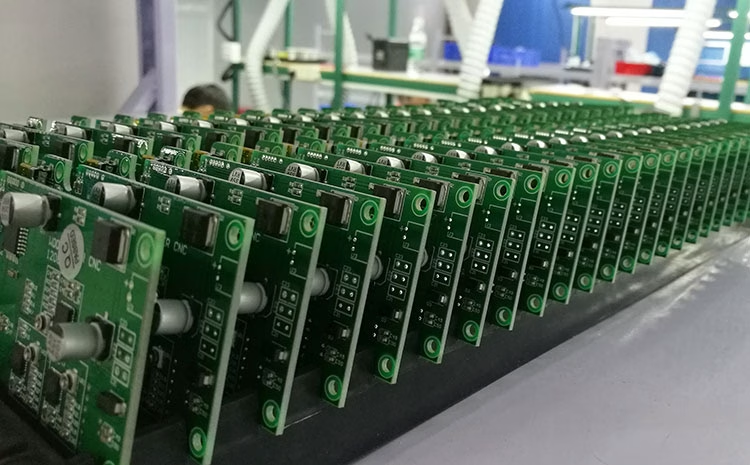
Our Low Volume PCB Assembly Capabilities
| Parameter | Value / Range |
| Supported Order Quantity | 1 to 250 units (Scalable to 5,000+ units) |
| Supported Package Types | 0201, QFN, BGA, CSP, PoP, Fine-Pitch ICs |
| Accuracy | <±30μm, under the condition of 3σ,CPK≥1 |
| Board Thickness Range | 0.5 mm to 4.5 mm |
| Max Board Size | 610 mm × 508 mm |
| Testing | Flying Probe testing, ICT Testing, Automated Optical Inspection (AOI), Functional Testing, X-ray Inspection |
| Turnaround Time | 24 to 72 hours (prototype quantities) |
For the small volume PCB assembly process, we use three different technologies –
1.Through-hole Mounting
While we opt for this method for low volume PCB assembly, our designers place the requisite components in the holes drilled on the board. Although an old-school technology, we make the best use of this technique. Especially for industrial applications in aerospace, we make use of this technique to make your circuit boards withstand high levels of stress and operate at high speeds and temperatures. We make sure the bond between the circuit and its components is stronger and hence you can have a reliable product that provides a high level of efficiency for your operations.
2.Surface Mount Technology
Our purpose to go for the SMT technique is to improve the quality as well as performance. As we mount the components onto the surface of PCBs, we offer tremendous flexibility, and more importantly, even the complex circuits can be done into small assemblies. Even the smallest of the components can be mounted by using contact terminals instead of leads. Also, we meticulously build dual-sided circuit boards with all the components on one side and complex circuitry on the other side. Through the automation process, we build highly customizable circuit boards for almost any application.
3.Mixed Technology
We use the properties of SMT and through-hole whenever necessary. We are a reliable small batch PCB manufacturer and well-equipped with the capabilities of both SMT and THT for manufacturing circuit boards. We can provide quick prototypes and even go for high-speed production. We have advanced and precise equipment to place the component of miniature size with great accuracy. You can have custom assemblies that are built by following the best practices in the industry.
Low-Volume High-Mix PCB Assembly Capabilities
Low-volume high-mix PCB assembly is suitable for projects that require several board variants in small quantities. We support SMT, through-hole, and mixed-technology assemblies, with BOM and DFM reviews completed before production.
Our capabilities include:
-
Multiple PCB variants within one project
-
Prototype and small-batch production
-
0201, QFN, BGA, CSP, PoP, and fine-pitch components
-
Full turnkey and partial turnkey component sourcing
-
AOI, X-ray, flying probe, ICT, and functional testing
Each board variant should be submitted with its corresponding Gerber files, BOM, assembly drawings, and testing requirements so that we can review manufacturability and provide an accurate quotation.
Why Choose OrinewPCB for Your Low Volume PCB Assembly?
We offer two flexible turnkey models based on your needs:
Full Turnkey PCB Assembly
You provide the design files—we handle everything else:
- PCB manufacturing
- Component sourcing
- SMT and through-hole assembly
- Testing and inspection
- Final shipment
Perfect for customers who want a completely hands-off solution with one vendor handling the entire process.
Partial Turnkey PCB Assembly
You supply some of the components, and we take care of the rest. This is ideal for:
- Special/custom parts you already stock
- Cost-sensitive projects
- Risk control on critical components
Our experts can help manage your BOM and ensure all third-party parts match your quality expectations.
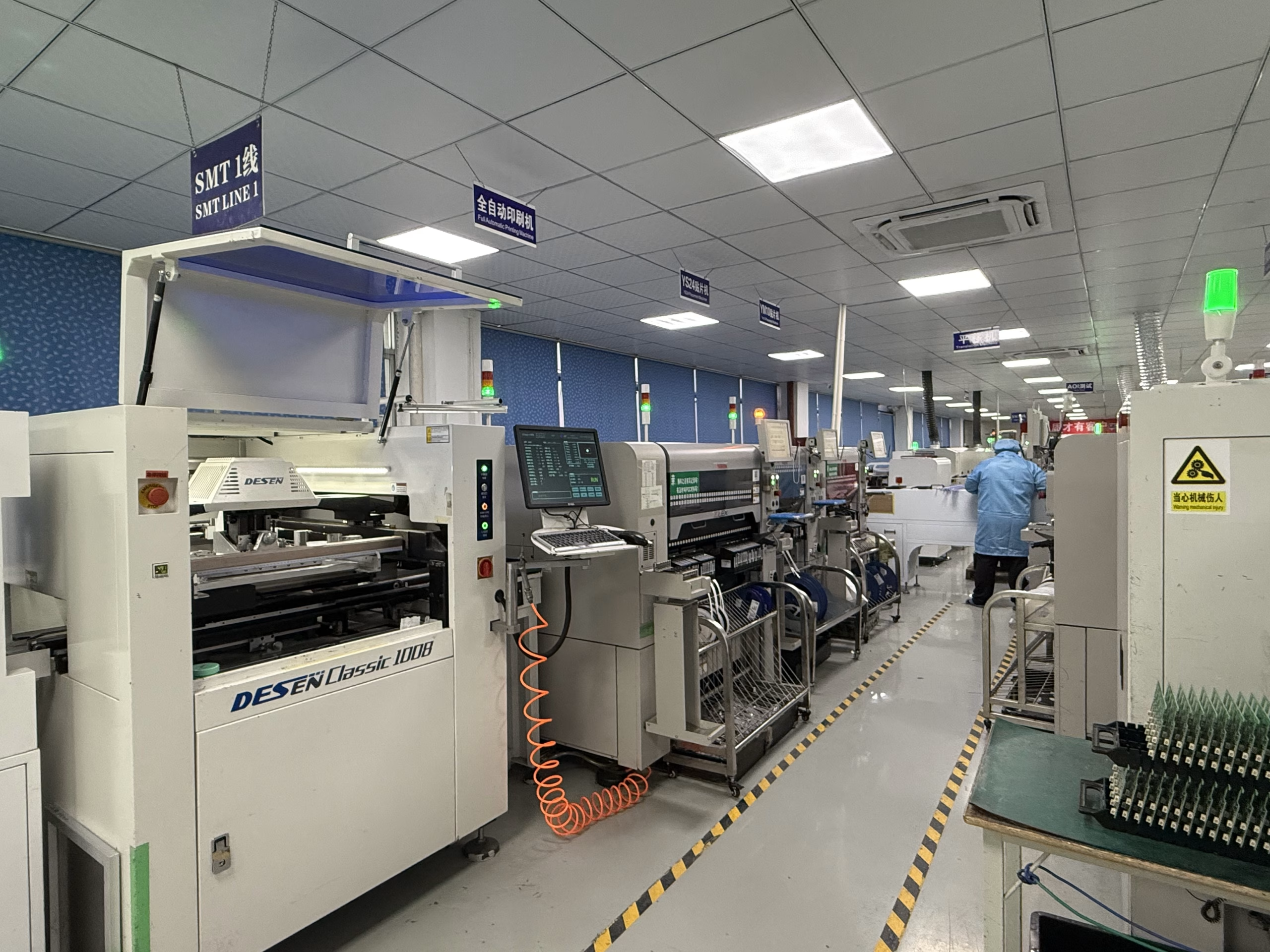
Some Suggestions about Low Volume PCB Assembly
In low-volume PCB assembly, following some rules may make your production less troublesome, here are some suggestions:
Low Volume Assembly and Testing Processes
Assembly and testing are crucial to ensuring Military PCB reliability. At OrinewPCB, we perform surface mount technology (SMT) and through-hole assembly using IPC Class 3 standards. Our inspection and testing processes include AOI, X-ray inspection, in-circuit testing (ICT), and functional testing. We also offer flying probe and environmental stress screening (ESS) to simulate real-world operating conditions. These steps ensure each Military PCB meets stringent quality and performance benchmarks.
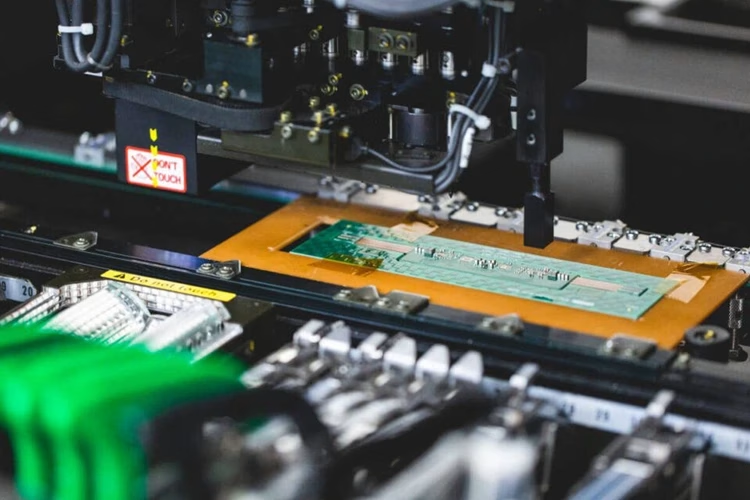
How to Order Your Low Volume PCB Assembly
Low Volume Assembly FAQs
What is low volume PCB assembly?
Low volume or a small batch PCB Assembly is the process of mounting components to the small batch of boards. The number of boards can be in the range of 25 to 5000. Due to small batches, this is called a low volume PCB assembly. There are times when you need PCBs for your application but you don’t need a large batch. Like the regular PCB Assembly, even the low volume PCB assembly process also involves 3 steps – PCB fabrication, component mounting, and assembly.
What are the benefits of small batch Printed Circuit Board Assembly?
A low volume PCB assembly is usually defined as small amounts of less than 5000 PCBs. It is ideal for building new products, repairs/replacements in the final product. If you have time and cost limitations while you need a PCB for your application then you need to go for low volume PCB assembly as it reduces your cost, time and offers optimal quality circuit boards.
What is the cost involved in small batch PCB assembly?
Depends on the number of boards you want us to assemble. But we look for ways to improve your cost savings wherever possible. We strive to maintain long-term relationships with our clients and suppliers and hence purchase quality parts at competitive prices. We ensure that our customers obtain the highest quality that any PCB turnkey service provider can provide.
How can we request a quote for low volume PCB assembly?
There are two ways to request a quote for low volume PCB assembly; The first is; email your requirements at [email protected]. Or the second most preferred method is; submit all your requirements via low volume PCB assembly quote form and we will get back to you as soon as possible.
Need PCB Manufacturing or Assembly?
Get a free quote within 24 hours. We specialize in prototype-to-production PCB/PCBA for hardware teams worldwide.
