High-Volume PCB Manufacturing: Mass Production Cost Guide
If you're evaluating high-volume PCB manufacturing pricing, the math works entirely differently than prototypes. The difference between a competitive mass-production quote and an overpriced one comes down to panel utilization, material selection, testing strategy, and how well your design aligns with the manufacturer's standard processes.
Get Your PCB Quote!
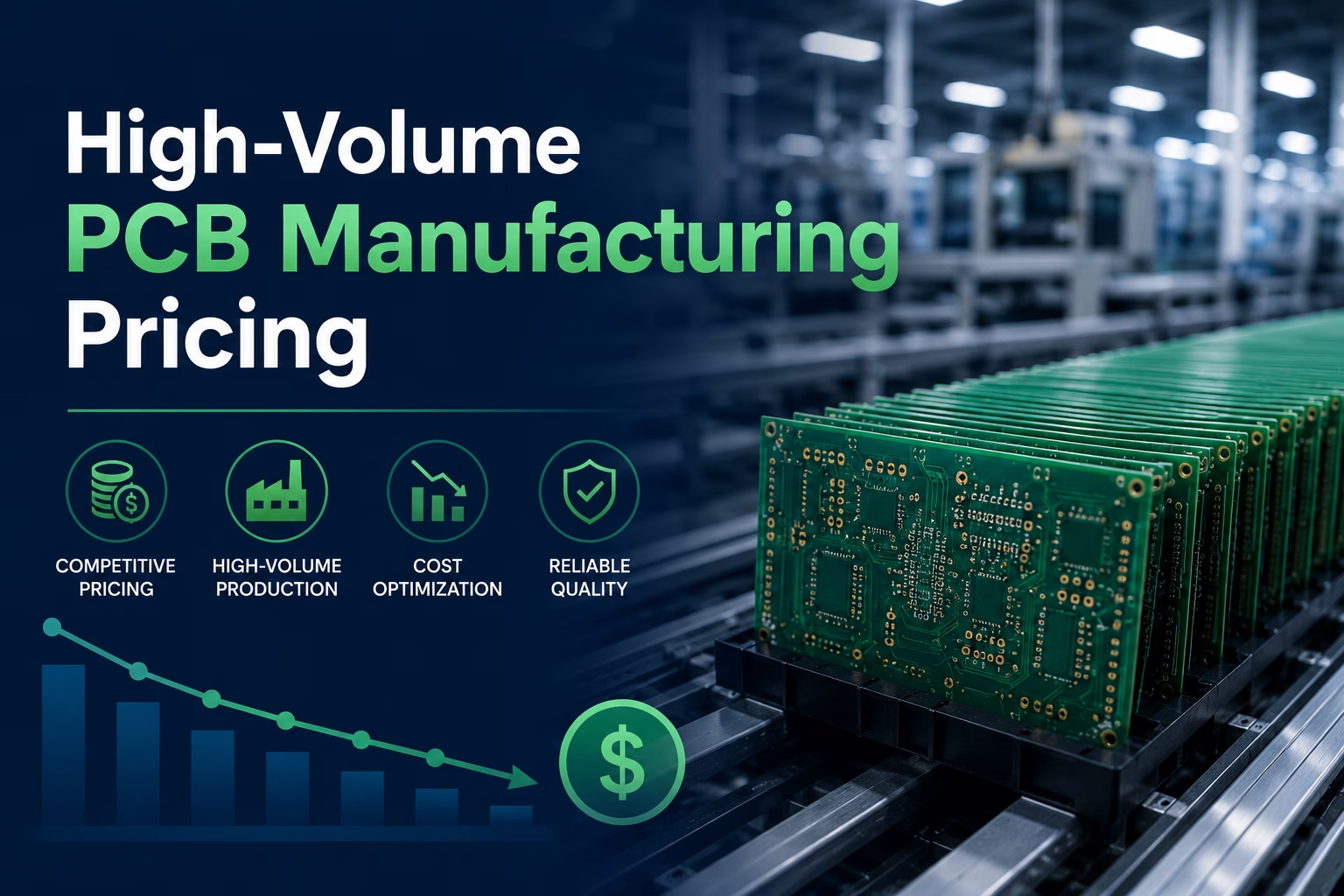
Table of Contents
- Что такое крупносерийное производство печатных плат?
- Модели ценообразования для печатных плат больших объемов
- Анализ затрат: куда уходят ваши деньги
- Ключевые факторы, влияющие на себестоимость крупносерийного производства печатных плат.
- Затраты на тестирование при больших объемах
- Стратегии снижения затрат при крупномасштабном производстве печатных плат
- OrinewPCB: Ваш партнер по крупномасштабному производству печатных плат
- Часто задаваемые вопросы
- Заключение
Table of Contents
- Что такое крупносерийное производство печатных плат?
- Модели ценообразования для печатных плат больших объемов
- Анализ затрат: куда уходят ваши деньги
- Ключевые факторы, влияющие на себестоимость крупносерийного производства печатных плат.
- Затраты на тестирование при больших объемах
- Стратегии снижения затрат при крупномасштабном производстве печатных плат
- OrinewPCB: Ваш партнер по крупномасштабному производству печатных плат
- Часто задаваемые вопросы
- Заключение
Key Takeaways
- Per-piece PCB pricing drops 70-90% from prototype to high volumes as NRE and tooling costs are amortized
- Panel utilization is the single most impactful cost lever—a 10% utilization improvement can cut per-unit cost by 8-12%
- Layer count is the dominant cost multiplier: 4-layer boards cost ~2x 2-layer, 6-layer boards cost ~3-4x at volume
- Standard materials (FR-4, green solder mask, HASL finish) minimize cost; any deviation adds premium
- Testing at volume shifts from flying probe (slow, no fixture cost) to ICT/bed-of-nails (fast, high fixture cost amortized over volume)
What is High-Volume PCB Manufacturing?
High-volume PCB manufacturing refers to production runs typically exceeding 1,000 units, where the fabrication process shifts from general-purpose equipment to dedicated, automated production lines optimized for throughput and repeatability. At these volumes, the cost structure fundamentally changes:
- Setup costs (NRE)are spread across thousands of boards, approaching zero per unit
- Material purchasing powerincreases with bulk orders, reducing per-unit material cost by 15-30%
- Process optimizationbecomes economical—dedicated tooling, automated optical inspection (AOI), and in-circuit test (ICT) fixtures that would be uneconomical for prototypes become cost-effective
- Panelizationis optimized for maximum board count per production panel
High-Volume vs Prototype: Key Differences
| Factor | Prototype (1-100 pcs) | Low-Volume (100-1,000) | Mid-Volume (1,000-10,000) | High-Volume (10,000+) |
| Per-unit cost | High | Moderate | Low | Lowest |
| Lead time | 3-7 days | 5-10 days | 10-20 days | 15-30 days |
| Setup cost share | 40-60% of total | 15-25% | 5-10% | 1-3% |
| Testing method | Flying probe | Flying probe + AOI | AOI + ICT fixture | ICT + automated AOI |
| Material cost leverage | None | Low | Moderate | High (bulk pricing) |
| Panel optimization | Minimal | Moderate | Fully optimized | Maximized |
High-Volume PCB Pricing Models
Manufacturers use several pricing models for mass production. Understanding which one applies to your quote helps you compare apples to apples.
Per-Piece Pricing
The most common model for high-volume PCB orders. The manufacturer calculates total production cost (materials + labor + NRE amortization + margin) and divides by quantity. Per-piece pricing includes all setup, tooling, and testing costs.
Panel Pricing
The manufacturer quotes based on the number of production panels required rather than individual boards. A standard production panel is typically 18″ x 24″ (457mm x 610mm) or 21″ x 24″ (533mm x 610mm). The more boards you fit per panel, the lower your per-unit cost.
Example: Panel Pricing Calculation
| Board Size | Boards per Panel (18″x24″) | Panel Price | Per-Board Cost (panel basis) |
| 50mm x 50mm | 120 | $180 | $1.50 |
| 100mm x 80mm | 48 | $180 | $3.75 |
| 150mm x 100mm | 24 | $180 | $7.50 |
| 200mm x 150mm | 12 | $180 | $15.00 |
Turnkey vs Consignment Pricing
For PCB assembly (PCBA) included in your order:
| Model | How It Works | Cost Implication | Best For |
| Turnkey | Manufacturer sources all components | 10-30% markup on BOM, but lower admin overhead | High-volume where manufacturer’s purchasing power matters |
| Consignment | Customer supplies all components | No markup, but logistics + liability costs | When customer already has bulk component pricing |
| Partial Turnkey | Customer sources long-lead ICs, manufacturer sources passives | Balanced approach | Most common for volume production |
Cost Breakdown: Where Your Money Goes
Understanding the cost structure of a high-volume PCB order helps you identify where savings are possible.
Typical Cost Breakdown for High-Volume PCB Orders
| Cost Component | Share of Total Cost | Description |
| Substrate material (FR-4) | 20-30% | Laminate, prepreg, copper foil |
| Fabrication labor | 15-25% | Drilling, plating, etching, lamination |
| Solder mask + legend | 5-10% | Coating, curing, silkscreen |
| Surface finish | 5-12% | HASL, ENIG, OSP, or other finish |
| Electrical test | 5-10% | AOI, flying probe, ICT fixture amortization |
| Tooling / NRE | 2-5% (at volume) | CAM, stencil, test fixture (amortized) |
| Shipping + logistics | 5-15% | Packaging, freight, customs (for offshore) |
| Manufacturer margin | 10-20% | Overhead, profit, quality systems |
NRE (Non-Recurring Engineering) Costs
These are one-time charges that should be amortized over the total order quantity.
| NRE Item | Typical Cost | Notes |
| CAM engineering | $50-$200 | Gerber review, DFM check, panelization |
| Stencil (for SMT assembly) | $150-$300 | Laser-cut stainless steel |
| Test fixture (ICT) | $500-$5,000+ | Custom bed-of-nails; volume-dependent |
| First article inspection | $100-$300 | IPC-A-610 verification |
| SMT programming | $200-$800 | Pick-and-place machine setup |
Key Insight: At 10,000 units, a $3,000 ICT fixture adds only $0.30 per board. At 100 units, the same fixture adds $30 per board—prohibitively expensive.
Key Cost Drivers in High-Volume PCB Manufacturing
1. Layer Count
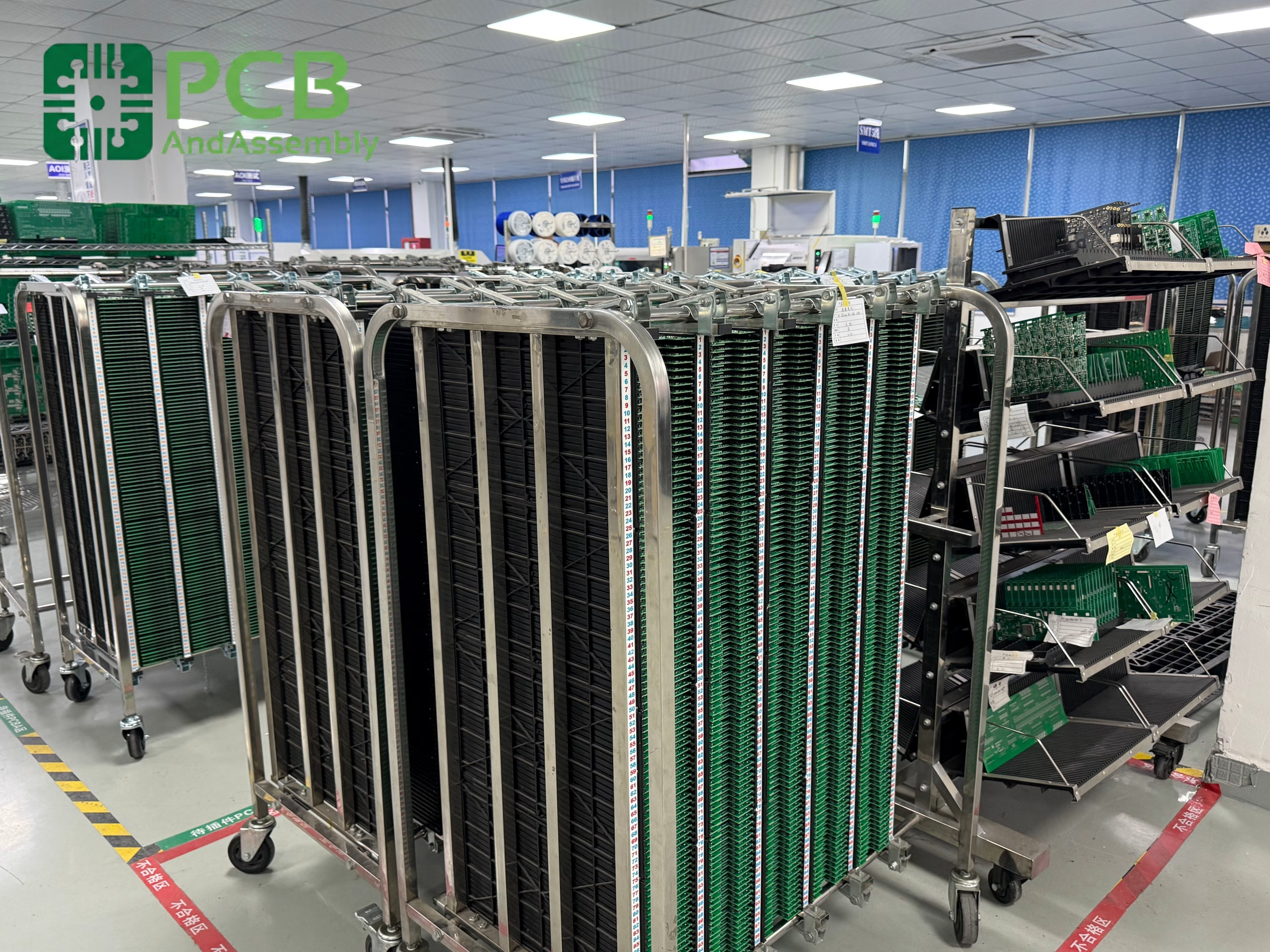
Layer count is the single largest cost multiplier in PCB fabrication. Each additional layer requires more material, additional lamination cycles, and tighter alignment tolerances.
| Layer Count | Relative Cost (2-layer = 1x) | Typical Applications |
| 2-layer | 1.0x (baseline) | Simple consumer devices, LED lighting |
| 4-layer | 1.8-2.5x | Power supplies, industrial controls |
| 6-layer | 3.0-4.5x | Automotive ECUs, telecom |
| 8-layer | 5.0-7.0x | Networking equipment, servers |
| 10-layer+ | 8.0-12.0x | High-speed digital, RF modules |
Cost multiples are for high-volume pricing. Prototype multiples are typically higher.
2. Board Size and Panel Utilization
Board size directly impacts how many boards fit on a standard production panel. Maximizing panel utilization is the most effective cost reduction strategy.
Standard Panel Sizes:
- 18″ x 24″ (457mm x 610mm)
- 21″ x 24″ (533mm x 610mm)
- 24″ x 30″ (610mm x 762mm) — less common
| Panel Utilization | Per-Board Cost Impact | Action |
| >85% | Baseline (best pricing) | Design within standard panel constraints |
| 70-85% | +5-15% | Minor redesign may improve utilization |
| 50-70% | +15-30% | Significant waste; reconsider board dimensions |
| <50% | +30%+ | Consider panelization with other designs |
Rule of Thumb: Optimize board dimensions to fit within 18″ x 24″ panels with minimal waste. A board that measures 100mm x 80mm (48 panels) costs significantly less per unit than a 105mm x 85mm board (36 panels).
3. Material Selection
| Material Grade | Cost Premium vs Standard FR-4 | When to Use |
| Standard FR-4 (Tg 130-140°C) | Baseline | General-purpose, consumer products |
| High-Tg FR-4 (Tg 170-180°C) | +15-30% | Automotive, industrial, lead-free assembly |
| Halogen-free FR-4 | +10-20% | RoHS/environmental requirements |
| Polyimide | +300-500% | High-temperature, aerospace |
| Rogers high-frequency | +400-1000% | RF, microwave, 5G applications |
4. Copper Weight
| Copper Weight | Cost Premium vs 1 oz | Notes |
| 0.5 oz (18µm) | -5% (slightly less) | Fine-pitch designs, HDI |
| 1 oz (35µm) | Baseline | Standard for most applications |
| 2 oz (70µm) | +15-25% | Power electronics |
| 3 oz+ (105µm+) | +30-100%+ | Heavy copper; longer etch times |
5. Surface Finish Cost Comparison
| Surface Finish | Cost Ranking | Shelf Life | Best For |
| HASL (leaded) | Lowest | 12 months | General purpose, low-cost |
| HASL (lead-free) | Low | 12 months | RoHS-compliant general purpose |
| OSP | Low | 6 months | Fine-pitch, cost-sensitive |
| Immersion Silver | Mid | 6-12 months | RF, fine-pitch |
| Immersion Tin | Mid | 6 months | Press-fit connectors |
| ENIG | High | 12+ months | BGA, high-reliability, medical |
| ENEPIG | Highest | 12+ months | Advanced packaging, wire bonding |
6. Solder Mask and Legend
| Option | Cost Impact | Notes |
| Green solder mask + white legend | Baseline | Industry standard; lowest cost |
| Green + black legend | No premium | Most manufacturers include this |
| Blue, red, black solder mask | +5-15% | Requires separate cleaning and cure cycles |
| White solder mask | +10-20% | Higher contrast inspection challenges |
| Yellow, purple, custom colors | +15-25% | Special pigment batches; longer lead times |
Testing Costs at High Volume
Testing strategy shifts significantly between prototype and mass production volumes.
| Test Method | Fixture/Setup Cost | Per-Unit Cost (Volume) | Fault Coverage | Best Volume |
| Visual inspection | $0 | $0.01-0.05 | Low (surface defects only) | All volumes |
| AOI (Automated Optical Inspection) | $0-2,000 (programming) | $0.02-0.10 | Medium (solder joint, component presence) | All volumes |
| Flying probe | $0 (no fixture) | $0.10-0.50 | High (opens, shorts, components) | Prototype to 1,000 |
| ICT (In-circuit test) | $500-$5,000 | $0.02-0.10 | Very high (component values, opens, shorts) | 1,000+ (best at 10,000+) |
| Functional test (FCT) | $1,000-$10,000+ | $0.05-0.50 | Application-specific | 500+ (best at 5,000+) |
| X-ray inspection | $0-500 (programming) | $0.10-0.30 | BGA, QFN hidden solder joints | Sampling or all units |
Recommendation: For high-volume production (>5,000 units), invest in ICT fixture testing. The initial $2,000-5,000 fixture cost is quickly recovered through faster test times and higher fault coverage.
Need PCB Manufacturing or Assembly?
Get a free quote within 24 hours. We specialize in prototype-to-production PCB/PCBA for hardware teams worldwide.
Cost Reduction Strategies for High-Volume PCB Production
Design for Manufacturing (DFM)
DFM optimization during the design phase yields the largest cost savings at volume.
- Standardize component packages: Use 0603 or 0805 resistors throughout instead of mixing 0402, 0603, and 0805. Each unique package size requires a separate feeder on the SMT line, increasing setup time and cost.
- Single-side component placement: Design all SMD components on one side of the board to eliminate the second reflow pass. This can reduce assembly cost by 30-40%.
- Optimize board dimensions: Design to fit efficiently on standard 18″ x 24″ panels. Even 1-2mm adjustments can improve panel utilization by 10-20%.
- Minimize layer count: Using 4 layers instead of 6 reduces fabricated cost by approximately 40-50%.
- Avoid blind/buried vias: Through-hole vias are significantly cheaper than HDI microvias. Only use HDI when routing density absolutely requires it.
Panelization Optimization
| Strategy | Potential Savings | Effort Level |
| Adjust board aspect ratio for better panel fit | 10-20% | Low (design phase) |
| Use standard panel sizes (18″x24″) | 5-10% | None |
| Add breakaway tabs or V-scoring | 2-5% | Minimal |
| Combine multiple designs on one panel | 15-30% | Medium (requires coordination) |
Material Standardization
- Stick with FR-4 unless performance requirements demand otherwise
- Use green solder mask (the most cost-effective for manufacturers)
- Select HASL (lead-free) as default surface finish; only upgrade when required
- Use 1 oz copper unless high-current requirements dictate heavier copper
OrinewPCB: Your High-Volume PCB Manufacturing Partner
At OrinewPCB, we specialize in high-volume PCB fabrication and assembly for customers who need production-grade quality at competitive pricing. With 14 years of experience serving North American and European OEMs, our manufacturing processes are optimized for runs from 1,000 to 100,000+ units.
Our High-Volume Capabilities
| Capability | Specification |
| Layer count | 1-50 layers |
| Standard panel size | 18″ x 24″ (custom available) |
| Surface finishes | HASL, lead-free HASL, ENIG, OSP, Immersion Silver, Immersion Tin |
| Testing | AOI (100%), flying probe, ICT fixture, X-ray, functional test |
| Quality standards | ISO 9001:2015, IPC-A-610 Class 2/3, UL certified, RoHS compliant |
| Copper weight | 0.5 oz to 6 oz |
| Materials | FR-4, High-Tg, halogen-free, aluminum, Rogers |
| Lead time | Standard 15-20 working days for volume production |
| Assembly | Turnkey and partial turnkey available |
Why Customers Choose Us for Mass Production
- Competitive volume pricing: Panel-optimized production with 85%+ utilization targets
- Dedicated project management: Single point of contact from quote to delivery
- Quality systems: <15 PPM defect rate verified by AOI and electrical test on every panel
- Flexible volume scaling: One price lock for quantities 1,000-100,000+ with no MOQ surprise.
Get a quote: Email [email protected] or request a quote online for your high-volume PCB project.
Frequently Asked Questions
How much does high-volume PCB manufacturing cost per board?
For a standard 4-layer FR-4 board measuring 100mm x 80mm with green solder mask and HASL finish, typical high-volume pricing (10,000+ units) ranges from 4.00 per board, depending on complexity, testing requirements, and the manufacturer’s location. A comparable 2-layer board of the same size can cost 1.50 per unit at volume. These prices include fabrication only; assembly adds additional cost based on component count and complexity.
What is the cost difference between 2-layer and 4-layer PCBs at high volume?
At high volume, 4-layer PCBs typically cost 1.8-2.5x more than equivalent 2-layer boards. For example, if a 2-layer board costs $1.00 at 10,000 units, a 4-layer version of the same board would cost approximately $1.80-$2.50. The difference comes from additional core material, prepreg, lamination cycles, and drilling time. The cost gap narrows slightly at higher volumes as setup costs become negligible.
Does ENIG cost significantly more than HASL at volume?
Yes, ENIG typically adds 15-30% to the fabrication cost compared to lead-free HASL at high volume. For a typical board, ENIG may add 0.80 per unit at volume pricing. The premium is justified for boards with fine-pitch BGA components, exposed contact pads, or applications where flat surface finish and long shelf life are critical. For general-purpose boards without these requirements, HASL remains the most cost-effective choice.
How much can panel optimization reduce per-unit cost?
Improving panel utilization from 65% to 85% can reduce per-unit cost by 15-25%. This is because the manufacturer charges for the entire panel area, including waste. A board that efficiently fills the panel effectively “spreads” the panel cost across more units. For a specific example, optimizing board dimensions to fit 48 units per panel instead of 36 reduces per-unit cost by 25% before any other cost factors change.
What is the minimum order quantity for high-volume PCB pricing?
Most manufacturers consider “high-volume” pricing starting at 1,000-5,000 units, with the best per-unit pricing typically achieved at 10,000+ units. Some manufacturers have tiered pricing at 5,000, 10,000, 25,000, and 50,000+ units. The MOQ for specific materials (like high-Tg FR-4 or Rogers) may be higher due to material minimums from suppliers.
How does assembly cost compare to fabrication cost at high volume?
At high volume, assembly cost often exceeds fabrication cost for boards with high component counts. For a simple board with few components, fabrication might represent 60% of total cost. For a complex board with hundreds of components, assembly (including component cost) can represent 70-80% of total cost. Component sourcing at volume offers significant savings through bulk purchasing and tape-and-reel packaging.
Is it cheaper to manufacture high-volume PCBs in China or locally?
For most standard PCB types, manufacturing in China or Southeast Asia offers 30-50% lower per-unit pricing compared to US or European manufacturers at high volume, even after accounting for shipping and customs. However, the total cost of ownership includes factors beyond unit price: longer lead times, inventory carrying cost, communication overhead, and shipping logistics. For time-sensitive or IP-sensitive products, domestic manufacturing may be cost-competitive despite higher unit pricing.
What percentage of PCB orders include a test fixture charge?
For high-volume production, approximately 60-70% of orders include ICT fixture charges as a separate NRE line item. The fixture cost (5,000) is typically quoted separately from the per-unit price and is amortized across the production run. Some manufacturers include basic fixture costs in their per-unit pricing for very large volumes (>50,000 units). For prototype and low-volume orders, ICT fixtures are rarely used—flying probe testing is the standard.
Conclusion
High-volume PCB manufacturing pricing is determined by a combination of design decisions, material choices, and production volume more than any single factor. The most cost-effective mass-production strategy starts at the design stage: optimizing layer count, board dimensions, and component selection for manufacturability. Panel utilization, standard material selection, and appropriate testing strategy then drive the final per-unit cost down toward the theoretical minimum.
The transition from prototype to volume production is where the smart money is made or lost. Design for manufacturing from day one, choose a partner with experience in your volume range, and always evaluate quotes on total cost of ownership rather than unit price alone.
Get Quote Free