Rogers RT/duroid 5880 PCB: Specifications and Applications
RT/duroid 5880 is a high-reliability, high-frequency circuit material belonging to the filled polytetrafluoroethylene (PTFE) composite family, manufactured by Rogers Corporation.
Get Your PCB Quote!
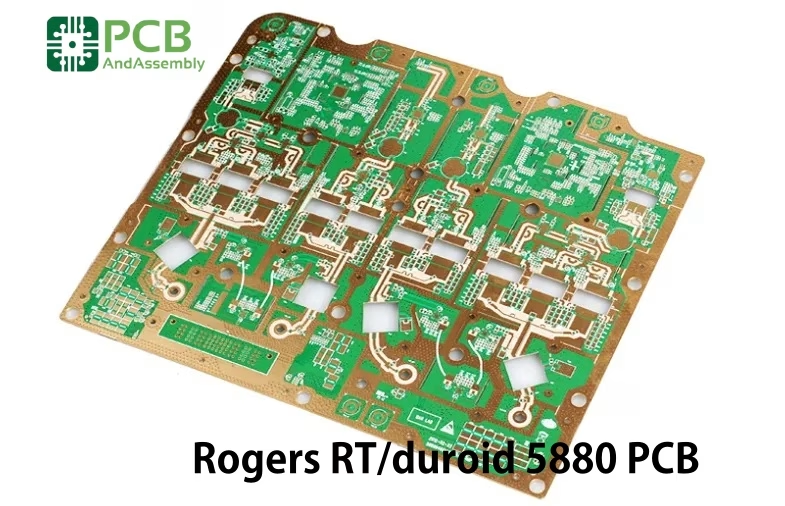
Table of Contents
Introduction
If you have ever had an RF design fail compliance because of subtle phase shifts or excessive dielectric loss at 24 GHz, you know that standard laminates are a liability. After years of troubleshooting military radar and millimeter-wave boards, one conclusion keeps holding: Rogers RT/duroid 5880 is unmatched for loss performance—but it will punish you during fabrication if you treat it like FR-4.
This guide walks through what the material actually is, what its electrical and physical parameters mean for your design, where the fabrication traps are hidden, and which applications genuinely justify its premium price. From hybrid stack-up construction to via reliability under thermal stress, every section addresses the decisions engineers face when transitioning a design to this substrate.
Need PCB Manufacturing or Assembly?
Get a free quote within 24 hours. We specialize in prototype-to-production PCB/PCBA for hardware teams worldwide.
What RT/duroid 5880 Actually Is
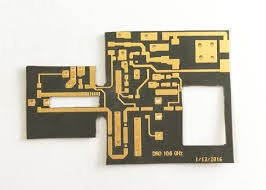
RT/duroid 5880 is a high-reliability, high-frequency circuit material belonging to the filled polytetrafluoroethylene (PTFE) composite family, manufactured by Rogers Corporation. Unlike woven-glass laminates—where dielectric properties shift depending on whether a signal travels along the warp or fill fibers—RT/duroid 5880 uses randomly oriented glass microfibers embedded in a pure PTFE matrix. The result is a genuinely isotropic material with uniform electrical characteristics in all three axes.
That isotropy matters enormously for precision stripline and microstrip applications. The random microfiber distribution eliminates the fiber-weave effect—a primary source of signal skew and localized impedance variations that plague high-speed digital and RF designs on woven-glass substrates.
The table below shows how this structural difference translates into performance, compared to other common PCB substrates:
| Substrate | Reinforcement | Fiber Orientation | Dielectric Isotropy | Processing Difficulty |
| RT/duroid 5880 | Glass Microfibers | Randomly Oriented | Excellent (Isotropic) | Difficult — PTFE tooling required |
| RT/duroid 5870 | Glass Microfibers | Randomly Oriented | Excellent (Isotropic) | Difficult — PTFE tooling required |
| Standard FR-4 | Woven Glass Cloth | Warp and Fill (90°) | Poor (Anisotropic) | Very Easy — standard tooling |
| Rogers RO4003C | Woven Glass / Ceramic | Warp and Fill (90°) | Moderate | Easy — FR-4 compatible |
Beyond isotropy, the PTFE matrix gives the material excellent chemical resistance to etching solvents, plating acids, and photoresist strippers, as well as extremely low moisture absorption—a property that becomes critical in field-deployed hardware.
Electrical and Physical Parameters
Accurate RF circuit modeling depends on precise material data. RT/duroid 5880 achieves a dielectric constant (Dk) of 2.20 ± 0.02 at 10 GHz—among the lowest available in the reinforced-laminate family. A lower Dk translates directly to wider trace widths for a given target impedance, reducing conductor losses and skin-effect attenuation. The dissipation factor (Df) of 0.0009 at the same frequency keeps insertion loss exceptionally low even into the millimeter-wave bands.
The following table compares RT/duroid 5880 against its closest sibling and standard high-Tg FR-4, with a column explaining the design significance of each parameter:
| Parameter | RT/duroid 5880 | RT/duroid 5870 | High-Tg FR-4 | Unit | Design Significance |
| Dielectric Constant (Dk) | 2.20 ± 0.02 | 2.33 ± 0.02 | 4.40 ± 0.20 | — | Sets transmission line width and signal propagation velocity. |
| Dissipation Factor (Df) | 0.0009 | 0.0012 | 0.0160 | — | Governs dielectric loss and overall signal attenuation. |
| Moisture Absorption | 0.02 | 0.02 | 0.15 | % | Maintains impedance stability in humid field conditions. |
| Glass Transition Temp (Tg) | 260 | 260 | 170 | °C | Thermal stability limit; determines lead-free solder compatibility. |
| X/Y-Axis CTE | 31 / 48 | 22 / 28 | 12 / 15 | ppm/°C | Influences layer-to-layer registration during lamination. |
| Z-Axis CTE | 237 | 173 | 45 | ppm/°C | Determines plated through-hole via reliability under thermal cycling. |
| Thermal Conductivity | 0.20 | 0.22 | 0.40 | W/m·K | Controls heat dissipation from high-power active components. |
RT/duroid 5880 is available in seven standard dielectric thicknesses to accommodate different transmission line geometries, power handling requirements, and mechanical rigidity needs:
| Thickness (inches) | Thickness (mm) | Tolerance | Typical Use |
| 0.005″ | 0.127 mm | ± 0.0005″ | Ultra-thin RF circuits, compact designs |
| 0.010″ | 0.254 mm | ± 0.0007″ | High-frequency antennas, space-constrained layouts |
| 0.015″ | 0.381 mm | ± 0.0010″ | Microstrip filters and couplers |
| 0.020″ | 0.508 mm | ± 0.0015″ | General RF applications |
| 0.031″ | 0.787 mm | ± 0.0020″ | Standard microwave circuits |
| 0.062″ | 1.575 mm | ± 0.0030″ | Power amplifiers, high-power applications |
| 0.125″ | 3.175 mm | ± 0.0050″ | Thick-core and structural applications |
Why Z-Axis Thermal Expansion Kills Multilayer Boards
The 237 ppm/°C Z-axis coefficient of thermal expansion (CTE) is the single most dangerous number in the RT/duroid 5880 datasheet for multilayer designers. Boards have come back from contract manufacturers with completely sheared via barrels after a single reflow cycle because that figure was ignored.
While the X and Y axes remain reasonably stable thanks to the microfiber reinforcement, pure PTFE expands rapidly in the Z-axis when heated above its transition temperature. That expansion places immense tensile stress on the copper plating inside plated through-holes (PTHs) and microvias. Standard 0.8 to 1.0 mil copper plating is often too thin to survive the stress of lead-free reflow peaks near 260°C.
To ensure long-term reliability under thermal stress, apply the following design rules to any multilayer board using RT/duroid 5880 cores:
- Specify a minimum of 1.2 to 1.5 mils of electrodeposited copper in all PTHs to increase mechanical yield strength.
- Limit via aspect ratio (board thickness to drill diameter) to 6:1 or lower to prevent stress concentration at via shoulders.
- Include non-functional pads on inner layers to anchor copper barrels to the surrounding laminate.
- Require highly ductile acid-copper plating chemistries so the copper can stretch rather than fracture under load.
Drilling, Smear, and Hole Preparation
PTFE is a soft thermoplastic elastomer, and that softness creates two interrelated problems during mechanical drilling: smear and drill wander. If spindle speed, feed rate, or chip load are not dialled in precisely, frictional heat will melt the PTFE matrix and smear it across inner copper planes—creating an insulating layer that blocks electrical continuity. Separately, the abrasive glass microfibers wear drill bits rapidly, causing wander and misregistered vias.
Surface preparation compounds the challenge. Boards where factories used standard mechanical brushing before lamination show smeared PTFE surfaces that destroy the micro-roughness copper needs to bond. Chemical-only cleaning is mandatory.
The table below summarises the critical fabrication parameters for drilling and hole preparation:
| Process Step | Variable | Recommended Value | Rationale |
| Drilling | Infeed Rate | 100–120 in/min | Prevents frictional heating and PTFE melt. |
| Drilling | Spindle Speed | 40,000–50,000 RPM (12 mil drill) | Maintains clean cutting action through glass microfibers. |
| Drilling | Tool Replacement | 100–150 hits per bit (max) | Abrasive microfibers dull tools rapidly; worn bits cause via wall tearing. |
| Desmear | Primary Treatment | Sodium naphthalene etch | Chemically modifies inert PTFE to allow copper adhesion. |
| Desmear | Alternative | Helium/oxygen plasma etch | Creates reactive sites on via walls without hazardous wet chemistry. |
| Surface Prep | Pre-lamination Cleaning | Chemical only—no mechanical brushing | Brushing deforms PTFE and embeds contaminants. |
| Copper Adhesion | Oxide Substitute | Organo-silane or light chemical micro-etch | Ensures bond strength without damaging the copper surface profile. |
The hole preparation chemistry is non-negotiable. Because PTFE is chemically inert and hydrophobic, standard electroless copper will not bond to untreated via walls. Without a dedicated sodium naphthalene or plasma etch, adhesion failure and complete via separation are the expected outcomes, not edge cases.
Specific process requirements:
- Sodium naphthalene etchant must be thoroughly rinsed with clean alcohol, followed by a hot-water rinse, to remove all chemical residues before plating.
- Plasma cycles must use a helium and oxygen gas mixture to safely alter the molecular structure of the PTFE surface.
- Treated boards must advance to the electroless copper plating line within 4 to 24 hours to prevent surface re-passivation.
Electrical Performance Across Frequency
As operating frequencies climb past 5 GHz, standard FR-4 becomes unusable. Its high dissipation factor converts an increasing fraction of the RF signal into heat within the dielectric. RT/duroid 5880 overcomes this limitation, delivering near-linear electrical performance from 1 MHz through 40+ GHz.
The insertion loss comparison below quantifies what that means in practice:
| Frequency (GHz) | FR-4 Insertion Loss (dB/in) | RT/duroid 5880 (dB/in) | Dominant Loss Mechanism |
| 1.0 | ~0.10 | <0.02 | Conductor skin effect |
| 5.0 | ~0.50 | ~0.05 | Conductor skin effect |
| 10.0 | >1.20 | ~0.12 | Dielectric dissipation |
| 28.0 | Unusable (>3.00) | ~0.35 | Dielectric dissipation |
| 40.0 | N/A | ~0.55 | Dielectric and surface roughness loss |
The low Dk of 2.20 requires layout adjustments. A lower dielectric constant increases guide wavelength, so physical structures—couplers, filters, resonant stubs—must be larger than on high-Dk substrates. Key layout practices:
- Calculate trace widths with 2D boundary element solvers that account for the trapezoidal cross-section of chemically etched traces, not ideal rectangular models.
- Optimise ground plane clearance around RF traces to suppress unwanted coplanar waveguide modes.
- Specify rolled copper cladding for phase-sensitive structures to minimise surface roughness-induced phase velocity dispersion.
Hybrid Stack-Ups with FR-4
Using RT/duroid 5880 for every layer in a multilayer board is rarely practical. Pure PTFE multilayers are mechanically flexible, difficult to register, and expensive. The industry-standard approach is a hybrid stack-up: RT/duroid 5880 on the outer RF layers, with lower-cost rigid FR-4 or high-Tg cores handling power distribution and low-speed digital routing on the inner layers.
Successful hybrid construction requires careful attention to lamination temperature matching and thermal expansion compatibility. The example below shows a well-proven 4-layer hybrid configuration for millimeter-wave applications:
| Layer | Material | Nominal Thickness | Function |
| L1 (Top) | RT/duroid 5880 with 0.5 oz rolled copper | 0.020″ (0.508 mm) | Microstrip routing and millimeter-wave signal traces |
| Dielectric | Rogers Speedboard C or FEP bondply | 0.0035″ (0.089 mm) | Low-loss thermoplastic bonding layer |
| L2 (Inner) | FR-4 core — Isola 370HR or equivalent | 0.024″ (0.610 mm) | RF ground plane and power planes |
| L3 (Inner) | FR-4 prepreg — high-Tg 1080/3313 glass | 0.0040″ (0.102 mm) | Low-speed digital and DC power routing |
| L4 (Bottom) | FR-4 core with 1.0 oz electrodeposited copper | 0.016″ (0.406 mm) | Digital control signals and component mounting |
Copper foil selection has a significant impact on RF attenuation, particularly above 10 GHz where the skin effect confines current to the conductor surface. Surface roughness on the dielectric-facing side of the foil forces high-frequency currents to travel a longer path, raising conductor losses directly:
| Foil Type | Surface Roughness (Rq) | Phase Consistency | Loss at 28 GHz | Peel Strength | Recommendation |
| Electrodeposited (ED) | ~1.8 µm | Moderate | Moderate-High | 8.0 lbs/in | Not recommended for mmWave circuits. |
| Reverse Treated (RT) | ~1.0 µm | Good | Moderate | 7.5 lbs/in | Standard balance of performance and cost. |
| Rolled Copper Foil | <0.5 µm | Excellent | Very Low | 6.0 lbs/in | Best performance; handle carefully during thermal processing. |
Applications
Aerospace and Defense
Military radar, missile guidance, and electronic warfare systems have relied on RT/duroid 5880 for decades. The material’s stable performance across temperature extremes, combined with its isotropic structure, makes it essential for phased array antennas where beam steering accuracy must be maintained across wide scan angles. Its low outgassing characteristics also qualify it for space applications, where material volatility can contaminate sensitive optical or electronic components.
Representative applications include T/R modules for active electronically scanned arrays, flight termination receivers, IFF transponders, GPS anti-jam antennas, and communication links for unmanned aerial vehicles.
5G and Millimeter-Wave Communications
The rollout of 5G networks has created significant demand for high-frequency laminate materials. RT/duroid 5880 is widely deployed in base station antennas, small cells, and millimeter-wave front-end modules operating at 28 GHz and 39 GHz. Its low loss becomes especially critical at these frequencies, where each fraction of a dB in insertion loss directly reduces link budget and coverage area.
Outdoor equipment including fixed wireless access terminals and small cell units also benefits from the material’s moisture resistance, which maintains stable dielectric properties across years of environmental exposure.
Automotive Radar
Modern ADAS systems rely on radar sensors operating at 24 GHz and 77 GHz for adaptive cruise control, collision avoidance, and autonomous driving. RT/duroid 5880 supports these frequency bands while withstanding the demanding thermal environment of automotive applications: temperature cycling from -40°C to +125°C, exposure to automotive fluids, and reliability requirements spanning 15+ year vehicle lifespans.
Satellite Communications
From low-earth-orbit constellations to geostationary platforms, RT/duroid 5880 appears throughout satellite communication systems. Its radiation resistance, stable vacuum performance, and low outgassing make it space-qualifiable. For high-power satellite transceivers, the material’s loss characteristics maximise power efficiency—a critical factor when available energy is limited by solar panel capacity.
Test and Measurement Equipment
High-precision RF test fixtures and vector network analyser calibration standards require substrates with predictable, repeatable properties. RT/duroid 5880’s consistency minimises measurement uncertainty in on-wafer device characterisation, precision attenuators, and power calibration standards where fractional-dB accuracy is the requirement.
Medical Electronics
RF ablation systems, MRI coils, and wireless patient monitoring devices benefit from the material’s biocompatibility, low-loss RF performance, and chemical resistance to sterilisation processes. Stable dielectric properties ensure consistent signal quality for medical data transmission over extended deployment periods.
Selecting the Right Material: 5880, 5870, or Rogers 4000
Not every high-frequency design justifies RT/duroid 5880. For sub-6 GHz designs without strict phase-matching requirements, the Rogers 4000 series can cut board fabrication costs by up to 60% while significantly improving manufacturing yields. The decision framework below applies to most material selection decisions:
- Use Rogers RO4003Cor RO4350B for designs below 6 GHz where cost and mechanical rigidity are the primary constraints.
- Choose RT/duroid 5870 (Dk 2.33) when an isotropic substrate is required but slightly smaller trace widths are acceptable.
- Specify RT/duroid 5880 (Dk 2.20, Df 0.0009) for millimeter-wave radar, missile guidance, and satellite antennas where loss budgets are extremely tight.
- Avoid pure PTFE laminates in high-vibration applications unless the board is secured to a rigid metal backing plate.
| Material | Dk | Df (10 GHz) | Thermal Conductivity | Processing | Relative Cost |
| RT/duroid 5880 | 2.20 | 0.0009 | 0.20 W/m·K | Requires PTFE processing | High |
| RT/duroid 5870 | 2.33 | 0.0012 | 0.22 W/m·K | Requires PTFE processing | High |
| RO4003C | 3.38 | 0.0027 | 0.71 W/m·K | FR-4-like processing | Medium |
| RO4350B | 3.48 | 0.0037 | 0.69 W/m·K | FR-4-like processing | Medium |
| FR-4 | 4.3–4.7 | 0.0200 | 0.30 W/m·K | Standard processing | Low |
Frequently Asked Questions
Can RT/duroid 5880 be processed on a standard FR-4 fabrication line?
No. While etching and copper stripping are compatible with standard chemical lines, mechanical drilling, routing, and hole preparation all require dedicated PTFE processing equipment—specifically plasma or sodium naphthalene treatment systems. Running this material through a standard FR-4 line produces adhesion failures and unusable via walls.
Why does RT/duroid 5880 cost so much more than other RF laminates?
Raw material pricing typically runs $150 to $600 per sheet, depending on thickness and copper cladding. The cost is driven by the pure PTFE chemistry, the precision required to disperse random glass microfibers uniformly, and the comparatively low production volumes of military-grade materials. For applications where its performance is genuinely required, the premium is usually justified by reduced system complexity and improved yields.
What surface finish is best for high-frequency microstrip circuits?
ENIG (Electroless Nickel Immersion Gold) is widely used and gives consistent solderability, but the nickel layer introduces measurable insertion loss at millimeter-wave frequencies. For loss-critical microstrip circuits, Immersion Silver or OSP (Organic Solderability Preservative) are preferred. ENIG remains a practical choice for mixed-signal boards where connector and component soldering is the primary concern.
Does RT/duroid 5880 support lead-free reflow profiles?
Yes. With a glass transition temperature of 260°C and a decomposition temperature above 315°C, the material withstands standard lead-free reflow conditions. The high Z-axis CTE does require robust PTH structures—see the section on Z-axis thermal expansion—to survive multiple thermal cycles without via barrel fracture.
Summary
Rogers RT/duroid 5880 remains the benchmark material for microwave and millimeter-wave PCB designs. Its randomly oriented microfiber structure delivers genuine electrical isotropy, and its ultra-low dielectric constant and loss tangent enable minimal signal degradation across frequency bands that would be unusable on conventional laminates.
That performance comes with real fabrication demands. The soft PTFE matrix requires calibrated drilling parameters, chemical-only surface preparation, and dedicated sodium naphthalene or plasma hole treatment before any copper can reliably adhere to via walls. The high Z-axis CTE demands over-specified copper plating in through-holes and constrained via aspect ratios for any multilayer design expected to survive thermal cycling.
Treated as a precision instrument rather than a general-purpose board material, RT/duroid 5880 consistently delivers millimeter-wave yields that justify the investment for aerospace, defense, automotive radar, and 5G infrastructure applications where signal integrity is non-negotiable.
Get Quote Free