
Mid Volume Robotics PCB Assembly for
Precision Automation Systems
OrinewPCB delivers mid volume robotics PCB assembly for manufacturers needing dependable robot circuit board production from small to large batches.
Our PCB assemblies are built to IPC Class 3 standards, combining SMT and THT for industrial, medical, and service robotics applications.
We produce runs from a single PCB board to thousands in one order, with rapid turnaround from prototype to medium batch production.
Mid Volume Robotics PCB Assembly for Scalable Robotics Production
Mid-volume robotics PCB assembly is the bridge between prototype work and higher production runs, supporting reliable operation of every robot circuit board in automation, medical and service robotics systems.
These PCB assemblies are produced in PCBAndAssembly certified facilities using high-quality materials and IPC Class 3 workmanship, ensuring consistent performance in environments exposed to vibration, heat and electrical interference.
Our assembly process combines SMT placement accuracy within ±30 µm, fine-pitch BGA capability down to 0.2 mm, and selective soldering for durable connectors and power modules. Each robot PCB assembly undergoes AOI, X-ray inspection and functional testing to verify reliability before shipment.
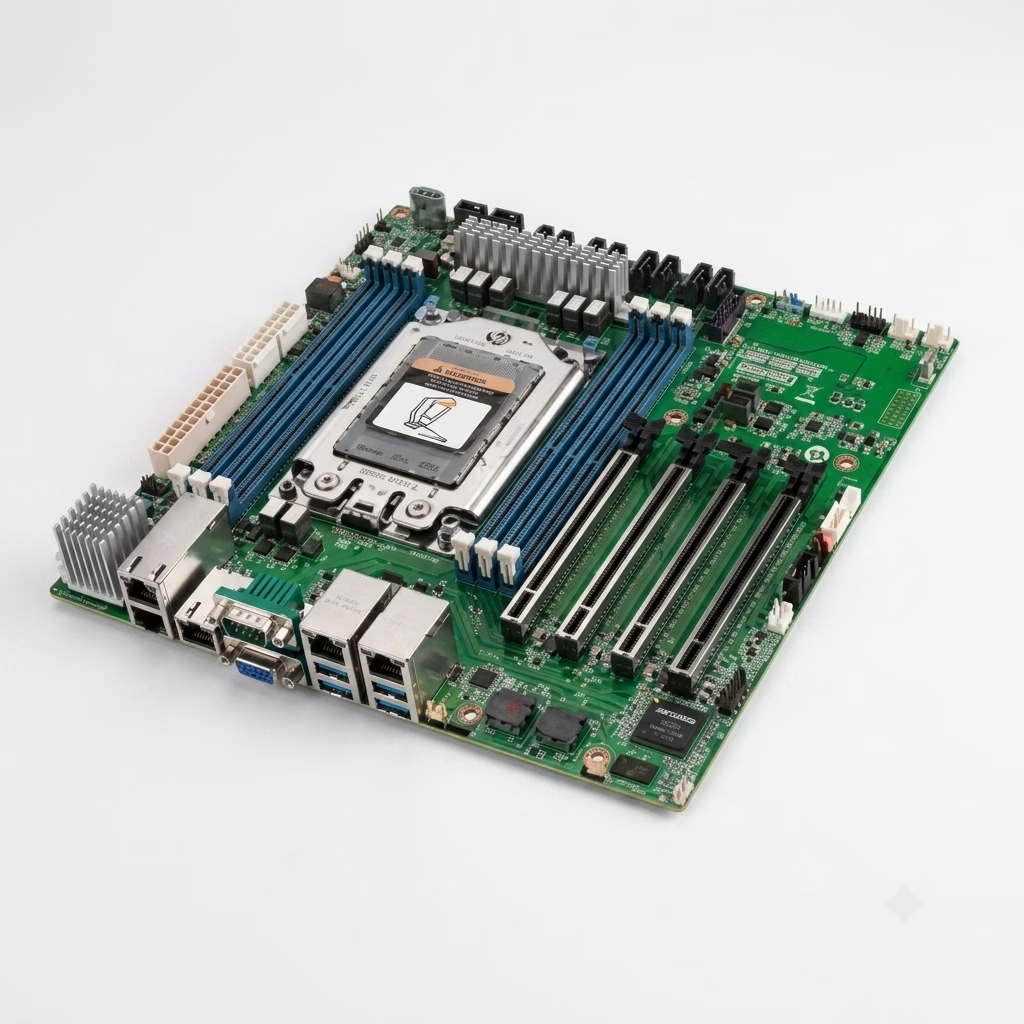
What Is a Robot PCB and Why Does It Matter?
A robot PCB (Printed Circuit Board) is a specialized circuit board designed specifically for robotic applications. Unlike the PCB in your TV remote or laptop, a robot PCB must handle some unique challenges: high-current motor drives, sensitive sensor inputs, constant vibration, and often harsh environmental conditions — all while fitting into a compact, lightweight package.
Think of the robot PCB as the central nervous system of your robot. It coordinates communication between the microcontroller (the brain), sensors (the senses), and actuators (the muscles). A poorly designed robot PCB will cause random resets, motor interference, sensor noise, and reliability problems that can take weeks to diagnose.
Our Mid Volume Robotics PCB Assembly Capabilities
PCBAndAssembly mid volume robotics PCB assembly combines high precision placement, certified inspection processes and advanced material options to deliver reliable robot circuit boards for a range of applications.
Surface Mount Technology (SMT) for Robotics PCBs
Our SMT lines achieve placement accuracy within ±30 µm, with throughput up to 600,000 components per hour. We assemble ultra-fine pitch devices down to 01005, BGA packages with 0.2 mm pitch, and QFP spacing at 0.25 mm.
Robotics applications often require compact layouts; we support HDI PCB designs with microvias, via-in-pad and stacked structures for dense interconnects. Reflow soldering profiles are tightly controlled to avoid component shift and maintain joint integrity.
Through-Hole Assembly for Robotics Power Modules
We provide through-hole assembly for connectors, power transistors and mechanical support components on robotics boards that undergo vibration and continuous load.
Finished drill sizes down to 0.15 mm with aspect ratios up to 12:1 are supported, ensuring reliable plated through-holes.
Flexible & Rigid-Flex PCB Assembly for Robotics Enclosures
Mixed Assembly for Complex Robotics Systems
Our mixed assembly process integrates SMT and THT on the same robot PCB assembly, combining miniaturized signal processing with robust power connections.
This is common in complex robot designs where control circuits, high-power drivers and safety systems must be integrated onto a single printed circuit board.
Conformal Coating & Protective Finishes
Surface treatments include leaded HASL, lead-free HASL, immersion gold, OSP, and silver.
Protective coatings are available for robots exposed to dust, chemicals, or outdoor environments, helping extend the service life of each finished robot PCB.
Robotics-Grade Testing & Validation
Every robotics PCBA undergoes 100% automated optical inspection (AOI), X-ray inspection for BGA joints, in-circuit testing and functional testing.
Additional reliability checks include solderability, impedance control, thermal shock and microsection analysis of copper plating.
Certifications and Compliance for Robotics PCB Assembly
PCBAndAssembly mid volume robotics PCB assembly follows IPC-A-610 Class 3 workmanship standards, providing 99.9% reliability for mission-critical robotics.
Our facilities are ISO 9001 and ISO 14001 certified, with processes aligned to AS9100D for aerospace robotics, and ISO 13485 for medical device robotics requiring FDA compliance for collaborative robotics safety.
These certifications ensure access to industrial, aerospace, medical, and collaborative robotics markets with proven quality assurance.
Robotics-Specific Applications

Industrial Automation Robots
Robotics PCBs for industrial automation must operate in high-temperature environments up to 125 °C, resist vibration, and maintain EMI/EMC compliance.
PCBAndAssembly delivers robot circuit boards with heavy copper options up to 20 oz, controlled impedance and conformal coating to support reliable operation on production lines.

Collaborative Robots (Cobots)
Collaborative robotics requires built-in safety and energy efficiency.
PCBAndAssembly supports safety standards with dedicated safety circuits, polyimide flex PCB structures for moving joints, and optimized power management systems that extend runtime while protecting human operators during interaction.

Autonomous Mobile Robots (AMR/AGV)
Autonomous robots rely on navigation, wireless communication and battery management.
Our PCB assemblies integrate LiDAR and vision sensors, Wi-Fi and Bluetooth modules and robust BMS circuitry, with conformal coating to protect boards in warehouses and outdoor applications.

Medical robots demand miniaturized and sterilization-ready electronics.
PCBAndAssembly provides HDI PCB and rigid-flex structures with microvia technology for compact designs, along with biocompatible finishes such as ENIG and tested IPC Class 3 solder joints to guarantee safety in surgical and diagnostic systems.
How to Order Your Industrial Control PCB Assembly
Mid Volume Robotics PCB Assembly FAQs
How long is the lead time for mid volume robotics PCB assembly?
Lead times vary by complexity and batch size. PCB prototypes can be completed in 2 to 3 weeks, while mid volume robotics PCB assembly typically ships within 4 to 5 weeks, with expedited service available for urgent projects.
Can PCBAndAssembly handle both SMT and THT for the same robotics board?
Yes, we support mixed assembly combining SMT placement and through-hole soldering on the same robot circuit board, ideal for robotics systems that need both miniaturized signal circuits and robust power connections.
Do you support custom PCB designs for robotics applications?
Yes, our team works with customer-supplied PCB design files to create PCB assemblies for robotics systems, from prototype to mid volume production.
What packaging and shipping methods are used for robotics PCB assemblies?
Finished robot PCBs are vacuum-sealed with ESD protection, boxed securely, and shipped worldwide using tracked logistics partners to ensure safe delivery.
What does the future look like for robotics PCB assembly?
AI chip integration will bring edge computing directly onto the robot circuit board, enabling real-time decision making without relying on cloud latency. 5G communication modules will support remote operation and coordination of robots across factories, warehouses, and medical facilities.
To manage next-generation power densities, advanced thermal management solutions, such as heavy copper layers, heat spreaders, and optimized via structures, will become standard in robotics pcb assemblies, ensuring long-term reliability under demanding workloads.
