How Much Does It Cost to Outsource PCBA Manufacturing? A Cost Guide (2026)
In outsourced PCBAs, component costs account for 50-70% of the actual cost, while bare boards and solder joints are only a small fraction. That's the number we audit first when quoting a build at OrinewPCB — send us your BOM and we'll show you where the cost really sits, free and with no obligation.
Get Your PCB Quote!
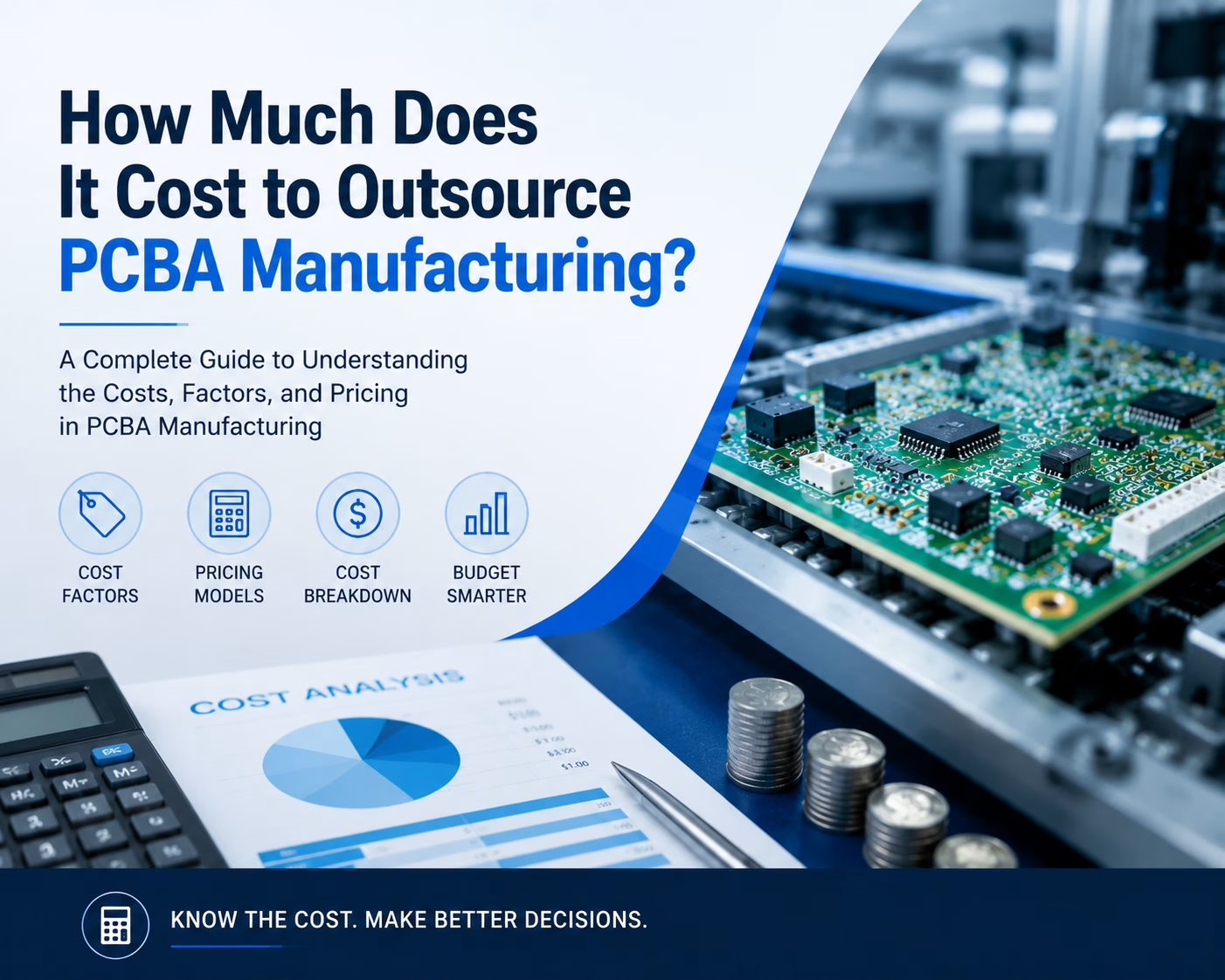
Table of Contents
- Что на самом деле входит в смету на изготовление печатных плат на заказ у стороннего поставщика?
- Сколько стоит изготовление панелей без корпуса?
- Сколько стоит сборка печатной платы?
- Компоненты: 50–70% вашего бюджета, которые чаще всего скрываются в сметах.
- НИОКР, тестирование и другие разовые расходы
- Почему цена за единицу продукции снижается в 5–10 раз от прототипа до серийного производства?
- Почему цитаты так сильно различаются — и как их справедливо сравнивать.
- Как снизить затраты на аутсорсинг производства печатных плат без ущерба для качества.
- Часто задаваемые вопросы
- Почему мы это пишем
- Ссылки и источники
Table of Contents
- Что на самом деле входит в смету на изготовление печатных плат на заказ у стороннего поставщика?
- Сколько стоит изготовление панелей без корпуса?
- Сколько стоит сборка печатной платы?
- Компоненты: 50–70% вашего бюджета, которые чаще всего скрываются в сметах.
- НИОКР, тестирование и другие разовые расходы
- Почему цена за единицу продукции снижается в 5–10 раз от прототипа до серийного производства?
- Почему цитаты так сильно различаются — и как их справедливо сравнивать.
- Как снизить затраты на аутсорсинг производства печатных плат без ущерба для качества.
- Часто задаваемые вопросы
- Почему мы это пишем
- Ссылки и источники
Quick Specs
| Components’ share of total cost | 50–70% (up to ~80% on component-dense boards) |
| Bare-board fabrication share | ~10–25% at prototype volumes, 5–15% at production volumes |
| SMT assembly setup fee | $8–$50 at rapid-prototype shops (published); $150–$500+ at full-service CMs |
| Automated SMT placement | $0.001–$0.002 per joint (China/East Asia) vs. $0.015–$0.05 per joint (US/EU) |
| ICT fixture tooling (one-time) | $5,000–$20,000 per design |
| Flying-probe testing | $500–$2,000 programming + $5–$20 per board |
| Prototype-to-production delta | 5–10× lower per-unit price at volume (directional) |
| Turnkey component markup | ~10–20% over BOM cost (vendor-reported) |
Outsourcing PCBA manufacturing costs roughly $50–$500 in setup and tooling plus a per-unit price that ranges from about $30–$150 per board at prototype volumes down to $5–$20 per board at production volumes — but the single largest line item is almost never manufacturing at all. Components typically account for 50–70% of total landed cost, so the real driver of what you pay is your BOM, not the solder joints. This guide breaks down every cost bucket in an outsourced PCBA quote — bare board, assembly, components, tooling, testing, and freight — with published price points where they exist, so you can read a quote and know whether you’re overpaying.
The short version up front: there is no single “cost to outsource PCBA” because the same board can vary 5–10× in per-unit price between a 5-piece prototype run and a 10,000-piece production run, and the biggest variable is component pricing that most quote-to-quote comparisons never touch. If you walk into the process knowing that components are the elephant, that setup and NRE hit you once no matter the volume, and that per-joint rates are a rounding error next to BOM cost, you’ll evaluate quotes on the numbers that actually matter.
Key Takeaways
- Components are 50–70% of total PCBA cost — optimizing your BOM (sourcing, substitutes, authorized parts) saves more than any assembly-line discount ever will.
- Setup fees, stencils, and test programming are fixed costs: a $300 setup on a 5-board run adds $60/board; on a 1,000-board run it’s $0.30/board. That’s the whole prototype-to-production price delta in one sentence.
- A “cheap per-joint” assembly quote is misleading if the shop adds line-item charges for stencil, programming, extended parts, and test that the headline number doesn’t include.
- Flying-probe testing is the right default below ~1,000 units (no fixture cost); ICT’s $5,000–$20,000fixture only pays off at production volume.
- China/East-Asia placement rates run roughly 10–50× lower than US/EU rates, but freight, duties, and lead-time risk can erase the gap on small, time-sensitive orders.
What’s actually in an outsourced PCBA quote
Every outsourced PCBA quote is built from the same four cost buckets, and knowing their typical proportions tells you where to focus negotiation energy:
Typical cost split of an outsourced PCBA program — components dominate at every volume tier.
| Cost bucket | Prototype (1–50 pcs) | Production (1,000+ pcs) | Notes |
| Components | 50–65% | 60–70% | Largest line item at every tier; often billed at BOM cost + 10–20% turnkey markup |
| Bare board | 10–25% | 5–15% | Panelized pricing drops sharply at volume |
| Assembly | 10–20% | 15–25% | Setup fee dominates at low volume; per-joint cost dominates at volume |
| NRE + testing + freight | 5–20% | 2–8% | One-time tooling amortizes to near zero at volume |
These proportions are directional — a board with $0.80 of passives and one $40 connector shifts the split dramatically. But the ordering is stable: components first, everything else second. That ordering is why the most cost-effective thing you can do is fix your BOM before you shop assembly, not after.
How much does bare-board fabrication cost?
Bare-board fabrication is usually the second most expensive line item, and it’s the one buyers most often over-spec. Layer count is the dominant driver — each pair of layers adds material, lamination cycles, and drilling steps — followed by board size, panel utilization, copper weight, and surface finish.
Published and industry-typical bare-board pricing by layer count — cost per board drops steeply as quantity rises.
| Layer count | Prototype (5–10 pcs) | Low volume (100 pcs) | Production (1,000+) |
| 2-layer | $2–$10 | $1–$4 | $0.50–$1.50 |
| 4-layer | $5–$30 | $3–$8 | $2–$5 |
| 6-layer | $15–$60 | $6–$15 | $4–$8 |
| 8+ layer / HDI | $40–$200+ | $15–$50 | $8–$25 |
Figures are directional ranges compiled from published prototype-shop pricing. The exact number depends on panelization: if your board fits multiple-up on a standard panel, per-unit price falls proportionally.
The panelization lever. A standard production panel in East Asia is roughly 500×400mm (or 250×300mm for rapid-prototype shops). A 100×100mm board fits five-up on a 250×300mm panel — so a $7–$13 five-piece quote isn’t five boards each costing $1.40–$2.60; it’s one panel’s worth of material split five ways. Designing your board to a standard panel grid (e.g., multiples of 50mm) can cut fabrication cost 20–40% before you ever send files.
What adds cost to the bare board
- Surface finish: HASL is the baseline and cheapest. OSP adds a small premium but is handling-sensitive. Immersion silver/tin sits mid-range. ENIG typically adds 15–25% to surface-finish cost and is required for fine-pitch BGAs and edge connectors — if your design doesn’t need it, don’t pay for it. ENEPIG costs more still and is only justified for wire bonding or harsh-environment reliability.
- Copper weight: 2 oz and 3 oz copper for high-current designs adds roughly 30–50% to material cost — and forces wider trace/space rules that can lower panel yield. Design for the thinnest copper that meets your current requirement.
- Special laminates: high-frequency (Rogers-class, PTFE) or high-Tg materials run 2–3× the cost of FR-4. See our Rogers RO4835T materials guideif you’re weighing whether you actually need them.
- Tolerance and impedance control: controlled impedance (±10% typical) and tight registration add test and process cost. Required for high-speed designs, wasted otherwise.
📐 Engineering Note
Take a 4-layer, 100×100mm board, 5 pieces, at a rapid-prototype shop. Published baseline is roughly $7 for the first run; adding a lead-free finish, ENIG (because your design has a fine-pitch BGA), and a color adds up to roughly $17–$24 total for five boards — about $3.40–$4.80 per board. Re-quote the same board at 500 pieces and per-board price typically falls to $3–$8 because the setup is amortized and the board now panels efficiently. That’s the fabrication half of the 5–10× prototype-to-production delta.
What does PCB assembly cost?
Assembly pricing has three components: a fixed setup/tooling charge, a per-joint (or per-component) placement charge, and add-on line items for stencils, extended parts, and testing. At low volume, the fixed charges dominate; at volume, the per-joint rate dominates.
Setup fees and stencils
Published rapid-prototype pricing from JLCPCB’s assembly price breakdown shows the low end of the market:
- SMT setup: $8 per order (economic line), $25 single-side / $50 double-side (standard line)
- Stencil: $1.50 (economic, production-use only) to $7.86 single-side / $15.72 double-side (standard)
- Extended-parts fee: $1.50–$3.00 per additional component type beyond the standard feeder set — this is where boards with 100+ unique part numbers quietly add up
- Hand-soldering labor: ~$3.50 per order plus higher per-joint rates for through-hole
Full-service contract manufacturers quote higher setup — commonly $150–$500 — because they include engineering review, DFM analysis, programming, and first-article inspection in that charge. The rapid-prototype number and the full-service number buy different things; comparing them apples-to-apples requires reading what’s included, not just the number.
Per-joint placement rates
Automated SMT placement is billed per solder joint or per component placement. Published rates:
- Rapid-prototype shops (East Asia): ~$0.001–$0.002per joint, tiered down with volume
- US/EU contract manufacturers: ~$0.015–$0.05per placement — roughly an order of magnitude or more higher, reflecting labor, overhead, and typically more complete documentation and traceability
📐 Engineering Note
A 200-component board with a realistic mix of passives, QFNs, and a couple of BGAs typically lands at 400–600 solder joints per board, so a 100-board run is roughly 50,000 joints. At $0.0015/joint that’s $75 of placement; at $0.03/placement it’s $1,500. The spread is real — roughly 10–50× depending on the shop — but it’s still smaller than the component-cost spread on the same board, which is why buyers who fixate on per-joint rates are optimizing the wrong line item.
⚠️ Important
A $8 setup fee sounds unbeatable until you add stencil, extended parts, programming, and test as separate line items — charges that a bundled quote from a full-service CM already includes. Always ask for the complete cost per board, including setup, stencil, extended parts, and test, rather than comparing headline setup numbers. The two models converge once every line item is on the table.
Components: the 50–70% of your budget most quotes bury
Here’s the number that decides whether outsourcing is cheap or expensive: components are typically 50–70% of total PCBA cost (up to ~80% on boards with expensive active components). That’s a directional industry range — multiple EMS and cost-analysis sources converge on it, but every program differs — yet it has a practical consequence most cost guides miss: your BOM is your cost, and the assembly shop is only managing it, not creating it.
Turnkey vs. consignment
- Turnkey— the CM sources all components per your BOM. You pay the BOM cost plus a procurement markup, typically 10–20% (vendor-reported; many shops quote 8–15%) to cover purchasing overhead, supply-chain management, and risk. Turnkey is where the CM’s distributor relationships and bulk buying actually help you.
- Consignment— you buy and deliver all components. You save the markup but take on the full risk: you must buy 15–25% extra components for attrition and scrap, track lead times yourself, and absorb the cost of a line stop when a part is late or wrong.
📐 Engineering Note — consignment isn’t automatically cheaper
On a 100-board run where components total $8,000, a 12% turnkey markup costs you ~$960. Buying consigned, you save that — but you’re now carrying inventory, purchasing buffer stock (15–25% extra on the BOM), and owning the schedule risk. The break-even depends on your procurement team’s bandwidth and your component lead times, not on the markup alone. For most low-volume and mid-volume buyers, turnkey nets out ahead; consignment only wins at scale or when you have genuine sourcing leverage.
The silent cost: component substitution risk
The largest hidden cost in outsourced PCBA isn’t a fee — it’s a substitution. When a BOM component is obsolete, long-lead, or on allocation, a CM that swaps in an equivalent but different part without your sign-off can change electrical behavior, thermal performance, or compliance status. The cost isn’t the swap itself; it’s the field failure or the regulatory surprise six months later.
The fix is contractual, not technical: your quote should state that any component substitution requires written approval with datasheet comparison. On a recent low-volume program, our team at OrinewPCB caught a proposed substitution for a customer’s precision voltage reference that would have shifted its tolerance spec — we flagged it in DFM review before the BOM was purchased, and the customer’s decision to keep the original part avoided a test failure that would have scrapped the first production batch.
NRE, testing, and other one-time costs
Non-recurring engineering (NRE) and tooling hit you once per design, and their per-board impact collapses as volume rises. Budget for them explicitly — they’re the difference between “the quote was cheap” and “the total bill was fine.”
| Cost item | Typical range | When it applies |
| DFM review / engineering | $0–$500 (often free at full-service CMs) | Every order, bundled or line-item |
| SMT programming + setup | $8–$500 | Every assembly run |
| Stencil | $10–$150 | Per board design (reusable) |
| ICT fixture (bed-of-nails) | $5,000–$20,000 | Production volume (10,000+ typically justifies it) |
| Flying-probe test programming | $500–$2,000 | Prototype/low volume |
| Test program software (ICT) | $1,000–$3,000 | With ICT fixture |
| Conformal coating | $0.03–$0.15 material, $1+ service per board | Humidity/vibration environments |
Testing: the decision that shapes your per-board cost
- Flying probe— no fixture required; a machine probes each net programmatically. Programming costs $500–$2,000, and testing runs $5–$20 per board with 5–15 minutes per board. This is the right default for prototypes and low volume (under ~1,000 units), because there’s no fixture to pay for.
- ICT (In-Circuit Test)— a custom bed-of-nails fixture per design costs $5,000–$20,000 plus $1,000–$3,000 for the test program, but per-board testing drops to $1–$5 with fast cycle times. The fixture pays for itself only at production volumes; at 100 boards it adds $50–$200 per board, which no one budgets for when they quote ICT “because it’s more thorough.”
- AOI and X-ray— AOI is standard practice on SMT lines and usually included in assembly; X-ray is required for hidden-lead packages (BGAs, QFNs) and is often billed per board on a tiered scale.
📐 Engineering Note — when ICT actually makes sense
Take a $12,000 ICT fixture on a board built in quantities of 500. That’s $24 per board just for the fixture — four to eight times the cost of flying-probe testing at the same volume. Double the quantity to 10,000 and the fixture drops to $1.20/board, below flying probe. The crossover is roughly in the low thousands of boards per design, depending on board size and test coverage. A good CM will tell you which test method fits your quantity instead of defaulting to the more expensive one.
Why per-unit price drops 5–10× from prototype to production
The single biggest source of confusion in PCBA cost is the gap between prototype and production pricing. A board that costs $80/unit at 5 pieces can cost $15/unit at 1,000 and $8/unit at 10,000. That’s not a discount — it’s the amortization of fixed costs plus volume component pricing:
- Setup and NRE amortize: a $300 setup spread over 5 boards is $60/board; over 1,000 boards it’s $0.30.
- Panelization efficiency: production runs fill panels, cutting fabrication waste.
- Component pricing: distributors and manufacturers tier pricing by quantity; the same connector that costs $1.20 at qty 1 might be $0.55 at qty 10,000. With components at 50–70% of cost, this is the largest single driver of the delta.
- Line efficiency: pick-and-place runs continuously instead of stopping for changeovers.
📐 Engineering Note — worked example: the same board at two volumes
Consider a 4-layer board, 100×100mm, ~150 components, ENIG finish, flying-probe tested. At 20 pieces, a realistic landed quote is $1,800–$2,500 total — roughly $90–$125 per board — because setup, stencil, programming, and a 20-piece component buy dominate. At 2,000 pieces, that same design typically quotes $14,000–$20,000 — $7–$10 per board, with components still about 60% of the total and setup amortized to cents. These are directional ranges, not quotes for any specific design, but the shape — a 10× per-unit drop driven mostly by component volume and fixed-cost amortization — is consistent across published prototype pricing and industry-typical production quotes.
Why quotes vary so much — and how to compare them fairly
Two quotes for the same Gerber and BOM can differ by 3–5×. Usually that’s not one shop “cheating” — it’s different inclusions. When comparing quotes, normalize for these five variables:
- Component cost basis: Is the quote including the BOM at your cost, or at the shop’s sourced cost plus markup? Ask for the component cost breakdown line by line — this is 50–70% of the total, so a $0.05 difference on a 100-component BOM is a $5–$10 difference on your board cost before you even count assembly.
- Setup and NRE inclusions: Does the quote include DFM review, programming, and stencil, or are they line items?
- Test coverage: AOI only, or AOI + flying probe/ICT? Is X-ray included for BGAs?
- Quantity basis: Per-board price at what quantity? Never compare a per-board prototype price to a per-board production price without adjusting for volume.
- Landing cost: Freight, duties, and customs brokerage on East-Asia orders can add 5–20% depending on order size and destination. A $0.0015/joint assembly quote doesn’t help if your express freight is $200 on a small order.
The landing-cost rule. For orders under ~$3,000–$5,000 of goods, freight and duties are a significant fraction of the total — often 5–20% — which is why a domestic or regional CM can be competitive on small batches despite higher per-joint rates, and why offshore wins decisively as order value grows. Express freight on a small parcel runs roughly $10–$45 depending on carrier and destination (Freightos shipping rate data). Compare landed cost per board, not per-joint rates.
How to reduce PCBA outsourcing costs without cutting quality
Ordered by impact, because most cost-reduction advice starts at the wrong end:
- Fix the BOM first.Consolidate part numbers, standardize on common values, and prefer parts with multiple suppliers. A board with 60 unique parts is meaningfully cheaper to assemble than one with 120 unique parts — extended-parts fees, feeder changes, and sourcing effort all scale with unique part count.
- Avoid over-specifying.ENIG where HASL works, 4 layers where 2 layers route, ±5% impedance where ±10% passes — each over-spec adds cost you can’t see on the schematic. Our guide to PCB manufacturing costs in 2026walks through the fabrication-side decisions line by line.
- Panelize to standard sizes.Multi-up on a standard panel grid cuts fabrication cost 20–40%.
- Let the CM source components (turnkey).The 10–20% markup usually nets out against the buffer stock, expedite fees, and line-stop risk of doing it yourself — and it transfers allocation risk to someone who lives in the market.
- Choose the right test method.Flying probe below ~1,000 units; ICT only when the fixture amortizes. AOI is standard — make sure it’s included, not a line item.
- Ask for DFM feedback before you commit to the first quote.Most layout-level cost drivers — over-tight spacing, exotic finishes, inefficient panelization — are fixable before production but expensive after.
From our floor. On a recent 6-layer HDI prototype order, our DFM review caught that the customer’s design used blind vias on an inner layer pair where a through-via stackup would have passed every signal-integrity requirement at roughly 30% lower fabrication cost. We flagged it before the quote was locked; the customer revised the stackup, and the fabrication line item dropped by about a third. That’s the difference between a CM that quotes your files and one that engineers your costs — the same engineering-first approach we take to every order at OrinewPCB.
Frequently Asked Questions
Q: What is the average cost to outsource PCBA manufacturing?
There’s no single average — components dominate at 50–70% of total cost, so per-board price tracks your BOM first. Directionally, expect roughly $30–$150 per board at prototype volumes and $5–$20 per board at production volumes for a typical 4-layer design, before tooling and freight. A more useful number: total program cost for a 100-board prototype run with a mid-complexity BOM typically lands in the $3,000–$8,000 range including setup, stencil, testing, and freight.
Q: Why is my PCBA quote so much higher than a competitor’s published price?
Published prices are usually prototype-optimized headline numbers (small boards, basic finish, economic line, no test coverage, self-sourced components). Your quote includes your BOM cost, finish, test requirements, and the shop’s inclusions. Compare normalized total cost per board — BOM included — not headline setup fees.
Q: Is it cheaper to outsource PCB assembly overseas?
For order values above a few thousand dollars, East-Asia contract manufacturers typically offer materially lower per-joint and fabrication rates, and the ~10–50× placement-rate gap is real. Below that, freight (45 express on small parcels) and lead-time risk can erase the savings — so small, urgent orders are often cheaper closer to home. Compare landed cost per board, not rates.
Q: What percentage of PCBA cost is components?
Directionally, 50–70%, and up to ~80% on boards with expensive active components. This is the single most important number in PCBA cost management: it means BOM optimization and sourcing discipline matter more than assembly pricing.
Q: What is a fair markup for turnkey component sourcing?
Most contract manufacturers quote 10–20% over BOM cost for turnkey sourcing (many in the 8–15% range) — vendor-reported, not an audited industry figure. Fairness depends on what’s included: an authorized-distributor supply chain and documented traceability justify the top of the range; a shop sourcing from gray-market brokers should not be charging the same premium.
Q: Do I have to pay NRE every time I change the design?
No — NRE (fixture, programming, test program) is per design, and minor revisions usually reuse most of it. Major revisions that change layer count, board shape, or component placement may trigger new setup and stencil charges. Clarify in the quote what counts as a revision vs. a new program before you sign.
Why we write this
Cost guides that list “factors affecting PCBA price” without a single number teach readers nothing they couldn’t guess. We wrote this guide to put actual published price points and directional ranges on the table — so buyers can check whether their quote sits in a sane range and, more importantly, know that the component line, not the assembly line, is where their money actually goes. We’re a contract manufacturer ourselves, and we’ve watched buyers overpay on consignment setups, over-spec finishes they didn’t need, and pick test methods that added $20/board of fixture cost to a 200-board run. The recommendations here come from that floor experience. Reviewed by the OrinewPCB technical team.
References & Sources
- What does your PCB assembly price include?— published setup, stencil, and line-item pricing (vendor-published)
- Flying Probe vs. Fixture Testing Cost Analysis— ICT fixture and flying-probe cost ranges (vendor-published)
- What Affects PCB Assembly Cost?— stencil and tooling cost ranges (vendor-published)
- EEVblog forum: USA vs. China assembly pricing— practitioner-reported placement rate ranges (directional)
- IPC releases J-revisions of J-STD-001 and IPC-A-610— assembly workmanship standards context (standards body)
- IPC-6012: qualification standard for bare boards— bare-board qualification reference (standards body)
Get Quote Free