Contract Electronics Manufacturing: A Complete Guide for OEMs
Contract electronics manufacturing enables OEMs to bring electronic products from validated designs to reliable production without investing in their own manufacturing infrastructure. With a focus on quality, flexibility, and engineering support, OrinewPCB helps businesses turn their electronic designs into reliable finished products.
Get Your PCB Quote!
Table of Contents
- ¿Qué es la fabricación de productos electrónicos por contrato?
- CEM vs. EMS vs. ODM vs. OEM: ¿Cuál es la diferencia?
- ¿Qué hace exactamente un fabricante de productos electrónicos por contrato?
- Soluciones llave en mano frente a modelos de consignación: ¿Qué modelo se adapta mejor a su programa?
- ¿Qué normas y certificaciones de IPC son realmente importantes?
- Cómo calificar a un fabricante de productos electrónicos por contrato: El marco de decisión
- ¿Qué plazos de entrega se pueden esperar?
- Errores comunes que cometen los fabricantes de equipos originales (OEM) con la fabricación por contrato.
- ¿Cuánto cuesta la fabricación por contrato?
- Preguntas frecuentes
- Recursos útiles
- Referencias y fuentes
- Conclusión
Table of Contents
- ¿Qué es la fabricación de productos electrónicos por contrato?
- CEM vs. EMS vs. ODM vs. OEM: ¿Cuál es la diferencia?
- ¿Qué hace exactamente un fabricante de productos electrónicos por contrato?
- Soluciones llave en mano frente a modelos de consignación: ¿Qué modelo se adapta mejor a su programa?
- ¿Qué normas y certificaciones de IPC son realmente importantes?
- Cómo calificar a un fabricante de productos electrónicos por contrato: El marco de decisión
- ¿Qué plazos de entrega se pueden esperar?
- Errores comunes que cometen los fabricantes de equipos originales (OEM) con la fabricación por contrato.
- ¿Cuánto cuesta la fabricación por contrato?
- Preguntas frecuentes
- Recursos útiles
- Referencias y fuentes
- Conclusión
Quick Specs
| Typical program size | 1–50 units (prototype) to 5,000+ (production) |
| Business models | Turnkey, consignment (kitted), and hybrid sourcing |
| Assembly technologies | SMT, through-hole, mixed-technology, box build, cable harness |
| Governing standards | IPC-A-610J, J-STD-001J (assembly); IPC-6012F (bare board); IPC-7711/7721D (rework) |
| Typical certifications | ISO 9001, ISO 13485 (medical), IATF 16949 (automotive), AS9100D (aerospace) |
| Prototype lead time | 1–3 weeks with standard component availability |
| Production lead time | 4–8 weeks typical, longer with long-lead components |
Contract electronics manufacturing (CEM) is the practice of outsourcing the production of electronic assemblies—PCB assembly, box build, cable harnesses, and final system integration—to a specialized third-party factory, rather than building them in-house. For an OEM, the practical question is not whether the industry is moving to contract manufacturing (it has been for decades, with the global electronics manufacturing services market estimated at roughly $620–650 billion in 2025 across several industry reports), but which contract manufacturer, under which engagement model, for which stage of your program. This guide gives you the framework to answer all three.
Key Takeaways
- CEM and EMS are often used interchangeably, but the terms carry a real distinction: CEM traditionally describes build-to-print manufacturing, while EMS covers the broader set of supply-chain, design-support, and after-sales services wrapped around it.
- Turnkey and consignment are not “one is better” choices—they shift risk and control in opposite directions, and most mature programs run a hybrid of the two.
- “IPC certified” is not one thing: assembly acceptance (IPC-A-610), bare-board quality (IPC-6012), and soldering process (J-STD-001) are separate standards families covering separate production stages.
- The three questions that decide everything are technical capability fit, quality-system certification relevance to your industry, and whether the manufacturer’s volume model matches your stage (prototype vs. production).
- A contract manufacturer’s component sourcing discipline—authorized-distributor-only purchasing, obsolescence management, and substitution sign-off—is often a bigger reliability risk than the assembly itself.
What is contract electronics manufacturing?
Contract electronics manufacturing is the outsourcing of electronic product assembly to a specialized manufacturer that builds to the OEM’s design files, bill of materials (BOM), and specifications. The OEM retains ownership of the design and the brand; the contract manufacturer provides the factory, the process engineering, the component sourcing, the test equipment, and the labor.
The scope can remain limited to board assembly, or it can expand into full electronics contract manufacturing. OrinewPCB’s PCB assembly services support SMT, through-hole and mixed-technology builds, with options for PCB fabrication, component sourcing, programming and functional testing when the project requires a broader scope.
The scale of that layer is enormous. Industry research firms put the global electronics manufacturing services market in a range of roughly $620–650 billion for 2025 (Mordor Intelligence projects $620.16 billion; Fortune Business Insights projects $650.77 billion)—the two firms differ in methodology, so treat both figures as directional estimates rather than audited facts. Asia-Pacific accounts for the largest regional share, around 56% of the market by revenue in 2025, according to Mordor Intelligence’s estimate.
CEM vs. EMS vs. ODM vs. OEM: What’s the difference?
The terminology confusion here is not pedantry—it changes what you contract for and who owns the design.
The four business models differ in who owns the design and who owns the manufacturing.
| Model | Owns the design/IP | Owns manufacturing | What they deliver |
| OEM | Yes | Usually no | The product idea, brand, specifications, and sales channel |
| CEM (contract electronics manufacturer) | No—builds to your files | Yes | Assembly, testing, sourcing, and production capacity to your spec |
| EMS (electronics manufacturing services) | No | Yes | The broader package: CEM scope plus supply-chain management, NPI, DFM feedback, and after-sales/repair |
| ODM (original design manufacturer) | Yes—owns the reference design | Yes | A product they designed and can manufacture, often white-labeled |
In practice, most manufacturers describe themselves as EMS providers, because the modern service package is broader than pure build-to-print. The distinction matters on the ODM side most: if you hand a manufacturer full design ownership (even informally, by accepting their reference design as-is), you may find yourself competing against your own supplier later. If you are an OEM, you want a CEM/EMS relationship where your IP stays yours—that is the normal arrangement in build-to-print.
What does a contract electronics manufacturer actually do?
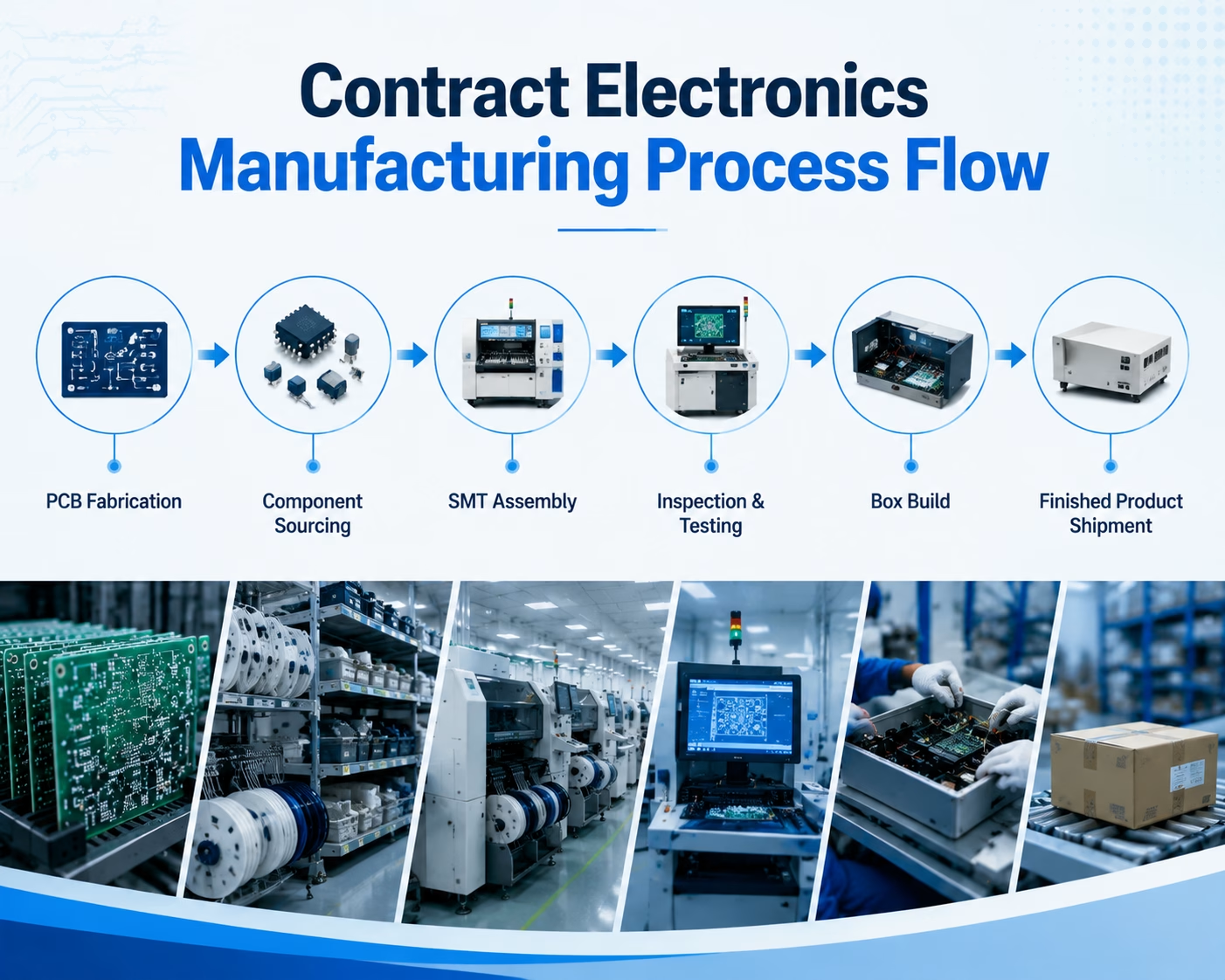
A contract manufacturer’s service list maps to the production lifecycle. Here is what a full-service partner typically covers, and where each stage adds or removes risk for you.
PCB assembly
The core service: placing and soldering components onto bare boards using SMT lines, through-hole lines, or a mix. Assembly acceptance criteria are governed by IPC-A-610 (current revision J, published March 2024) for the visual and mechanical acceptability of the finished assembly, and by J-STD-001 (also revision J, March 2024) for the soldering process requirements. These are separate documents covering separate stages—a common source of confusion when an OEM asks for “IPC compliance” without specifying which standard.
Component sourcing and supply chain management
Under a turnkey model, the contract manufacturer buys the components. The reliability implications are larger than most OEMs assume: a manufacturer that sources only from authorized/franchised distributors gives you traceability back to the original component maker, while one that buys from brokers exposes you to counterfeit and substandard parts. Your contract should state the sourcing policy explicitly.
Testing and quality control
Mature contract manufacturers run inspection at multiple stages—solder paste inspection (SPI) after printing, automated optical inspection (AOI) after placement and reflow, X-ray for hidden BGA/QFN joints, and in-circuit or functional test at the end. Ask which of these are standard in the price and which are add-ons; the difference between “AOI only” and “AOI + X-ray + ICT + functional test” is the difference between catching defects and shipping them.
Box build and system integration
Box build takes the assembled PCBAs and integrates them into the final product: enclosures, wiring harnesses, power supplies, displays, and final functional test of the complete unit. For OEMs selling a finished product rather than a bare board, this is where a single accountable partner (rather than three vendors pointing at each other) saves the most time.
NPI and design support
New product introduction is the bridge from engineering prototype to volume production: DFM review, test-fixture design, pilot builds, and process qualification. A manufacturer that gives substantive DFM feedback at the quoting stage—not just automated rule-checking—will save you a board respin or two before you ever commit tooling.
Turnkey vs. consignment: Which model fits your program?
This is the single most common decision OEMs get wrong, because the “right” answer flips depending on your stage and your team’s procurement muscle.
Turnkey and consignment shift cost, control, and risk in opposite directions.
| Turnkey | Consignment (kitted) | |
| Who buys components | Contract manufacturer | You (the OEM) |
| Component cost visibility | Lower day-to-day, markup on handling | Full control, direct supplier pricing |
| Administrative load | Low—one purchase order | High—you manage every supplier |
| Line-stop risk if parts are late | Manufacturer’s problem | Your problem |
| Best fit | Startups, low-volume, single-threaded teams | Established teams with strong procurement, or programs with special components |
Most OEMs with a full-time procurement team run a hybrid: consigning long-lead or hard-to-source active components (ASICs, custom connectors, specialized MCUs) while letting the contract manufacturer turnkey standard passives and commodity parts. That split keeps control where it pays off and offloads the commodity grind where it doesn’t.
📐 Engineering Note
A consignment decision often looks cheaper on paper and isn’t. When an OEM consigns every part, they own the full inventory cost, the incoming-inspection workload, and every line-stop caused by a late or damaged shipment. The break-even point is roughly where the OEM’s procurement team can manage component logistics at lower overhead than the manufacturer’s handling markup. If your team is fewer than one dedicated procurement person, full turnkey is usually the honest recommendation—on a recent low-volume medical program at OrinewPCB, a customer’s “cost-saving” consignment plan had stopped the line twice in a month on late connector shipments before we moved the commodity portion to turnkey and the schedule stabilized.
Which IPC standards and certifications actually matter?
The standards that govern your assembly
Three standard families cover the three production stages, and they are not interchangeable:
The three IPC/J-STD standard families map to three different production stages—naming the wrong one on a purchase order is a common, costly mix-up.
| Standard | What it governs | Stage |
| IPC-6012 (Rev F, Oct 2023) | Bare-board quality and performance | After fabrication, before assembly |
| J-STD-001 (Rev J, Mar 2024) | Soldering process requirements | During assembly |
| IPC-A-610 (Rev J, Mar 2024) | Acceptability of the finished assembly | Final inspection/acceptance |
IPC-7711/7721 (Rev D, Jan 2024) covers rework, modification, and repair—relevant when you need to decide whether a defect is reworkable or scrap. Saying your manufacturer is “IPC certified” without specifying which document tells you nothing; a manufacturer can hold IPC-A-610 certification and be irrelevant to your bare-board quality questions, which are governed by IPC-6012.
The certifications that gate your industry
Certifications are audited proof of process control, and the relevant one is industry-specific:
- ISO 9001— the baseline quality-management standard; any serious manufacturer holds it.
- ISO 13485— medical devices; required for OEMs shipping into healthcare, with traceability and risk-management (ISO 14971) expectations.
- IATF 16949— automotive; adds APQP, PPAP, and FMEA requirements on top of ISO 9001.
- AS9100D— aerospace and defense; adds counterfeit-part prevention and configuration management.
- ITAR/EAR— U.S. export control for defense articles; only relevant if your product is ITAR-controlled.
An OEM in medical devices should treat a manufacturer’s ISO 13485 as a hard gate; an automotive Tier 2 with IATF 16949 as a hard gate; a consumer-electronics program may reasonably accept ISO 9001 plus strong testing.
How to qualify a contract electronics manufacturer: The decision framework
When evaluating candidates, most OEMs compare price and lead time first. The manufacturers who make that comparison easy are not necessarily the ones who ship reliable product. Run candidates through these four filters in order; a “no” on an early filter ends the evaluation regardless of price. For an industry-specific version of this framework, our guide to choosing an EMS partner for industrial automation applies the same logic to factory-floor programs.
Filter 1: Technical capability fit
Does the manufacturer routinely build your board technology? Not “can we,” but “do they, every week”—layer count, pitch, material set, and box-build scope. Ask for a reference design in your technology class, not a generic capabilities page. A shop that mostly builds 2-layer consumer boards will price a 12-layer HDI quote differently than one that runs them daily, and the difference is risk, not just price.
Filter 2: Quality-system relevance
Match the certification to your industry (the list above). Then ask one specific question: what is your first-pass yield (FPY) on assemblies like mine, and what testing is standard in your quoted price? A manufacturer quoting AOI-only should say so; one quoting AOI + X-ray + ICT + functional test is priced accordingly, and for a program with any field-failure cost, that difference pays for itself many times over.
Filter 3: Volume-model match
Prototype-stage OEMs need a partner with low or no minimum order quantities and quick-turn lines; production-stage OEMs need predictable capacity. The worst mismatch is a startup signing with a high-volume EMS that deprioritizes a 50-unit pilot build behind its million-unit accounts. Ask directly how your order size fits their scheduling priority.
Filter 4: Sourcing and communication discipline
- Do they buy only from authorized distributors, and is that policy in writing?
- What happens when a BOM part is obsolete or out of stock—do they stop and get your sign-off on a substitution, or swap silently?
- Do they respond to engineering questions within a day during quoting? That response speed is a reliable predictor of production-phase responsiveness.
⚠️ Important
A silent substitution is the most dangerous single failure mode in a contract manufacturing relationship. The contract manufacturer’s incentive is to keep the line moving; the OEM’s incentive is a validated product. The contract must require written approval for any component substitution, and must define who carries liability if a substituted part fails in the field. One unapproved substitution can invalidate your regulatory certification or your warranty assumptions without a single failed board at the factory.
What should you expect for lead times?
Lead times break into two regimes, and the second one is where programs slip.
- Prototype builds:1–3 weeks from a complete, correct data package (Gerber/ODB++, centroid, BOM) with standard component availability.
- Production runs:4–8 weeks typical, depending on volume, component availability, and factory backlog.
- Long-lead components:the real schedule driver. Automotive-grade MCUs, specialized power-management ICs, and high-reliability MLCCs can still run 16–30 weeks on the open market even after the post-pandemic shortage cycle eased.
The practical implication: your contract manufacturer should be involved in BOM risk review before you finalize the design freeze, not after. A manufacturer that flags a 28-week part in your BOM at the quoting stage—and proposes a pin-compatible alternative or a forward-buy plan—is saving you a quarter of schedule. One that discovers it at line-start is costing you one.
Common mistakes OEMs make with contract manufacturing
Mistake 1: Choosing the model for the wrong reason
Picking consignment to “save the markup” without the procurement team to support it, or picking turnkey to “delegate everything” and losing visibility into component cost—both are model misuse. The model should follow your team’s actual capability, not a cost-accounting preference.
Mistake 2: Treating NRE as a one-time cost
Non-recurring engineering (NRE) covers stencils, feeder setup, test-fixture design, and process qualification. It is not lifetime tooling: change the layout after NRE and you pay again for new stencils and re-qualification. Budget for it as a per-revision cost, not a one-time line item.
Mistake 3: Not reading the data package as the contract
Your Gerber files, centroid data, and BOM are the manufacturing contract. Missing files, unverified centroid coordinates, or ambiguous polarity markings on silkscreen are the most common cause of engineering holds and scrapped boards—not the manufacturer’s equipment. A DFM review before release catches these at zero cost; discovering them at line-start costs a respin.
📐 Engineering Note
On a recent prototype-to-production transition at OrinewPCB, our DFM review flagged that a customer’s BOM specified a 28-week-lead MCU while the rest of the design could have shipped in three—the program would have stalled waiting for a single component. We proposed a pin-compatible authorized alternative with identical firmware behavior and the customer approved the substitution in writing. The first production batch shipped six weeks earlier than the original plan. This is the kind of catch that has no line item in a quote but is the entire value of a contract manufacturer that reviews your BOM, not just your Gerbers.
How much does contract manufacturing cost?
There is no honest single number, and any article that gives you one is guessing. What you can plan around are the four cost drivers:
- Volume.Per-unit cost falls steeply from prototype to production as NRE and setup amortize. A 50-unit build might carry 3–5× the per-unit cost of a 5,000-unit build—directional, since every program differs.
- Component cost.Under turnkey, components are typically 50–70% of total program cost—a directional estimate based on typical low-to-mid-volume programs across the industry, not an audited average. That is why sourcing discipline and authorized-distributor policy matter more than assembly labor rates.
- Testing depth.AOI-only vs. AOI + X-ray + ICT + functional test can add meaningfully to per-unit cost—and is the most common place quotes “look cheap.”
- Data-package quality.A clean, complete data package is free; a package that needs engineering holds and respins is expensive in schedule and NRE.
📐 Engineering Note
A useful budgeting rule of thumb: for a turnkey low-to-mid-volume run (100–5,000 units), expect component cost to dominate the quote, assembly labor and testing to form the next tier, and NRE/tooling to be a smaller line item that amortizes away at higher volume. Treat any quote that is dramatically cheaper than its peers with suspicion—the difference usually lives in testing depth, sourcing policy, or an MOQ hidden in the fine print. For a detailed breakdown of the cost drivers in PCB outsourcing, see our guide to how much it costs to outsource PCBA manufacturing.
Need a Contract PCB Assembly Partner?
Send your Gerber or ODB++ files, BOM, CPL/centroid data, assembly drawings and test requirements. Our team will review the package and help determine whether consigned, partial-turnkey or full-turnkey assembly fits your program.
Frequently Asked Questions
Q: What is the difference between a contract manufacturer and an EMS provider?
The terms overlap heavily in practice. CEM (contract electronics manufacturing) traditionally describes build-to-print manufacturing to the OEM’s files; EMS (electronics manufacturing services) is the broader package that adds supply-chain management, design-for-manufacturability support, NPI, and after-sales services. Most modern manufacturers describe themselves as EMS providers because they offer the full package.
Q: What is the difference between turnkey and consignment manufacturing?
In turnkey manufacturing, the contract manufacturer sources and buys all components; in consignment (kitted) manufacturing, the OEM buys and ships the components, and the manufacturer provides labor, equipment, and process only. Turnkey minimizes your administrative load but adds a handling markup; consignment maximizes your component-cost control but makes you own line-stop risk.
Q: How do I choose a contract electronics manufacturer?
Run candidates through four filters in order: technical capability fit (do they routinely build your board technology), quality-system relevance (current, industry-appropriate certification with a named registrar), volume-model match (does their MOQ and scheduling priority fit your stage), and sourcing/communication discipline (authorized-distributor policy, substitution sign-off, response speed).
Q: What certifications should a contract electronics manufacturer have?
The baseline is ISO 9001. Industry-specific: ISO 13485 for medical, IATF 16949 for automotive, AS9100D for aerospace, ITAR registration for U.S. defense work. Verify the certificate is current and issued by an accredited registrar, and match it to your industry rather than collecting a generic list.
Q: What IPC standards apply to contract electronics manufacturing?
IPC-6012F covers bare-board quality (after fabrication), J-STD-001J covers soldering process (during assembly), IPC-A-610J covers acceptability of the finished assembly (final acceptance), and IPC-7711/7721D covers rework and repair. They are separate standard families for separate stages—specify which one you mean when you ask for “IPC compliance.”
Q: Can contract manufacturing handle low-volume or prototype production?
Yes, but only if the manufacturer’s volume model supports it. Look for a partner with no minimum order quantity and quick-turn lines that treats a 50-unit pilot with the same engineering rigor as production. High-volume EMS providers sometimes deprioritize small builds—ask about scheduling priority directly.
Useful Resources
Industry Standards
- IPC-A-610J — Acceptability of Electronic Assemblies (published March 2024)
- J-STD-001J — Requirements for Soldered Electrical and Electronic Assemblies (March 2024)
- IPC-6012F — Qualification and Performance Specification for Rigid Printed Boards (October 2023)
- IPC-7711/7721D — Rework, Modification, and Repair of Electronic Assemblies (January 2024)
Design Tools
- Free DFM/DFA review with every OrinewPCB quote request
- Gerber/ODB++ file validation before production commitment
- BOM risk review and substitution sign-off as standard pre-production steps
References & Sources
- Electronics Manufacturing Services Market Size (2025)— Mordor Intelligence; global EMS market estimate, $620.16 billion (2025). Market-research estimate—directional, not audited.
- Electronics Manufacturing Services Market Report— Fortune Business Insights; $650.77 billion (2025) valuation. Market-research estimate—directional, not audited.
- IPC Releases J-Revisions of Two Leading Standards for Electronics Assembly (J-STD-001 / IPC-A-610)— IPC/Global Electronics Association; confirms J-STD-001J and IPC-A-610J (March 2024).
- IPC Standards Revision Table— Global Electronics Association; confirms current revisions of IPC-6012 (Rev F) and IPC-7711/7721 (Rev D).
- ISO 13485: Medical Devices Quality Management— International Organization for Standardization; medical-device QMS requirements.
- IATF 16949: Automotive Quality Management— IATF Global Oversight; automotive QMS with APQP/PPAP/FMEA requirements.
- AS9100: Aerospace Quality Management— SAE ITC; aerospace and defense QMS standard.
Conclusion
Contract electronics manufacturing is not a single service—it is a set of decisions: build-to-print vs. design ownership, turnkey vs. consignment vs. hybrid, which standards govern your acceptance criteria, which certification gates your industry, and which volume model matches your stage. Get those decisions right and a contract manufacturer is the most efficient manufacturing asset you will ever rent. Get them wrong and the same relationship becomes the source of schedule slips, hidden costs, and field failures.
Get Quote Free