Low Volume PCB Assembly Cost: Cost Buckets and Hidden Costs
Low volume PCB assembly costs $10-$50 per board plus $150-$500 in setup fees. See the full line-item breakdown, the price-by-quantity curve, and hidden costs to budget for.
Get Your PCB Quote!
Table of Contents
- Быстрые функции
- Что означает малый объем производства для стоимости сборки печатных плат?
- Три категории затрат: НИОКР, спецификация материалов и трудозатраты.
- Реальный пример расчета стоимости мелкосерийной сборки печатных плат.
- Стоимость сборки печатных плат в малых объемах на каждом уровне тиража.
- Скрытые издержки в производстве печатных плат
- Готовые решения против услуг консигнатора: реальная разница в стоимости.
- США против Азии: какова реальная разница в ценах?
- Как снизить затраты на мелкосерийную сборку печатных плат без ущерба для качества?
- Стоимость тестирования при небольших объемах: зонд для измерения активности насекомых, а не ИКТ.
- Как получить точную смету (и какие вопросы задавать)
- Часто задаваемые вопросы
- Заключение
- Ссылки и источники
Table of Contents
- Быстрые функции
- Что означает малый объем производства для стоимости сборки печатных плат?
- Три категории затрат: НИОКР, спецификация материалов и трудозатраты.
- Реальный пример расчета стоимости мелкосерийной сборки печатных плат.
- Стоимость сборки печатных плат в малых объемах на каждом уровне тиража.
- Скрытые издержки в производстве печатных плат
- Готовые решения против услуг консигнатора: реальная разница в стоимости.
- США против Азии: какова реальная разница в ценах?
- Как снизить затраты на мелкосерийную сборку печатных плат без ущерба для качества?
- Стоимость тестирования при небольших объемах: зонд для измерения активности насекомых, а не ИКТ.
- Как получить точную смету (и какие вопросы задавать)
- Часто задаваемые вопросы
- Заключение
- Ссылки и источники
Quick Specs
| Typical per-board cost (2-4 layer board) | $10-$50 |
| One-time setup (NRE) fees | $150-$500 |
| BOM share of total assembly cost | 60-70% |
| Turnkey cheaper than consigned below | ~250 boards |
| Flying probe cheaper than ICT fixture below | ~500 boards |
| Dominant cost driver below 100 boards | NRE (setup) amortization |
Low-volume PCB assembly typically costs $10 to $50 per board for a standard 2-to-4-layer design, plus $150 to $500 in one-time setup (NRE) fees—and at quantities under 100 boards, those fixed fees, not the board itself, are what quietly drive your price up. This guide walks you through a real line-item cost breakdown, a per-board price curve from 5 to 1,000 units, and the hidden charges most budgets miss, so you can estimate your all-in cost before you send your first quote request.
Key Takeaways
- Low-volume assembly (roughly 10 to 500 boards) costs about $10 to $50 per board for standard designs, plus $150 to $500 in one-time setup fees.
- Setup/NRE fees are the dominant hidden cost at low volume: a single $600 setup fee adds $120 per board at 5 units but only $1.20 per board at 500 units.
- Components (the BOM) typically account for 60-70% of assembly cost, so BOM consolidation and in-stock part selection save more than most design changes.
- Below about 250 boards, turnkey sourcing is usually cheaper and faster than consigned parts; below about 500 boards, flying probe test beats an ICT fixture.
- Your price is set by quantity tier, board complexity, NRE, and testing strategy—not by a single rate card. Get a line-item quote before you budget.
What low volume means for your PCB assembly cost
“Low volume” is not one price band. Most contract manufacturers recognize three tiers, and each one changes your cost logic because fixed setup fees spread across a different number of boards.
| Volume tier | Typical quantity | Primary goal | Cost sensitivity |
| Prototype | 1 to 10 boards | Design validation | Lowest—speed matters more than price |
| Pilot / small batch | 11 to 50 boards | Pre-production validation | Cost starts to matter |
| Short-run production | 51 to 250 boards | Early commercial units | DFM directly affects your margin |
Below 50 boards, the per-unit price is dominated by fixed setup costs, so comparing two quotes on “price per board” alone is misleading—you have to look at total landed cost. This is the single most important framing for reading any low-volume quote.
The people buying at this tier are mostly hardware startups validating a first design, IoT teams running regional pilots, R&D groups building test instrumentation, and industrial OEMs producing specialty equipment in limited quantities. What they all share is that they need speed and flexibility more than line-optimized throughput—and they get quoted differently from a 50,000-unit program.
The three cost buckets: NRE, BOM, and labor
Every low-volume assembly quote breaks into three buckets. Understanding which bucket your money lands in tells you where to negotiate and where to cut.
Non-Recurring Engineering (NRE): the fixed costs that hit small batches hardest
NRE covers one-time setup work that happens regardless of how many boards you order. The common line items:
| NRE item | Typical range | When it repeats |
| Solder paste stencil | $30 to $80 (standard laser-cut; specialty or step stencils to ~$300) | Every board revision |
| SMT programming | $50 to $150 | Every board revision (minor changes often waived) |
| First-article inspection (FAI) | $50 to $200 | Every order |
| Panel tooling (if panelized) | $50 to $200 | Every new panel layout |
A major Asian prototype assembly platform publishes a concrete example: a $50 setup fee plus a $15.72 standard stencil comes to $65.72 in NRE, which is $1.31 per board on a 50-board run and effectively zero ($0.0013 per board) on a 50,000-board run. By contrast, a US-based contract manufacturer’s 2026 guide reports NRE of $600 to $1,750 per job for domestic assembly—the same fixed-cost logic, a much larger number, and the reason the amortization math matters more than the headline per-board rate.
📐 Engineering Note
Amortization is the whole game at low volume. A $600 setup fee adds $120 per board at 5 units, $12 per board at 50 units, and $1.20 per board at 500 units. Going from 5 to 50 units can cut your per-board cost by 40-70% with no design change at all—simply because the fixed cost spreads further.
The bill of materials (BOM): the biggest slice
Components typically account for 60-70% of total assembly cost, according to a cost-reduction analysis from a PCB assembly provider. At low volume this share is even more important, because you rarely get volume price breaks: distributors sell full reels of 1,000 to 5,000 parts, and a 100-board build might need only 200 capacitors, so you either pay a cut-tape premium for the small quantity or buy a full reel you will not use.
Assembly labor and testing: the variable slice
Placement and soldering labor, plus whatever testing you specify, is the remaining 30-40%. This scales with component count and board complexity more than with order size. It is also the slice where a bad panel layout or a hard-to-place package silently adds cost.
A real low-volume PCB assembly cost example
Let us put the buckets together for a concrete, common design: a 4-layer board with about 100 placed components and one BGA, standard 1.6mm thickness with an ENIG finish. The ranges below come from the published pricing tables referenced throughout this guide, not from a single quote.
| Line item | 50 boards | 250 boards |
| Stencil (one-time) | $30-$80 | $30-$80 |
| SMT programming (one-time) | $50-$150 | $50-$150 |
| First-article inspection (one-time) | $50-$200 | $50-$200 |
| NRE subtotal | $130-$430 | $130-$430 |
| NRE per board | $2.60-$8.60 | $0.52-$1.72 |
| Fab + BOM + assembly + test (per board) | $55-$85 | $45-$75 |
| Total per board (NRE included) | $58-$94 | $46-$77 |
Two things stand out. First, the NRE subtotal is identical at 50 and 250 boards—it does not get cheaper because you ordered more, it just spreads thinner. Second, the per-board fab/BOM/assembly figure drops at higher quantity, but the NRE amortization is the larger swing at this tier: it falls by roughly 80% between the two columns while the variable cost drops by only 10-20%.
This is why two vendors quoting the same board can be $40 apart on paper while landing within a few dollars all-in: one quotes NRE separately, the other buries it in the per-board price. Always ask for the line-item breakdown, not the summary number.
Low-volume PCB assembly cost per board across every quantity tier
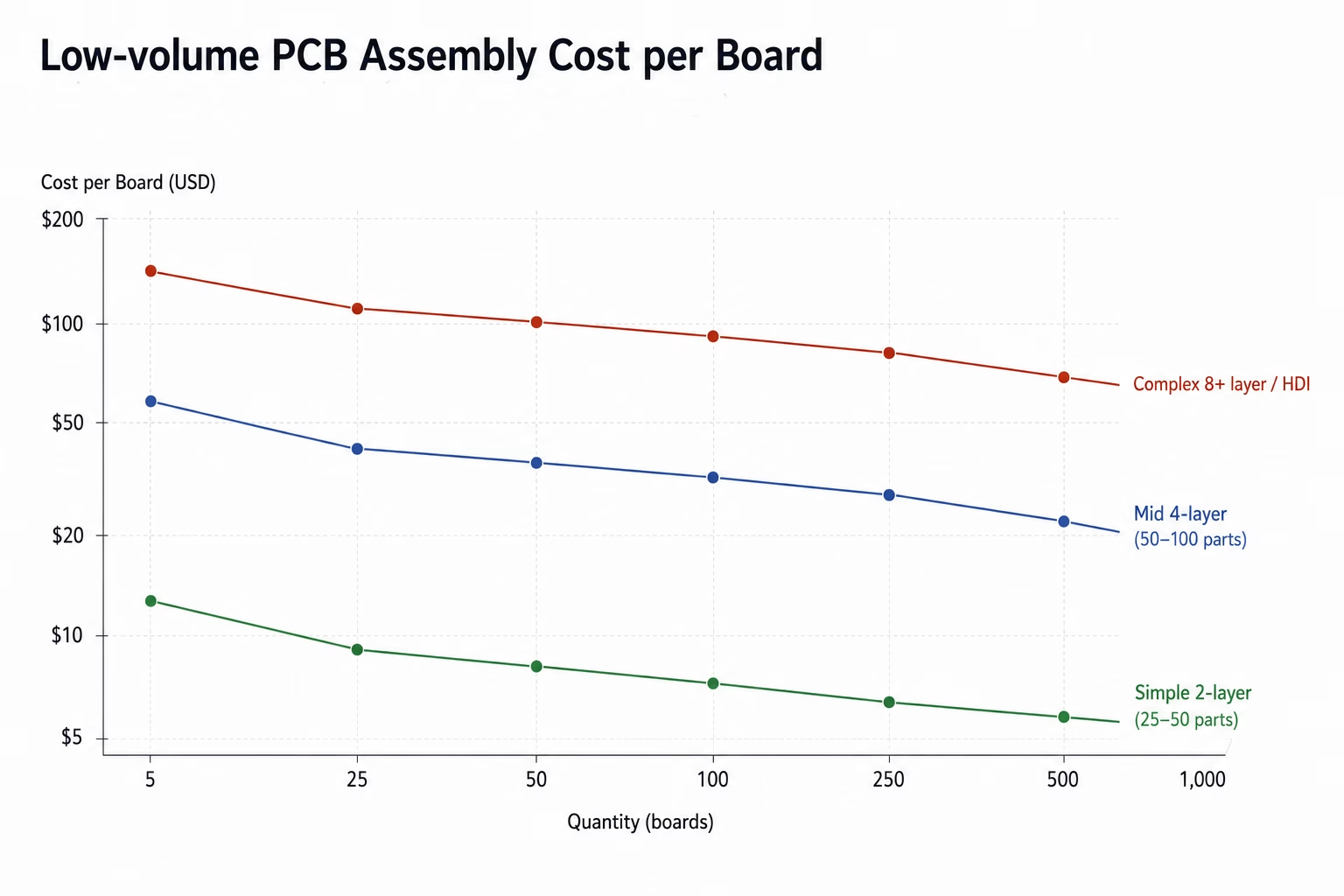
Here is how the per-board price moves as quantity climbs, for three levels of board complexity. These are 2026 market ranges assembled from multiple published sources and should be read as directional, not a rate card—your board’s layer count, component mix, and surface finish will shift them. Every figure is an all-in per-board price with setup (NRE) amortized across the run, matching the line-item example above.
| Quantity | Simple 2-layer (25-50 parts) | Mid 4-layer (50-100 parts) | Complex 8+ layer / HDI |
| 5 boards | $20-$80 | $60-$120 | $150+ |
| 25 boards | $12-$40 | $45-$90 | $120-$200 |
| 50 boards | $10-$35 | $40-$80 | $100-$180 |
| 100 boards | $8-$25 | $35-$70 | $90-$160 |
| 250 boards | $6-$20 | $30-$60 | $80-$150 |
| 500 boards | $5-$15 | $25-$55 | $70-$130 |
| 1,000 boards | $4-$12 | $20-$45 | $60-$120 |
The curve has a clear shape: the steepest drop happens between 5 and 100 boards, where NRE amortization is doing most of the work. After 250 boards the curve flattens, and further savings come from component price breaks and line efficiency, not from spreading setup fees. A useful real-world benchmark from a US contract manufacturer’s guide: a wearable-device board at about $100 per board at 5 units drops to roughly $35 per board at 100 units—a vendor-reported figure, but it matches the curve above.
One warning that applies at every tier: 8-layer or HDI boards do not follow the same curve. They carry a premium at low volume because their tooling and yield are inherently more expensive, so the ranges above should be treated as a floor, not a ceiling. For a deeper look at how costs shift once you scale past this tier, see our high-volume PCB manufacturing cost guide.
Hidden costs in PCB manufacturing
Three of the usual suspects—stencil, SMT programming, and first-article inspection—are already itemized in the NRE table above; the list below covers the hidden costs that appear even when those are quoted honestly.
- Cut-tape and distributor MOQ premiums.Buying 200 capacitors from a 5,000-part reel means you pay for the whole reel or a per-part cut-tape markup. This is the most under-appreciated low-volume cost.
- Board revision rework.Every revision usually means a new stencil and reprogramming—and possibly scrapped boards from the prior revision. Budget for at least one revision cycle.
- Freight and tariffs.Offshore assembly adds international shipping plus customs clearance; domestic adds courier costs on quick turns. Neither shows up in the “per board” figure.
- Testing fixtures.If you are quoted an in-circuit test (ICT) fixture, that is a one-time $200 to $1,500 (or much more for production-grade fixtures). Below 500 boards it usually is not worth it.
- Rework and scrap yield.A small run has no volume to absorb a single process error. One bad board in 25 is 4% scrap; one in 5,000 is noise.
- Payment and currency.Offshore quotes in USD with wire fees and exchange-rate movement between quote and invoice can shift your landed cost by a few percent.
In our DFM reviews at OrinewPCB, the most common budget-breaking surprise we flag is not a hidden fee—it is a BOM with a single non-stocked or single-sourced part. That one line item can add 8 to 12 weeks of lead time and a full-reel purchase, which is why we check every BOM against our in-stock library before we quote a low-volume order.
Turnkey vs consigned: the real cost difference
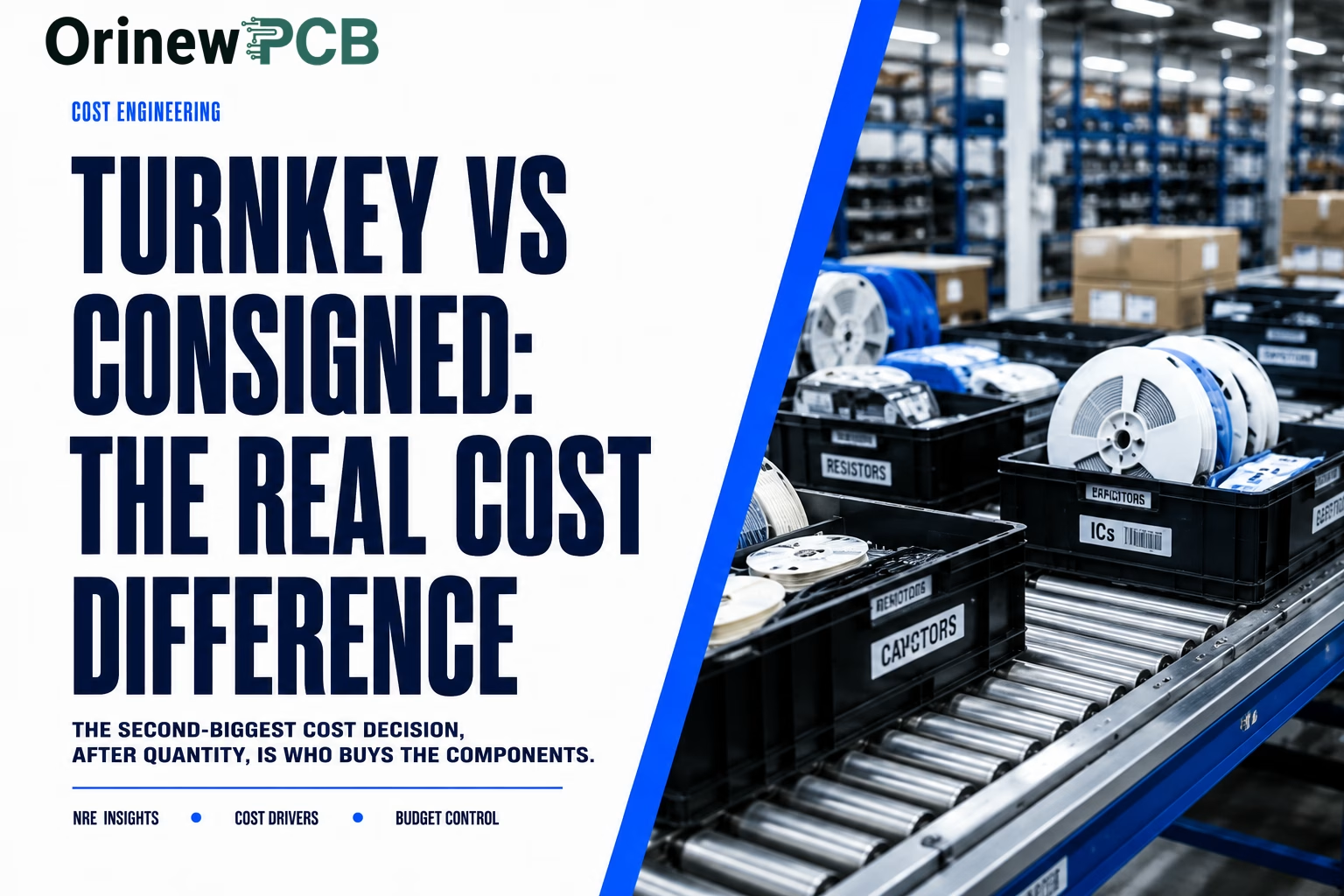
The second-biggest cost decision, after quantity, is who buys the components.
Turnkey means the assembler sources everything and bills you one invoice. At low volume this is almost always the more efficient model, because the assembler pools demand across many customers and can pull from its in-stock library instead of paying cut-tape premiums on every part. The trade-off is markup: industry sourcing markups on the BOM run anywhere from 5% to 100%, per one small-run assembler’s published breakdown, so a turnkey quote can carry a premium you cannot see line by line.
Consigned means you buy and ship the parts yourself. It eliminates the markup and makes sense when you have proprietary, long-lead, or already-negotiated components. But it hands component quality control, kitting accuracy, and shortage risk back to you—and at low volume, managing partial reels and distributor MOQs yourself usually costs more in time than the markup you save.
The practical rule: below about 250 boards, use turnkey unless you have a specific part you must control. Above that, consigning high-value parts and letting the assembler source passives (a hybrid) starts to pay. Ask any assembler for their BOM markup range in writing before you compare a turnkey quote against a consigned one—this is the number that explains most “cheaper” consigned quotes.
US vs Asia: what the price gap actually is
The offshore-versus-domestic decision is real, but it is usually quoted backwards. The gap is mostly in NRE and labor, not in the bare board or the components.
A US contract manufacturer’s 2026 guide puts the honest numbers in one place: an offshore assembler can deliver 30 boards for roughly $750 all-in, including shipping and tariffs—about $25 per board—while a domestic shop can run $300 or more per board for a single unit. The spread is widest at the smallest quantities and narrows as volume climbs and labor amortizes.
But the landed cost includes time, not just money. Offshore assembly runs 5 to 10 business days, plus 4 to 7 days of shipping and 1 to 7 days of customs—so the fastest realistic door-to-door is 6 to 10 days and two weeks is common. Domestic quick-turn can deliver fully assembled boards in 24 to 72 hours when parts are in stock. If your program has any deadline under five days, domestic is the only option.
Choose offshore when unit cost dominates and a 10-plus-day timeline is acceptable. Choose domestic when IP protection, supply-chain visibility, tariff complexity, or a hard deadline outweighs the price gap. Neither is universally cheaper—the right answer depends on your program’s constraints, and a shop that only offers one of the two cannot give you an honest comparison.
How to cut low-volume PCB assembly cost without hurting quality
Cost reduction at low volume is not about haggling—it is about shrinking the NRE and BOM buckets and keeping every quality gate intact. Here is a decision matrix that shows what each change is actually worth and when it is worth the engineering time.
| Change | Typical saving | The trade-off | When it is worth it |
| Reduce a layer (for example, 4-layer to 2-layer) | 20-30% on fabrication | Routing and EMI rework | Early in design, before layout lock |
| Panelize multiple boards per panel | 15-30% on assembly | Panel tooling and design rules | Any run over ~25 boards |
| Use manufacturer in-stock parts | Avoids cut-tape/full-reel premiums | May constrain part choice | Always, before finalizing the BOM |
| Consolidate BOM part numbers | Fewer reels, less setup | Minor redesign | When you have many near-duplicate values |
| Standardize footprints (for example, 0805 passives) | Fewer placement errors, less procurement | Board space | Early in design |
| Align polarized components one direction | ~15% placement time | Minor layout effort | Any design with many polarized parts |
| Use standard spec (1.6mm, 1 oz copper, green mask) | Avoids non-standard premiums | None for most designs | Always, unless the spec is required |
Two things in this table deserve emphasis. First, the biggest lever is not a design trick—it is the BOM, because that is 60-70% of your cost. Second, none of these touch your quality gates: AOI on every board and X-ray for BGA packages should stay in the quote no matter how aggressive your cost target is. Cutting inspection to save a few dollars per board is how a “cheap” low-volume run becomes an expensive recall. For a broader view of what drives assembly pricing across all volumes, see our breakdown of how much it costs to outsource PCBA manufacturing.
Testing costs at low volume: fly probe, not ICT
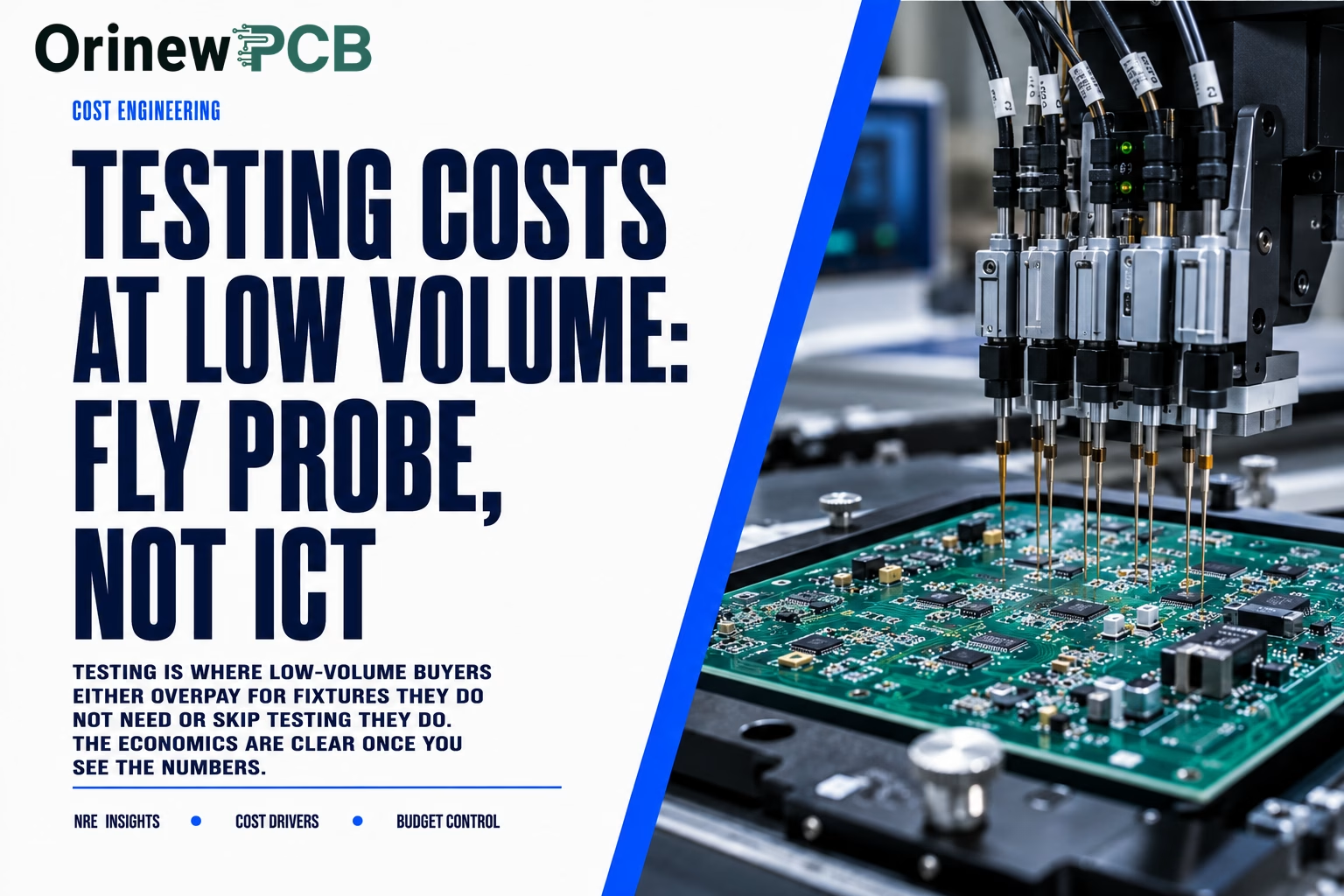
Testing is where low-volume buyers either overpay for fixtures they do not need or skip testing they do. The economics are clear once you see the numbers.
| Test method | Setup cost | Per-board cost | Best for |
| AOI (automated optical inspection) | $0 (included) | Minimal | Solder joints, missing parts, polarity—every board |
| X-ray | $0 | Minimal | BGA/QFN hidden solder joints—required if present |
| Flying probe | $50-$150 | $1-$5 | Opens, shorts, component values—no fixture |
| ICT (in-circuit test) | $200-$1,500 (simple) to $5,000-$20,000 (production-grade) | Under $0.50 | Volume production (500+ units) |
| Functional test | $200-$2,000 | $2-$10 | Verifying the board actually works |
The fixture range deserves a note, because sources disagree: a simple bed-of-nails fixture can run a few hundred to about $1,500, while a production-grade fixture with many test points runs $5,000 to $20,000. Both are real—they are different scopes of fixture—but neither makes sense below roughly 500 units, where a flying probe test achieves the same fault coverage with no fixture at all.
The rule that resolves the decision: under 500 boards, specify AOI on every board, X-ray for any BGA/QFN, and flying probe for electrical verification. Skip ICT. If the assembler defaults to an ICT fixture on a 100-board quote, that is a sign they are running you through a volume process you do not need.
How to get an accurate quote (and what to ask)
A low-volume quote is only as accurate as the files and questions you bring. Prepare these three things before you contact anyone:
- Gerber files(complete, with the drill file and a board outline)
- A clean BOMwith manufacturer part numbers, not just values (“GRM188R71C104KA01” not “0.1uF cap”)
- Centroid / pick-and-place fileso the assembler can program the line
Then ask these questions, in writing:
- Is NRE a one-time charge, and is it waived or re-billed if I revise the board?
- What is the BOM markup range, and do you use in-stock parts to avoid cut-tape premiums?
- Is AOI included on every board, and do you run X-ray on BGA/QFN packages at no extra cost?
- What is the lead time at my quantity, with and without component sourcing?
- What is your minimum order quantity, and where does a 25-board order sit in scheduling priority?
Red flags worth walking away from: “testing available at extra cost,” an auto-generated DFM report with no human review, a quote that refuses to separate NRE from per-board cost, and any shop that only has sales contacts and no engineering contact for design questions. The right vendor answers all five questions with specific numbers.
Need PCB Manufacturing or Assembly?
Get a free quote within 24 hours. We specialize in prototype-to-production PCB/PCBA for hardware teams worldwide.
Frequently Asked Questions
How much does low-volume PCB assembly cost per board?
Low-volume PCB assembly typically costs $10 to $50 per board for a standard 2-to-4-layer design, plus $150 to $500 in one-time setup (NRE) fees. The per-board figure depends mainly on quantity tier, layer count, component count, and testing requirements.
What counts as low-volume PCB assembly?
Low-volume generally means roughly 10 to 500 boards, usually split into three tiers: prototype (1 to 10 boards), pilot or small batch (11 to 50), and short-run production (51 to 250). Each tier has different lead-time, NRE, and testing expectations.
Why are setup fees so expensive at low volume?
Setup fees (stencil, SMT programming, first-article inspection) are fixed regardless of order size. On a 5-board run a $600 setup fee adds $120 per board; on a 500-board run it adds only $1.20 per board. The fee is not expensive—it is just concentrated across too few boards.
Is turnkey cheaper than consigned at low volume?
Below about 250 boards, turnkey is usually cheaper and faster, because the assembler pools demand and avoids cut-tape and full-reel premiums. Consigned sourcing saves on BOM markup but hands shortage and kitting risk back to you.
When does an ICT fixture become worth it?
An in-circuit test fixture becomes cost-justified around 500 units or more. Below that, flying probe testing provides the same opens/shorts/component-value coverage with no fixture cost at $1 to $5 per board.
Conclusion
Low-volume PCB assembly is not a stopover on the way to mass production—it is its own cost problem, and the number that matters is not “per board” but total landed cost. Budget $10 to $50 per board plus $150 to $500 in setup fees for a standard design, remember that NRE is the dominant cost below 100 boards, and keep your quality gates intact while you cut from the BOM and NRE buckets instead. Use turnkey sourcing under 250 boards, flying probe instead of ICT under 500 boards, and get a line-item quote before you commit a budget number.
At OrinewPCB, we build low-volume orders on the same lines and quality system we use for production—free DFM review, an in-stock component library that avoids cut-tape premiums, and no minimum order quantity. If you are planning a small-batch build, send your Gerber files and BOM and we will return a line-item quote you can actually budget against.
References & Sources
All figures below are market ranges assembled in 2026 from the published sources listed. Where a number is a single company’s self-reported pricing or a directional estimate rather than an audited figure, it is labeled as such in the article text above.
- Low-volume PCB assembly: costs, lead times and partner tips— a US contract manufacturer’s 2026 guide; source of the $600-$1,750 NRE range, the $600 setup amortization example, the wearable-device benchmark, and the $750-for-30-boards offshore figure (vendor-reported).
- Low-volume PCB assembly for startups and prototyping—a prototype assembly platform’s published NRE example ($50 setup + $15.72 stencil) and its amortization table (vendor-reported).
- How much does PCB assembly cost— source of the $10-$50 per board and $150-$500 setup ranges (vendor-reported).
- PCBA cost breakdown: what actually drives your assembly price— source of the prototype-to-production per-board curve ($100-$500 prototype to $5-$20 at 1,000 units).
- Cost factors in small-run PCB assembly projects— source of the 5-100% BOM markup range and stencil pricing (vendor-reported).
- How to reduce PCB assembly costs without compromising quality— source of the 60-70% BOM share figure.
Get Quote Free