Top 10 HDI PCB Manufacturers: A 2026 RFQ Shortlist by Build Type
A researched shortlist of 10 HDI PCB manufacturers, grouped by volume and build type, plus the microvia reliability checks and RFQ package to use before you compare quotes.
Get Your PCB Quote!
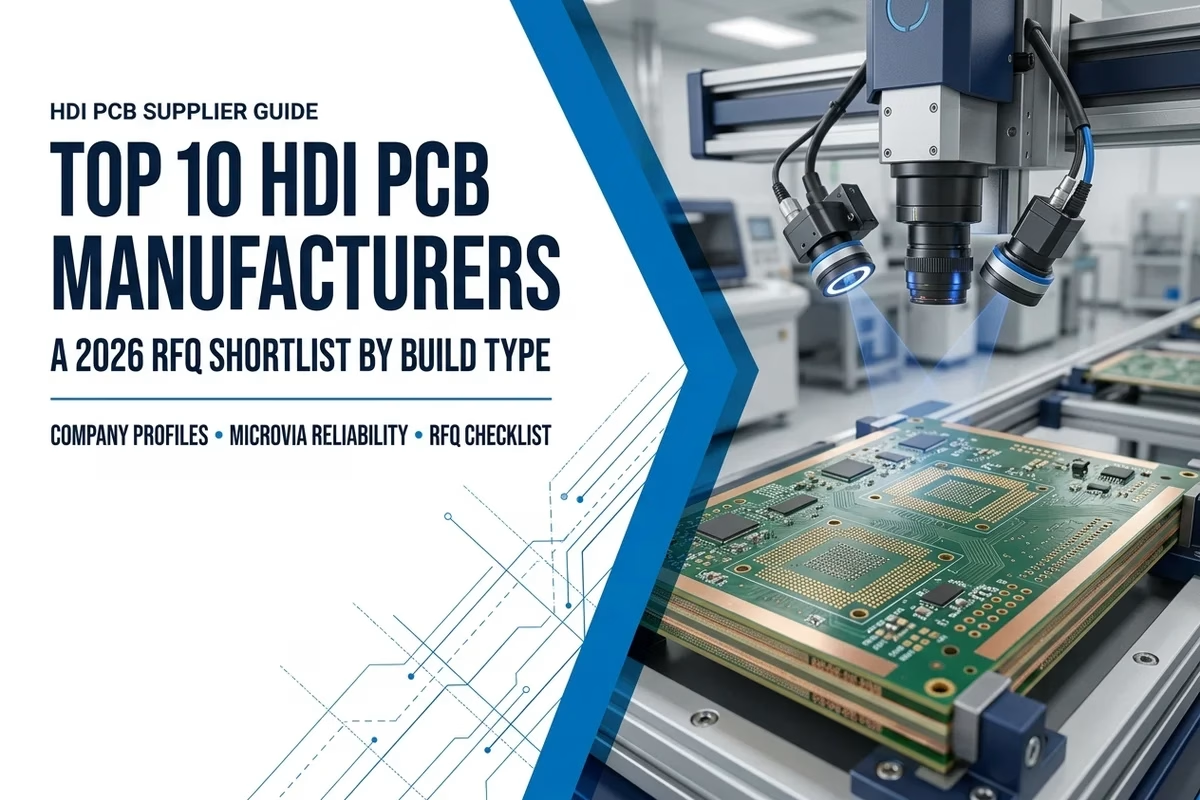
Table of Contents
Table of Contents
This guide lists 10 HDI PCB manufacturers that publish verifiable HDI capability, grouped by the kind of project each one is set up to handle. It is a research shortlist for building an RFQ list, not a performance or market-share ranking. OrinewPCB is listed first because this list is published by OrinewPCB; the remaining companies are presented in alphabetical order within each group.
Choosing an HDI supplier depends less on brand size than on three variables. They are the HDI structure you need (1+N+1, stacked microvias or any-layer), your volume, and the microvia reliability evidence a fabricator can show. Below you will find a summary table, a profile of each company, a build-to-supplier matching table, and an RFQ checklist for comparing quotes on the same board.
Quick Takeaways
- Prototype and low-volume HDI work usually fits a regional or quick-turn specialist; phone, server and automotive platforms usually go to a high-volume group.
- Define the build first: the smallest BGA pitch and the via structure decide which suppliers can quote at all.
- Ask every supplier for reflow-simulation reliability data on stacked microvias; IPC warned in 2019 that routine lot acceptance can miss these failures.
- Send all suppliers one identical RFQ package, or the quotes will describe different boards.
How We Selected These HDI PCB Manufacturers
Each company on this list met four checkable criteria in October 2026. A typical reader is a hardware engineer or sourcing lead who needs three to five credible names before releasing an HDI RFQ. The criteria therefore focus on what can be confirmed from public documents.
- Published HDI capability. The company’s own website describes HDI processes such as laser-drilled microvias, sequential lamination, stacked or staggered vias, or any-layer construction.
- Identifiable operations. Company documents or investor filings show a headquarters location, at least one production site and a founding year, or state that the year is not published.
- Current activity. The HDI product pages were live and reachable when we reviewed them.
- Distinct fit. Each company serves a recognizable segment: quick-turn prototypes, regional defense or industrial programs, or high-volume consumer and automotive platforms.
Candidates came from Google results for HDI supplier lists, company websites, annual and sustainability reports, and stock-exchange disclosures. We did not test boards, audit factories or collect price quotes, so nothing here ranks quality or cost. Capability figures are each company’s own published claims, and the profiles say so where it matters.
HDI PCB Manufacturers at a Glance
The list splits into four specialists for prototypes and regional programs and six groups built for high-volume HDI.
| No. | Company | Founded | Headquarters | Primary fit |
|---|---|---|---|---|
| 1 | OrinewPCB | 2011 | Shenzhen, China | HDI prototypes to mid-volume, with in-house assembly |
| 2 | Sierra Circuits | 1986 | Sunnyvale, California, USA | Quick-turn HDI prototypes in the US |
| 3 | Summit Interconnect | 2016 | Irvine, California, USA | US aerospace, defense and medical HDI |
| 4 | Würth Elektronik Circuit Board Technology | 1971 (PCB production) | Niedernhall, Germany | European industrial and automotive HDI |
| 5 | AT&S | 1987 | Leoben, Austria | HDI, any-layer and IC substrates from Europe and Asia |
| 6 | Compeq Manufacturing | 1973 | Taoyuan, Taiwan | High-volume any-layer HDI and rigid-flex |
| 7 | Kinwong Electronic | 1993 | Shenzhen, China | Volume HDI and substrate-like PCB in China |
| 8 | TTM Technologies | 1998 | Santa Ana, California, USA | Volume HDI plus US defense ultra-HDI |
| 9 | Unimicron Technology | 1990 | Taoyuan, Taiwan | Mobile HDI and IC carriers at scale |
| 10 | Zhen Ding Tech. Group | 2006 | Taoyuan, Taiwan | High-volume consumer and mobile HDI |
Prototype, Low-Volume and Regional HDI Specialists
Start with this group if you are in NPI, need fewer than a few thousand boards, or must keep fabrication in a specific region. These companies publish HDI rules aimed at engineers and accept small first orders, which matters when the stack-up is still changing between revisions.
1. OrinewPCB
Founded / Headquarters: 2011 · Shenzhen, China
Company introduction: Founded in 2011, OrinewPCB is a Shenzhen-based PCB fabrication and assembly company. It provides HDI, multilayer and rigid-flex PCBs with in-house assembly, supporting projects from prototypes to mid-volume production.
Main products: HDI rigid boards, HDI rigid-flex and flex circuits, multilayer PCBs and PCB assembly.
Key advantages:
- According to its HDI page, OrinewPCB builds 1+N+1 through 8+N+8 structures and any-layer HDI up to 18 layers, using UV laser drilling and up to four lamination cycles.
- The company reports stacked, staggered, step and skip microvias, with order quantities from 1 piece to more than 10,000 pieces.
- It states IPC-6012 Class 2 and Class 3 builds and lists AOI, X-ray, electrical test, microsection and TDR impedance testing.
Purchasing considerations: The HDI page states different minimum microvia diameters in different sections, so confirm the drill and capture-pad rule for your stack-up in writing. Ask for a sample microsection report from a comparable build before you release volume.
Official website: pcbandassembly.com
2. Sierra Circuits
Founded / Headquarters: 1986 · Sunnyvale, California, USA
Company introduction: Sierra Circuits is a Silicon Valley PCB fabricator and assembler that focuses on quick-turn prototypes. The company reports a 70,000 sq ft facility in Sunnyvale.
Main products: Quick-turn and production PCBs, HDI boards, HDI flex and rigid-flex circuits, and PCB assembly.
Key advantages:
- Sierra Circuits states HDI capability with laser microvias, blind, buried and stacked vias, and via-in-pad.
- It lists boards from 1 to 30 layers on its capability pages.
- It publishes engineering design guides and an online quoting system aimed at prototype buyers.
Purchasing considerations: Ask which HDI structures are built in Sunnyvale and which, if any, are routed to partner factories. Confirm whether quick-turn lead times apply to stacked-microvia builds or only to simpler structures.
Official website: protoexpress.com
3. Summit Interconnect
Founded / Headquarters: 2016 · Irvine, California, USA
Company introduction: Summit Interconnect was formed in 2016 through the acquisition of KCA Electronics and Marcel Electronics and has since grown into a multi-site US fabricator. The company reports seven facilities.
Main products: HDI, rigid, rigid-flex and RF/microwave PCBs for aerospace, defense, medical and industrial customers.
Key advantages:
- Summit states HDI microvias, sequential lamination, via fill and back drilling.
- Its markets page names aerospace, defense and medical programs, which helps when a project needs US-based fabrication.
- Multiple facilities give buyers a choice of site for prototypes and production.
Purchasing considerations: Ask which facility will build your HDI design and whether the quoted site holds the registrations your program requires, such as ITAR. Confirm whether prototype and production lots run in the same plant.
Official website: summitinterconnect.com
4. Würth Elektronik Circuit Board Technology
Founded / Headquarters: 1971 (PCB production) · Niedernhall, Germany
Company introduction: Würth Elektronik Circuit Board Technology is the PCB division of the Würth Elektronik group. The company reports three PCB plants in Germany.
Main products: HDI microvia boards, rigid-flex and flex circuits, and multilayer PCBs.
Key advantages:
- Its MICROVIA.hdi range covers microvia and micro via-in-pad builds, according to the company.
- It publishes an HDI design rules poster with fan-out examples for 0.8 mm, 0.5 mm and 0.4 mm BGA pitches.
- Fabrication in Germany suits European programs that want short logistics and EU-based supply.
Purchasing considerations: Ask which German plant handles your HDI class and how many sequential laminations it supports. Request the design-rule document version that applies to your quote so the layout team works from the same limits.
Official website: we-online.com
Global High-Volume HDI Groups
Look at this group if your board goes into a phone, wearable, server, networking or automotive platform with annual volumes in the tens of thousands or more. These manufacturers run multiple HDI plants, build any-layer or substrate-like PCBs, and usually engage through a program manager rather than an online quote.
5. AT&S
Founded / Headquarters: 1987 · Leoben, Austria
Company introduction: AT&S (Austria Technologie & Systemtechnik) describes itself as a maker of high-end PCBs and IC substrates, with plants in Europe and Asia. Its headquarters and one production site are in Leoben.
Main products: HDI and any-layer PCBs, multilayer boards, embedded-component PCBs and IC substrates.
Key advantages:
- AT&S lists HDI up to 7-N-7 and any-layer up to 7-N-7 for its Leoben plant.
- The same site reports multilayer boards up to 28 layers and its ECP embedded-component technology.
- European and Asian plants allow a project to start in Austria and move to volume in Asia.
Purchasing considerations: Ask which plant will build volume production and whether the prototype site matches it. Check minimum order expectations early, because high-end groups often prioritize long-term programs.
Official website: ats.net
6. Compeq Manufacturing
Founded / Headquarters: 1973 · Taoyuan, Taiwan
Company introduction: Compeq was established in August 1973 in Luzhu, Taoyuan, and is a listed Taiwanese PCB maker. Its company profile names data center, wearable, camera-module and automotive applications.
Main products: Any-layer HDI, flex and rigid-flex boards, multilayer PCBs and substrate-like PCBs.
Key advantages:
- Compeq’s 2020 sustainability report describes any-layer HDI, copper fill and stacked vias.
- Its 2026 company profile lists substrate-like any-layer boards with 20/20 µm (about 0.8 mil) line and space made by mSAP.
- The same profile lists HDI, rigid, flex and rigid-flex boards plus SMT, so one supplier can cover several board types.
Purchasing considerations: Ask whether your expected volume meets the program threshold and which factory will run it. Confirm how engineering changes are handled once a high-volume line is set up.
Official website: compeq.com.tw
7. Kinwong Electronic
Founded / Headquarters: 1993 · Shenzhen, China
Company introduction: Kinwong is a Shanghai Stock Exchange–listed PCB maker (603228) founded in Shenzhen. The company reports seven production bases and 13 factories.
Main products: HDI and any-layer PCBs, substrate-like PCBs, multilayer, flex and metal-based boards.
Key advantages:
- Kinwong states HDI and any-layer capability, with its Zhuhai high-layer-count plant listed for 3+ HDI and substrate-like PCBs.
- It reports 10 offices with field application engineers, which supports design reviews close to the customer.
- A wide product range lets one supplier quote HDI alongside standard multilayer parts.
Purchasing considerations: Ask which of the 13 factories will build your HDI design and request that plant’s capability sheet. Confirm export documentation and logistics if you ship to the US or Europe.
Official website: kinwong.com
8. TTM Technologies
Founded / Headquarters: 1998 · Santa Ana, California, USA
Company introduction: TTM Technologies is a Nasdaq-listed PCB and RF component manufacturer with plants in North America and Asia. It serves aerospace and defense, data center, automotive and medical customers.
Main products: HDI and any-layer PCBs, rigid-flex, RF and microwave boards, and engineered RF components.
Key advantages:
- TTM’s HDI page describes stacked copper-filled microvias, any-layer HDI and its NextGen-SMV single-lamination process.
- It lists a microvia of 0.004 in (100 µm) on a 0.008 in (200 µm) pad and notes that 0.4 mm and finer BGA pitches need stacked microvias.
- The company reports a 215,000 sq ft ultra-HDI facility in Syracuse, New York, aimed at defense programs.
Purchasing considerations: Ask which plant will quote your board, because capability and registrations differ between US and Asian sites. Confirm whether a single-lamination option fits your reliability requirements.
Official website: ttm.com
9. Unimicron Technology
Founded / Headquarters: 1990 · Taoyuan, Taiwan
Company introduction: Unimicron was founded on January 25, 1990, and is listed on the Taiwan Stock Exchange (3037). It runs PCB, carrier and IC test business units.
Main products: HDI and notebook HDI PCBs, rigid-flex boards, automotive PCBs and IC carriers.
Key advantages:
- Unimicron describes itself as a major supplier of HDI PCBs and carriers for mobile phones.
- Separate PCB and carrier business units mean HDI boards and packaging substrates come from one group.
- Plants in Taiwan and mainland China support volume programs.
Purchasing considerations: Expect a program-level engagement with forecasts rather than spot prototype orders. Ask which business unit and site will own your part number.
Official website: unimicron.com
10. Zhen Ding Tech. Group
Founded / Headquarters: 2006 · Taoyuan, Taiwan
Company introduction: Zhen Ding Tech. Group (ZDT), formerly part of Foxconn Advanced Technology, is listed on the Taiwan Stock Exchange (4958). Its subsidiary Avary Holding is listed in Shenzhen (002938).
Main products: HDI and substrate-like PCBs, flexible circuits, rigid-flex boards and IC substrates.
Key advantages:
- ZDT lists HDI, flex and substrate-like PCB production for consumer electronics.
- Two public listings mean audited financial and operational disclosures are available for supplier risk review.
- Its roots in a contract-manufacturing group align it with high-volume phone and computing programs.
Purchasing considerations: ZDT is built for large consumer programs, so confirm early whether it will accept your volume. Ask which subsidiary and plant will build the board, since contracts may sit with Avary rather than the parent.
Official website: zdtco.com
Match Your HDI Build to the Right Type of Manufacturer
Your board’s structure narrows the list faster than any company profile. The smallest BGA pitch sets the via structure, and the via structure sets which suppliers can build it at your volume. IPC classifies these structures in IPC-2226A, its HDI design standard from 2017, which IPC now lists as no longer maintained.
A 1+N+1 board can go to most specialists, while any-layer and substrate-like builds usually need a high-volume group.
| HDI build | What matters most | Supplier type to shortlist | What to ask |
|---|---|---|---|
| 1+N+1, staggered microvias, 0.5 mm BGA | Laser drill registration, one sequential lamination | Prototype or regional specialist | Capture-pad size and drill-to-pad tolerance |
| 2+N+2 or 3+N+3, stacked microvias, 0.4 mm BGA | Copper fill quality, reliability data on stacks | Specialist with stacked-via data, or volume group | Reflow-simulation results on stacked coupons |
| Any-layer HDI, 0.3 mm BGA or finer | Every layer laser-drilled and filled | High-volume group | Lamination count, plant and yield history |
| Substrate-like PCB (SLP) | Very fine line and space, modified semi-additive process | Group with SLP or substrate lines | Line/space capability and plant certification |
| HDI rigid-flex | Microvias near flex transitions, material stack | Specialist or group with rigid-flex lines | Where microvias may sit relative to the bend |
A typical case is a wearable main board with a 0.4 mm-pitch BGA and a first build of 25 prototypes. TTM notes that BGAs at 0.4 mm and finer generally need stacked microvias, so a 2+N+2 stacked design is a realistic starting point. That build fits the specialist group for prototypes, but the buyer should confirm early that the same structure can transfer to a volume group if the product ships at scale.
Buyer Tip: Send the BGA pitch, layer count and via structure in the first email to every supplier. A fabricator that cannot build your structure can decline before preparing a quote, which saves a full quote cycle.
For background on the structures themselves, see this complete guide to HDI PCB design and the overview of blind, buried and microvia types.
Microvia Reliability: The Check Most HDI Shortlists Skip
Stacked microvias can pass every routine inspection and still fail during assembly. In March 2019, IPC issued an industry warning on printed board microvia reliability. The warning said failures at the interface between the microvia and its target pad often appear during reflow and stay hidden at room temperature. They have also occurred on boards that passed normal lot acceptance.
IPC also stated that a thermal-stress microsection examined under an optical microscope is not sufficient to find this weak interface. Its recommendation was performance-based testing, such as the thermal-stress method in IPC-TM-650 2.6.27 with resistance measured on coupons designed to IPC-2221B Appendix D. The warning was added to IPC-6012E, and the current IPC-6012F qualification and performance specification followed in 2023.
Stack height matters. A summary of IPC data by Altium on the IPC microvia warning reports that stacks of three or more microvias show these failures more often. Staggered microvias show little of the problem.
Important: A clean microsection report does not prove stacked-microvia reliability. For Class 3 products or stacks of three or more microvias, require reflow-simulation coupon data before you approve a supplier.
A typical case is an industrial controller with a three-high stacked microvia under a fine-pitch processor. Two suppliers might quote similar prices, but only one may be able to send IPC-TM-650 2.6.27 coupon results from a similar stack. The second supplier is not necessarily worse, yet without data the buyer carries the risk of latent failures that show up after assembly.
Checklist: Microvia reliability evidence to request
- [ ] Reflow-simulation coupon results (IPC-TM-650 2.6.27 or equivalent) for a stack height equal to or greater than yours
- [ ] Coupon design reference, such as IPC-2221B Appendix D, and the resistance-change pass criterion used
- [ ] The supplier’s rule on maximum stack height, and when it recommends staggering instead
- [ ] The via fill and cap method, for example filled and capped vias per IPC-4761 Type VII
Staggered microvias offset each layer; stacked microvias align in one column, where IPC flagged the target-pad interface as a weak point.
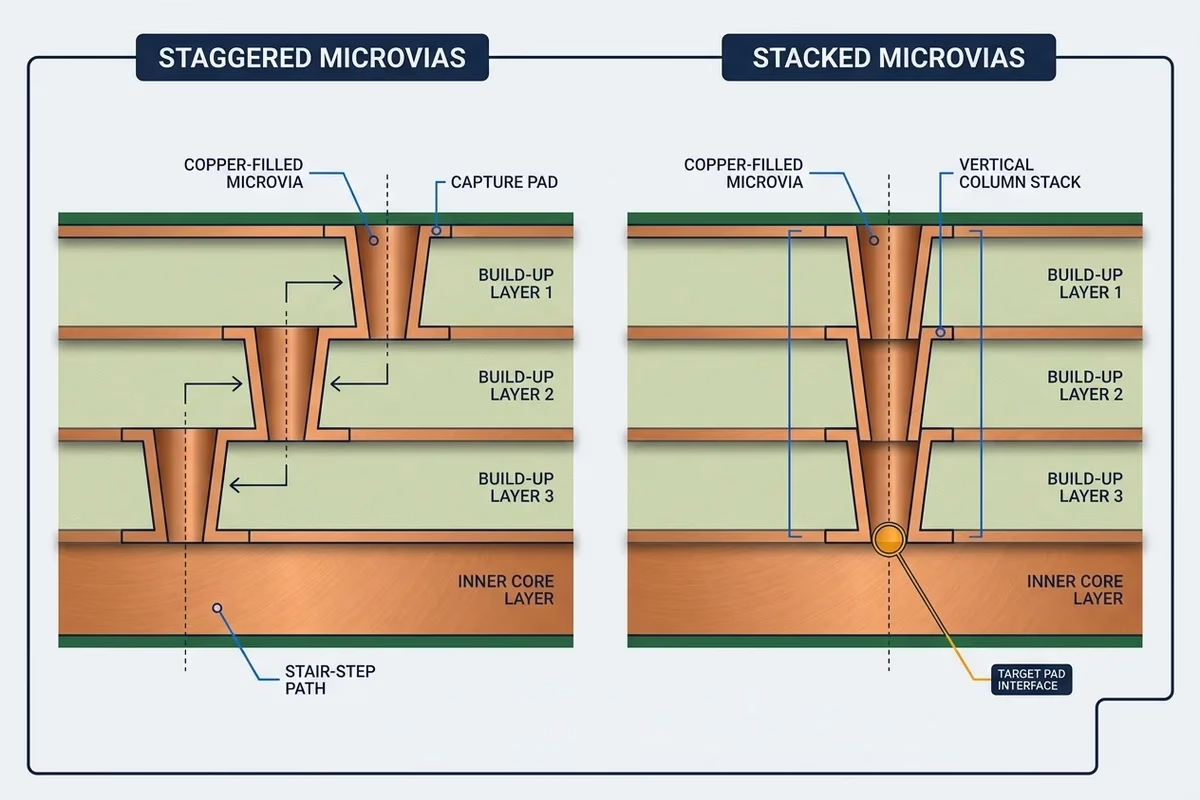
Staggered microvias offset each layer; stacked microvias align in one column, where IPC flagged the target-pad interface as a weak point.
How to Compare HDI Quotes Without Comparing Different Boards
HDI quotes are only comparable when every supplier prices the same stack-up. Cost on an HDI board comes mainly from sequential laminations, laser drilling and copper filling of microvias. A supplier that silently drops one lamination or switches from stacked to staggered vias can look cheaper while quoting a different board.
One identical RFQ package keeps every quote tied to the same structure, class and test plan.
| Item | Why it changes the quote | Example entry (illustrative only) |
|---|---|---|
| HDI structure | Each extra build-up layer adds a lamination and drilling cycle | 2+N+2, 10 layers total, stacked microvias on L1–L3 |
| Stack-up and materials | Laminate choice affects pressing, drilling and yield | Stack-up drawing with dielectric thickness and laminate grade |
| Smallest BGA pitch and line/space | Sets laser drill size, pad size and imaging limits | 0.4 mm BGA; 0.003 in (75 µm) line/space |
| Via fill and cap | Copper fill and capping add plating steps | Via-in-pad filled and capped, IPC-4761 Type VII |
| Performance class | Class 3 adds inspection and coupon requirements | IPC-6012 Class 3 |
| Test and reliability data | Coupons and reports add time and cost | TDR impedance report; IPC-TM-650 2.6.27 coupons |
| Quantity and lead time | Prototype and volume pricing use different setups | 25 prototypes, then 2,000 per year |
The 4-Gate HDI Supplier Check
The 4-Gate HDI Supplier Check is our own framework, not an industry standard. It sorts candidates in a fixed order so price is compared last:
- Build fit: Can the supplier build your structure, BGA pitch and line/space at your volume?
- Reliability evidence: Can it send coupon data for your stack height and class?
- Stack-up and DFM response: Did it return a stack-up proposal and DFM comments, or only a price?
- Quote breakdown: Does the quote separate tooling, unit price, testing and lead time?
Worked example: A buyer sends the package above to six suppliers. Five confirm build fit; four can share stacked-via coupon data; three return a stack-up proposal with DFM comments. Only those three quotes go to price comparison, and the buyer compares them line by line on tooling, unit price and test cost.
Buyer Tip: Ask each supplier to restate your HDI structure, class and via fill method on the quote itself. Any mismatch with your package shows up before the purchase order, not at first article.
Final Shortlisting Advice
Take three to five suppliers into the RFQ. Include at least one specialist for the prototype phase and, if the product will ship in volume, one high-volume group that can build the same structure. Remove a supplier if it cannot confirm your via structure or share reliability data for stacked microvias. Do the same if its quote does not state the class and stack-up it priced.
Key Takeaways
- Grouping: Specialists suit prototypes, NPI and regional programs; high-volume groups suit phone, server and automotive platforms.
- Build first: BGA pitch and via structure decide which suppliers can quote before price enters the discussion.
- Reliability: Request reflow-simulation coupon data for stacked microvias, especially stacks of three or more.
- Quotes: One identical RFQ package and the 4-Gate HDI Supplier Check keep comparisons on the same board.
FAQ
Who is the best HDI PCB manufacturer?
No single manufacturer fits every HDI project. A quick-turn specialist suits prototypes, while any-layer or substrate-like builds at high volume usually need a large group such as those in the second half of this list. Choose by build type, volume and reliability evidence rather than company size.
Which HDI PCB manufacturers are in the USA or Europe?
In this list, Sierra Circuits, Summit Interconnect and TTM Technologies are headquartered in the US, and TTM reports an ultra-HDI facility in Syracuse, New York. Würth Elektronik Circuit Board Technology fabricates in Germany, and AT&S has its headquarters and a production site in Leoben, Austria.
Who is the cheapest HDI PCB manufacturer?
There is no reliable cheapest supplier, because HDI price depends on the build. Lamination count, laser drilling and copper fill drive most of the cost, so two suppliers quoting different structures cannot be compared. Send one identical RFQ package and compare quotes line by line.
Why are HDI PCBs more expensive than standard boards?
HDI boards need laser-drilled microvias, sequential lamination cycles and often copper-filled vias, and each step adds process time and yield risk. A 2+N+2 stacked design, for example, goes through more pressing and drilling cycles than a through-hole multilayer board with the same layer count.
What is the difference between 1+N+1 and any-layer HDI?
A 1+N+1 board has one build-up layer with microvias on each side of a conventional core. Any-layer HDI uses laser-drilled, copper-filled microvias between every pair of layers, so any layer can connect to the next. Any-layer allows finer BGA pitches but needs more lamination and drilling cycles.
Can a quick-turn shop build stacked microvias reliably?
Some can, but ask for evidence rather than assuming. Request reflow-simulation coupon results for a stack at least as tall as yours, along with the shop’s via fill method. If the shop cannot share data, consider a staggered design or a supplier that can.
References & Sources
- IPC Issues Electronics Industry Warning on Printed Board Microvia Reliability for High Performance Products — IPC
- IPC-6012F: Qualification and Performance Specification for Rigid Printed Boards — IPC
- IPC-2226A: Sectional Design Standard for High Density Interconnect (HDI) Printed Boards — IPC
- IPC Document Revision Table — IPC
- Microvia Reliability Failure Modes — IPC technical paper
- IPC Warning About Microvia Reliability for High-Performance Products — Altium
HDI stack-up review
Check Your HDI Build Before You Compare Quotes
OrinewPCB fabricates and assembles HDI boards for engineering and sourcing teams. Send us your Gerber or ODB++ files, the stack-up and the smallest BGA pitch, and we will review them against the 4-Gate HDI Supplier Check. You get back DFM comments and a stack-up proposal you can use in any RFQ.
- + Free DFM checks
- + PCB fabrication + assembly
- + AOI, X-ray, ICT & functional test options
Get Quote Free