Top 10 Automotive PCB Manufacturers for EV, ADAS, and Vehicle Electronics
Compare 10 automotive PCB manufacturers for EV, ADAS and vehicle electronics. Review capabilities, manufacturing locations and project fit before shortlisting.
Get Your PCB Quote!
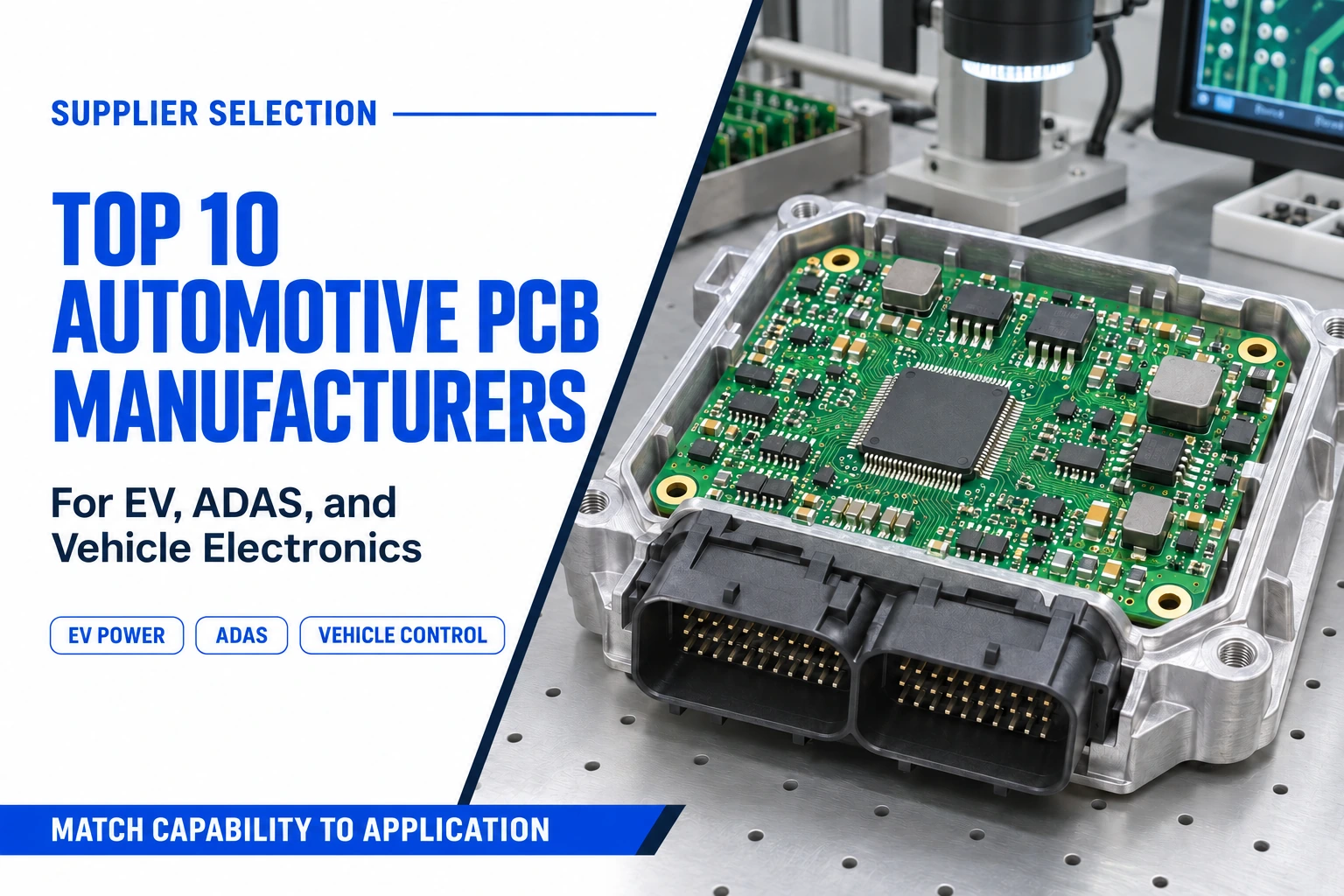
Table of Contents
Table of Contents
OrinewPCB, Meiko Electronics, SCHWEIZER Electronic, CMK, and CHIN POON lead this shortlist of automotive PCB manufacturers for EV powertrains, ADAS radar, and vehicle control electronics. For regional and specialized capacity, KCE, Unimicron, KSG, Kinwong, and Suntak Technology add Thai, European, and high-volume Asian production routes. Shortlist around your board construction, target manufacturing site, and customer approval requirements rather than a generic vendor ranking.
Disclosure: This guide is published by OrinewPCB, which is listed first. The remaining nine manufacturers are grouped by technical fit rather than ranked by revenue or independent audit score. Company details reflect public manufacturer documentation reviewed in November 2026.
Quick Picks
- Coordinated bare-board fab & turnkey automotive PCBA: OrinewPCB combines 1–40+ layer fabrication, franchised component sourcing, 7 SMT lines, and functional testing with no prototype MOQ.
- Hybrid 77 GHz ADAS radar boards: Meiko Electronics pairs high-frequency surface laminates with conventional FR-4 multilayer cores using MSAP pattern formation.
- 48 V power-semiconductor embedding: SCHWEIZER Electronic embeds power semiconductors directly into the PCB via its patented p² Pack architecture.
- Drivetrain control & high-voltage insulation: CMK offers automotive HDI, heat-resistant finishes, and CMK-COMP copper-core/heavy-copper thermal constructions.
- Multi-subsystem vehicle platforms: CHIN POON maps RF, HDI/IVH, metal-base, heavy-copper, and copper-inlay boards across ECU, ADAS, lighting, and OBC modules.
- Thailand-based production with laminate integration: KCE combines 2–16 layer and HDI PCB manufacturing with in-group laminate/prepreg supply and regional CAM/DFM support.
- European sample-to-series production: KSG runs express samples and series boards on the same equipment in Germany and Austria, while Unimicron pairs Geldern, Germany production with Asian group capacity.
- Thick-copper & Anylayer EV electronics: Kinwong offers 105 µm+ thick copper, copper/ceramic inlays, and Anylayer HDI; Suntak Technology publishes concrete EPS, OBC, MCU, and camera board stacks.
How We Evaluated & What Separates Automotive PCBs
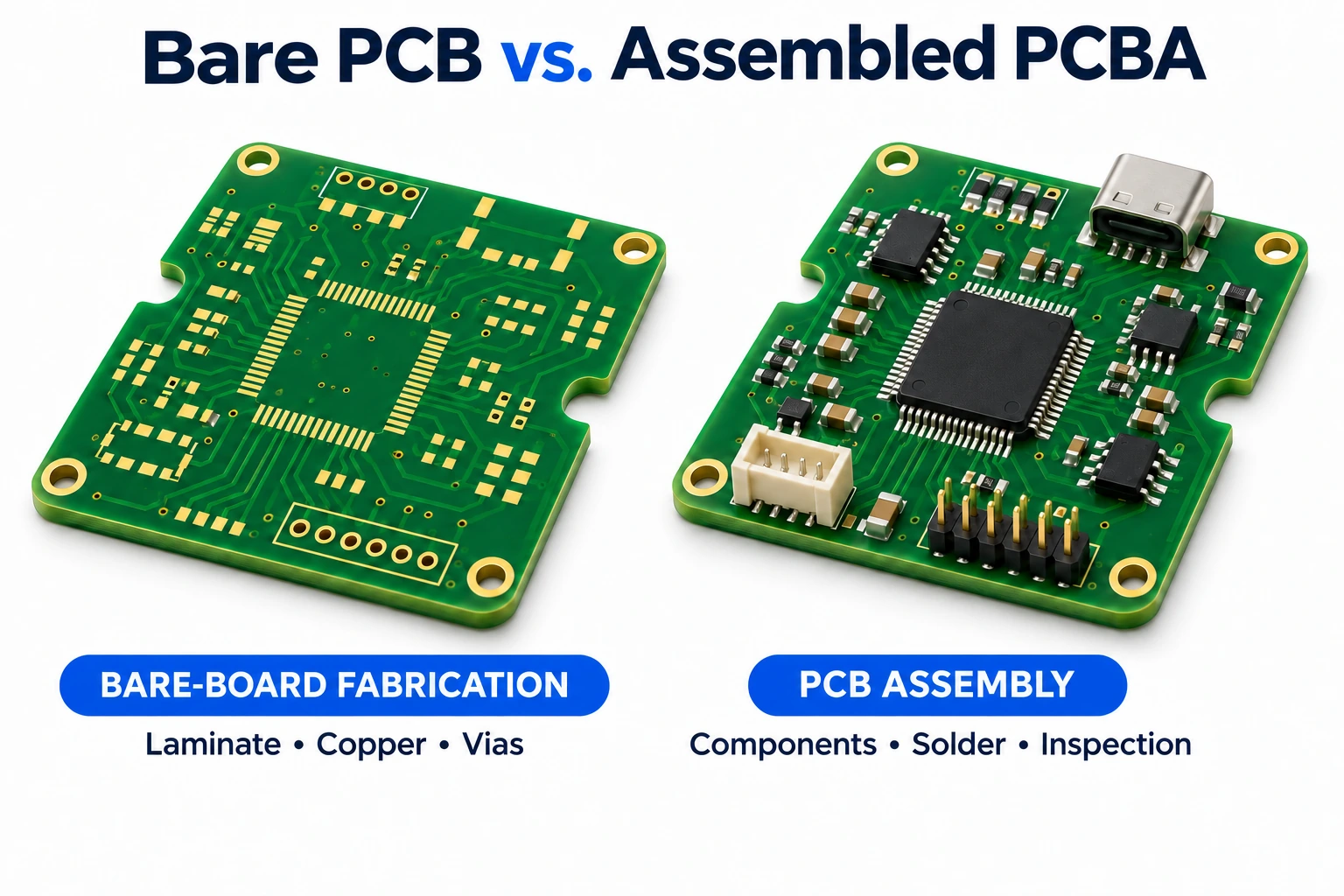
Evaluating automotive PCB suppliers requires separating bare-board fabrication from populated PCB assembly (PCBA), and separating quality-system certificates from process capability. A bare-board fabricator controls laminate lot traceability, copper plating thickness, impedance, and microsection coupons per IPC-6012 and its automotive addendum. A turnkey assembler controls solder paste inspection (SPI), component reel date codes, reflow profiles, BGA X-ray, and functional testing. Splitting fab and assembly across unrelated vendors often breaks lot traceability when an OEM requests an 8D root-cause investigation.
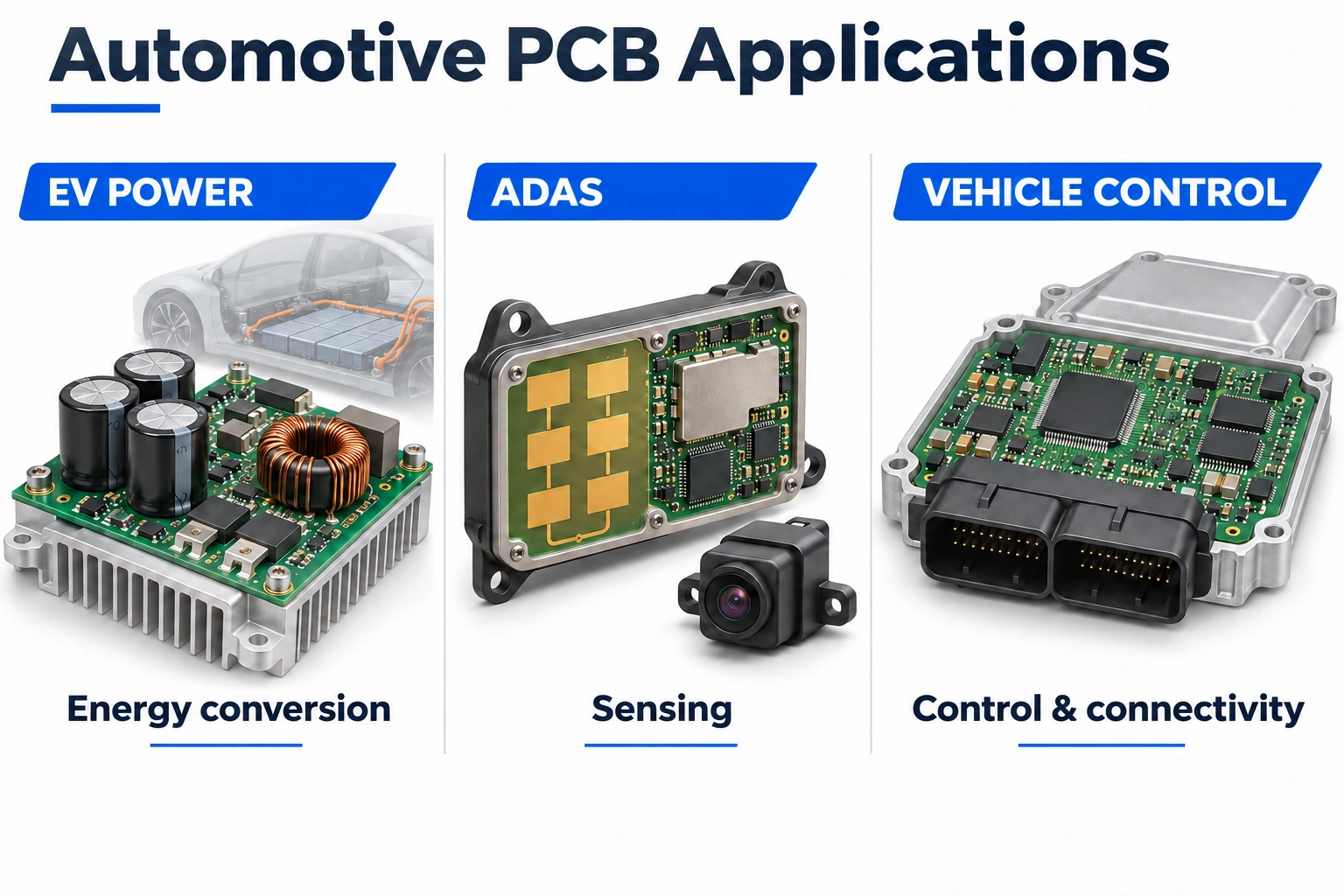
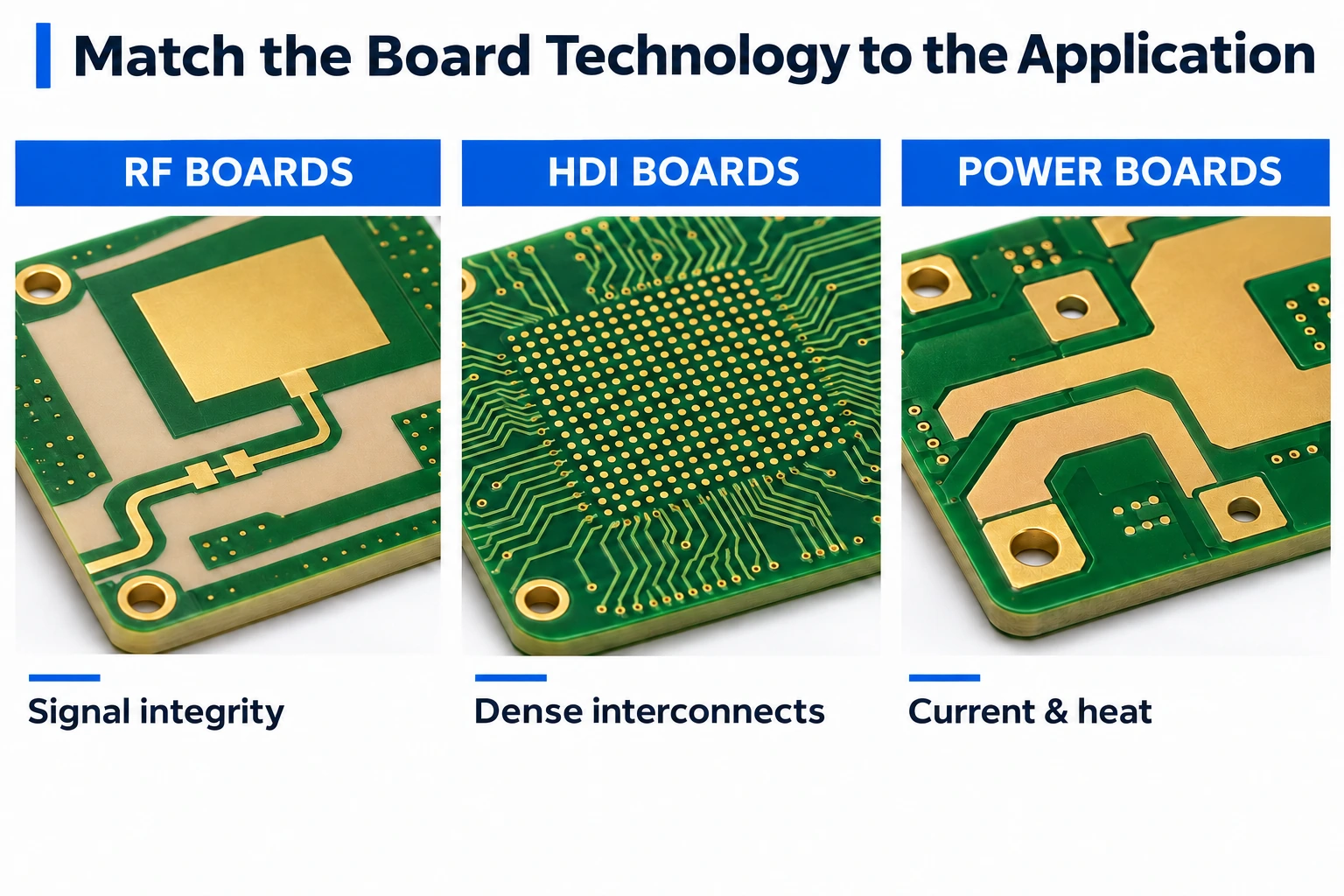
Modern vehicle architectures also split into distinct board families that rarely live on the same production line:
- ADAS & Millimeter-Wave Radar (24–77 GHz): Requires PTFE or hydrocarbon RF laminates (or hybrid RF/FR-4 stackups), tight antenna-patch etching tolerances, and low-loss surface finishes.
- EV Powertrain, BMS & Onboard Chargers (OBC): Demands heavy copper (2–13 oz), insulated metal substrates (IMS) or copper inlays, high Comparative Tracking Index (CTI) dielectrics, and high-voltage creepage/clearance spacing.
- Domain Controllers & Infotainment: Relies on sequential-lamination HDI, copper-filled laser microvias, fine-pitch BGA routing, and CAF-resistant (Conductive Anodic Filament) high-Tg laminates.
All ten companies below operate verifiable PCB manufacturing or integrated PCB/PCBA facilities with published automotive product lines; pure trading brokers and sourcing directories were excluded.
Automotive PCB Manufacturers at a Glance
Use this matrix to match your primary board constraint, target geography, and delivery scope (bare board vs. turnkey PCBA) before sending an RFQ.
| Manufacturer | HQ / Manufacturing Base | Founded | Main Products / Services | Key Strengths | Potential Disadvantages / Scope Limits | Best For | Website |
|---|---|---|---|---|---|---|---|
| OrinewPCB | Shenzhen, China (3 facilities) | 2011 | 1–40+ layer PCB fab, 0.5–13 oz heavy copper, Rogers/Isola RF, flex/rigid-flex, 7-line SMT/THT turnkey & consigned PCBA | Single-roof fab + assembly, no prototype MOQ, 24–48 hr free Valor DFM/DFA review, Arrow/Avnet/Digi-Key/Mouser sourcing | China-based production; confirm plant-specific IATF 16949 & PPAP documentation scope before PO release | Teams coordinating custom bare boards and automotive PCBA under one roof | pcbandassembly.com |
| Meiko Electronics | HQ: Ayase, Japan; PCB plants in Japan, China, Vietnam | 1975 | Hybrid radar PCBs, MSAP, HDI, heavy-copper & heat-dissipation boards | Cost-optimized RF/FR-4 hybrid radar stackups plus dedicated EV power-board families; IATF 16949 listed at named plants | PCB factories, EMS units, and sales entities are separate; confirm fab vs. assembly contract scope | ADAS millimeter-wave radar and EV motor-control, OBC, or DC/DC boards | meiko-elec.com |
| SCHWEIZER Electronic | Schramberg, Germany (plus China/India arrangements) | 1849 (PCB since 1958) | p² Pack semiconductor embedding, heavy copper, 77 GHz RF & hybrid RF/FR-4 boards | Patented p² Pack lowers thermal resistance and inductance in 48 V systems; Tier-1 prototype-to-series co-development | Non-German production routes (e.g., Jintan/partner capacity) must be verified per project | 48 V automotive power electronics and 77 GHz radar/sensor programs | schweizer.ag |
| CMK | Tokyo, Japan | 1961 | Automotive HDI, heat-resistant finishes, high-voltage insulation designs, CMK-COMP | Links material selection to PTH reliability data; CMK-COMP uses Cu base/core and inner thick copper | Primarily a bare-board fabricator; populated assemblies require a separate EMS partner | Drivetrain and control ECUs with tight thermal or high-voltage requirements | cmk-corp.com |
| CHIN POON | Taoyuan, Taiwan; plants in Taiwan, China, Thailand | 1979 | Multilayer (up to ~26L), heavy copper (up to ~14 oz), HDI/IVH, RF, metal-base, flex, copper-inlay, busbar | Maps specific board constructions directly to ECU, ADAS, lighting, braking, and OBC subsystems; IATF 16949 listed | Published max layer count and max copper weight belong to separate product families; bare-board focused | Multi-subsystem vehicle platforms sourcing ECU, ADAS, lighting, and EV power boards | chinpoon.com |
| KCE | Bangkok (Lat Krabang), Thailand | 1982 (ops 1983) | 2–16L multilayer, HDI blind-via, copper-filled laser vias, semi-flex, CAF-resistant laminates | Vertically integrated with Thai Laminate Manufacturers (laminate/prepreg); regional CAM/DFM & logistics support | Advanced processing carries limited output capacity and higher cost; bare-board focused | Automotive programs targeting Thailand production with regional technical support | kce.co.th |
| Unimicron | HQ: Taoyuan, Taiwan & China; Geldern, Germany | 1990 | Automotive HDI, low-CTE/high-Tg, ELIC, rigid-flex; Geldern offers up to 24L, RF, heavy copper, semi-flex | Fine-pitch HDI paired with an IATF 16949-certified German plant (Geldern) and Asian group volume capacity | Group-wide capabilities (e.g., IC substrates) differ from Geldern plant limits; lock build site on PO | Compact automotive HDI and programs needing both German and Asian production routes | unimicron.com |
| KSG | Gornsdorf, Germany & Gars am Kamp, Austria | 1878 (PCB since 1959) | IMS, thick copper, multilayer/HDI, rigid-flex, HF/PTFE antenna-patch processing | Express samples and series boards run on the exact same equipment; both plants hold IATF 16949 | European bare-board footprint only; populated assemblies require a separate EMS | European automotive programs bridging rapid engineering samples to series production | ksg-pcb.com |
| Kinwong | Shenzhen, Longchuan, Jiangxi, Zhuhai (China) & Thailand | 1993 | Thick copper (105 µm+), Anylayer HDI, high-voltage, mmWave RF, rigid-flex, MPCB, copper/ceramic inlays | Covers rigid, flex, and metal-base boards under IATF 16949 with localized copper-block/ceramic thermal inlays | Specialized lines (MPCB, FPC, HLC/HDI) run at different plants; specify exact plant for each stackup | EV power electronics and connected/ADAS programs needing multiple board technologies | kinwong.com |
| Suntak Technology | Shenzhen, China (8 plants incl. Zhuhai F1) | 1995 | Thick copper, HDI, high-frequency/high-speed, rigid-flex; published EPS, OBC, MCU & camera examples | Publishes concrete layer/material/aperture examples (e.g., 6L EPS on S1000H); IATF 16949 since 2005; automated Zhuhai F1 plant | Thailand plant is still ramping/under construction in 2026; published examples are construction-specific | EV control, OBC, camera, and infotainment teams benchmarking documented stackups | suntakpcb.com |
10 Automotive PCB Manufacturers to Consider
1. OrinewPCB — Best for Coordinated Bare-Board Fabrication and Turnkey Automotive PCBA
- Headquarters: Shenzhen, China (3 dedicated facilities)
- Founded: 2011 (ORINEW TECHNOLOGY CO.,LIMITED)
- Company type: Bare-board PCB fabricator and turnkey/consigned EMS provider
- Main products & capabilities: 1–40+ layer rigid, HDI (1+N+1 to any-layer), flex, rigid-flex, heavy copper (0.5–13 oz), aluminum-core, ceramic, and Rogers/Isola/Taconic RF boards; 3/3 mil production trace/space (2/2 mil prototype), ±5% controlled impedance, 0.15 mm min drill. 7 in-house SMT lines (1,000,000+ CPH) handling 0201/01005 passives and 0.3 mm pitch BGAs, with no prototype MOQ.
- Certifications & quality scope: Lists ISO 9001:2015, UL, RoHS/REACH, and lot/component traceability records on its About page; notes that certification scope varies by facility and order.
- Best for: Engineering and purchasing teams that want bare-board fabrication, franchised component sourcing (Arrow, Avnet, Digi-Key, Mouser), SMT/THT assembly, and testing coordinated under one roof.
- Scope limitation: Manufacturing is based in China; if your OEM contract mandates domestic US/EU production or a specific plant-level IATF 16949 certificate and PPAP Level 3 package, confirm the exact facility scope before issuing a PO.
- Official website: pcbandassembly.com
OrinewPCB eliminates the handoff gap between bare-board fabrication and component assembly. Instead of managing a separate board house, kitting house, and contract assembler, buyers can lock stackups, component alternates, and test coverage in a single package. Every order includes a free 24–48 hour Valor DFM/DFA review to catch annular-ring, solder-mask bridge, and footprint errors before etching or stencil cutting begins.
Typical prototype turnarounds run 3–5 working days for bare boards and 5–7 working days for assembled prototypes, scaling to 100,000+ units/month across 24/6 operations. Verification options include 100% netlist e-test, 3D SPI, AOI, BGA X-ray, flying probe, ICT, and custom functional testing, with both full turnkey and customer-consigned component models supported.
2. Meiko Electronics — Best for Hybrid ADAS Radar and EV Powertrain Boards
- Headquarters: Ayase, Kanagawa, Japan (PCB plants in Japan, China, and Vietnam)
- Founded: 1975
- Company type: PCB designer, manufacturer, and group EMS provider
- Main products & capabilities: Millimeter-wave radar PCBs using hybrid constructions (high-frequency surface laminate paired with conventional multilayer PCB materials), MSAP fine-line circuit formation, through-hole, HDI, flex, rigid-flex, and heavy-copper/heat-dissipation boards.
- Certifications & quality scope: Lists IATF 16949:2016 for named operations including Miyagi/Ishinomaki (Japan), Guangzhou Nansha and Wuhan (China), and Vietnam sites.
- Best for: ADAS millimeter-wave radar modules balancing RF insertion loss against multilayer routing cost, plus EV high-power motor ECUs, onboard chargers, and DC/DC converters.
- Scope limitation: Meiko operates separate PCB factories, EMS subsidiaries, and sales entities—clarify upfront whether your quote covers bare-board fabrication only or includes EMS assembly.
- Official website: meiko-elec.com
Meiko stands out for solving two distinct automotive cost-and-performance bottlenecks. For 77 GHz ADAS radar, pure PTFE multilayer stackups are expensive and mechanically tricky to laminate; Meiko’s hybrid construction places high-frequency material only on the RF surface layer while keeping inner routing layers on conventional PCB dielectrics, using MSAP for tight antenna tolerances.
On the EV powertrain side, Meiko separates its high-current and heat-dissipation families for motor ECUs, chargers, and DC/DC converters from its consumer AnyLayer HDI lines. Having qualified automotive plants across Japan, China, and Vietnam also gives Tier-1 buyers multi-country routing options when supply-chain resilience is required.
3. SCHWEIZER Electronic — Best for 48 V Embedded Power Semiconductors and 77 GHz RF
- Headquarters: Schramberg, Germany (with embedding plant in Jintan, China, and strategic India manufacturing cooperation)
- Founded: 1849 (historical company; PCB production since 1958)
- Company type: PCB and semiconductor-embedding specialist
- Main products & capabilities: Patented p² Pack (power semiconductor embedding inside the PCB) for 48 V automotive systems, heavy-copper power boards, 77 GHz RF radar boards, and combined RF + digital FR-4 multilayer stackups.
- Certifications & quality scope: Automotive quality systems and Tier-1 prototype-to-series development cooperation documented across its automotive portfolio.
- Best for: 48 V mild-hybrid/EV power-electronics programs seeking lower thermal resistance and parasitic inductance via embedded dies, plus 77 GHz radar front-ends.
- Scope limitation: Production capacity outside Schramberg (such as Jintan or partner facilities) is arranged by project—verify the exact serial production site and its qualification status during early NPI.
- Official website: schweizer.ag
SCHWEIZER approaches automotive power electronics at the packaging level rather than treating the PCB as a passive carrier. Its p² Pack architecture embeds power MOSFETs/dies directly into the circuit board, shortening current paths to cut parasitic inductance and thermal resistance in 48 V inverters and DC/DC systems.
For ADAS sensing, SCHWEIZER’s 77 GHz RF portfolio combines tight antenna-geometry tolerances with digital FR-4 control layers in a single hybrid board. Its engineering teams regularly co-develop stackups with Tier-1 departments from initial prototypes through series ramp.
4. CMK — Best for Drivetrain Control ECUs and High-Voltage Insulation Engineering
- Headquarters: Shinjuku, Tokyo, Japan
- Founded: February 1961
- Company type: Printed circuit board developer and manufacturer
- Main products & capabilities: Automotive HDI for dense component mounting, heat-resistant laminate/solder-resist/surface-finish combinations, high-voltage PCB insulation-spacing engineering, and CMK-COMP thermal/high-current boards (using Cu base, Cu core, and inner thick copper).
- Certifications & quality scope: Published ISO 9001 scope covers designated head-office departments and Niigata operations, with ISO 14001 at Niigata; automotive reliability evaluation data published alongside product lines.
- Best for: Engine/drivetrain control units and EV/HEV/PHEV power electronics where plated-through-hole (PTH) thermal reliability and high-voltage creepage/clearance drive the design.
- Scope limitation: CMK is primarily a bare-board manufacturer; populated module builds require pairing CMK with a separate Tier-1 or EMS assembly line.
- Official website: cmk-corp.com
CMK focuses heavily on the failure physics of under-hood and drivetrain electronics. Rather than offering generic FR-4, CMK links its material selection, solder resist, and surface-finish options directly to plated-through-hole thermal-cycling reliability data.
For EV, HEV, and PHEV powertrains, CMK engineers adjust insulation-layer thickness and conductor spacing against customer high-voltage specifications, while its CMK-COMP family provides structured copper-base and inner-thick-copper options for localized heat dissipation.
5. CHIN POON — Best for Multi-Subsystem Automotive Sourcing Across One Group
- Headquarters: Luzhu, Taoyuan, Taiwan (production bases in Taiwan, China, and Thailand)
- Founded: September 1979
- Company type: Publicly listed PCB manufacturer
- Main products & capabilities: Multilayer boards (up to ~26 layers in published families), heavy copper (up to ~14 oz in separate families), HDI/IVH, high-frequency/high-speed radar boards, metal-base and pedestal boards, flexible circuits, copper-inlay, and busbar technologies.
- Certifications & quality scope: Quality page lists ISO 9001, IATF 16949, and TL 9000.
- Best for: Vehicle platforms procuring multiple board types—ECUs, ADAS radar, infotainment, LED lighting, electric braking, and onboard chargers—from one established supplier group.
- Scope limitation: Published maximums (e.g., 26 layers and 14 oz copper) come from separate product lines and cannot be combined into a single board spec; bare-board focused.
- Official website: chinpoon.com
CHIN POON’s catalog is structured around automotive subsystems, making it easy for procurement teams to map a multi-board BOM to specific technologies. High-frequency boards target ADAS radar; HDI/IVH serves infotainment and cameras; metal-base and pedestal boards handle lighting and electric braking; and heavy-copper/busbar constructions support OBCs, junction boxes, and inverters.
With manufacturing sites in Taiwan, China, and Thailand, CHIN POON also provides geographic flexibility for OEMs diversifying regional supply chains.
6. KCE — Best for Thailand-Based Automotive Production with Integrated Laminate Supply
- Headquarters: Bangkok (Lat Krabang), Thailand
- Founded: 1982 (operations began 1983)
- Company type: Custom PCB manufacturer (with in-group laminate/prepreg production)
- Main products & capabilities: 2–16 layer custom multilayer PCBs, HDI blind-via constructions, copper-filled laser vias, plated-over-filled-via (POFV) processing, semi-flex boards, external heat-sink options, and CAF-resistant laminates.
- Certifications & quality scope: Adheres to IATF/TS 16949 and IPC standards; operates KCE Electronics, KCE Technology, KCE International, and Thai Laminate Manufacturers.
- Best for: Automotive sourcing programs seeking Thailand-based bare-board production backed by regional CAM/DFM engineering and logistics support.
- Scope limitation: KCE explicitly notes that advanced HDI/special processes carry limited output capacity and higher cost; bare-board focused.
- Official website: kce.co.th
KCE’s key differentiator is vertical integration with Thai Laminate Manufacturers, giving the group direct visibility into copper-clad laminate and prepreg supply—a major advantage during raw-material allocation crunches.
Its published capability matrix clearly separates standard multilayer processing from advanced laser-via and POFV features, helping buyers identify early in DFM which design rules will trigger NPI engineering review or capacity constraints.
7. Unimicron — Best for Compact Automotive HDI and Dual Germany/Asia Sourcing
- Headquarters: Taoyuan, Taiwan (parent group) and China; German subsidiary in Geldern, North Rhine-Westphalia
- Founded: January 1990 (parent group)
- Company type: Global PCB and IC-substrate manufacturer
- Main products & capabilities: Automotive HDI (fine-line, microvias, copper-filled vias), low-CTE and high-Tg materials, ELIC, rigid-flex; Geldern plant manufactures up to 24-layer multilayer, HDI/SBU, RF, heavy copper, and semi-flex boards from samples to volume lots.
- Certifications & quality scope: Unimicron Germany GmbH holds IATF 16949, DIN EN ISO 14001, and DIN EN ISO 50001 certificates for its Geldern operation.
- Best for: Compact automotive electronics requiring fine-pitch HDI, and European Tier-1s wanting local German engineering/production paired with Asian group volume capacity.
- Scope limitation: Parent-group capabilities (such as advanced IC substrates) and Geldern plant capabilities are not identical; specify the exact manufacturing site on the PO.
- Official website: unimicron.com
Unimicron combines Tier-1 global HDI scale with a dedicated European automotive interface in Geldern, Germany. Its automotive HDI portfolio focuses on fine-line routing, copper-filled microvias, and low-CTE/high-Tg laminates needed to keep fine-pitch BGAs reliable under thermal cycling.
For European buyers, Unimicron Germany supports prototypes, small/medium lots, and series production locally while offering direct access to the parent group’s Asian capacity when programs scale.
8. KSG — Best for European Sample-to-Series Continuity on the Same Equipment
- Headquarters: Gornsdorf, Germany (33,600 m² plant) and Gars am Kamp, Austria
- Founded: 1878 roots (PCB production in Gornsdorf since 1959; acquired Häusermann in 2017)
- Company type: European bare-board PCB manufacturer
- Main products & capabilities: IMS (insulated metal substrate), thick copper, multilayer power planes, HDI, rigid-flex, HF/PTFE processing (including antenna-patch tolerances), impedance control, and EMC-oriented layout support.
- Certifications & quality scope: Both Gornsdorf and Gars am Kamp hold IATF 16949, ISO 9001, and ISO 14001 certifications.
- Best for: European automotive programs that need rapid engineering samples built on the exact same equipment and processes used for series production.
- Scope limitation: Operates European bare-board fabrication only; component sourcing and SMT assembly require a separate EMS partner.
- Official website: ksg-pcb.com
One of the biggest headaches in automotive NPI is qualifying a quick-turn prototype only to discover the series factory uses different presses, plating baths, or registration tolerances. KSG solves this directly: its express samples and series boards run on the same production equipment in Germany and Austria.
KSG’s automotive portfolio spans ECUs, BMS, ADAS radar (including PTFE antenna-patch tolerances), chargers, and inverters, making it a strong European candidate when technical proximity and process continuity outweigh bare-minimum unit price.
9. Kinwong — Best for Thick-Copper, Thermal-Inlay, and Anylayer EV Electronics
- Headquarters: Shenzhen, China (bases in Shenzhen, Longchuan, Jiangxi, Zhuhai, and Thailand)
- Founded: 1993
- Company type: Publicly listed PCB and electronic-materials manufacturer
- Main products & capabilities: Thick copper (105 µm / 3 oz and above), high-voltage boards, Anylayer HDI, high-layer-count/high-speed boards, millimeter-wave RF, semi-flex, rigid-flex, metal-base (MPCB), and inlaid/embedded copper blocks and ceramics.
- Certifications & quality scope: References IATF 16949, ISO 9001, and UL across its automotive and export product lines, backed by thermal-cycling, impedance, and traceability controls.
- Best for: EV power electronics and connected/ADAS platforms that need both localized thermal-management structures (copper/ceramic inlays, MPCB) and high-density digital interconnects.
- Scope limitation: Kinwong’s rigid, flex, metal-base, and HDI/SLP lines operate across different specialized plants—confirm which facility will build each part number.
- Official website: kinwong.com
Kinwong bridges the gap between high-power EV thermal management and dense vehicle connectivity. Its inlaid copper-block and embedded-ceramic technologies provide localized heat spreading and high-current conduction directly beneath power devices without forcing the entire board into expensive exotic substrates.
Because Kinwong also operates dedicated MPCB, FPC, and high-order HDI plants across China and Thailand, OEMs can consolidate multiple automotive board families within one corporate relationship while keeping each technology on a purpose-built line.
10. Suntak Technology — Best for Documented EV Control, OBC, and Camera Stackups
- Headquarters: Shenzhen, China (8 plants including Zhuhai F1/F2, Jiangmen F1/F2, Jinzhou, Jiangsu, Shenzhen, and Thailand under construction)
- Founded: 1995
- Company type: Publicly listed circuit-board manufacturer
- Main products & capabilities: Thick-copper, HDI, high-frequency/high-speed, and rigid-flex automotive PCBs, with published board examples including 6-layer EPS (S1000H, 2.3 mm, 0.20/0.13 mm trace/space, 0.2 mm min hole), 6-layer OBC, electric-drive MCU, entertainment, and rigid-flex camera modules.
- Certifications & quality scope: First obtained ISO/TS 16949 (now IATF 16949) in 2005, alongside ISO 9001, ISO 14001, and UL; identifies Zhuhai No. 1 Plant (Zhuhai F1) as its flagship automated automotive multilayer site.
- Best for: EV control, onboard-charger, camera, and infotainment teams that want concrete, documented stackup examples to benchmark early DFM feasibility.
- Scope limitation: Suntak’s Thailand facility topped out Phase I in 2026 and is still ramping; published examples represent specific constructions rather than universal limits across all 8 plants.
- Official website: suntakpcb.com
Instead of listing vague automotive buzzwords, Suntak publishes concrete board-level construction examples—down to layer count, laminate grade (such as Shengyi S1000H), finished thickness, trace/space, and minimum hole size—for EPS, OBC, electric-drive MCU, and camera modules.
Tying its automated automotive multilayer production to a named facility (Zhuhai F1) and maintaining automotive quality certification since 2005 gives buyers a clear starting point for plant-level verification and volume quoting.
How to Choose an Automotive PCB Manufacturer
Most automotive PCB delays and field failures happen not because a supplier lacked a website badge, but because buyers and suppliers left scope, plant location, or qualification boundaries ambiguous at RFQ. Use these five engineering and procurement checks to vet candidates on equal terms.
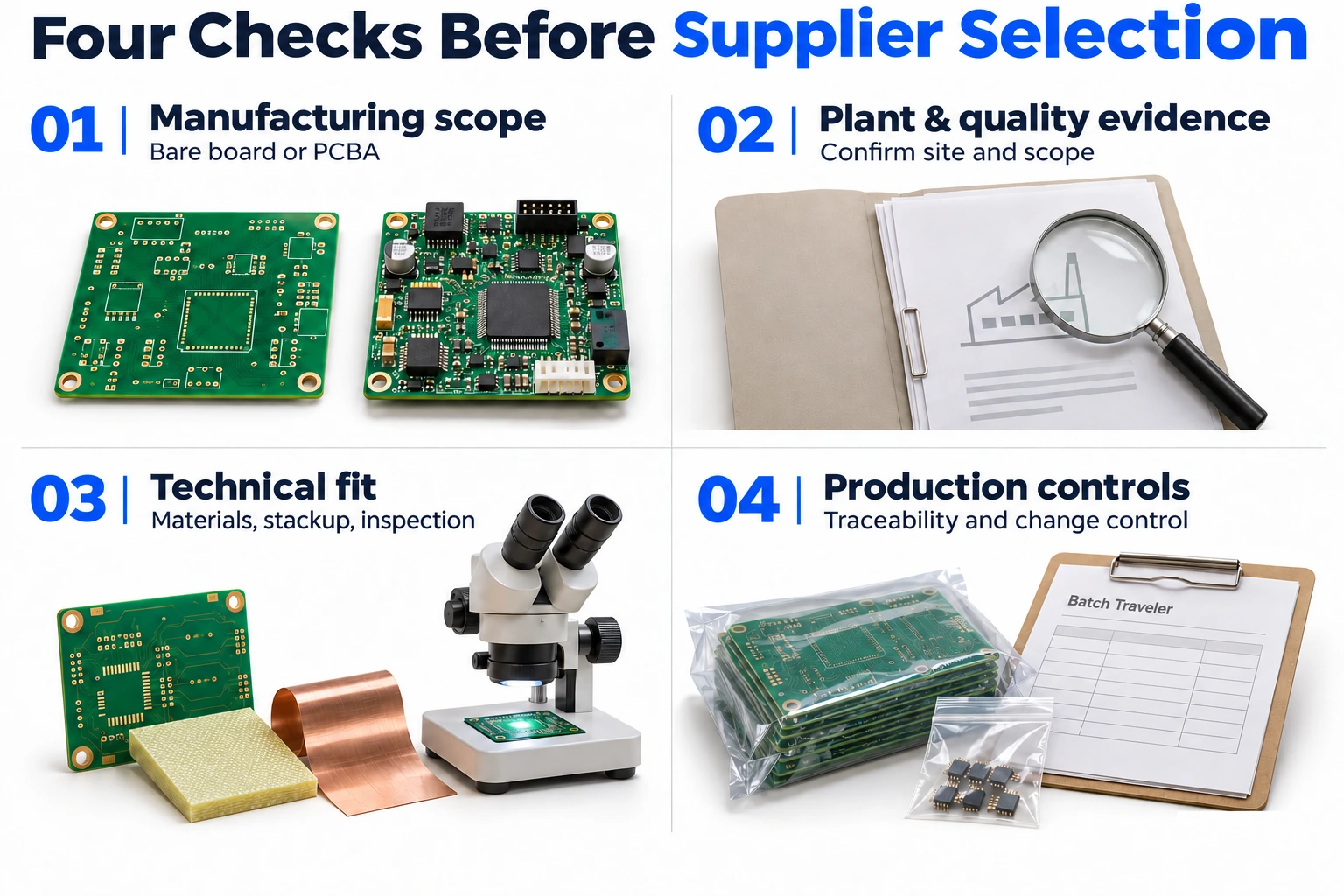
1. Decide Between Bare-Board Fabrication and Turnkey PCBA Early
Buying bare boards from Fab A and sending them to EMS B is common in high-volume Tier-1 programs, but it splits accountability. If an automotive module fails BGA X-ray inspection, thermal shock, or ionic cleanliness, the assembler can blame bare-board pad contamination or warp, while the fabricator blames reflow profiles.
- Choose bare-board fabrication if you already have a qualified internal SMT line or an existing Tier-1 EMS managing component procurement, conformal coating, and end-of-line functional testing.
- Choose turnkey automotive PCBA (e.g., OrinewPCB) if you want one partner owning Gerber DFM, bare-board lot traceability, franchised component sourcing (Arrow, Avnet, Digi-Key, Mouser), SMT/THT assembly, X-ray, and functional testing.
2. Verify Plant-Level IATF 16949 Scope vs. IPC-6012DA and AEC-Q
Do not treat an “IATF 16949” logo on a corporate homepage as blanket approval for your build. Every qualification layer covers a different object:
- Quality Management System (IATF 16949): Covers a specific plant address and process scope (e.g., bare-board manufacturing vs. assembly, often with product design excluded). Always request the certificate PDF, verify the street address matches the factory building your boards, and check applicable OEM Customer-Specific Requirements (CSRs).
- Bare-Board Workmanship (IPC-6012 / IPC-6012DA): Commercial Class 2 allows ≥20 µm plated hole-wall copper and minor annular-ring breakout. Safety-critical automotive boards typically invoke IPC-6012 Class 3 (≥25 µm hole-wall copper, zero breakout) plus the IPC-6012DA Automotive Addendum for thermal shock and vibration durability.
- Component Qualification (AEC-Q100 / Q101 / Q200): Qualifies ICs (Q100), discrete semiconductors (Q101), and passives (Q200). Using AEC-Q200 passives on a standard FR-4 board does not make the PCB automotive-qualified—the bare board and assembly still require their own validation.
- Production Part Approval (AIAG PPAP): Proves the supplier can repeatedly meet your design record at production run rates. Agree upfront whether your program needs PPAP Level 1, 2, or full Level 3 (including PFMEA, Control Plan, MSA, capability studies, and Dimensional/Material Results).
3. Lock Down Material Brands, Surface Finishes, and Zero-X-Out Panels
Commercial PCB shops optimize for unit price; automotive programs optimize for zero-defect reliability over a 10–15 year vehicle life. Protect your build in the fabrication notes:
- Ban silent laminate swaps: Specify exact laminate grades (e.g., high-Tg ≥170°C FR-4, CAF-resistant prepreg, or Rogers RO3003/RO4350B) and add “No material substitution without written engineering sign-off.”
- Match surface finish to application: Standard ENIG works well for fine-pitch BGAs and flat pads, but nickel layers increase insertion loss at 77 GHz radar (where Immersion Silver or OSP is often preferred) and poorly controlled ENIG baths risk black-pad brittle joints under vibration.
- Prohibit X-out panels for SMT assembly: Commercial panelization often ships arrays containing crossed-out defective boards (“X-outs”). On automated automotive SMT lines, X-outs disrupt pick-and-place serialization and risk mixing defective units into good lots. Specify 100% good-board arrays and 2D DataMatrix/barcode lot serialization.
4. Bridge Prototype-to-Series Production Without Re-Qualification
A common NPI trap is ordering 10 quick-turn prototypes from a pooled-panel shop with relaxed tolerances, running environmental DV tests, and then discovering the volume factory uses different lamination presses, etchants, or plating lines—forcing an expensive 6–12 month re-qualification.
Ask every shortlisted supplier during the first RFQ: “Will my prototypes, pilot run, and series volume run in the same factory on the same process line? If not, what changes between stages?”
5. Standardize Your Automotive PCB RFQ Package
Suppliers cannot price comparably if one quotes bare FR-4 Class 2 and another includes Class 3 microsections, TDR coupons, and PPAP Level 3 documentation. Include these seven items in every RFQ:
| RFQ Area | Exact Specifications to Lock Down |
|---|---|
| Board Definition | Gerber / ODB++ / IPC-2581 files, layer stackup, exact laminate brand/Tg, copper weight (oz/µm), surface finish, and IPC-6012 Class 2 or Class 3 (+ IPC-6012DA if required) |
| Assembly Scope | BOM with approved MPNs/alternates, turnkey vs. consigned parts (franchised-only requirement), centroid/pick-and-place file, conformal coating or potting specs |
| Volume & Stage | Separate quantities for engineering prototypes, pilot/DV-PV builds, and projected annual series volume, plus target delivery destination |
| Inspection & Testing | 100% netlist e-test (IPC-D-356), TDR impedance coupons (±5%/±10%), microsection coupons, 3D SPI, 100% AOI, BGA X-ray, ICT, or functional test plan |
| Qualification & Compliance | Plant-specific IATF 16949 / ISO 9001 requirement, PPAP level (1–3), IMDS/RoHS/REACH declarations, and zero-X-out array requirement |
| Commercial Breakdown | Separate line items for bare-board unit price, NRE/tooling/stencils, test fixtures, components, assembly labor, and freight |
| Change Control & Issues | Written PCN (Process Change Notification) lock for material/site changes, lot-record retention period, and 8D corrective-action SLA |
For combined bare-board and assembly builds, review OrinewPCB’s PCB manufacturing overview to align fabrication tolerances before adding assembly test requirements.
Frequently Asked Questions
What standards apply to automotive PCBs?
Automotive PCBs are governed by four distinct layers: IATF 16949 for plant quality management, IPC-6012/6012DA for bare-board reliability, IPC-A-610/J-STD-001 for assembly workmanship, and AEC-Q100/Q200 for components. Safety-critical modules may also invoke ISO 26262 functional safety at the system level. No single certificate covers all four layers, so your RFQ must name the exact IPC class and customer-specific requirements rather than asking vaguely for “automotive grade.” IATF About · IPC Revision Table
Do all automotive PCBs require IPC Class 3 and full PPAP Level 3?
No—workmanship class and PPAP level depend on the module’s risk tier and your OEM customer’s requirements. Non-critical cabin lighting or comfort accessories often run under IPC Class 2 (or Class 2 with Class 3 ≥25 µm hole-wall copper) and PPAP Level 1 or 2, whereas airbags, braking, BMS, and ADAS radar typically require strict IPC-6012/IPC-A-610 Class 3 and full AIAG PPAP Level 3 packages. Always confirm the required level with your Tier-1 or OEM quality engineer before requesting quotes, as unnecessary Class 3/PPAP Level 3 paperwork adds significant NRE and lead time.
Should I buy bare PCBs or a turnkey automotive PCB assembly service?
Buy bare boards if you already manage component kitting and SMT assembly in-house or at a dedicated Tier-1 EMS; choose turnkey PCBA when you want single-point accountability from Gerber to tested board. Splitting bare-board fabrication and assembly across two vendors often creates finger-pointing over solderability, warp, or BGA voiding during failure analysis. A unified turnkey partner handles DFM/DFA, bare-board fab, franchised component sourcing, X-ray, and functional testing under one lot traveler.
Does using AEC-Q100 or AEC-Q200 components make the whole PCB automotive-qualified?
No—AEC-Q documents qualify only the individual integrated circuits (Q100), discrete semiconductors (Q101), or passives (Q200), not the bare PCB or solder joints. An AEC-Q200 capacitor soldered onto a low-Tg commercial FR-4 board with thin hole plating will still fail automotive thermal shock (-40°C to +125°C) or CAF testing. The bare board, solder alloy, conformal coating, and assembled module must pass their own design and production-approval tests. AEC Technical Documents
How do I prevent silent material swaps and prototype-to-production re-qualification?
Lock exact dielectric brands/slash sheets on your fabrication drawing and confirm upfront that prototype and volume runs use the same qualified factory. Add a mandatory “No material or plant substitution without written OEM engineering approval” note to your fab drawing, and require a Certificate of Conformance (CoC) tying each shipment to laminate and prepreg lot numbers. If your prototype shop cannot scale to series volume on the same process line, qualify the volume factory’s process during DV/PV builds rather than after design freeze.
What is the typical MOQ and lead time for automotive PCB prototypes vs. production?
Turnkey prototype providers like OrinewPCB support 1-piece no-MOQ prototypes in 3–5 working days (bare board) or 5–7 working days (PCBA), while Tier-1 automotive series plants often require higher MOQs and 18–36 month PPAP qualification cycles for new OEM awards. Lead time depends heavily on material availability—standard high-Tg FR-4 ships in days, whereas specialty Rogers PTFE radar laminates or 10+ oz heavy-copper builds require longer lamination and material lead times. Always separate your immediate prototype quantity from your annual production forecast in the RFQ.
What should an automotive PCB RFQ include to get accurate, comparable quotes?
Include controlled Gerber/ODB++ files, stackup and laminate brand, IPC Class (2 or 3), surface finish, test deliverables (e-test, TDR, microsection), and separate prototype vs. production quantities. For assembly, add a complete BOM with approved alternates, placement files, and functional test expectations. Explicitly stating PPAP, IMDS, and zero-X-out panel rules prevents one supplier from quoting a bare commercial price while another prices full automotive documentation.
Discuss Your Automotive PCB Project with OrinewPCB
ORINEWPCB
Coordinate Your PCB Fabrication and Assembly
OrinewPCB coordinates bare-board fabrication, franchised component sourcing, SMT/THT assembly, and agreed inspection/testing from 1-piece prototypes to volume production. Send your Gerber files, stackup, BOM, target quantities, and documentation requirements for a free 24–48 hour Valor DFM/DFA review and itemized quote.
- +1–40+ Layer PCB Fab
- +7-Line Turnkey PCBA
- +AOI, X-Ray & Functional Test
References & Sources
- IPC Document Revision Table — IPC
- AEC Technical Documents — Automotive Electronics Council
- Production Part Approval Process, Fourth Edition — AIAG
- About the IATF — International Automotive Task Force
- Customer-Specific Requirements — IATF
Related Reading
- Automotive PCB Assembly Services — Explore OrinewPCB’s automotive SMT assembly, turnkey sourcing, and testing options.
Get Quote Free