Choose the Right PCB Assembly Manufacturer: A 2026 Guide
Selecting the right PCB assembly manufacturer is not merely a logistical decision, but rather a strategic partnership that directly impacts product quality, reliability, cost-effectiveness, and—crucially—time-to-market.
Get Your PCB Quote!
Table of Contents
1. Why Your Choice of PCB Assembly Manufacturer Matters
A professional electronic PCB assembly manufacturer acts as an extension of your development team, safeguarding against potential pitfalls like poor assembly, last-minute Bill of Materials (BOM) issues, and quality inconsistencies. Their expertise can help you navigate the complexities of modern PCB manufacturing, translating your intricate designs into functional, high-performance products. This guide aims to equip you with the knowledge to evaluate and select a reliable PCB assembly supplier, turning a critical decision into a strategic advantage.
2. Defining Your PCB Assembly Project Needs
Before you begin evaluating potential PCB assembly services, a thorough assessment of your specific project requirements is paramount. This foundational step dictates the type of partner best suited to your needs, mitigating risks associated with incompatibility and ensuring a successful production outcome. Defining these needs encompasses a range of parameters that will guide your selection process:
- Production Volume:Are you looking for prototype PCB assembly, low-volume production, or large-scale manufacturing ? Some manufacturers specialize in certain volumes, and their capabilities and pricing models will reflect this.
- Complexity of Design:Does your PCB feature fine-pitch components, Ball Grid Arrays (BGAs), or require intricate multi -layer designs? The manufacturer must possess the advanced equipment and expertise for such complexities.
- Required Technologies:Will your design utilize Surface Mount Technology (SMT), Through-Hole Technology (THT), or a mix of both? Does it involve flexible PCBs, rigid-flex, or specialized components?
- Quality Certifications:What industry-specific certifications are mandatory for your product (e.g., medical, automotive, aerospace)?
- Budget Constraints:Establishing a realistic budget helps narrow down options, but remember that the lowest price isn’t always the best value when it comes to quality and reliability.
- Turnaround Time:How quickly do you need your PCBs assembled? Some manufacturers offer quick-turn services, which can be critical for rapid prototyping or urgent market launches.
Understanding these parameters deeply allows you to engage with manufacturers from an informed position, ensuring a more efficient and effective selection process. This initial self-assessment is the bedrock upon which a successful manufacturing partnership is built.
3. Key Factors for Evaluating PCB Assembly Manufacturers
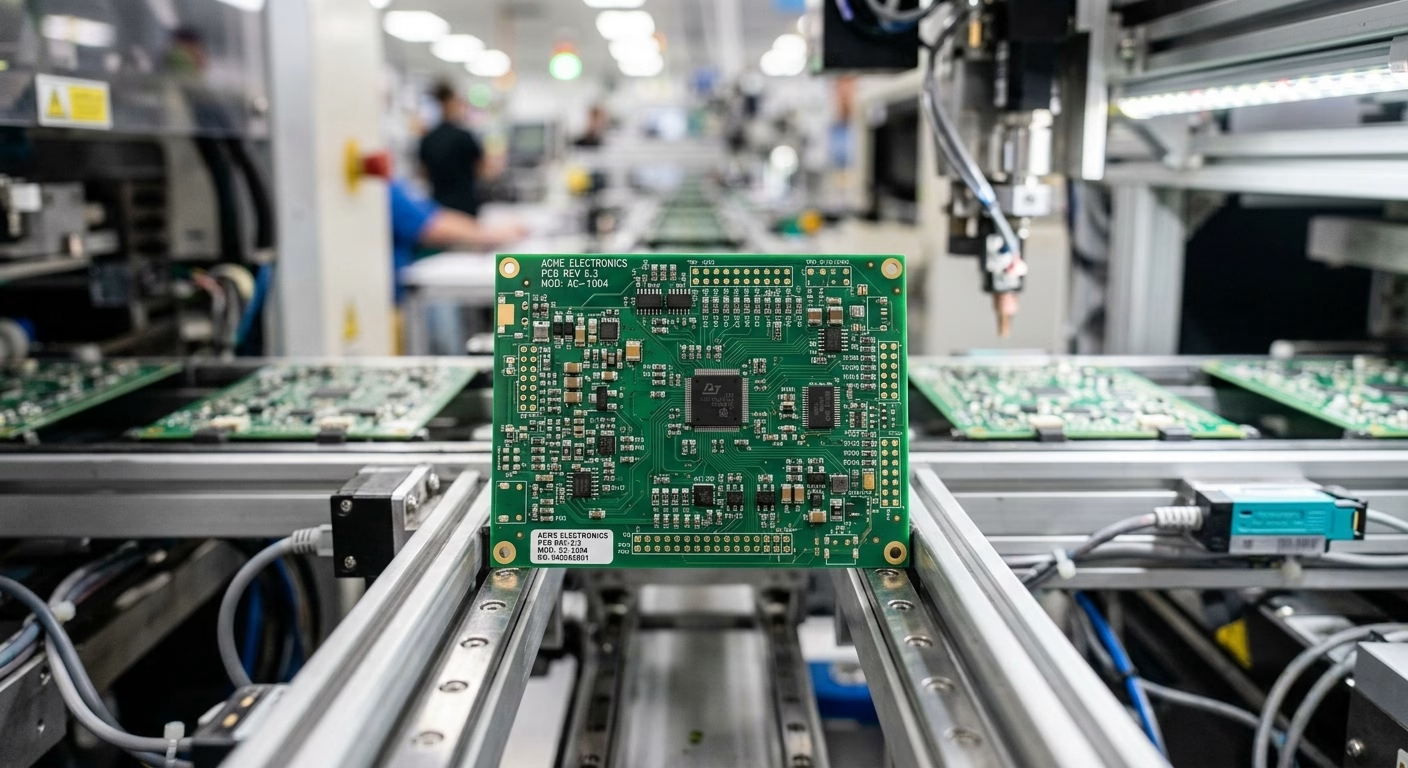
Choosing the right PCB assembly manufacturer involves a holistic evaluation of several critical factors. Each plays a vital role in the overall success of your project.
3.1. Manufacturing Capabilities and Technologies
The technical capabilities of a manufacturer are fundamental. You need a partner whose facilities and expertise align precisely with your design requirements. This includes:
- Assembly Technologies:Confirm they support both SMT (Surface Mount Technology) and THT (Through-Hole Technology) if your design requires it. Look for expertise in complex SMT placements, such as fine-pitch components (e.g., QFNs, QFPs) and BG As (Ball Grid Arrays), which demand precise equipment and skilled technicians.
- Board Types:Can they handle various PCB types like rigid, flexible, or rigid-flex PCBs?
- Production Scale:A manufacturer specializing in prototype PCB assembly might be different from one geared for high-volume production. Ensure they can cater to your specific volume needs, whether it’s a few boards for testing or tens of thousands for market release.
- Specialty Processes:Do they offer services like conformal coating, potting, or advanced cleaning processes if your product demands them?
3.2. Quality Standards and Certifications
Quality is non-negotiable. A reliable manufacturer will adhere to internationally recognized quality standards and hold relevant certifications, demonstrating their commitment to excellence and consistency. Key indicators include:
- ISO 9001 :This certification indicates a robust quality management system.
- IPC Standards:Compliance with IPC standards (e.g., IPC-A-610 Class 2 for general electronics or Class 3 for high -reliability products like medical devices) is crucial. These standards define acceptance criteria for electronic assemblies.
- Environmental Compliance:Ensure compliance with regulations like RoHS (Restriction of Hazardous Substances) and REACH (Registration, Evaluation, Author isation, and Restriction of Chemicals), especially if your product is for the European market or requires specific environmental responsibility.
- Quality Control Processes:Inquire about their in-house quality control systems, including incoming material inspection, in-process checks, and final product verification.
3.3. Industry Experience and Expertise
Experience matters, particularly when a manufacturer has a proven track record in your specific industry. Requirements for a medical device PCB differ significantly from those for a consumer electronics gadget or an automotive component. Manufacturers with relevant industry experience are more likely to understand the unique challenges, compliance requirements, and performance expectations of your sector.
- Examples:Ask for examples of similar projects or clients within your industry (e.g., medical PCB assembly, industrial controls, telecom).
- Problem-Solving:Experienced partners can anticipate potential issues and offer valuable solutions, saving time and cost.
3.4. Lead Times and Turnaround Capabilities
Time-to-market is often a critical competitive factor. Evaluate a manufacturer’ s stated lead times and, more importantly, their track record for on-time delivery. Quick-turn capabilities are essential for prototyping and agile development. Ask about their flexibility to accommodate expedited orders or changes in production schedules. A manufacturer’s ability to provide fast and reliable turnaround ensures your project stays on schedule.
3.5. Cost Structure and Pricing Transparency
While cost is always a consideration, it should not be the sole determinant. Transparent pricing is key . Request detailed quotes that break down costs for materials, assembly, tooling, testing, and shipping. Beware of hidden fees. Compare different pricing models:
- Turnkey PCB Assembly:The manufacturer handles everything from component sourcing to assembly and testing. This often provides the best value and convenience, especially for low-volume PCB assembly, as it streamlines the process and reduces your management burden.
- Consignment:You supply the components, and the manufacturer handles only the assembly. This can be cost-effective if you have existing component sourcing channels but shifts the responsibility for BOM accuracy and component quality onto you.
Always consider the total cost of ownership, including potential costs from rework, delays, or quality issues that might arise from choosing a cheaper but less reliable option.
3.6. Supply Chain Management and Component Sourcing
A robust supply chain is crucial. The ability of your electronic PCB assembly partner to reliably source components impacts both cost and lead time. Inquire about their relationships with authorized distributors, their component procurement process, and how they mitigate risks like component obsolescence or counterfeiting. Effective component sourcing involves:
- Authorized Distributors:Working with trusted suppliers minimizes the risk of counterfeit parts.
- Inventory Management :How do they manage stock and ensure component availability, especially for long-term projects?
- Obsolescence Planning:Their strategy for handling end-of-life (EOL) components.
3.7. Testing, Inspection, and Validation
Comprehensive testing and inspection are vital for product reliability. A good manufacturer offers a range of validation services to ensure functionality and quality:
| Testing/Inspection Method | Description | Benefit |
| Automated Optical Inspection (AOI) | Automated visual inspection of PCBs for manufacturing defects. | Identifies solder joint issues, missing components, polarity errors. |
| X-Ray Inspection (AXI) | Ex amines hidden solder joints, such as those under BGAs. | Crucial for complex assemblies with hidden connections. |
| In-Circuit Test (ICT) | Tests individual components on the assembled board. | Verifies correct component placement and functionality. |
| Functional Testing (FCT) | Simulates the end-use environment to verify overall product function. | Ensures the PCB performs as designed under operational conditions. |
| Environmental Testing | Exposes boards to extreme conditions (temperature, humidity). | Assesses durability and reliability in harsh environments. |
Discuss their testing protocols, equipment, and how they handle non-conforming products or rework processes.
3.8. Communication, Support, and DFM Services
Effective communication is the cornerstone of any successful partnership. Evaluate the manufacturer’s responsiveness, the clarity of their communication, and the availability of dedicated project managers. Furthermore, look for partners who offer Design for Manufacturability (DFM) feedback and support. DFM involves analyzing your design early in the process to identify potential manufacturing issues, optimize for cost-efficiency, and improve reliability, ultimately saving time and money down the line.
3.9. Scalability and Flexibility
Your manufacturing needs might evolve. Can the chosen manufacturer scale production up or down as your market demands change? Do they have the flexibility to accommodate design revisions or adapt to unexpected challenges? A scalable and flexible partner can support your product throughout its entire lifecycle, from initial concept to end-of-life.
Need PCB Manufacturing or Assembly?
Get a free quote within 24 hours. We specialize in prototype-to-production PCB/PCBA for hardware teams worldwide.
4. The Step-by-Step Selection Process
Navigating the selection of a PCB assembly manufacturer can be streamlined into a systematic approach:
- Define Your Requirements:As discussed, clearly outline your project’s volume, complexity , budget, timeline, and quality needs.
- Research and Shortlist:Utilize online directories, industry references, and recommendations to create a preliminary list of potential manufacturers. Focus on those with experience in your specific industry or technology.
- Request for Quote (RFQ):Provide shortlisted manufacturers with detailed design files (Gerber files, BOM, assembly drawings) and your specific requirements to obtain comprehensive quotes.
- Evaluate Proposals:Compare quotes not just on price, but on all the key factors discussed above – capabilities, certifications, lead times, communication, DFM support, and testing options.
- Conduct Due Diligence:Perform background checks, review client testimonials, and if possible, arrange for facility audits or virtual tours to assess their manufacturing environment and quality control in person.
- Start with a Pilot Project:For critical or complex projects, consider a small pilot run or prototype PCB assembly to evaluate their performance before committing to large-scale production.
- Final Selection and Partnership:Choose the manufacturer that best aligns with your needs, budget, and long-term goals, establishing a clear communication and collaboration framework .
FAQ
Question1: What is the difference between SMT and THT PCB assembly?
Answer: SMT (Surface Mount Technology ) involves soldering components directly onto the surface of the PCB, allowing for smaller, denser boards. THT (Through-Hole Technology) uses leads inserted into holes drilled in the PCB, then soldered on the opposite side. Most modern PCBs use a combination of both.
Question2: Why is DFM (Design for Manufacturability) important when choosing a PCB assembly partner?
Answer: DFM is crucial because it helps identify potential manufacturing issues during the design phase, before production begins. A manufacturer offering strong DFM support can provide valuable feedback to optimize your design for cost-effectiveness, reliability, and efficient production, preventing costly delays and rework later on.
Question3 : What should I look for regarding component sourcing in a turnkey PCB assembly service?
Answer: For turnkey PCB assembly, ensure the manufacturer has established relationships with authorized component distributors to guarantee genuine parts and avoid counterfeits. Ask about their inventory management, obsolescence handling, and how they manage lead times for critical components to prevent production delays.
Summary
Choosing the right PCB assembly manufacturer is a cornerstone of success for any electronics project. It’s about forging a strategic partnership that ensures your product meets stringent quality standards, is delivered on time, and remains cost-effective. By meticulously defining your project needs, thoroughly evaluating a manufacturer’s capabilities, certifications, lead times, cost structure, supply chain management, and communication, you can make an informed decision. Prioritize partners who offer comprehensive testing, DFM support, and the flexibility to scale with your evolving demands . A well-chosen manufacturing partner will not only build your PCBs but also contribute significantly to your product’s reliability and market competitiveness.
Get Quote Free