What is SMT Production Line?
It is the process of mounting electronic components directly onto the surface of a Printed Circuit Board (PCB). This is an automatic manufacturing process.
Get Your PCB Quote!
Table of Contents
Table of Contents
What Is an SMT Production Line?
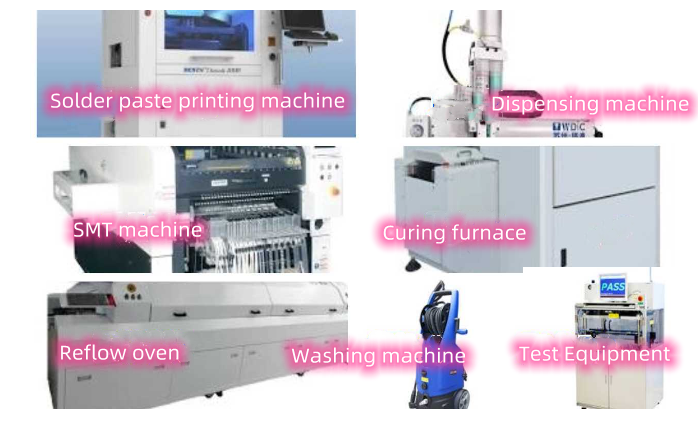
The SMT production line refers to the surface assembly equipment that forms the SMT production system, such as surface apply equipment, placement machines, welding machines, cleaning machines, and testing equipment.
SMT, short for Surface Mount Technology, was first introduced by IBM in the 1960s and has since become the dominant method for PCB assembly in modern electronics manufacturing. Unlike the earlier through-hole technology (THT), which required component leads to be inserted into drilled holes on the board, SMT mounts components directly onto the surface of the PCB. The electronic components used in an SMT line are known as surface mount devices (SMDs), which are generally smaller, lighter, and better suited for high-density circuit layouts. Today, SMT production lines are central to the manufacture of smartphones, computers, medical devices, automotive electronics, and a wide range of other consumer and industrial products.
Composition of SMT Production Line
The components of the SMT production line mainly include the following categories:
1) Solder Paste Printing Machine
Its function is to print solder paste or patchtape onto the pads of the PCB.
2) Dispensing Machine
Drip the glue onto the PCB fixing position.Its main function is to fix the components on the PCB.
3) SMT Machine
Surface mount components are installed accurately to the fixed position on the PCB.
4) Curing Furnace
When using SMD adhesive, solidify the SMD adhesive so that the surface mount components and the PCB are firmly stuck together.
5) SMT Reflow Oven
By melting the solder paste,the surface mount components stick firmly on the PCB.
The reflow soldering process involves four distinct temperature zones to ensure reliable solder joint formation:
(1) Preheat zone — the board temperature gradually rises at approximately 1–2 ℃/s to around 140–160 ℃;
(2) Soaking zone — the temperature holds steady at 140–160 ℃ for about 90 seconds to activate the flux and evaporate volatile substances;
(3) Reflow zone — the temperature climbs again to a peak of 210–230 ℃ to fully melt the solder and bond each component to the pad;
(4) Cooling zone — the board is cooled rapidly to solidify the solder joints and prevent welding defects. Precise control of these temperature profiles is essential to avoid component damage and ensure long-term joint reliability.
6) Washing Machine
Remove welding residues, such as flux, that are harmful to the human body or products on the assembled PCB.
7) Test Equipment
Inspect the welding and assembly quality of the assembled SMA (surface mount assembly).
Modern SMT lines employ multiple inspection methods to ensure quality at every stage. Solder Paste Inspection (SPI) equipment checks the solder paste deposition after the printing stage, detecting issues such as insufficient paste, misalignment, or bridging before components are placed. Automated Optical Inspection (AOI) systems use high-resolution cameras to scan the board after component placement and reflow, identifying missing components, polarity errors, and solder defects. For components with hidden solder joints such as ball grid arrays (BGAs), Automated X-ray Inspection (AXI) is used to examine internal connections that cannot be seen optically. Together, these inspection technologies minimize the risk of defective boards reaching the end customer and reduce the cost of rework in the manufacturing process.
SMT Line Assembly Ways
Depending on the assembly objects, assembly processes, and assembly methods, SMT production lines have a variety of assembly methods.
1) Single Line Form
Generally, it is used for surface PCB assembly of SMC/SMD on one side of the PCB.
2) Dual Line Form
It is used for surface assembly of SMC/SMD on both sides of the PCB.
3) Mixture Form
There are inserts and mounts of the assembly.
4) Integrated Form
SMT product integrated assembly system equipped with feeding trolley controlled and managed by computer.
SMT Production Line Process
The process of an SMT production line generally includes the following steps:
• Printing: Solder paste or patch tape printed on to the pads of the PCB to prepare for the soldering of components.
• Glue dispensing: Glue drops onto the fixed position of the PCB. The function is to fix the components on the PCB when using wave soldering.
• Mounting: Surface mount components are installed accurately to the fixed position of the PCB.
• Curing: When using SMD adhesive, curethe SMD adhesive so that the surface assembly components and PCB are firmly stuck together.
• Reflow soldering: Melting the solder paste makes SMT components stuck on the PCB.
• Cleaning: Remove welding residues, such as flux, that are harmful to the human body or products on the assembled PCB.
• Inspection: Inspect the welding and assembly quality of the assembled SMA (surface assembly assembly).
• Return for repair: Return for repair has detected a fault of the SMA.
Characteristics of SMT Production Line
SMT production line has the following characteristics:
The high degree of automation: The SMT production line uses a lot of automated equipment, reducing manual operations and improving production efficiency and product quality.
• High productivity
The production efficiency of SMT production lines is many times higher than that of traditional plug-in production lines.
• Low product cost
SMT production lines can reduce material consumption and labor costs, there by reducing product costs.
Application of SMT Production Line
SMT production lines have been used widely in the fabrication of various electronic products, such as computers, mobile phones, TVs, automotive electronics, etc.
The scope of SMT applications continues to expand as electronics become embedded in more aspects of daily life and industry. In the consumer electronics sector, SMT is indispensable for assembling compact, lightweight devices including tablets, wearables, smart home appliances, and wireless earphones. In the automotive industry, SMT lines are used to manufacture advanced driver assistance systems (ADAS), engine control units (ECUs), dashboard displays, and in-vehicle communication modules. The medical device industry relies on SMT for producing miniaturized diagnostic equipment, portable monitoring devices, and implantable electronics where precision and reliability are critical. Industrial automation, telecommunications infrastructure, and aerospace electronics are further areas where SMT production lines play a key role. The versatility of SMT technology makes it applicable across virtually any sector that requires compact, reliable, and cost-effective electronic assemblies.
Development Trend of SMT Production Line
The development trends of SMT production lines mainly include the following aspects:
High-density: As electronic products continue to become tiny and intelligent, SMT production lines will also develop in the direction of high-density.
Multifunctional: SMT production lines will develop towards multifunctional to satisfy the needs of different products.
One-stop PCB Fabrication and Assembly from PCBAndAssembly
Get Quote Free