Top 10 LED PCB Assembly Manufacturers for OEM Lighting Projects
Compare 10 LED PCB assembly manufacturers by board construction, LED processes, testing, and lighting integration to build an OEM supplier shortlist.
Get Your PCB Quote!
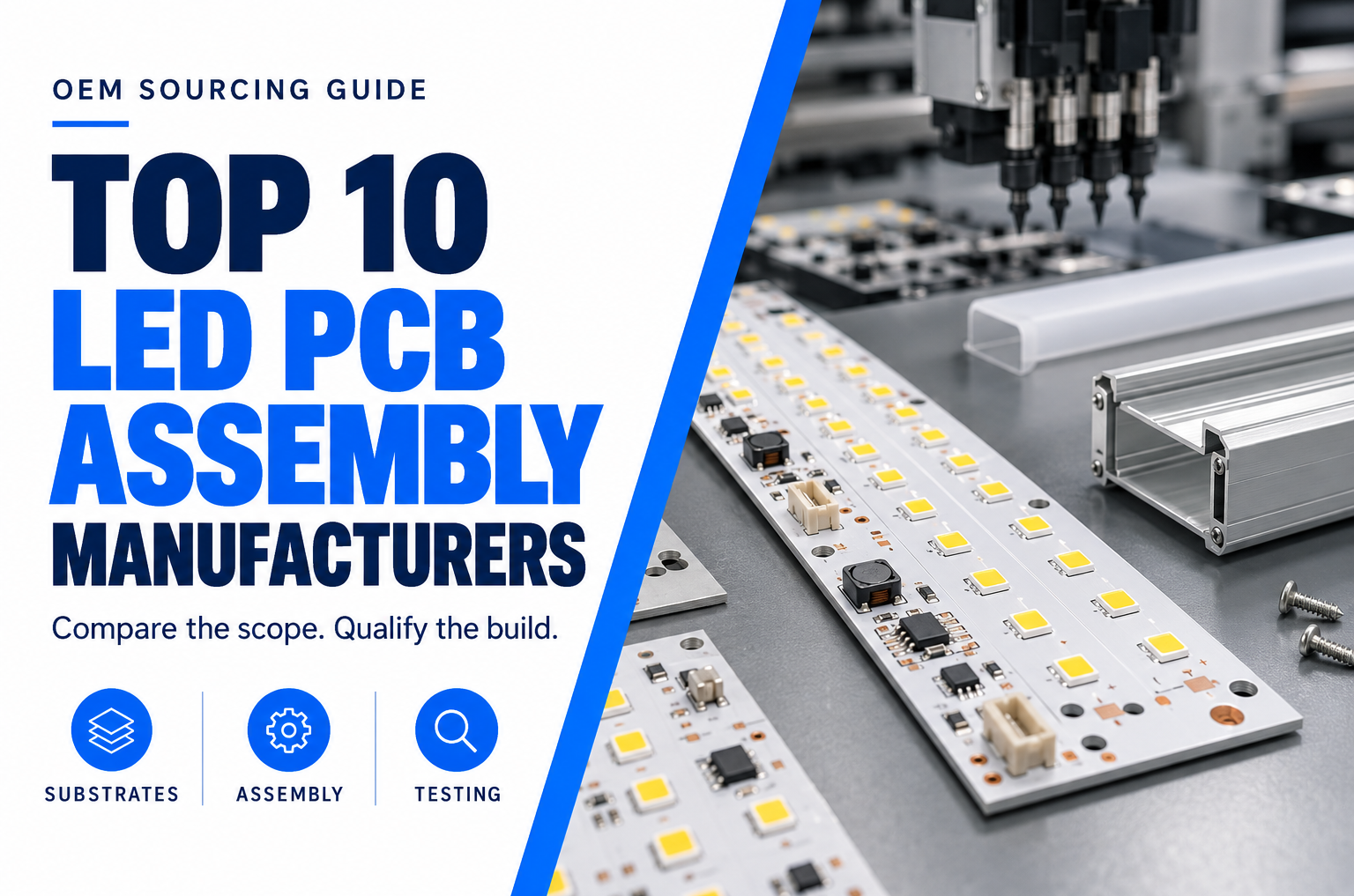
Table of Contents
Table of Contents
Direct answer: The best LED PCB assembly manufacturer for your project depends on your delivery scope and optical requirements: OrinewPCB connects bare-board fabrication with complete lighting box build integration, ThermOmegaTech Electronics specializes in extended boards up to 1,200 mm (47.24 inches), Fusion Optix delivers precision light engines with integrating-sphere testing, and Diode Dynamics provides ruggedized lamp potting and assembly.
Building a successful LED product requires coordinating the circuit substrate, thermal path, emitter placement, driver electronics, and optical consistency. This guide compares 10 established LED assembly manufacturers across their board constructions, manufacturing footprints, and integration scopes, followed by an engineering guide on how to evaluate thermal management, binning, and photometric acceptance before issuing an RFQ.
Disclosure: OrinewPCB publishes this guide and is featured first. We take pride in our end-to-end capabilities, but we recognize that every lighting program has distinct technical and logistical constraints. The other 9 manufacturers are grouped by their specific production specialties, in no particular order.
Quick Picks by Project Need
Start with the core requirement that defines your lighting hardware build:
- Turnkey PCB fabrication & luminaire box build: OrinewPCB provides one-stop manufacturing from bare-board fab (MCPCB/FR-4) to full assembly with drivers, optics, wiring, and custom enclosures.
- Oversized & extended linear boards (up to 1,200 mm / 47.24 in): ThermOmegaTech Electronics offers dedicated US-based long-board SMT lines and AC/DC power module assembly.
- Light engines with precision photometric testing: Fusion Optix integrates CSP/SMT placement with in-house integrating-sphere validation and forward-voltage binning.
- Diverse & complex substrates (MCPCB, Flex, Rigid-Flex): Technotronix supports quick-turn California assembly across non-standard board geometries and high-thermal materials.
- Rugged automotive & outdoor sealed lamp builds: Diode Dynamics specializes in automotive-grade IMS assemblies, automated environmental encapsulation, and finished lamp manufacturing.
- Smart LED assemblies with embedded controls & IoT: MOKO Technology delivers mixed SMT/THT assembly, sensor integration, driver electronics, and wireless firmware flashing.
- Direct-die COB wire bonding & flip-chip assembly: PCBONLINE operates dedicated lines for both packaged SMD emitters and bare-die COB bonding on ceramic/metal cores.
- Long linear lighting with downstream mechanical integration (up to 1.6 m): PSL (Printed Systems Limited) provides UK-based long-board assembly with strict MacAdam bin control and luminaire finishing.
- Architectural single-pass continuous SMT (up to 1.5 m): Anode CKE specializes in seamless long-board runs that eliminate interconnect connectors in architectural lighting.
- High-volume standardized circular & linear modules: Kingford offers cost-effective, high-throughput assembly for standard 2835/3030 downlight discs and T5/T8 troffer strips.
How We Selected These LED PCB Assembly Manufacturers
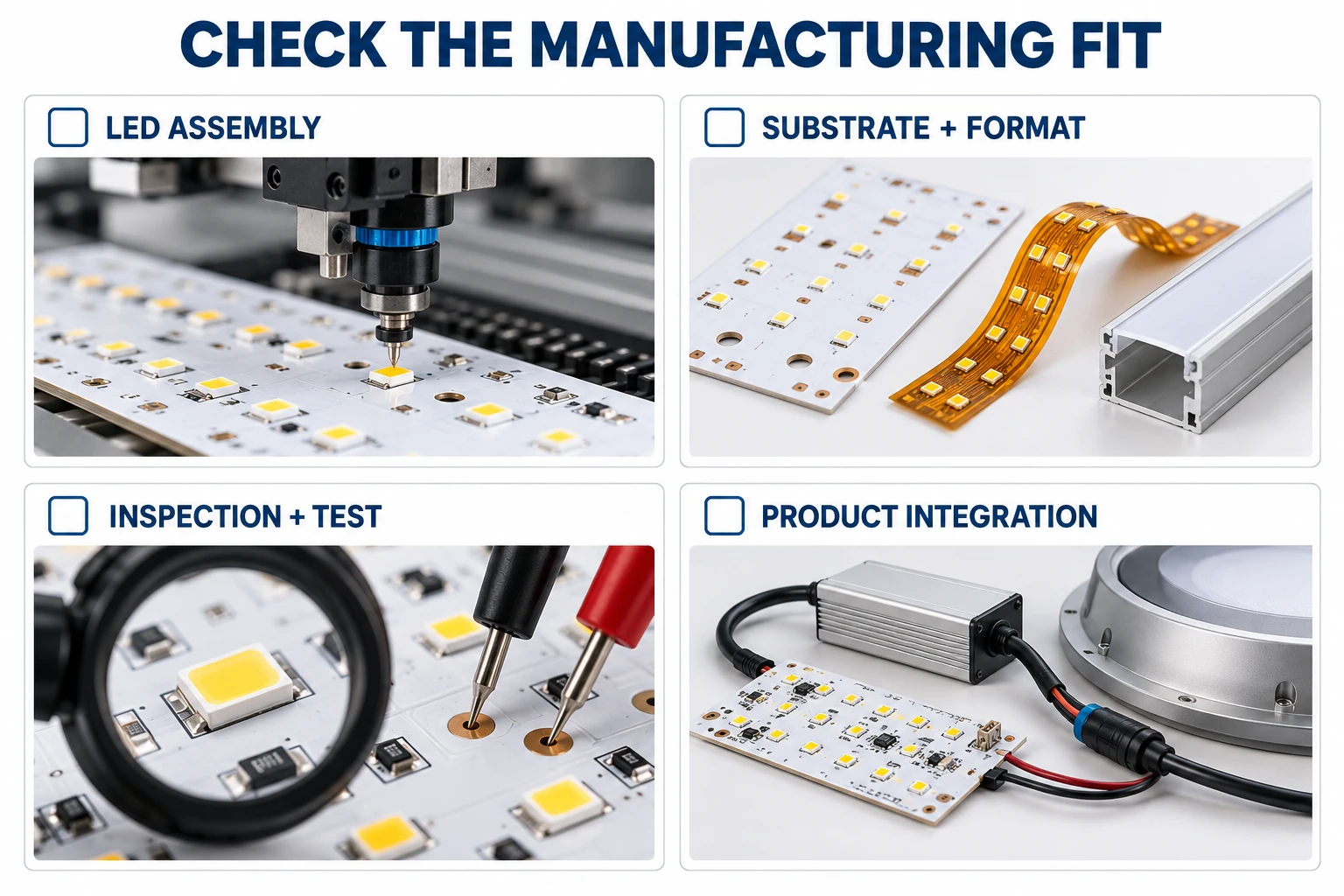
Assembling LED printed circuit boards requires specialized manufacturing controls that standard SMT lines cannot always provide. Emitters with soft silicone lenses are sensitive to nozzle placement pressure, metal-core boards demand tailored reflow thermal profiles to prevent cold joints, and optical consistency depends strictly on binning discipline.
To build this shortlist, we evaluated manufacturers against four practical engineering and sourcing criteria:
- Dedicated LED Assembly Capabilities: Specialized SMT placement equipment for fragile LED packages, long-format board handling (exceeding standard SMT conveyor limits, often 450–500 mm on conventional equipment), and metal-core substrate soldering.
- Thermal & Substrate Breadth: Demonstrated processing of aluminum/copper MCPCB, high-Tg FR-4 with thermal vias, ceramic substrates, and flex/rigid-flex circuits.
- Inspection & Test Coverage: In-house capability covering solder joint voiding checks (X-ray), polarity/placement optical inspection (AOI), electrical burn-in, and photometric testing.
- Integration Scope: Clear service tiers distinguishing bare PCBA, light engine subassemblies, and complete luminaire box build assembly.
The companies reviewed below operate manufacturing facilities across China, the United States, and the United Kingdom, representing diverse sourcing models for global OEMs.
LED PCB Assembly Manufacturers at a Glance
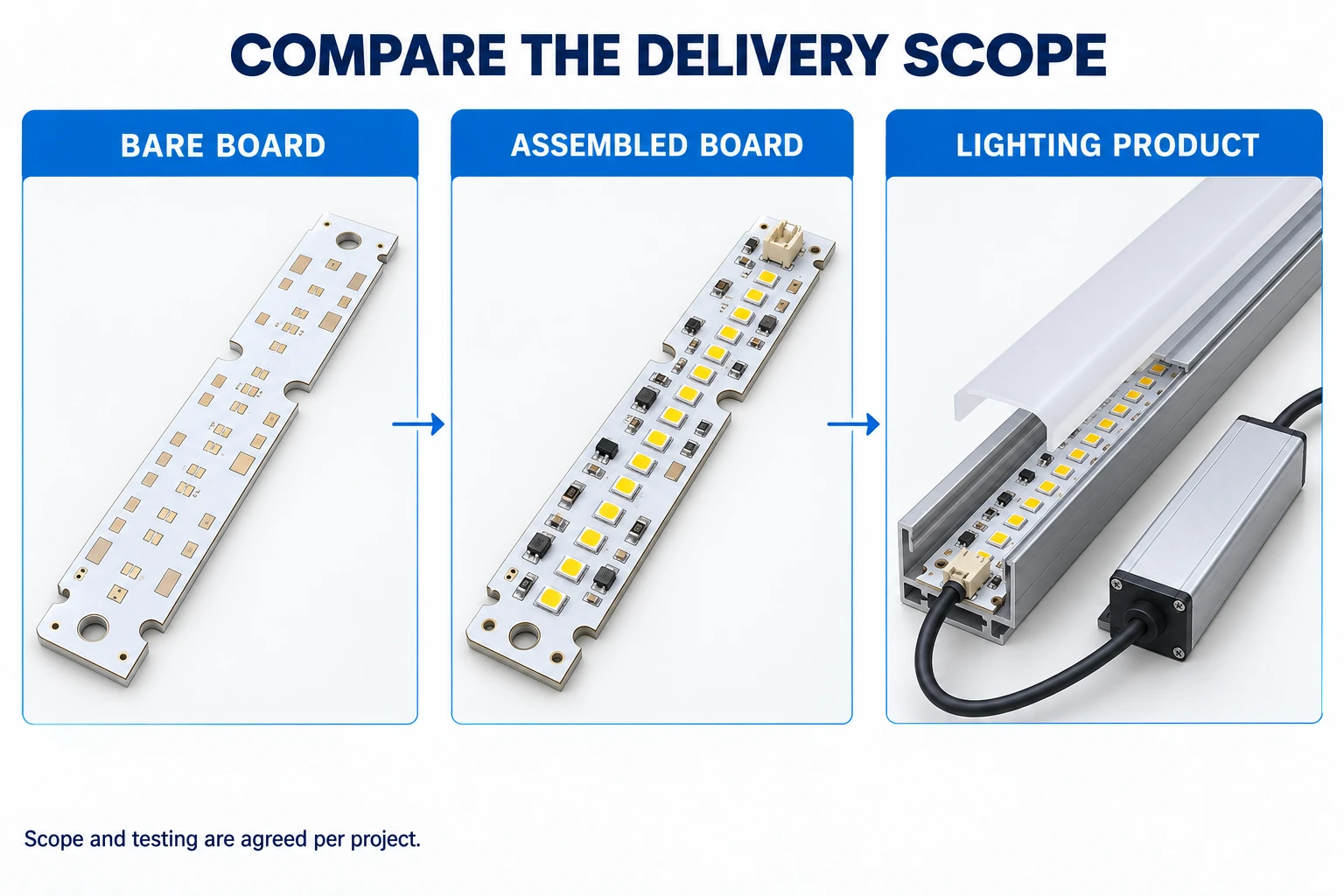
Use this comparative matrix to evaluate key production strengths, supported substrates, and sourcing trade-offs across each manufacturer:
| No. | Manufacturer | Location | Best For | Core Capabilities & Substrates | Key Advantages | Buying Considerations |
|---|---|---|---|---|---|---|
| 1 | OrinewPCB | Shenzhen, China | Full-turnkey PCB fabrication through luminaire box build | Aluminum/copper MCPCB (1.0–8.0 W/m·K), FR-4, flex; SMT, driver & optics integration, enclosure assembly | Single-source responsibility from bare fab to packaged fixture; agile prototyping to volume | Overseas logistics planning required for Western buyers; specify custom optical test protocols in RFQ |
| 2 | ThermOmegaTech Electronics | Warminster, PA, USA | Extended linear LED boards & large AC/DC modules | Continuous board SMT up to 1,200 mm (47.24 in); AC/DC driver integration; custom module assembly | Domestic US manufacturing; purpose-built equipment for oversized architectural and industrial boards | Long-board geometry requires tooling and palletization review; optimized for linear and panel formats |
| 3 | Fusion Optix | Woburn, MA, USA | Precision LED light engines & optical verification | Chip-scale packaging (CSP) placement, SMT, forward-voltage binning, integrating-sphere photometric testing | In-house optical lab measuring luminous flux, CCT, and CRI alongside board assembly | Best leveraged for programs requiring optical engineering, custom lensing, and color consistency |
| 4 | Technotronix | Anaheim, CA, USA | Diverse & complex board substrates (MCPCB, Flex, Rigid-Flex) | Aluminum/metal-core, flex, rigid-flex, heavy copper; quick-turn SMT, box build, and electrical testing | California quick-turn prototyping across non-standard geometries, curved luminaires, and thermal designs | Sweet spot is agile prototyping and high-mix US builds rather than low-cost commodity volume |
| 5 | Diode Dynamics | St. Charles, MO, USA | Rugged automotive & harsh-environment sealed lamp builds | IMS/MCPCB SMT, automated potting/encapsulation, robotic assembly, environmental stress testing | Vertically integrated OEM lighting manufacturing with ruggedized environmental sealing | Production lines are optimized for sealed, high-durability assemblies rather than bare commercial boards |
| 6 | MOKO Technology | Shenzhen, China | Smart LED assemblies with embedded controls & wireless IoT | SMT & DIP mixed assembly, driver boards, firmware flashing, conformal coating, wire harnesses | Strong support for smart lighting (BLE/Zigbee controls, sensor integration, and burn-in testing) | Firmware ownership, programming jigs, and flashing test criteria must be frozen before pilot runs |
| 7 | PCBONLINE | Shenzhen, China | SMD assembly & direct-chip COB wire/flip-chip bonding | High-power SMD placement, bare-die COB wire bonding, flip-chip assembly, ceramic (DPC)/metal MCPCB | Dedicated LED lines capable of both packaged emitter SMT and die-level direct bonding | Direct-die COB requires clear cleanroom and encapsulation specifications compared to standard packaged LEDs |
| 8 | PSL (Printed Systems Limited) | Stevenage, UK | Long linear boards up to 1.6 m with downstream electromechanical assembly | Continuous linear SMT up to 1,600 mm, bin management, board de-paneling, light-up testing, final assembly | Established UK contract manufacturer specialized in architectural linear profiles and custom luminaires | UK/European manufacturing footprint; specialized in architectural linear profiles rather than consumer bulbs |
| 9 | Anode CKE | Leicester, UK | Architectural single-pass long-board SMT (up to 1.5 m) | Single-pass SMT up to 1,500 mm, constant-current/constant-voltage layout design, MCPCB processing, box build | Eliminates interconnect seams on long architectural fixtures with single-pass continuous placement | Focused primarily on UK/European commercial programs; specify optical test requirements in RFQ |
| 10 | Kingford | Shenzhen, China | Standard circular modules & linear T5/T8 commercial lighting | High-volume 2835/3030 SMD placement, aluminum core (1.0–3.0 W/m·K), circular/strip modules | Cost-effective, high-throughput production lines for standardized commercial and residential lighting | Best suited for established, high-volume board designs; custom mechanical engineering requires explicit scoping |
10 LED PCB Assembly Manufacturers to Consider
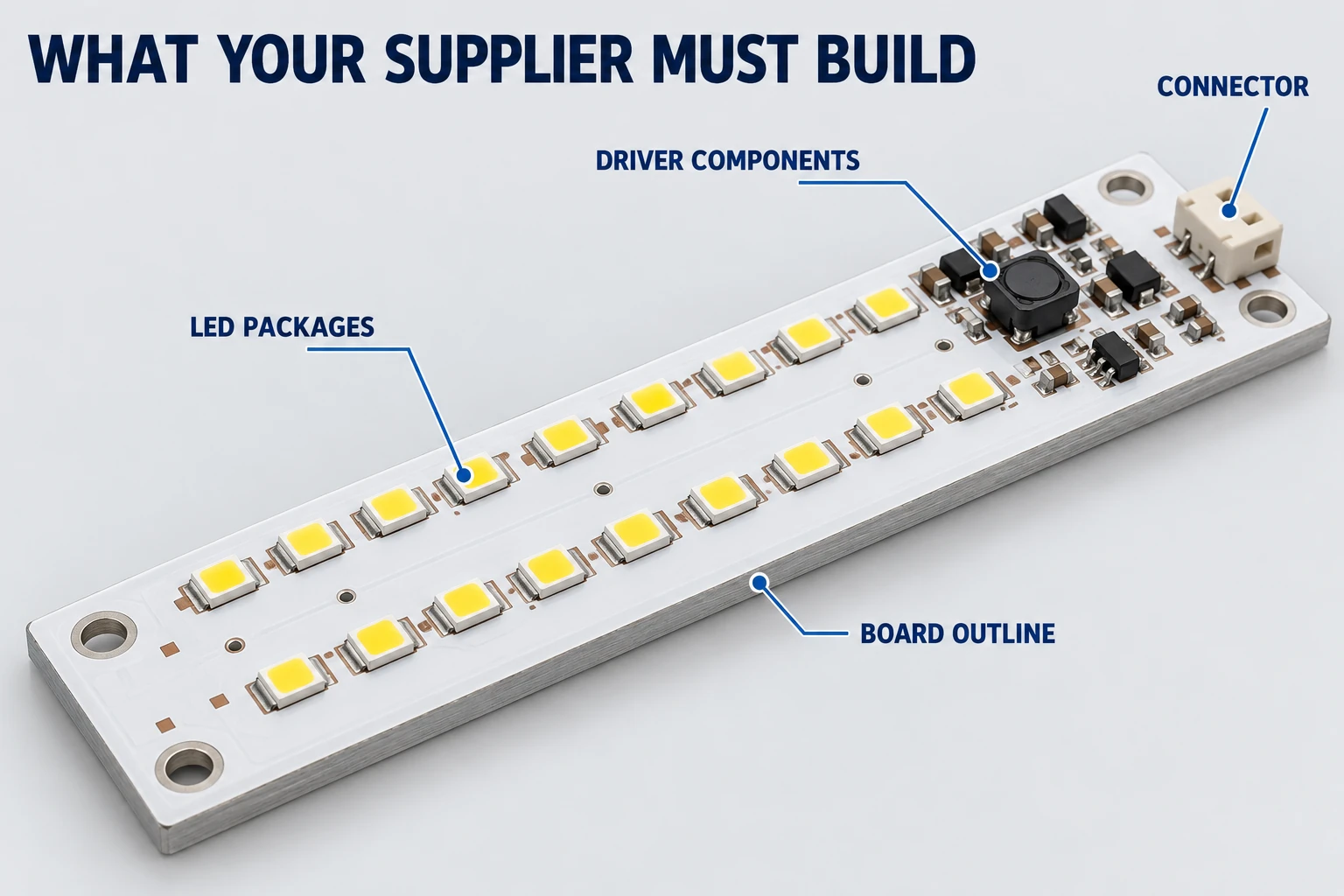
1. OrinewPCB — Best for PCB Fabrication Through Final Lighting Integration
Headquarters: Shenzhen, China · Manufacturing Model: Turnkey PCB Fabrication & Box Build EMS · Official Website: https://pcbandassembly.com/
OrinewPCB bridges the gap between raw circuit fabrication and final lighting product assembly. Through its dedicated LED PCB assembly service, the company handles the complete hardware lifecycle: bare board manufacturing (including high-thermal-conductivity aluminum and copper MCPCB), precision SMT placement, secondary optics attachment, wire harness preparation, and driver integration.
For lighting OEMs, this integrated delivery model eliminates the friction of managing separate vendors for metal-core boards, component sourcing, and final electro-mechanical assembly. If your product requires custom sheet metal or extruded aluminum housings, OrinewPCB coordinates enclosure integration and packaging through its turnkey box build assembly service.
- Core Capabilities: Aluminum MCPCB (1.0–8.0 W/m·K dielectric options), FR-4 with thermal vias, high-speed SMT placement for 2835/3030/5050 and high-power ceramic LEDs, cable harnessing, and driver potting.
- Key Strengths: Single-source accountability from Gerber files to boxed retail or commercial luminaires; flexible volume scaling from NPI prototyping to mass production.
- Buying Considerations: As a Shenzhen-based manufacturer, international freight and customs clearance must be accounted for in project schedules. Detailed optical acceptance criteria (such as CCT binning and integrating-sphere reports) should be explicitly agreed upon during the quotation phase.
2. ThermOmegaTech Electronics — Best for Large & Extended Linear LED Boards
Headquarters / Facility: Warminster, Pennsylvania, USA · Manufacturing Model: Electronics Contract Manufacturer · Official Website: https://totelectronics.com/
ThermOmegaTech Electronics is a US-based contract manufacturer with purpose-configured SMT lines designed specifically for oversized lighting assemblies. Through its dedicated custom LED PCB assembly service, the company processes continuous board lengths of up to 1,200 mm (47.24 inches), making it an ideal partner for linear architectural fixtures, industrial troffers, and high-bay lighting.
Beyond pure placement, ThermOmegaTech specializes in AC and DC driver modules, power electronics integration, and mechanical assembly. Having domestic manufacturing in Pennsylvania enables close engineering collaboration for North American OEMs during new product introduction (NPI).
- Core Capabilities: Extended continuous SMT up to 1,200 mm (47.24 in), aluminum and FR-4 substrates, AC/DC driver board assembly, automated optical inspection (AOI), and in-circuit testing.
- Key Strengths: Proven handling of large-envelope boards that exceed standard conveyor widths; domestic US production complying with local sourcing and fast-turnaround requirements.
- Buying Considerations: Long boards are susceptible to thermal warpage during reflow; assembly drawings must account for support tooling, palletization, and connector placement along the board edge.
3. Fusion Optix — Best for Precision LED Light Engines & Optical Verification
Headquarters / Factory: Woburn, Massachusetts, USA · Manufacturing Model: LED Light Engine & Optical Component Manufacturer · Official Website: https://www.fusionoptix.com/
Fusion Optix occupies a unique niche in the lighting industry by combining electronics manufacturing with optical physics. Rather than operating purely as a build-to-print board house, the company manufactures complete LED light engines, diffuse optics, and linear fixtures. Its SMT and PCB assembly capabilities cover chip-scale packaging (CSP) placement, rigid and flexible substrates, and specialized component mounting.
What sets Fusion Optix apart is its in-house optical testing suite. Equipped with integrating spheres, spectrometers, and goniophotometers, the facility verifies forward-voltage binning, color rendering indices (CRI, including R9), and luminous flux on assembled boards, ensuring exact color consistency across production batches.
- Core Capabilities: Precision SMT placement for high-density mid-power and chip-scale LEDs, forward-voltage (Vf) binning, integrating-sphere photometric verification, and secondary optical lens integration.
- Key Strengths: Deep in-house optical engineering; ideal for high-end architectural, museum, and commercial lighting where color consistency and spectral tuning are critical.
- Buying Considerations: The company’s engineering-centric light engine model delivers maximum value on programs requiring optical verification and custom diffusion; highly standardized commodity runs may not utilize these advanced optical services.
4. Technotronix — Best for Complex & Diverse Board Substrates
Headquarters / Plant: Anaheim, California, USA · Manufacturing Model: Quick-Turn Electronics Manufacturing Services · Official Website: https://www.technotronix.us/
Technotronix is an established California PCB fabricator and assembler specializing in advanced and non-standard board constructions. Its LED circuit board services cover aluminum-clad substrates, copper-core MCPCB, flexible circuits, and complex rigid-flex boards designed for compact or curved lighting fixtures.
Lighting designers often face tight mechanical envelopes—such as automotive headlamps, avionics displays, or custom curved luminaires—where rigid flat boards cannot fit. Technotronix supports these challenging form factors with quick-turn prototyping, automated SMT assembly, optical inspection, and box build integration from its Anaheim manufacturing facility.
- Core Capabilities: Single- and double-sided metal core (MCPCB), flexible polyimide LED strips, rigid-flex thermal assemblies, high-layer-count FR-4 with heavy copper, box build integration, and lead-free reflow soldering.
- Key Strengths: Broad substrate versatility under one roof; rapid prototype turnaround times for US engineering teams iterating on complex mechanical designs.
- Buying Considerations: Highly optimized for quick-turn US prototyping, complex stackups, and high-mix production; sustained ultra-high-volume commodity runs are typically more cost-effective through high-capacity offshore lines.
5. Diode Dynamics — Best for Rugged Automotive & Harsh-Environment Sealed Lamps
Headquarters / Facility: St. Charles, Missouri, USA · Manufacturing Model: Automotive & Industrial LED Lighting OEM Manufacturer · Official Website: https://www.diodedynamics.com/
Diode Dynamics is a premier US manufacturer of high-performance automotive and specialty LED lighting. On its OEM manufacturing services page, the company offers external clients access to its vertically integrated production facility, which spans SMT assembly, precision optical molding, automated encapsulation, and complete lamp build.
High-power automotive, marine, and off-road lighting operates under extreme thermal, vibration, and moisture conditions. Diode Dynamics addresses these challenges with specialized placement of fragile high-power emitters on insulated metal substrates (IMS), coupled with robotic dispensing of thermally conductive potting compounds to achieve ruggedized environmental sealing.
- Core Capabilities: High-power LED SMT on metal-backed substrates, robotic encapsulation and protective potting, automated optical alignment, transient voltage suppression testing, and environmental thermal cycling.
- Key Strengths: Deep domain expertise in severe-environment electronics; capable of taking a lighting program from raw PCB assembly all the way through a sealed, durable lamp assembly.
- Buying Considerations: The facility’s tooling and automation are tailored toward ruggedized, sealed lighting systems; buyers looking only for simple flat commercial boards will find the process over-engineered for basic indoor needs.
6. MOKO Technology — Best for Smart Lighting PCBAs with Embedded Controls & IoT
Headquarters: Shenzhen, China · Manufacturing Model: Electronic Manufacturing Services (EMS) Provider · Official Website: https://www.mokotechnology.com/
MOKO Technology is a large-scale EMS provider with comprehensive manufacturing lines covering surface mount, through-hole, and full electro-mechanical assembly. Its LED PCB assembly services support both commercial luminaire boards (such as street lights, industrial high-bays, and panel lights) and smart lighting control hardware.
As lighting projects increasingly incorporate smart building automation, MOKO excels at assembling boards that combine LED arrays with microcontrollers, wireless communication modules (BLE, Zigbee, Wi-Fi), sensors, and AC/DC power supplies. The company also provides automated conformal coating, firmware flashing, and burn-in testing.
- Core Capabilities: High-speed SMT, mixed DIP assembly, aluminum MCPCB, automated conformal coating, firmware programming, wire harness crimping, and temperature-controlled aging racks.
- Key Strengths: Strong capability in smart, connected lighting assemblies; scalable production lines capable of supporting rapid volume ramp-ups at competitive component sourcing pricing.
- Buying Considerations: Programs involving custom firmware flashing and RF validation require frozen test specifications, programming jigs, and gold-unit samples prior to pilot production.
7. PCBONLINE — Best for SMD Assembly & Direct-Die COB Wire Bonding
Headquarters / Factory: Shenzhen, China · Manufacturing Model: Advanced PCB Fabrication & Packaging Assembler · Official Website: https://pcbonline.com/
PCBONLINE distinguishes itself from standard assembly houses by operating dual-process manufacturing lines that handle both packaged SMD emitters and bare-die Chip-on-Board (COB) technology. Its dedicated LED manufacturing and assembly services provide ceramic substrates (Al₂O₃ and AlN), copper-core boards, and aluminum-base laminates.
For ultra-compact, high-lumen-density applications—such as studio spotlights, commercial projectors, and UV/IR curing systems—soldering discrete packaged LEDs can introduce excessive thermal resistance. PCBONLINE provides direct-die wire bonding and flip-chip bonding directly onto metal-core or direct plating copper (DPC) ceramic substrates, followed by automated phosphor/silicone encapsulation.
- Core Capabilities: High-speed surface-mount placement, automatic ultrasonic wire bonding, flip-chip die attachment, direct plating copper (DPC) ceramic substrates, and nitrogen reflow soldering.
- Key Strengths: Bridges microelectronics packaging with board-level assembly; enables OEMs to choose between discrete SMD layouts and high-density COB modules under one roof.
- Buying Considerations: Bare-die COB projects require strict cleanroom handling, clean die sourcing, and custom optical encapsulation tooling; lead times and NRE costs are naturally higher than standard SMD builds.
8. PSL (Printed Systems Limited) — Best for Long Linear Boards with Downstream Assembly
Headquarters: Stevenage, Hertfordshire, United Kingdom · Manufacturing Model: Contract Electronics Manufacturer (CEM) · Official Website: https://www.printsys.co.uk/
Printed Systems Limited (PSL) has supported the European lighting industry for decades with specialized electronics manufacturing. Its dedicated LED assembly department features long-format SMT equipment capable of processing FR-4 and aluminum metal-core boards up to 1,600 mm in continuous length.
PSL provides comprehensive bin-management protocols to ensure strict chromaticity matching across production batches. Furthermore, the company integrates downstream mechanical finishing, including board de-paneling, cable loom soldering, thermal interface material (TIM) application, and functional light-up testing prior to dispatch.
- Core Capabilities: Continuous long-board SMT up to 1,600 mm, aluminum MCPCB and FR-4 processing, chromaticity binning control, automated depaneling, and loom assembly.
- Key Strengths: Established UK manufacturing presence; excellent communication and agile logistics for British and European architectural lighting manufacturers.
- Buying Considerations: Primarily serves the UK and European lighting sectors; large-volume transatlantic orders require shipping coordination compared to domestic North American options.
9. Anode CKE — Best for Architectural Single-Pass Long-Board SMT
Headquarters: East Goscote, Leicestershire, United Kingdom · Manufacturing Model: Contract Electronics Manufacturer · Official Website: https://anodecke.co.uk/
Anode CKE is a British contract electronics manufacturer known for its engineering-driven approach to LED lighting assembly. Through its LED assembly services, the company operates single-pass long-board SMT placement equipment capable of assembling continuous boards up to 1,500 mm in length.
In architectural cove lighting, continuous linear extrusions, and commercial signage, connecting multiple short boards with pin headers or wire links creates visual dark spots and assembly failure points. Anode CKE’s single-pass capability eliminates these joints. The company also provides layout design support for constant-current and constant-voltage drive topologies, alongside box build integration.
- Core Capabilities: Single-pass continuous SMT up to 1,500 mm, metal-core and FR-4 substrates, constant-current and constant-voltage driver circuit assembly, box build integration, and optical inspection.
- Key Strengths: Eliminates mechanical connectors and dark spots in architectural linear fixtures; flexible high-mix production suitable for bespoke commercial installations.
- Buying Considerations: Focused primarily on UK and European commercial projects; specific photometric test reports should be defined during initial RFQ scoping.
10. Kingford — Best for High-Volume Standard Circular & Linear Modules
Headquarters: Shenzhen, China · Manufacturing Model: High-Volume PCB Fabrication & Assembly Provider · Official Website: https://www.kingfordpcb.com/
Kingford is an established Shenzhen-based PCB fabricator and assembler that maintains high-throughput SMT lines dedicated to mass-market lighting. Its LED PCB assembly catalog highlights proven production of round 2835 SMD downlight modules, circular engine boards, and standard T5/T8 linear LED strips.
For OEMs sourcing standard commercial, residential, or retrofit lighting products, Kingford offers pre-engineered board outlines, standardized aluminum-core stackups, and high-speed automated placement lines that maximize cost efficiency at scale.
- Core Capabilities: High-speed placement of 2835, 3030, and 5730 SMD LEDs, single-sided aluminum MCPCB (1.0–3.0 W/m·K dielectric, 1.0–2.0 mm core), circular V-cut routing, and automated optical inspection.
- Key Strengths: Highly competitive pricing and rapid throughput on standardized commercial lighting form factors; streamlined component supply chain for high-running LED packages.
- Buying Considerations: Well-suited for established, high-volume board designs; complex low-volume custom engineering or non-standard substrate developments receive less focus than standard production runs.
How to Choose an LED PCB Assembly Manufacturer
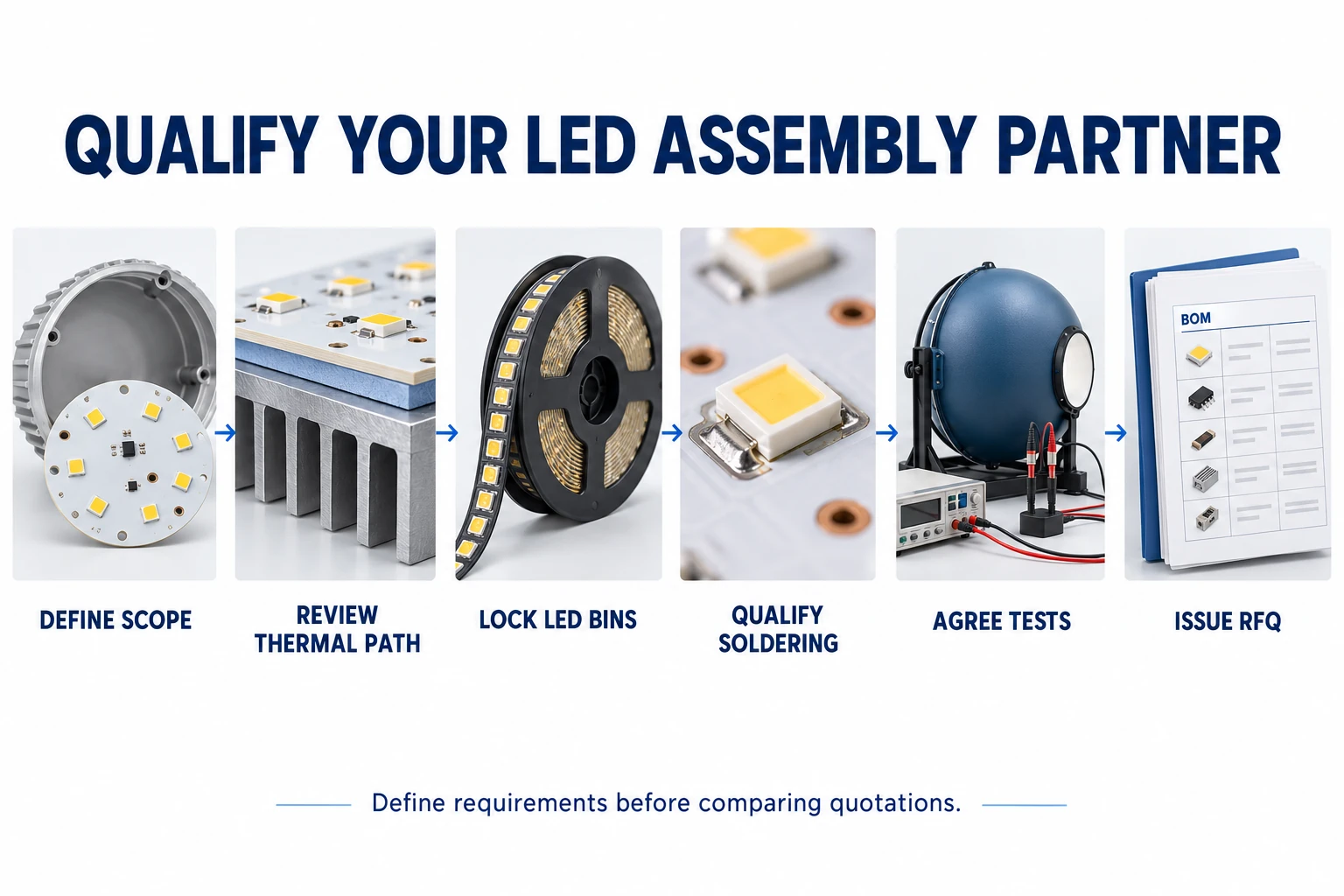
Selecting an LED assembly partner requires looking beyond basic component placement rates. Reliable LED hardware depends on solving three interrelated engineering challenges: heat dissipation, color consistency, and electromechanical packaging.
Use the following evaluation steps to qualify suppliers and structure your RFQ.
1. Define the Assembly Scope: Board-Only, Light Engine, or Complete Box Build
Clarify the exact physical handoff boundary between your engineering team and the manufacturer:
- Populated Board (PCBA): The supplier solders LEDs, connectors, and discrete components onto the bare substrate. You handle heatsink mounting, optics, driver wiring, and final fixture enclosure.
- Light Engine: The supplier mounts the PCBA onto an extruded heatsink, applies thermal interface material (TIM), solders driver leads, and installs primary or secondary diffusers.
- Full Box Build (Luminaire): The supplier builds the complete lighting fixture, including housing fabrication, internal wire routing, driver enclosure, gasket sealing, photometric testing, retail packaging, and labeling (e.g., OrinewPCB’s box build assembly service).
Clearly bounding this scope prevents hidden assembly costs and ensures all quoted prices are evaluated on an identical deliverable basis.
2. Match the Substrate to the Thermal Path
Thermal management directly determines LED lifespan (L70/L90 lumen maintenance) and color stability. As outlined in Cree LED’s Thermal Management of XLamp LEDs (Rev. 5), the circuit substrate is just one component in the complete thermal resistance chain:
Where Rth,j-sp is junction-to-solder-point resistance, Rth,sp-hs is substrate and thermal interface material (TIM) resistance, and Rth,hs-a is heatsink-to-ambient resistance. While this 1D series model applies directly to single-source calculations, multi-LED arrays also depend on lateral heat spreading across the copper plane and parallel dissipation into the fixture chassis. Select your substrate accordingly:
- Standard FR-4: Cost-effective for low-power indicator arrays or distributed mid-power linear strips (e.g., <0.5 W per emitter on 2835 packages with adequate copper pour and thermal vias). Vias may be open plated-through or filled/capped depending on whether components sit directly above them.
- Aluminum Metal Core (MCPCB): The industry standard for commercial and architectural luminaires. Typically features a 1.0–3.0 W/m·K thermally conductive dielectric layer (with advanced formulations reaching 4.0–8.0 W/m·K) bonded to a 1.0–2.0 mm aluminum base plate.
- Copper-Core MCPCB / Direct Thermal Path (DTP): Distinguishes between standard dielectric-insulated copper boards and Direct Thermal Path (DTP) constructions. DTP eliminates the dielectric layer directly beneath the LED’s central thermal pad, creating direct metal-to-metal solder contact with the copper core. This is essential for ultra-high-flux spotlights, stadium luminaires, and automotive high-beams where concentrated heat flux cannot easily cross a polymer dielectric.
- Ceramic Substrates (Al₂O₃ / AlN): Offers exceptional thermal conductivity (typically 20–30 W/m·K for alumina Al₂O₃, and 140–180+ W/m·K for aluminum nitride AlN), high dielectric strength, and close coefficient of thermal expansion (CTE) matching for high-density COB arrays and UV/IR emitters.
3. Enforce LED Part Numbers, Binning, and Substitution Rules
Unlike passive resistors, LEDs exhibit production variations in luminous flux, forward voltage (Vf), and correlated color temperature (CCT). Without strict procurement controls, luminaires from different batches will show noticeable color mismatches.
- Chromaticity Binning: Specify the required MacAdam ellipse tolerance. High-end architectural and retail lighting typically demands 2-step or 3-step SDCM (Standard Deviation of Color Matching); general industrial or outdoor lighting may accept 5-step SDCM.
- Exact MPN & Bin Codes: Never specify just generic descriptions like “4000K 2835 LED”. Provide the complete manufacturer part number with explicit order codes defining flux, CCT bin, and Vf bin.
- No-Substitution Policy: Mandate in purchase orders that no alternate emitter brand or bin code may be substituted without written engineering approval. Require reel labels and certificate of conformance (CoC) records with every production lot.
4. Verify Solder Joint Reliability & Thermal Voiding Control
The solder joint under an LED’s thermal pad serves as the primary heat conduit away from the semiconductor junction. Excessive voiding trapped in this joint causes hot spots, rapid lumen depreciation, and premature emitter burnout.
According to Cree LED’s Solder-Joint Reliability guidance (Rev. 3A), solder voiding below 30% under the thermal pad is generally considered an acceptable baseline for standard operation, while voiding above 50% severely degrades heat transfer. For demanding high-power luminaires, automotive, and industrial applications, OEMs frequently specify tighter targets of 15–20% voiding.
- Stencil Design: Large central thermal pads should use segmented “window-pane” stencil apertures rather than a solid opening to allow outgassing flux vapors to escape during reflow. Always align stencil thickness and aperture reductions with the specific LED package recommendations.
- Surface Finish: Electroless Nickel Immersion Gold (ENIG) and high-temperature Organic Solderability Preservatives (OSP) are widely specified for flat, coplanar solder pads that promote uniform wetting.
- X-Ray Inspection (AXI): Require the manufacturer to perform automated or sample X-ray inspection to verify thermal pad voiding levels and inspect for hidden solder bridges.
5. Establish Optical, Electrical, and Environmental Acceptance Criteria
A simple “light-up” test proves continuity, but it does not verify whether the assembly meets its photometric specification. Agree in advance on the following test battery:
- Assembly & Workmanship: IPC-A-610 Class 2 or Class 3 visual criteria; automated optical inspection (AOI) verifying emitter polarity, rotational alignment, and component placement.
- Electrical & Hi-Pot Testing: Input current draw at nominal voltage; forward voltage drop across series strings; dielectric withstand (Hi-Pot) testing between live circuit traces and the aluminum backing plate (typically 1,500–3,000 V AC depending on the luminaire’s input voltage class and applicable safety standards, such as UL 8750 or IEC 60598-1).
- Photometric Validation: Integrating-sphere testing referencing US Department of Energy lighting metrics and test methods. Sample units should be measured for total luminous flux (lumens), luminous efficacy (lm/W), CCT, and Color Rendering Index (CRI Ra and R9).
- Burn-In & Aging: Continuous powered burn-in (commonly 2 to 24 hours depending on project reliability targets) at rated operating conditions to trigger infant mortality defects before packaging.
6. Prepare a Complete RFQ Data Package
To receive accurate, apples-to-apples quotations, provide candidates with a comprehensive technical package:
- Gerber / ODB++ Files: Complete copper, solder mask, silkscreen, and mechanical outline layers.
- Bill of Materials (BOM): Controlled spreadsheet listing item designators, descriptions, package footprints, quantities, and exact manufacturer part numbers (including LED bin codes).
- Centroid / Pick-and-Place File: X-Y coordinates, rotation, and board side for all components.
- Fabrication & Assembly Drawings: Substrate material, copper weight (e.g., 1 oz or 2 oz), dielectric thickness and thermal conductivity (W/m·K), surface finish (ENIG or OSP), panelization drawings, and V-score specifications.
- Testing & Packaging Specifications: Inspection requirements (AOI, X-ray, Hi-Pot), burn-in duration, ESD packaging, and shipping container labeling.
FAQs About LED PCB Assembly Manufacturers
What is the difference between an LED PCB manufacturer and an LED PCB assembly manufacturer?
An LED PCB manufacturer fabricates the raw circuit board (the bare FR-4, aluminum, or copper substrate with etched copper traces). An LED PCB assembly (PCBA) manufacturer populates that bare board by soldering the LEDs, resistors, capacitors, connectors, and control electronics onto it. Many leading suppliers, such as OrinewPCB, provide both services under one roof, delivering turnkey populated assemblies directly to lighting OEMs.
Can a standard PCB assembly house handle aluminum-core LED boards?
Not all standard assembly houses are equipped for aluminum MCPCBs. Metal-core boards possess substantial thermal mass, acting as natural heat sinks that dissipate heat rapidly during reflow. Soldering them requires specialized multi-zone reflow ovens with extended pre-heat profiles or bottom-side pre-heaters to prevent cold solder joints. Furthermore, V-scoring and depaneling thick aluminum plates requires heavy-duty router or blade tooling.
When should an OEM choose an Aluminum PCB over an FR-4 board with thermal vias?
FR-4 with thermal vias is suitable when the thermal dissipation requirement is low or distributed (<0.5 W per LED on mid-power packages) or when double-sided component placement and low unit cost are primary drivers. Aluminum MCPCB is strongly recommended whenever total board thermal dissipation or localized heat flux exceeds the natural convection limits of FR-4, or where mechanical space constraints prevent bulky secondary heat sinks.
Why is LED bin control critical during component procurement?
LED manufacturing produces natural variations in color temperature (CCT), brightness (luminous flux), and forward voltage (Vf). If an assembly partner mixes different bin reels within the same production run, adjacent fixtures—or even adjacent LEDs on the same board—will exhibit visible variations in tint and intensity. Specifying strict 3-step MacAdam ellipse binning provides tight chromaticity matching at the component level, significantly reducing visible color variation across fixtures (when paired with consistent thermal design and drive currents).
Does a standard “light-up” test guarantee optical quality?
No. A basic light-up check only confirms electrical continuity—that current flows and emitters turn on. It does not measure luminous flux, color rendering index (CRI), correlated color temperature (CCT), or thermal resistance. If optical consistency is critical to your product, ensure your manufacturer’s scope includes integrating-sphere testing or that you have an in-house photometric test protocol for incoming batches.
Should a US lighting OEM manufacture domestically or overseas?
Domestic US manufacturers (such as ThermOmegaTech, Fusion Optix, and Diode Dynamics) excel at rapid prototyping, close engineering collaboration, quick turnaround, and supporting federal or municipal projects that require Buy American Act (BAA) / Build America, Buy America (BABA) compliance (subject to specific domestic content and qualification requirements). Overseas manufacturers in Shenzhen (such as OrinewPCB and MOKO Technology) offer deep supply chain integration, cost advantages on raw MCPCB fabrication, high-volume production scalability, and complete mechanical box build services. Many OEMs leverage domestic partners during NPI and scale into overseas or dual-sourced production for mass-market volumes.
Sources and Technical References
- Metrics and Test Methods — US Department of Energy: Standardized test protocols for solid-state lighting performance, luminous efficacy, and color rendering.
- Thermal Management of XLamp LEDs, CLD-AP5 Rev. 5 — Cree LED: Engineering guide detailing thermal resistance calculation, substrate selection, and junction temperature control.
- XLamp LEDs Solder-Joint Reliability, CLD-AP134 Rev. 3A — Cree LED: Technical bulletin covering solder stencil design, thermal voiding mitigation, and reflow profile optimization for high-power LEDs.
Discuss Your LED Assembly Project with OrinewPCB
YOUR LED ASSEMBLY PROJECT
Bring Your LED Board from Concept to Market
Whether you need a quick-turn prototype run of custom aluminum-core MCPCBs, high-speed SMT assembly, or complete luminaire box build integration, OrinewPCB provides single-source engineering and manufacturing support. Share your Gerber files, BOM with LED binning specifications, and target delivery requirements to receive a detailed DFM review and quotation.
- +Full Turnkey PCB & Box Build
- +High-Thermal MCPCB & Copper Core
- +Strict Bin Control & Testing
Related Reading
- LED PCB Assembly Services: Explore OrinewPCB’s dedicated SMT lines, thermal substrate capabilities, and turnkey assembly options.
- PCB Assembly Services: Review broader electronics manufacturing services, component sourcing, and test solutions.
- Box Build Assembly Services: Learn how we integrate populated circuit boards with wire harnesses, enclosures, and retail packaging.
Get Quote Free