3 oz PCB: Heavy Copper for High-Power & Industrial Designs
When your design demands sustained currents above 15A per trace, deals with extreme thermal cycling, or operates in environments where reliability under high power is non-negotiable — standard copper weights won't cut it. The 3 oz PCB marks the true entry point into heavy copper territory, and it solves problems that 2 oz copper cannot.
Get Your PCB Quote!
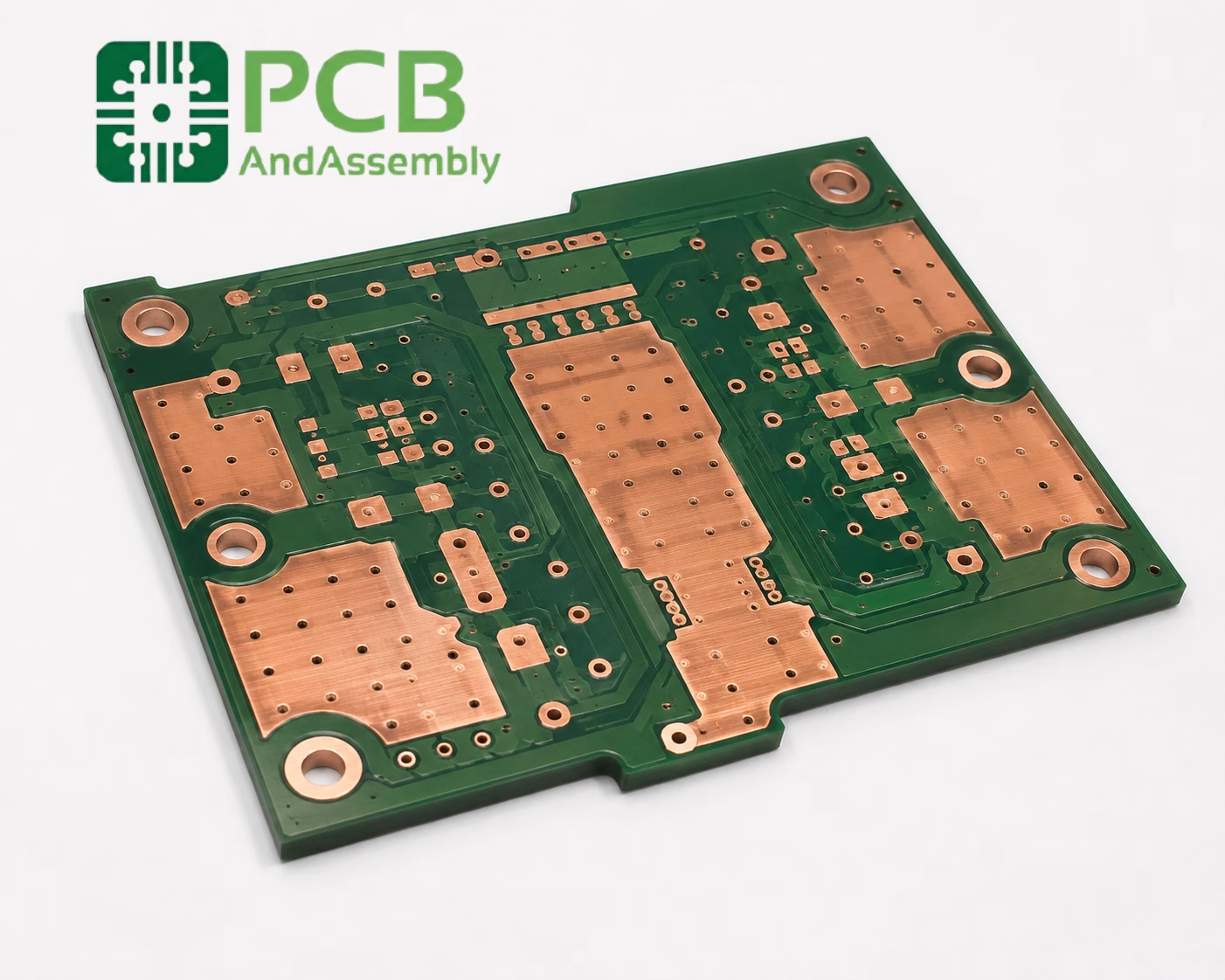
Table of Contents
Table of Contents
At 105 µm, 3 oz copper carries roughly three times the current of standard 1 oz at the same trace width. It provides exceptional thermal spreading for high-power semiconductors, withstands aggressive thermal cycling without barrel cracking, and can eliminate the need for external bus bars and heavy-gauge wiring in many industrial designs. For EV charging stations, industrial motor drives, welding equipment, and large-scale power converters, 3 oz copper isn’t a premium option — it’s the practical minimum.
Key Takeaways
- 3 oz copper measures ~105 µm (4.2 mils, 0.105 mm) — triple the thickness of standard 1 oz copper
- Carries approximately three times the current of 1 oz at the same trace width and temperature rise
- Minimum trace width/spacing is typically 8-12 mils (vs. 4-5 mils for 1 oz) due to aggressive etch undercut
- True entry point into “heavy copper” — requires specialized manufacturing processes
- Best for high-power supplies, EV charging, industrial motor drives, battery management systems, welders
- Typically adds 40-80% to board cost vs. 1 oz, but eliminates bus bars, external wiring, and additional layers
What is 3 oz PCB?
A 3 oz PCB uses copper foil weighing three ounces per square foot on its conductive layers. This is the first weight level that falls into the “heavy copper” category, requiring manufacturers to use specialized production processes rather than standard PCB fabrication lines.
In the PCB industry, copper weight is specified by the weight of copper distributed over one square foot of board area. While 2 oz copper is often handled on standard production lines with adjusted parameters, 3 oz copper truly crosses into heavy copper territory — requiring longer etching times, different lamination cycles, dedicated drill tooling, and experienced process engineering.
| Copper Weight | Thickness (µm) | Thickness (mils) | Thickness (mm) |
| 0.5 oz | 17.5 | 0.7 | 0.0175 |
| 1 oz (standard) | 35 | 1.37 | 0.035 |
| 2 oz | 70 | 2.74 | 0.070 |
| 3 oz | 105 | 4.11 | 0.105 |
| 4 oz | 140 | 5.48 | 0.140 |
| 6 oz | 210 | 8.22 | 0.210 |
At 105 µm, 3 oz copper is roughly twice the thickness of a human hair (50-70 µm). When you hold a 3 oz board, the traces are visibly raised above the substrate — you can feel the copper profile with your fingertip. This thickness is what enables 3 oz boards to handle currents that would vaporize standard traces.
Where 3 oz Fits in the Copper Weight Spectrum
Copper weights in PCB fabrication span from ultra-thin (0.25 oz, ~9 µm) to extreme heavy copper (10 oz+, ~350 µm). The 3 oz PCB sits squarely in the heavy copper range:
| Weight Class | Copper Weight | Typical Applications |
| Fine-line | 0.25-0.5 oz | HDI, RF/microwave, flex circuits |
| Standard | 1 oz | General-purpose PCBs, most designs |
| Medium copper | 2 oz | Power supplies, automotive, LED |
| Heavy copper | 3-6 oz | High-power industrial, EV charging, inverters, welders |
| Extreme copper | 8-10 oz+ | Bus bars, power distribution, military |
3 oz copper is often the practical starting point for heavy copper designs. It provides current capacity that standard weights cannot achieve without excessively wide traces, while remaining manufacturable at experienced fabricators. Above 3 oz, the manufacturing challenges compound significantly — 4 oz and 6 oz copper require even more specialized processes and carry higher cost premiums.
3 oz PCB Electrical Properties
The 105 µm thickness of 3 oz copper transforms every electrical parameter compared to standard weights.
Current Carrying Capacity
Current capacity scales with cross-sectional area. Since 3 oz copper has three times the thickness of 1 oz, it carries approximately three times the current at the same trace width and temperature rise. This is the single most important reason engineers specify 3 oz copper.
Current Capacity Table (External Layer, Various Temperature Rises):
| Trace Width | 10°C Rise | 20°C Rise | 30°C Rise |
| 20 mil | ~12.0A | ~17.0A | ~21.5A |
| 50 mil | ~28.0A | ~40.0A | ~51.0A |
| 100 mil | ~56.0A | ~80.0A | ~102.0A |
| 200 mil | ~112.0A | ~160.0A | ~204.0A |
| 500 mil | ~280.0A | ~400.0A | ~510.0A |
Note: Values are estimates based on IPC-2152. Internal layer capacity is approximately 40-60% of external due to reduced heat dissipation. Always verify with your specific design conditions and stackup. These figures assume standard FR-4 at 20°C ambient.
For practical comparison: a 100 mil trace on 1 oz carries ~22A (10°C rise), on 2 oz carries ~42A, and on 3 oz carries ~56A. This means a 3 oz board can handle a 50A bus without requiring bus bars, parallel traces, or external wiring — the copper itself is the conductor.
DC Resistance
At three times the copper thickness, DC resistance is one-third that of 1 oz copper:
| Trace Width | 3 oz Resistance (mΩ/inch) | 2 oz Resistance (mΩ/inch) | 1 oz Resistance (mΩ/inch) |
| 20 mil | ~4.0 | ~6.0 | ~12.0 |
| 50 mil | ~1.6 | ~2.4 | ~4.8 |
| 100 mil | ~0.8 | ~1.2 | ~2.4 |
| 200 mil | ~0.4 | ~0.6 | ~1.2 |
For a 48V power rail carrying 50A over a 10-inch 100 mil trace, the voltage drop on 1 oz would be an unacceptable 1.2V (2.5% loss). On 3 oz, it drops to 0.4V (0.8% loss) — well within typical regulation budgets.
Impedance Control
Impedance control becomes significantly more challenging with 3 oz copper. The etch process produces a pronounced trapezoidal trace cross-section — the base of the trace is wider than the top due to lateral undercut. This geometry makes predictable impedance calculations difficult and introduces impedance variation along the trace length.
Approximate 50 Ω Microstrip Widths (3 oz on FR-4, Dk ~4.2):
| Dielectric Thickness | Trace Width (3 oz) | Trace Width (1 oz) |
| 8 mil (0.2 mm) | ~18 mil | ~15 mil |
| 12 mil (0.3 mm) | ~28 mil | ~23 mil |
| 20 mil (0.5 mm) | ~48 mil | ~38 mil |
Best practice: Do not route controlled-impedance signals on 3 oz copper layers. Use 1 oz or 0.5 oz layers for high-speed signals in a hybrid stackup, and reserve 3 oz layers exclusively for power distribution and heavy copper planes.
Thermal Performance
3 oz copper provides exceptional thermal management. While copper’s thermal conductivity (~400 W/m·K) is constant regardless of thickness, the increased cross-sectional area dramatically improves heat spreading:
Heat Spreading: A 3 oz copper plane spreads heat from power components across a much larger area than 1 oz or 2 oz. For IGBT modules, high-power MOSFETs, and rectifier diodes, this can reduce junction temperatures by 20-40°C compared to a 1 oz design with the same copper coverage.
Reduced Self-Heating: With one-third the resistance of 1 oz copper, I²R losses are reduced by 67% for the same current. A trace that would reach a 30°C rise on 1 oz copper may only rise 10°C on 3 oz — or handle three times the current at the same temperature rise.
Thermal Mass: The additional copper mass acts as a thermal reservoir, smoothing temperature spikes during pulsed operation. This is particularly valuable in welding equipment, motor drives, and pulsed power applications where peak currents far exceed average values.
Need PCB Manufacturing or Assembly?
Get a free quote within 24 hours. We specialize in prototype-to-production PCB/PCBA for hardware teams worldwide.
Advantages and Disadvantages of 3 oz PCB
Advantages
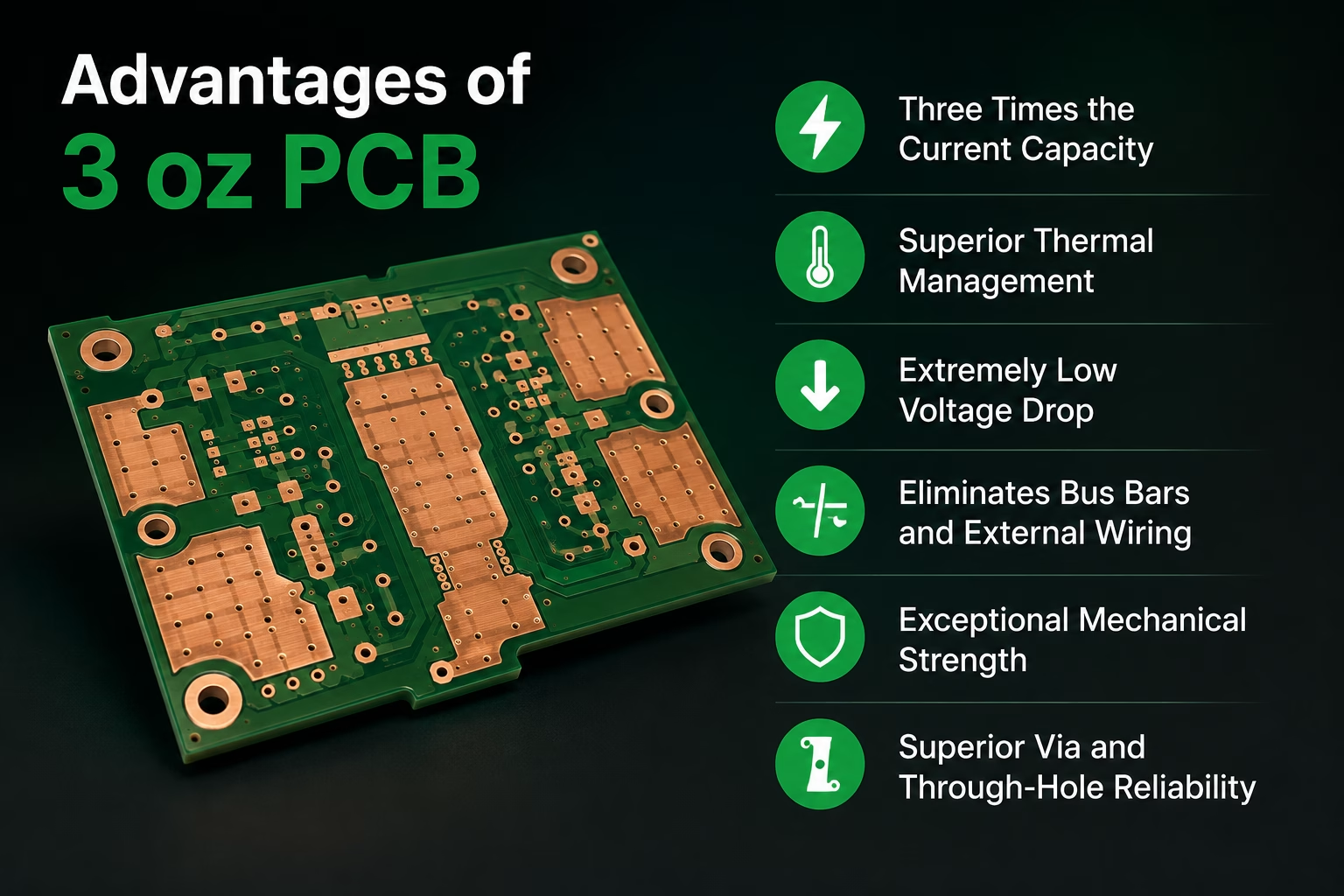
Three Times the Current Capacity: The headline benefit — 3 oz copper handles roughly three times the current of 1 oz at the same trace width. A 100 mil trace that carries 22A on 1 oz copper carries approximately 56A on 3 oz (external, 10°C rise). This eliminates the need for external bus bars, parallel traces, or heavy-gauge wiring in many designs.
Superior Thermal Management: 3 oz copper acts as a significant integrated heatsink. It spreads heat laterally from power semiconductors, IGBTs, and MOSFETs, reducing hot spots and often eliminating the need for additional thermal management. For applications like EV charging and industrial inverters, this translates directly to higher reliability and longer component life.
Extremely Low Voltage Drop: At one-third the resistance of 1 oz copper, voltage drop across power distribution traces is dramatically reduced. For high-current, low-voltage designs (e.g., 12V or 24V power rails at 50A+), this is critical for maintaining regulation at the load.
Eliminates Bus Bars and External Wiring: In many designs, 3 oz copper can replace copper bus bars, heavy-gauge wires, and crimped connections. The PCB itself becomes the power distribution backbone, reducing assembly complexity, improving reliability, and lowering total system cost.
Exceptional Mechanical Strength: The thick copper provides outstanding resistance to trace lifting, pad cratering, and plated through-hole barrel cracking. In high-vibration industrial environments, 3 oz copper provides reliability margins that lighter weights cannot achieve.
Superior Via and Through-Hole Reliability: Plated through-holes on 3 oz copper layers carry high currents without excessive heating and resist barrel cracking under extreme thermal cycling (-40°C to +125°C or wider).
Disadvantages
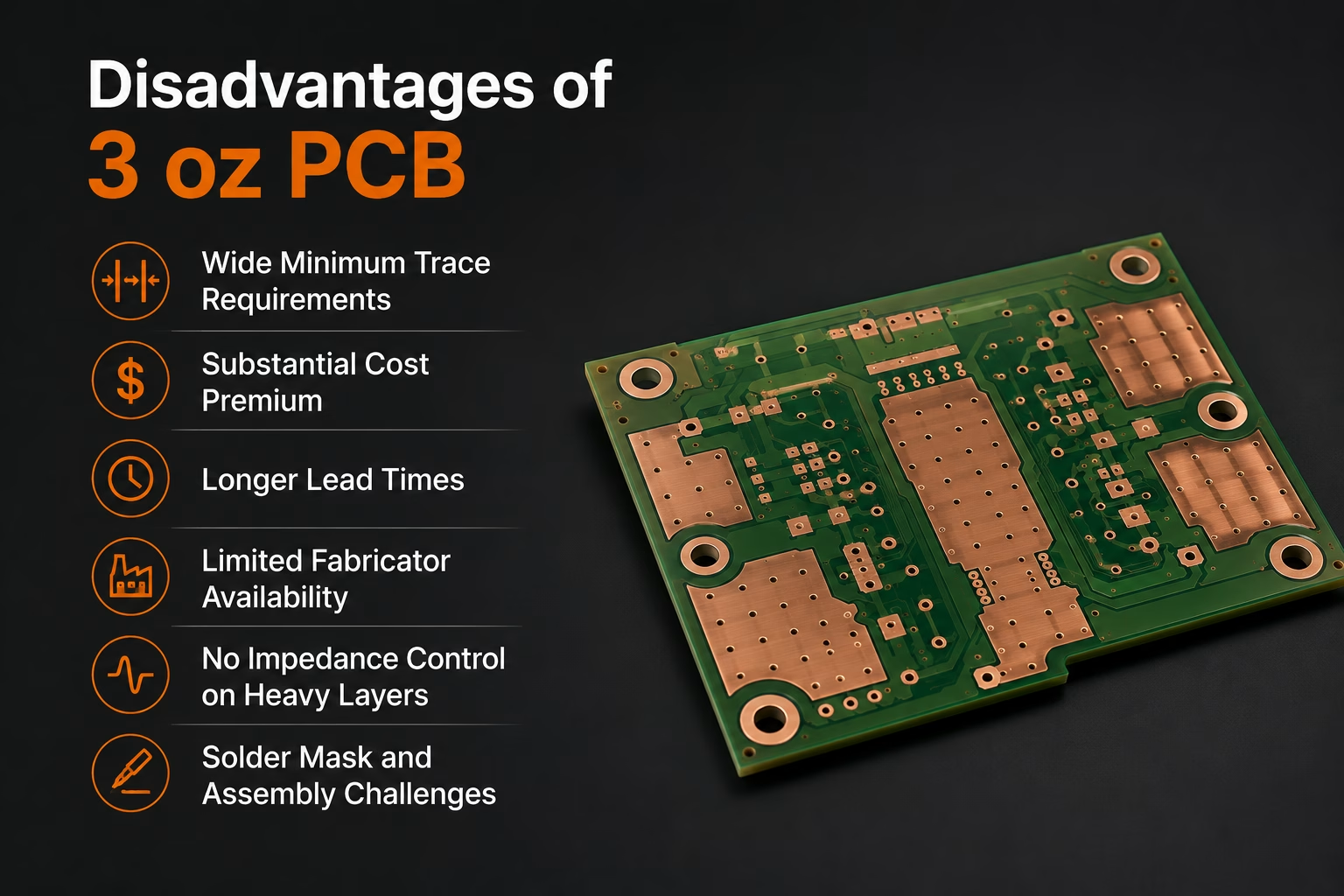
Wide Minimum Trace Requirements: The etch process for 3 oz copper produces significant lateral undercut. Minimum trace/space rules increase to 8-12 mils for outer layers and 12-16 mils for inner layers. This makes fine-pitch routing impossible on 3 oz layers.
Substantial Cost Premium: 3 oz boards typically cost 40-80% more than equivalent 1 oz boards. The premium comes from higher material cost, significantly longer etching time, specialized drill tooling, and lower production throughput.
Longer Lead Times: Most fabricators do not stock 3 oz laminate as a standard material. Lead times are typically 2-4 weeks longer than standard 1 oz boards, and quick-turn services rarely support heavy copper.
Limited Fabricator Availability: Not all PCB manufacturers can produce 3 oz copper boards. The specialized etching, lamination, and drilling equipment required limits the pool of qualified suppliers — especially for multilayer designs with 3 oz inner layers.
No Impedance Control on Heavy Layers: As noted above, controlled-impedance routing is impractical on 3 oz copper. Designs requiring both high current and signal integrity must use hybrid stackups.
Solder Mask and Assembly Challenges: The pronounced copper topography (105 µm steps between copper and substrate) makes solder mask application challenging. Mask may not cover trace edges adequately, and component placement on mixed-thickness pads requires careful process control.
| Parameter | 1 oz | 2 oz | 3 oz | Best For |
| Min trace width | 4-5 mils | 6-8 mils | 8-12 mils | 1 oz |
| Current capacity | Standard | 2× Standard | 3× Standard | 3 oz |
| Thermal spreading | Good | Excellent | Superior | 3 oz |
| DC resistance | Baseline | 50% lower | 67% lower | 3 oz |
| Mechanical strength | Good | Excellent | Exceptional | 3 oz |
| Impedance control | Good | Moderate | Not recommended | 1 oz |
| Cost vs. 1 oz | — | +20-50% | +40-80% | 1 oz |
| Lead time | Standard | +2-5 days | +2-4 weeks | 1 oz |
| Quick-turn availability | Yes | Most fabs | Limited | 1 oz |
| Bus bar replacement | No | Partial | Yes | 3 oz |
Applications for 3 oz PCB
3 oz copper is specified when standard and medium copper weights cannot meet the current, thermal, or reliability demands of the application.

High-Power Supplies and Power Converters
Industrial power supplies, large DC-DC converters, and AC-DC power stages handling 1 kW or more are among the most common applications for 3 oz copper.
In a 3 kW power supply with 48V output at 62.5A, 3 oz copper allows the main power plane to distribute current without supplementary bus bars. The reduced I²R losses also improve overall efficiency by 0.5-1.5% compared to a 2 oz design — significant at this power level.
EV Charging Stations
Electric vehicle charging infrastructure demands very high currents in compact form factors, often in outdoor environments with extreme temperature ranges. 3 oz copper is the standard for Level 3 DC fast-charging station PCBs.
A typical 150 kW DC fast charger delivers up to 350A at 500V at the connector. While the main power path through the charging cable is copper wire, the PCB-level power distribution and conversion stages routinely handle 50-150A — well within 3 oz copper’s capabilities with appropriate trace widths.
Industrial Motor Drives and Inverters
Industrial motor drives subject PCBs to sustained high currents, high-frequency switching, and demanding thermal environments. 3 oz copper is commonly specified for drives above 5 kW.
In a 15 kW VFD handling 30A per phase, 3 oz copper on the power stage PCB keeps trace temperatures within acceptable limits even at full load. The mechanical robustness also withstands the vibration common in industrial environments.
Battery Management Systems (BMS)
Large-scale battery systems — from EV battery packs to grid energy storage — require BMS boards capable of carrying high currents for cell balancing, monitoring, and protection.
High-current BMS designs often combine 3 oz copper for the main current-carrying traces (cell interconnect, discharge paths) with 1 oz layers for monitoring and communications circuits.
Welding Equipment
Welding power supplies push peak currents of 100-500A through the output stage, making 3 oz copper (or heavier) a necessity for the PCB-level power distribution.
Welding applications benefit particularly from 3 oz copper’s thermal mass — the copper absorbs brief peak current pulses without excessive temperature spikes, smoothing the thermal profile across the welding cycle.
Renewable Energy Inverters
Solar and wind energy inverters operate at high power levels in outdoor environments where reliability is critical. 3 oz copper provides the current capacity and thermal margin required.
3 oz vs 2 oz vs 4 oz: How to Choose the Right Copper Weight
The decision to use 3 oz copper should be driven by specific electrical or thermal requirements that 2 oz cannot satisfy. If 2 oz works, choose it — the cost, lead time, and availability advantages are significant.
Decision Framework
| Design Requirement | Recommended Weight | Reason |
| Current > 15A per trace (sustained) | 3 oz | 2 oz requires very wide traces or parallel routing |
| Current > 30A per trace | 3 oz or heavier | 3 oz with 100+ mil traces is practical |
| Eliminate bus bars | 3 oz+ | PCB copper replaces external conductors |
| Extreme thermal cycling (-40°C to +125°C+) | 3 oz | Maximum via barrel reliability |
| Peak currents > 50A (pulsed) | 3 oz | Thermal mass absorbs pulses |
| High efficiency > 98% target | 3 oz | Minimizes I²R losses at high current |
| Current > 100A per trace | 4 oz+ | Beyond practical 3 oz trace widths |
| Fine-pitch digital routing needed | 1 oz (hybrid) | Use 3 oz only on power layers |
| Cost-sensitive or quick-turn | 2 oz | Much lower cost, wider availability |
| Space-constrained design | 2 oz (hybrid) | 3 oz minimum widths too large |
Practical Hybrid Approaches
Almost all practical 3 oz designs use hybrid stackups, combining heavy copper power layers with standard or fine-line copper on signal layers.
Example 4-Layer High-Power Stackup:
| Layer | Function | Copper Weight | Reason |
| L1 (Top) | Power components + high-current buses | 3 oz | Component pads, heavy copper traces |
| L2 | Ground plane | 3 oz | Low-impedance ground return, thermal spreading |
| L3 | Power plane | 3 oz | High-current power distribution |
| L4 (Bottom) | Signal + control + low-power | 1 oz | Standard component and signal routing |
Example 6-Layer Mixed Design with Signal Integrity:
| Layer | Function | Copper Weight | Reason |
| L1 (Top) | Power components + heavy buses | 3 oz | High-current component pads |
| L2 | Ground plane | 1 oz | Reference plane for signal layers |
| L3 | Signal (digital control) | 0.5 oz | Fine-line routing for controller signals |
| L4 | Signal (sensing/feedback) | 0.5 oz | Fine-line analog routing |
| L5 | Power plane | 3 oz | High-current distribution |
| L6 (Bottom) | Power return + auxiliary | 3 oz | Heavy copper return path |
The key to successful hybrid stackups is maintaining copper balance to prevent warpage during lamination. Layers with 3 oz copper should be mirrored, and the prepreg thickness between heavy copper layers must be sufficient (at least 10-12 mils) to ensure proper resin flow around the thick copper traces.
Frequently Asked Questions About 3 oz PCB
What is 3 oz copper thickness in mm?
3 oz copper has a nominal thickness of 0.105 mm (105 µm, or 4.2 mils). This is the base copper thickness before processing. On outer layers, finished thickness after plating is typically 115-130 µm, while inner layers remain close to the base 105 µm.
How much current can a 3 oz PCB trace carry?
A 100 mil wide trace on 3 oz copper (external layer) can carry approximately 56A with a 10°C temperature rise, 80A with 20°C, or 102A with 30°C, based on IPC-2152. Internal layers carry approximately 40-60% of external values. For accurate calculations, use an IPC-2152 compliant calculator with your specific design parameters.
What’s the minimum trace width for 3 oz copper?
Standard manufacturing capability for 3 oz copper is 10 mil (0.25 mm) trace width and spacing on outer layers, with 14 mil (0.35 mm) on inner layers. Advanced fabricators can achieve 8 mil (0.2 mm) on outer layers and 12 mil (0.3 mm) on inner layers with tight process control. Below these limits, etch undercut makes reliable production impractical.
Is 3 oz copper considered heavy copper?
Yes — 3 oz is the entry point for true heavy copper PCBs. While 2 oz is sometimes grouped with heavy copper for marketing purposes, it can typically be fabricated on standard PCB production lines. 3 oz copper requires dedicated heavy copper processes: longer etching, specialized drilling, adjusted lamination cycles, and experienced process engineering.
Can 3 oz and 1 oz copper be mixed in the same board?
Yes — hybrid stackups combining 3 oz power layers with 1 oz or 0.5 oz signal layers are standard practice for high-power designs that also need signal routing. The fabricator handles the different copper foils during lamination, but careful stackup design is critical for copper balance and warpage prevention.
How does 3 oz compare to 2 oz for cost?
3 oz boards typically cost 15-30% more than equivalent 2 oz boards, and 40-80% more than 1 oz boards. The premium over 2 oz is driven primarily by lower manufacturing throughput (longer etch time, slower drilling) and the limited number of fabricators capable of producing 3 oz boards reliably.
What are the lead times for 3 oz PCBs?
Typical lead times for 3 oz PCBs are 2-4 weeks for prototypes and 3-5 weeks for production orders — significantly longer than the 1-2 week standard for 1 oz boards. Quick-turn services rarely support 3 oz copper. Plan your project schedule accordingly.
Does 3 oz copper eliminate the need for bus bars?
For many designs, yes. A 3 oz copper trace or plane 200-500 mils wide can carry 100-250A — sufficient to replace many PCB-mounted bus bars. However, for currents above 250A or for designs requiring separable connections, external bus bars and wiring remain necessary. 3 oz copper eliminates bus bars for the PCB-level distribution but may not replace them at the system interconnect level.
OrinewPCB: Your Partner for 3 oz Heavy Copper PCB Manufacturing
At OrinewPCB, we manufacture 3 oz PCBs as a standard heavy copper offering — supported by dedicated production processes and 14 years of high-power fabrication experience. With ISO 9001, UL, and IPC Class 3 certifications, our Shenzhen facility produces heavy copper boards for customers worldwide.
Our engineering team reviews every 3 oz design for heavy copper DFM issues — etch compensation, copper balancing, via aspect ratios, and solder mask coverage — before production begins. Contact us for a quote within 24 hours.
Conclusion
The 3 oz PCB is the true entry point into heavy copper fabrication — providing roughly three times the current capacity of standard 1 oz copper, exceptional thermal management, and the mechanical robustness required for high-power industrial applications. For EV charging stations, industrial motor drives, welding equipment, battery management systems, and large-scale power converters, 3 oz copper solves problems that lighter weights cannot address without bus bars, external wiring, or active cooling.

Get Quote Free